Self-Employment Tax in 2026: How Much to Set Aside
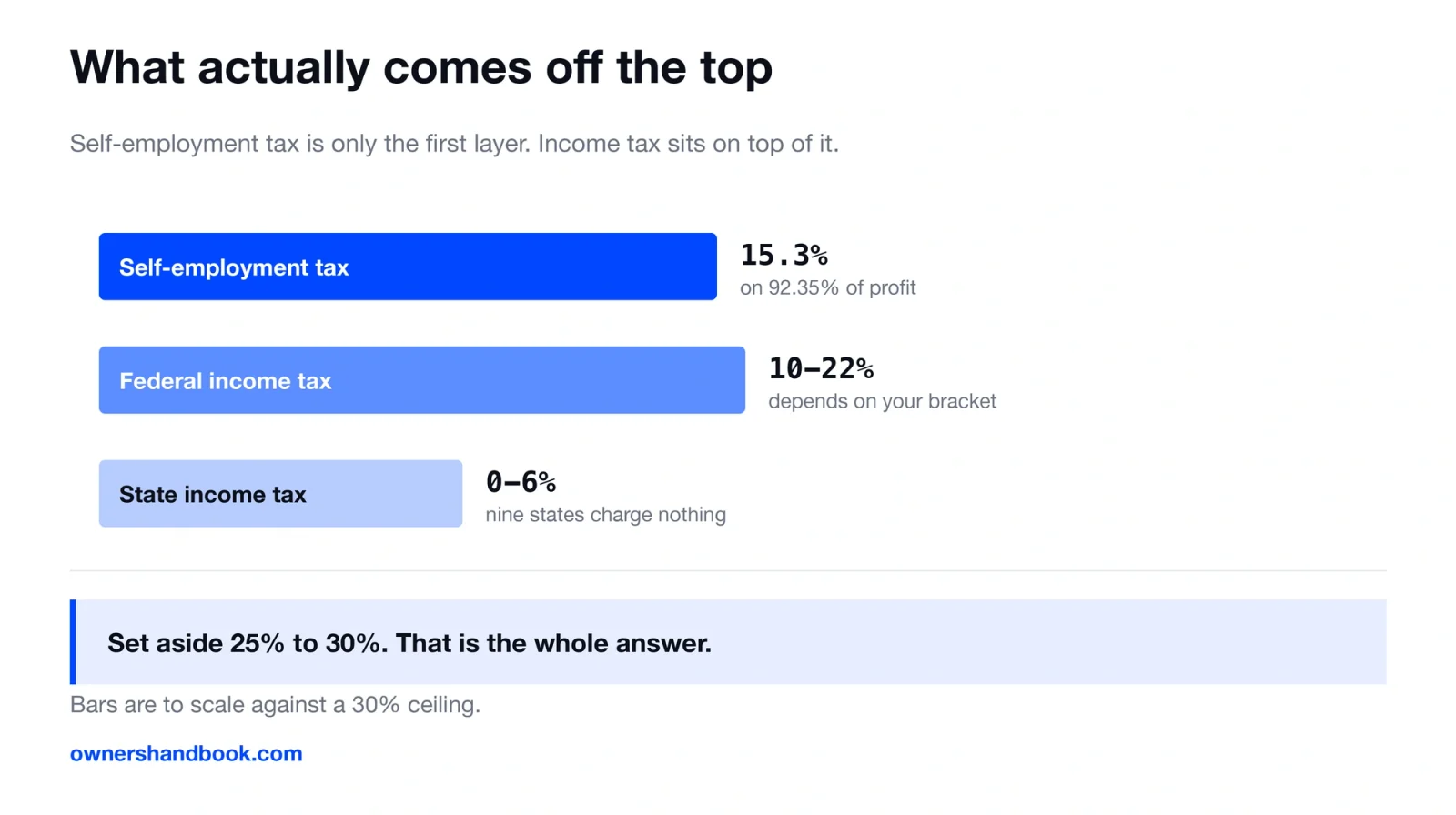
Set aside 25% to 30% of every payment you receive. On $80,000 of net profit that comes to about $22,000, and it covers the 15.3% self-employment tax the US charges anyone who works for themselves, plus federal income tax. Add 3% to 6% more if your state taxes income. Move it the day the money lands, before you have a chance to think of it as yours.
The part nobody warns you about
Your first big client payment arrives. Fifteen thousand dollars, sitting in your checking account, and it is the most money you have ever seen at once.
It is not yours. Roughly four thousand of it belongs to the IRS.
That is the whole problem in one sentence. As an employee you never saw the tax leave, so you never had to feel it. Now the money arrives whole and stays whole until you do something about it.
What the 15.3% actually is
Your old paycheck had Social Security and Medicare withheld. What it never showed you was that your employer paid an identical amount alongside yours.
Two halves. 7.65% each. You only ever saw one.
Now you are both halves.
| What it is | Rate | Goes to |
|---|---|---|
| Social Security | 12.4% | Retirement and disability |
| Medicare | 2.9% | Hospital insurance |
| Total | 15.3% |
This is separate from income tax. You pay both.
It applies to profit, not revenue
Here is the part that makes the number smaller than it first looks.
Self-employment tax is calculated on net earnings, not on what your clients paid you. Subtract your business expenses first. Then subtract a bit more, because the IRS multiplies net profit by 92.35% before applying the rate.
That 92.35% is not arbitrary. It roughly removes the employer half that an employee would never have been taxed on. There is a calculator for this, and it asks for your W-2 wages because a job changes the answer more than most people expect.
The profit this runs on is line 31 of Schedule C, which is where you subtract those expenses in the first place. There is a line-by-line walkthrough of Schedule C if you want to see where each expense goes.
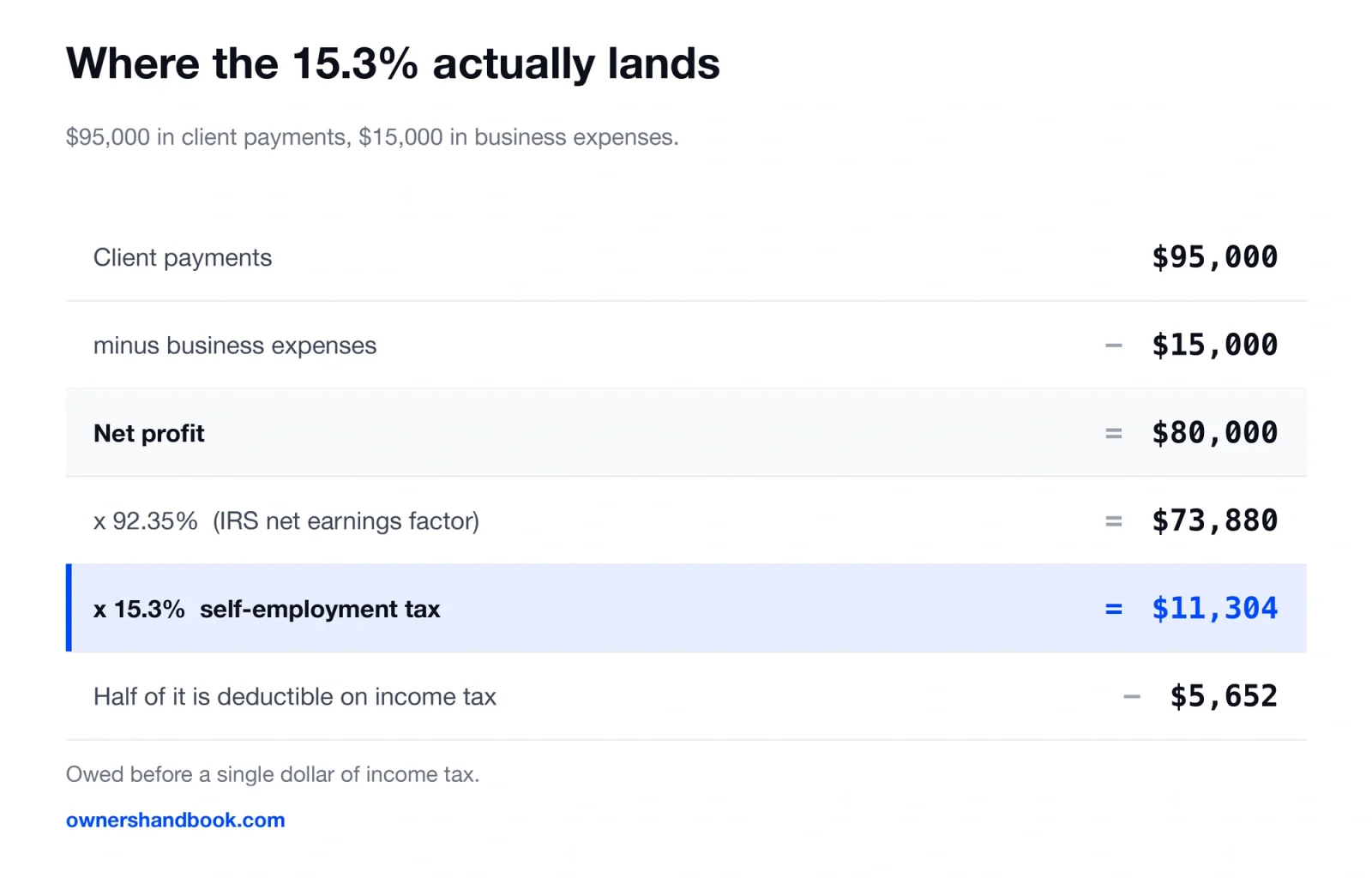
So the $11,304 is the real number, not 15.3% of $95,000. The difference between those two figures is about $3,200, which is worth knowing before you panic.
One part stops. One part does not.
The Social Security piece has a ceiling.
| Year | Social Security ceiling |
|---|---|
| 2024 | $168,600 |
| 2025 | $176,100 |
| 2026 | $184,500 |
Earn more than $184,500 in net earnings this year and the 12.4% stops applying to the excess. That is a real cliff, and it is the reason high earners see their effective rate drop.
The Medicare piece has no ceiling. It applies to every dollar you make, forever.
Above $200,000 single or $250,000 filing jointly, an extra 0.9% Medicare tax lands on the amount over the line.
Half of it comes back
You deduct half your self-employment tax on your income tax return.
In the example above that is $5,652 off your taxable income. It does not shrink the self-employment tax itself. It lowers what you owe on the income tax side.
Nobody mentions this in your first year. It is worth several hundred dollars.
Why 25 to 30 percent
Self-employment tax alone is 15.3% of profit. Federal income tax sits on top, and for most people earning $40,000 to $120,000 the effective rate lands between 10% and 15% after the standard deduction.
Add them and you are in the mid-twenties. Add state tax and you are near 30%.
| Your profit | Start by setting aside |
|---|---|
| Under $40,000 | 25% |
| $40,000 to $120,000 | 28% |
| Over $120,000 | 30%, then check |
Nine states do not tax income at all. The rest range from about 3% to over 9%, and a few cities add their own on top. This is the piece that varies most, so check your state revenue department instead of trusting a national average.
The four dates
The IRS does not want your money in April. It wants it four times a year, roughly as you earn it.
And the periods are not equal, which is where people get caught.
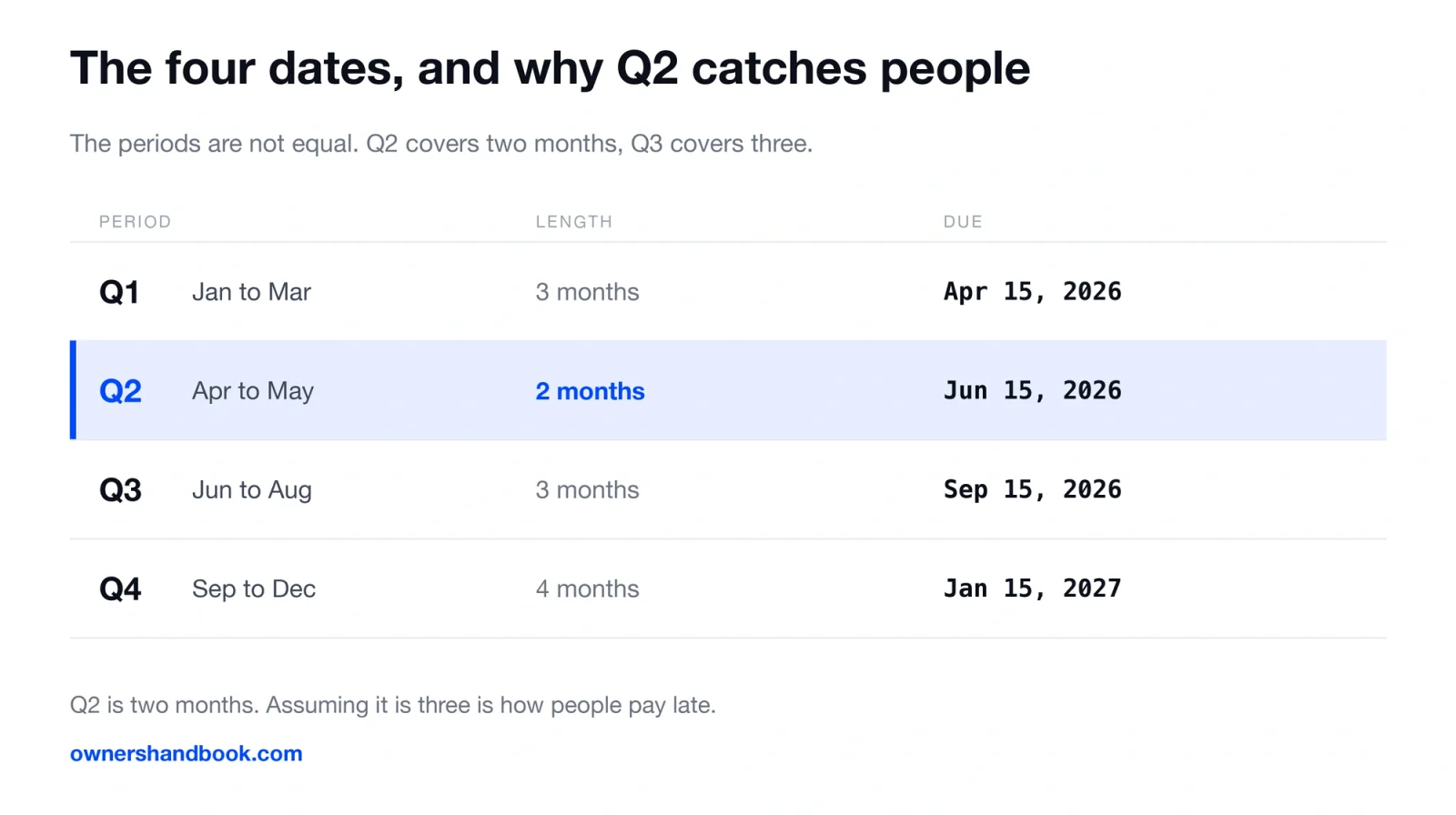
Q2 covers two months. If you assume every quarter is three months, you will pay the June one late and not understand why you were penalized.
How much to send each time
There are two ways to do this. One of them is much easier.
The hard way is to project your full-year tax and send a quarter each time. This works if your income is steady. Freelance income usually is not.
The easy way is the safe harbor.
Pay 100% of what your total tax was last year, split into four, and the IRS will not charge an underpayment penalty no matter how much you end up owing. If your prior-year adjusted gross income was over $150,000, that becomes 110%.
| Rule | What it means |
|---|---|
| 90% of this year | Requires accurate forecasting |
| 100% of last year | Safe harbor. Use this one. |
| 110% of last year | If prior-year AGI over $150,000 |
| Under $1,000 owed | No penalty regardless |
The safe harbor is not about guessing correctly. It is about staying out of penalty territory while you figure out the real number.
What actually happens if you skip one
The penalty is interest on the shortfall, running from the date it was due.
It is not a flat fine. Miss a $2,000 payment by six months and you owe interest on $2,000 for six months. That is the whole thing.
This changes the decision. Missing a payment is bad. It is not a disaster. If you are short in June, send what you can and catch up in September rather than skipping entirely and hoping.
1099-NEC and 1099-K are not the same form
Both land in your mailbox in January. They report different things, and you can receive both for the same money.
1099-NEC comes from a client who paid you $2,000 or more for services during 2026. That floor was $600 for years and rose in 2026.
1099-K comes from a payment platform. PayPal, Stripe, Etsy, Venmo for business.
Now put the two together.
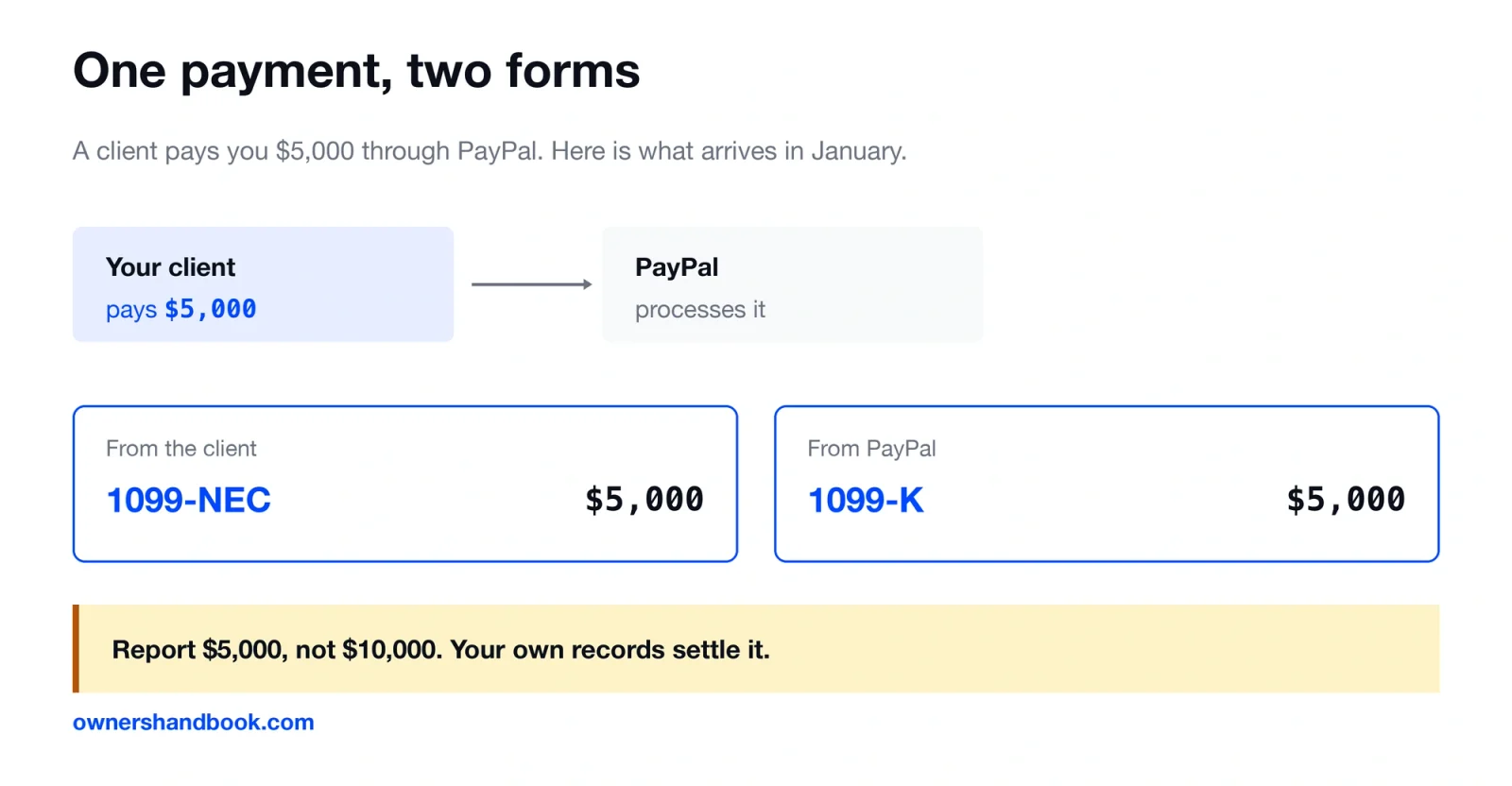
You report your actual income, not the sum of the forms. Keep your own records so you can reconcile what the forms claim against what you actually earned. If they disagree, the IRS will eventually ask, and that conversation is much shorter when you have your own bookkeeping to point at.
The 1099-K threshold has moved several times in recent years. Check the current one against the IRS each January instead of assuming last year’s number held.
If you also have a job
Almost nobody writes about this, and it is the best trick on this page.
If you have W-2 income alongside your freelance income, you can skip quarterly payments entirely. Raise the withholding on your job instead by filing a new Form W-4.
The reason it works is a quirk in how the IRS treats the two. Estimated payments are credited on the day you make them. Withholding is treated as though it was spread evenly across the whole year, no matter when it actually came out.
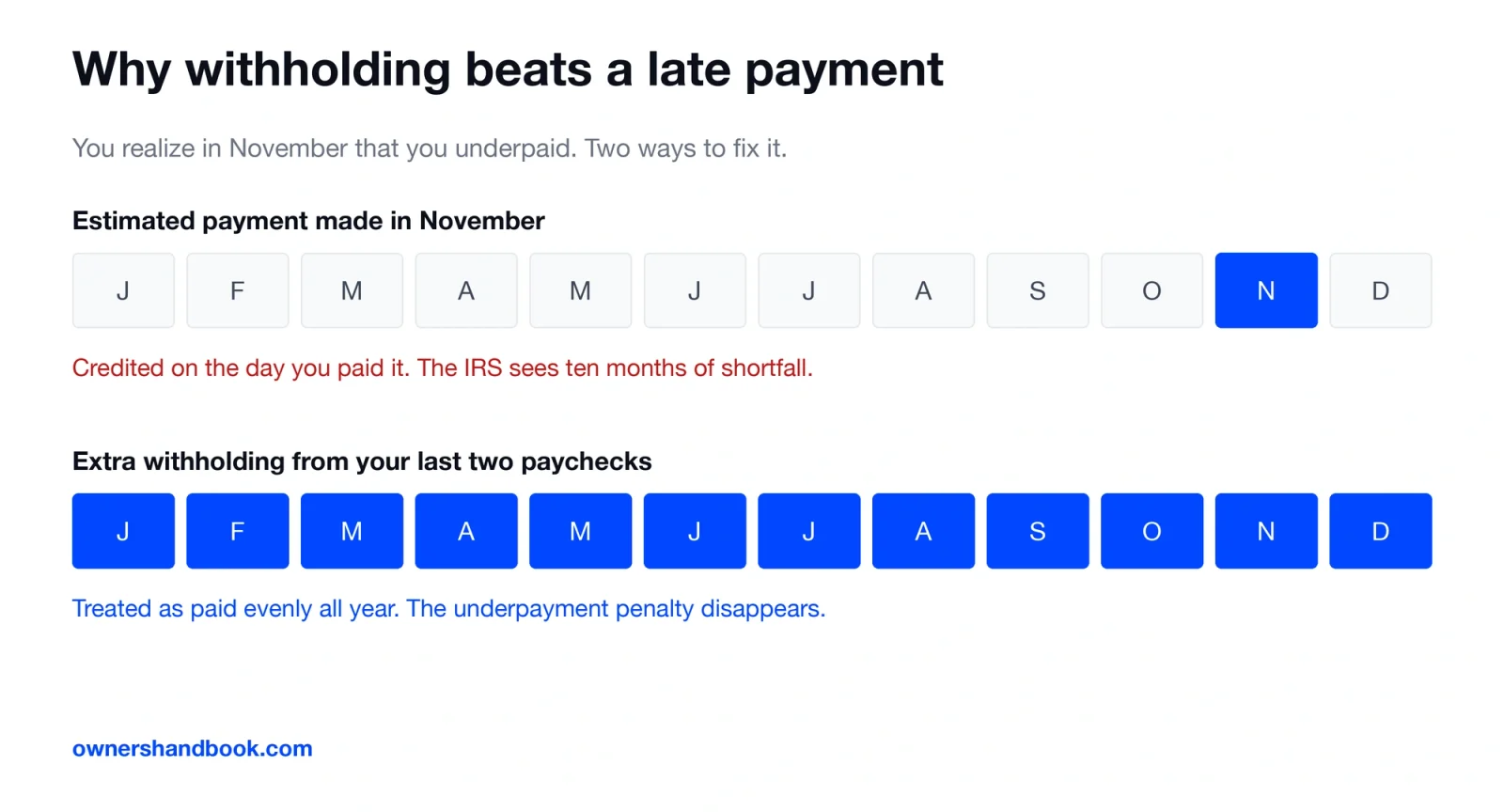
So you can discover in November that you underpaid, crank up withholding for your last two paychecks, and the IRS treats that money as if it arrived in equal installments starting in January.
The penalty disappears.
Use the IRS Tax Withholding Estimator to find the number, then put the extra amount on line 4(c) of your W-4.
Your first year, in order
Open a separate checking account for taxes. Any bank. The point is friction.
If you want the whole of your first year laid out month by month, with what is due when, there is a checklist for that.
Move 25% to 30% of every payment into it the day it arrives. Not monthly. Not when you remember.
Track expenses from day one. Every deductible dollar avoids 15.3% plus your income rate. A $1,000 expense you forgot to record costs you roughly $300.
Find last year’s total tax on your return and divide by four. That is your safe harbor payment, or a quarter of 110% of it if your adjusted gross income was over $150,000.
Pay through IRS Direct Pay. Free, about three minutes, gives you a confirmation number. Save it.
Put the four dates in your calendar with a one-week warning.
What this page does not cover
State income tax has its own rules, forms, and often its own quarterly schedule. Nine states have none. Everyone else needs to check separately.
S-corporation owners are on a different track. Once you elect S-corp status you pay yourself a salary through payroll and self-employment tax stops working the way it does here. That election starts making sense above a certain income, and it deserves its own page.
Under $400 in total self-employment earnings for the year, self-employment tax does not apply at all. Income tax still might.
Frequently asked questions
Do I pay self-employment tax on gross revenue or profit?
Profit. Subtract business expenses, multiply by 92.35%, then apply 15.3%. Those expenses go on Schedule C, and the number that comes out of it is what Schedule SE taxes.
What if I made almost nothing this year?
Below $400 in net self-employment earnings, self-employment tax does not apply. Income tax may still, depending on your full situation.
Can I pay all four quarters at once in January?
You can always pay early. Paying late is what triggers penalties. Sending all four in January of the following year means three are late, and interest runs from each original due date.
What if my income is seasonal?
The IRS allows an annualized income method that matches payments to when you actually earned the money. It requires Form 2210 and more paperwork. For most people the safe harbor gets to the same place with less effort.
Is the 15.3% on top of income tax or instead of it?
On top. Two separate taxes, two separate calculations.
What happens if I underpay?
You owe interest on the shortfall from the date it was due. Pay as soon as you can, because it accrues until you do.
Sources
IRS, Self-Employment Tax
IRS, Estimated Taxes
https://www.irs.gov/businesses/small-businesses-self-employed/estimated-taxes
IRS, Form 1040-ES
https://www.irs.gov/forms-pubs/about-form-1040-es
IRS, Tax Withholding Estimator
https://www.irs.gov/individuals/tax-withholding-estimator
IRS, Understanding Your Form 1099-K
https://www.irs.gov/businesses/understanding-your-form-1099-k
Social Security Administration, Contribution and Benefit Base