When an S Corp Election Starts Paying for Itself
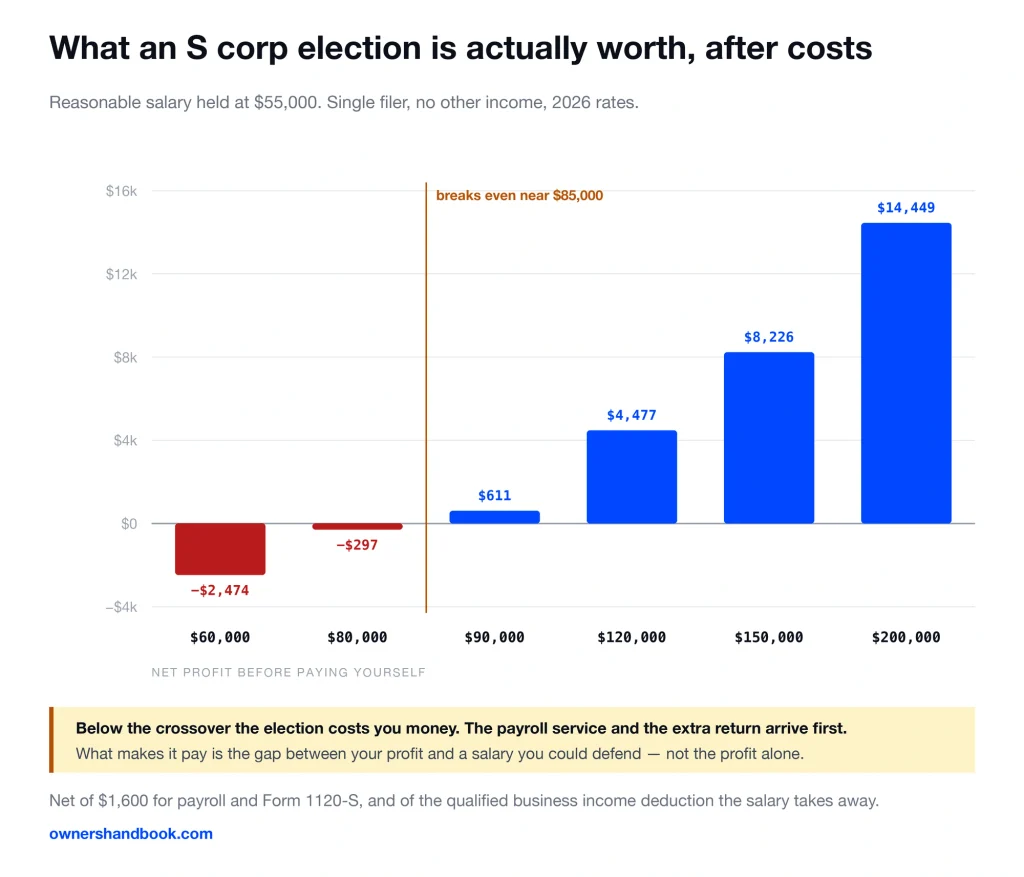
Electing S corporation taxation starts putting money in your pocket somewhere around $85,000 of net profit, and only if a fair salary for your own work sits well below that. Under that line, the payroll service, the extra tax return, and the qualified business income deduction you give up eat the whole saving. It is a trade, not free money, and the trade has a price.
This is the one change that actually changes the tax
Forming an LLC does not move your tax by a dollar. The IRS treats a one-owner LLC as a disregarded entity, meaning the entity is ignored and its activity lands on Schedule C.
The S corporation election is different. It is not a new company. It is a different set of tax rules applied to the company you already have.
And it is the only common structure change that moves a real number on your return.
Liability protection is a separate question. That comes from the LLC or the corporation itself, and the tax election neither adds to it nor takes from it.
The salary comes first
The IRS rule is one sentence. An S corporation must pay reasonable compensation to a shareholder-employee for services provided, before non-wage distributions may be made to that shareholder.
So you go on payroll. You become an employee of your own business, with a W-2, withholding, and quarterly payroll returns.
That salary carries Social Security and Medicare tax. 6.2% and 1.45% withheld from you, the same again paid by the corporation. 15.3% in total, on every dollar of salary.
Money you take out on top of the salary is a distribution. A distribution is not wages, and it carries no self-employment tax.
The corporation deducts the salary and its half of the payroll tax. Neither half is a gift from anywhere. Both come out of the profit you were going to keep.
That gap is the whole idea. As a sole proprietor, all of your profit runs through self-employment tax. As an S corporation, only the salary does.
$90,000, worked all the way through
Take a single filer with $90,000 of profit, no other income, and a reasonable salary of $55,000 for the work.
Sole proprietor first. Self-employment tax is 15.3% on 92.35% of profit. On $90,000 that is $12,717.
Now the S corporation. Pay yourself $55,000. The corporation owes its half of payroll tax, $4,208, leaving $30,792 to distribute.
Payroll tax on the salary is 15.3% of $55,000, or $8,415. Against $12,717, you saved $4,302.
Stop there and it looks like a clean win. It is not.
Your qualified business income deduction shrinks. That is the 20% write-off on profit that passes through to your personal return, and wages do not qualify for it.
The IRS excludes amounts received as reasonable compensation from an S corporation by name. Your salary is no longer part of the 20%.
The sole proprietor deducts $13,508. The S corporation owner deducts $6,158. The smaller deduction costs about $2,090 more in income tax.
| $90,000 of profit | Sole proprietor | S corp, $55,000 salary |
|---|---|---|
| Social Security and Medicare tax | $12,717 | $8,415 |
| Qualified business income deduction | $13,508 | $6,158 |
| Federal income tax | $6,599 | $8,689 |
| Total federal tax | $19,316 | $17,104 |
| Payroll service and Form 1120-S | $0 | −$1,600 |
| What is actually left | — | $612 |
Six hundred dollars. For a year of payroll filings and a second tax return.
The costs nobody puts in the pitch
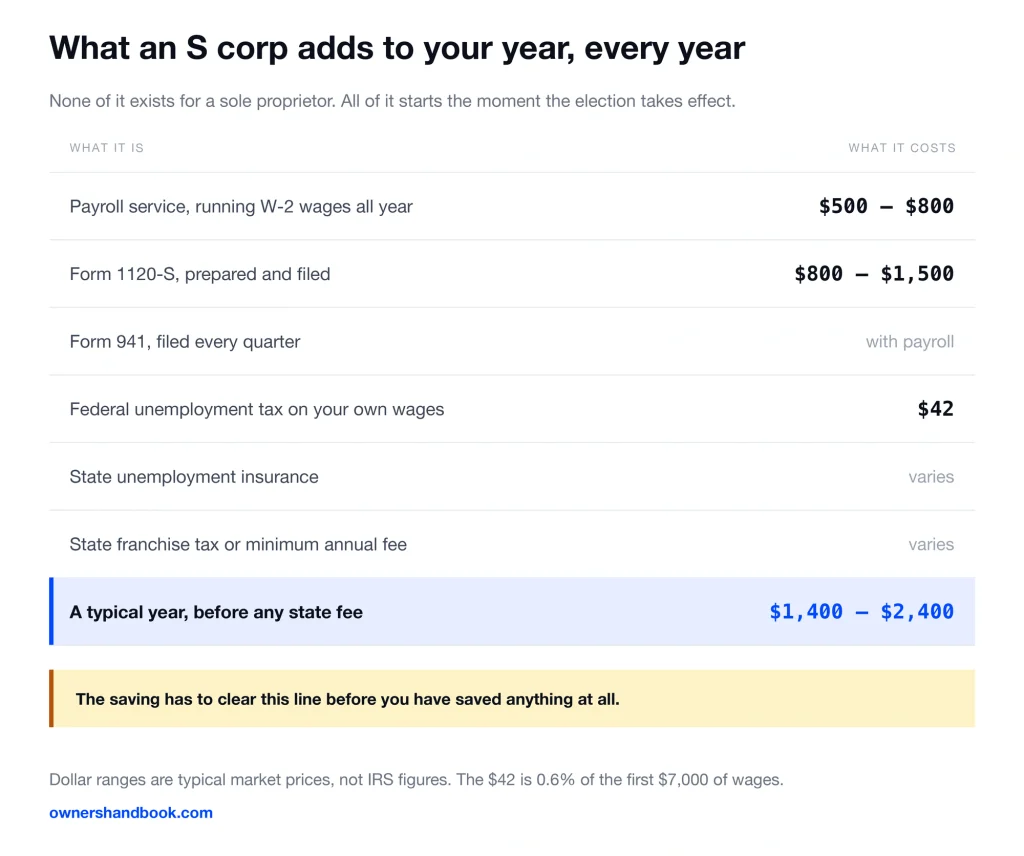
A payroll service, because W-2 wages mean deposits on a schedule and Form 941 every quarter. Doing that by hand is not worth the hours.
Form 1120-S, the S corporation return, filed separately from your 1040. It is due the 15th day of the third month after year end, so March 15 for a calendar year.
It reports the business, then hands you a Schedule K-1 that carries your share of the profit onto your personal return.
Federal unemployment tax on your own wages. It is small, roughly $42, but it is new paperwork.
State unemployment insurance, which is not small everywhere.
And whatever your state charges an S corporation to exist. Several states levy a franchise tax or a minimum annual fee that a sole proprietor never pays.
Your bookkeeping has to get tighter too. Money moving to you now has two names, wages on one date and distributions on another, and they are not interchangeable.
None of this is optional once you elect. Missed payroll deposits and late returns carry their own penalties.
Where it does not pay at all
Hold the salary at $55,000, a market rate for the work, and change only the profit.
| Net profit | Payroll tax saved | Left after costs and lost QBI |
|---|---|---|
| $60,000 | $63 | −$2,474 |
| $80,000 | $2,889 | −$297 |
| $90,000 | $4,302 | $612 |
| $120,000 | $8,540 | $4,477 |
| $150,000 | $12,779 | $8,226 |
| $200,000 | $19,819 | $14,449 |
At $60,000 the election loses you money. There is almost nothing left to distribute after a fair salary, so there is nothing to save.
The saving does not grow forever either. Social Security tax stops at the 2026 wage base of $184,500, for a sole proprietor as much as for an employee.
Past roughly $200,000 of profit, a sole proprietor is already done paying the 12.4% Social Security piece. Only the 2.9% Medicare piece is left to save on.
There is also an extra 0.9% Medicare tax above $200,000. It lands on wages and on self-employment income alike, so it does not tilt the comparison either way.
What reasonable has to mean
Reasonable compensation is tested against what the business would pay an unrelated person to do the same work. Not what leaves you the biggest distribution.
Courts weigh your training and experience, your duties, the hours you put in, what comparable positions pay, and what non-shareholder employees earn.
The IRS can reclassify distributions as wages to the extent they are really pay for services. Then the payroll tax comes due, with penalties and interest on top.
A $20,000 salary on $150,000 of profit is the shape that gets looked at. Write down how you arrived at your number, and keep the comparison you used.
A smaller salary does save payroll tax, and it leaves more pass-through profit for the 20% deduction. It also raises the odds of the distributions being recharacterized.
Weigh that against the size of the prize. A few thousand dollars a year is not worth a number you cannot defend with a straight face.
Form 2553 and the deadline
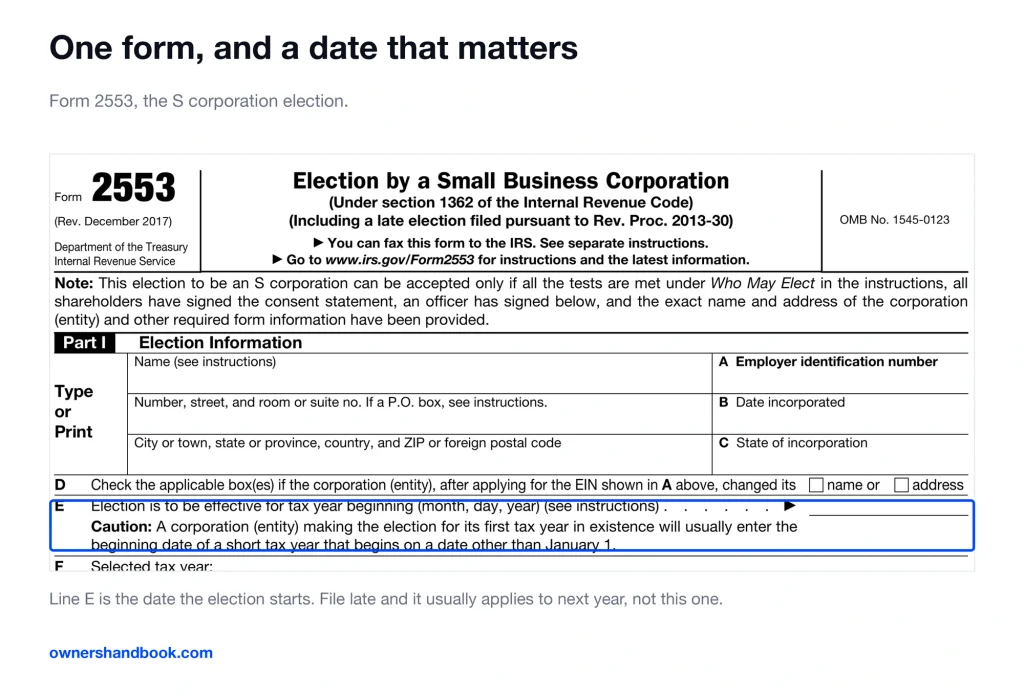
The election is made on Form 2553, signed by every shareholder.
The business has to be eligible first. Domestic, 100 shareholders or fewer, one class of stock, and no partnership, corporation, or non-resident alien among the owners.
A one-person LLC clears all of that without trying.
File it no more than 2 months and 15 days after the beginning of the tax year the election is to take effect, or any time during the preceding tax year.
For a calendar year, that is March 15.
Miss it and there is relief. Revenue Procedure 2013-30 lets you file late, within 3 years and 75 days of the intended effective date, if you explain the reasonable cause and what you did to fix it on discovery.
Relief is common, not automatic. You have to have reported your income all along as though the election were already in place.
One practical consequence people underrate. Once you elect, you are filing a business return with a March deadline, and most people stop doing their own taxes at that point. If you were not already paying an enrolled agent or an accountant, add that to the cost side before you decide.
Frequently asked questions
Do I have to form a corporation first?
No. An LLC can elect S corporation taxation and stay an LLC. You file Form 2553, and the state paperwork does not change.
What profit level makes it worth it?
Around $85,000 in the example above, where a fair salary is $55,000. The real test is the gap between your profit and your salary, not the profit alone.
Can I just pay myself a tiny salary?
You can, and it is the fastest way to draw attention. The standard is what you would pay someone else for the same work, and the IRS can reclassify the distributions as wages with penalties attached.
Does the S corporation pay its own tax?
Generally no. The corporation files Form 1120-S, but the income passes through to you on a Schedule K-1 and is taxed on your 1040.
What happens to my quarterly estimated payments?
Payroll withholding covers the salary. You will usually still owe estimated payments on the distributions, since nothing is withheld from those.
Can I undo the election?
Yes, but not casually. A revoked or terminated election generally cannot be made again for five tax years without IRS consent.
None of this is tax advice. The numbers here are arithmetic on an example, not a projection for your business, and what counts as reasonable compensation is judged on your facts. Before you file Form 2553, run your own figures past someone licensed to sign a return.
Sources
IRS, S Corporation Compensation and Medical Insurance Issues
IRS, S Corporations
https://www.irs.gov/businesses/small-businesses-self-employed/s-corporations
IRS, Instructions for Form 2553
https://www.irs.gov/instructions/i2553
IRS, About Form 2553, Election by a Small Business Corporation
https://www.irs.gov/forms-pubs/about-form-2553
IRS, About Form 1120-S, U.S. Income Tax Return for an S Corporation
https://www.irs.gov/forms-pubs/about-form-1120-s
IRS, Topic No. 751, Social Security and Medicare Withholding Rates
https://www.irs.gov/taxtopics/tc751
IRS, Topic No. 759, Form 940, Federal Unemployment Tax Act
https://www.irs.gov/taxtopics/tc759
IRS, Qualified Business Income Deduction
https://www.irs.gov/newsroom/qualified-business-income-deduction
IRS, Self-Employment Tax (Social Security and Medicare Taxes)
IRS, Single Member Limited Liability Companies
IRS, IRS releases tax inflation adjustments for tax year 2026