How to Form an LLC: Five Steps and What Each Costs
Forming an LLC takes five steps: check the name, name a registered agent, file the articles of organization, get an EIN, and write an operating agreement.
Four of the five cost nothing. The state filing fee is the only real bill, and it runs from $40 in Kentucky to $300 in Texas.
Then there is the fee nobody budgets for. Most states charge you again every year, and that annual number is what decides whether your state is cheap or expensive.
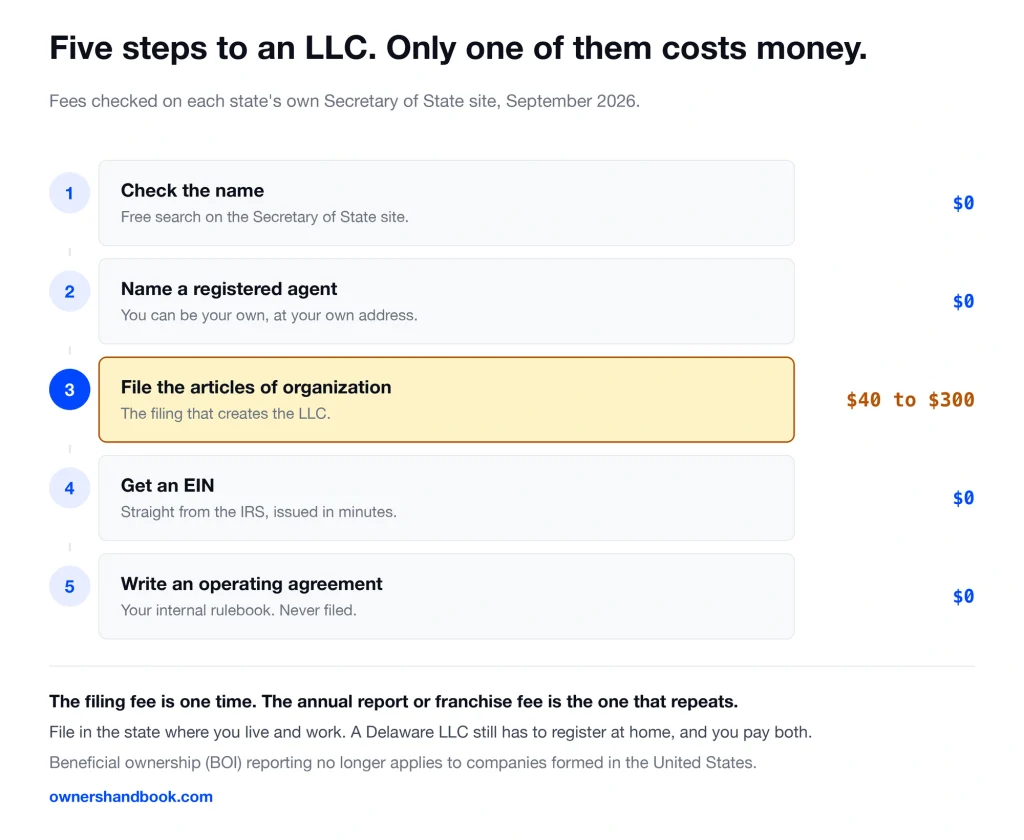
| Step | What it costs |
|---|---|
| Name availability search | $0 on your state’s website |
| Registered agent | $0 if it is you; a commercial agent sets its own annual fee |
| Articles of organization | The state filing fee, $40 to $300 |
| EIN from the IRS | $0, issued in minutes |
| Operating agreement | $0, and you never file it |
What an LLC actually does
An LLC is a state-law wrapper. You file one form with one state, pay that state, and the business becomes a legal entity separate from you.
Right now, with nothing filed, you are a sole proprietor. That is the default the moment you send your first invoice. It is free and it is automatic.
What the LLC buys is limited liability. If the business is sued or owes money, the claim generally stops at the business, not at your savings account.
What it does not buy is a tax break. The IRS treats a one-member LLC as a disregarded entity, meaning your Schedule C and your 15.3% self-employment tax do not change at all.
The S corp election is a separate decision, made later on Form 2553, and it has nothing to do with these five steps.
Step one: check the name
Every Secretary of State runs a free business name search. Type your name in. If an active entity already holds it, pick another one.
That search is the whole step. You do not need a lawyer and you do not need to pay a service to run it for you.
Reserving a name before you file is optional and it costs money. Colorado charges $25 to reserve one, Kentucky $15. Skip it unless you are weeks away from filing.
Step two: name a registered agent
A registered agent is the person or company at a physical in-state address who accepts legal papers for your LLC during business hours.
You can be your own agent in the state where you live. That costs nothing, and for a freelancer working from home it is usually the right call.
The catch is that the address becomes public record. If you do not want your home address in a searchable database, a commercial registered agent rents you theirs for an annual fee it sets.
Step three: file the articles of organization
This is the filing that creates the LLC. States call it different things — articles of organization in Colorado and Kentucky, a certificate of formation in Texas and Delaware, a certificate of organization in Pennsylvania and Iowa.
The form asks for the name, an address, the registered agent, and who runs the company. Most states accept it online and approve it the same day.
This is where the money goes, in both directions.
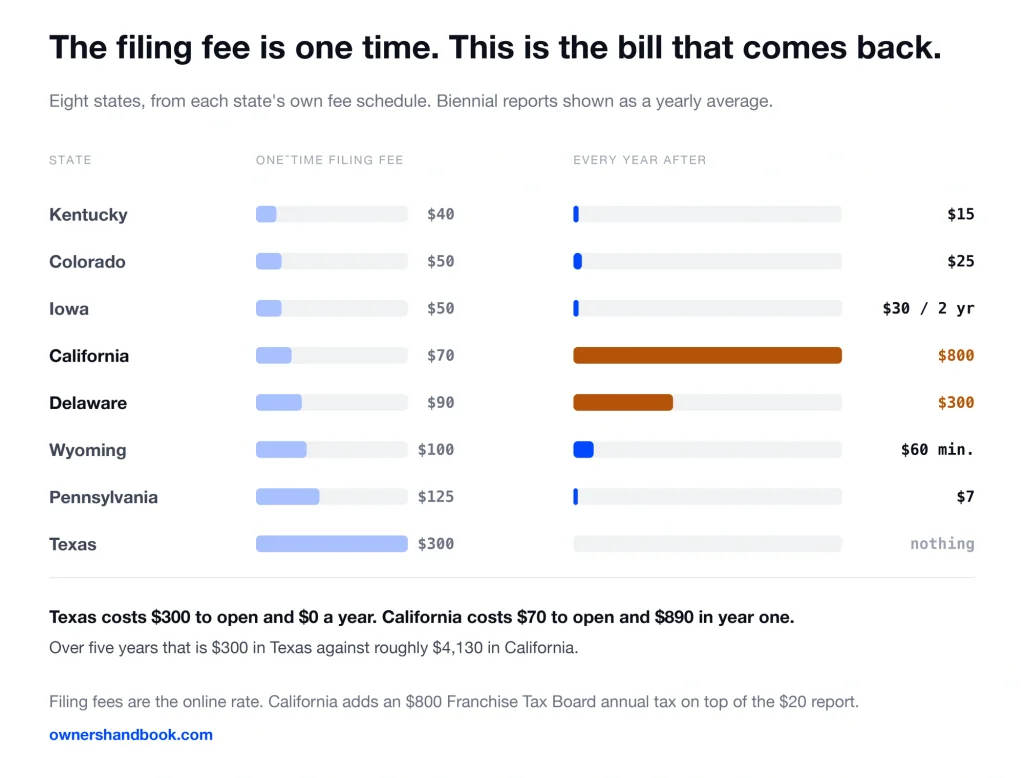
| State | Filing fee | Recurring fee |
|---|---|---|
| Kentucky | $40 | $15 a year |
| Colorado | $50 | $25 a year |
| Iowa | $50 | $30 every two years |
| California | $70 | $800 a year, plus $20 every two years |
| Delaware | $90 | $300 a year |
| Wyoming | $100 | $60 a year, minimum |
| Pennsylvania | $125 | $7 a year |
| Texas | $300 | $0 |
Read that table twice. The left column is what people compare. The right column is what you pay for the rest of the business’s life.
Step four: get an EIN
An EIN, or Employer Identification Number, is the business version of a Social Security number. The IRS issues one online in minutes, for free.
The IRS is blunt about it: you never have to pay a fee for an EIN. Any site charging you for one is reselling a free government form.
A single-member LLC with no employees is not required to have one for income tax. Get it anyway. A business bank account almost always requires it, and that account is what keeps the liability separation real.
Two limits worth knowing: one EIN per responsible party per day, and the online application expires after 15 minutes of inactivity.
Step five: write an operating agreement
The operating agreement is the internal rulebook. Who owns what percentage, who can sign contracts, what happens if a member leaves or wants out.
No state asks you to mail it in. It lives in your own files.
Write one anyway, even as a solo owner. It is the document that shows the LLC is a real entity and not just you with extra paperwork, and your bank will ask for it.
What year one costs, and what year two costs
Colorado, filed online: $50 to form, and nothing else that year. Year two, the periodic report is $25. Five years in you have spent about $150.
Texas: $300 to form, then $0. There is no Secretary of State annual report for Texas LLCs, and the Comptroller’s franchise tax report costs nothing below $2,650,000 in revenue.
California: $70 to file, $20 for the Statement of Information due within 90 days, and $800 in annual franchise tax. First year, $890.
Year two in California is $800. Year three is $820. The $70 filing fee that made California look cheap is under 2% of what you will actually spend.
That is the whole lesson of this page. Compare annual fees, not filing fees.
Register in your home state, not Delaware
Delaware’s reputation is real, and it is built for venture-backed corporations with outside investors and lawyers. It is not built for a freelancer with a laptop.
Here is the arithmetic. A Delaware LLC doing business in Colorado still has to register in Colorado as a foreign entity, which means out-of-state, not overseas.
So you pay twice. Delaware’s certificate of formation is $90, and Colorado’s Foreign Entity Authority Statement is $100. That is $190 in year one against $50 for a plain Colorado LLC.
Every year after, you owe Delaware’s $300 annual tax and Colorado’s $25 periodic report. That is $325 a year, forever, instead of $25.
You also need a paid registered agent in Delaware, because you do not live there. The free option disappears the moment you file out of state.
Form in the state where you live and work. The exceptions are real but narrow, and outside investors are the main one.
One thing you no longer have to file
Beneficial ownership information reporting, the BOI report that dominated LLC advice in 2024 and 2025, no longer applies to companies formed in the United States.
FinCEN’s final rule of August 11, 2026, effective August 14, exempts entities created in the United States, and their beneficial owners, from the reporting requirement.
If you find an article telling you to file a BOI report within 30 days of forming, it is out of date. Check FinCEN’s own page before you act on anything you read about this.
Frequently asked questions
Do I need an LLC to freelance?
No. You are a sole proprietor by default and you can invoice, get paid, and deduct expenses without filing anything. The LLC buys liability separation, not permission to work.
Will an LLC lower my taxes?
Not on its own. A one-member LLC is a disregarded entity, so the same Schedule C and the same 15.3% self-employment tax apply. The S corp election is a separate step with its own payroll costs.
How long does forming an LLC take?
Most states approve an online filing the same day or within a few business days. The EIN is immediate once the LLC exists.
Do I need a lawyer to file?
For a single-member LLC in your home state, no. The form asks for your name, an address, and your registered agent. A lawyer is worth it when there are co-owners splitting ownership.
What happens if I miss the annual report?
The state charges a late penalty, $50 in Colorado, and eventually dissolves the LLC administratively. That removes the liability protection you paid for, and reinstating costs more than filing on time.
Can I form in a no-income-tax state to avoid state tax?
No. State income tax follows where you live and earn, not where the paperwork sits. An out-of-state LLC adds a second registration and a second annual fee without changing what you owe.
Sources
IRS, Limited Liability Company (LLC)
https://www.irs.gov/businesses/small-businesses-self-employed/limited-liability-company-llc
IRS, Single Member Limited Liability Companies
IRS, Apply for an Employer Identification Number (EIN) Online
IRS, Self-Employment Tax
FinCEN, Beneficial Ownership Information Reporting
California Secretary of State, Limited Liability Companies (Domestic) forms and fees
California Franchise Tax Board, Limited Liability Company annual tax
https://www.ftb.ca.gov/file/business/types/limited-liability-company/index.html
Texas Secretary of State, Form 205 Certificate of Formation
https://www.sos.state.tx.us/corp/forms/205_boc.pdf
Texas Comptroller, Franchise Tax
https://comptroller.texas.gov/taxes/franchise
Delaware Division of Corporations, Certificate of Formation of a Limited Liability Company
https://corpfiles.delaware.gov/LLCFormation.pdf
Delaware Division of Corporations, How to Form a New Business Entity
Pennsylvania Department of State, Fees and Payments
https://www.pa.gov/agencies/dos/programs/business/fees-and-payments
Colorado Secretary of State, Business Organizations Fee Schedule
https://www.coloradosos.gov/pubs/info_center/fees/business.html
Wyoming Secretary of State, Business Division Fee Schedule
https://sos.wyo.gov/Business/docs/BusinessFees.pdf
Wyoming Secretary of State, Business Division FAQs
https://sos.wyo.gov/faqs.aspx?root=BUS
Kentucky Secretary of State, Business Filings Fees
https://www.sos.ky.gov/bus/business-filings/Pages/fees.aspx
Iowa Secretary of State, Business Forms and Fees