Colorado Taxes Your Federal Number, Then Sends Some Back
Colorado charges a flat 4.4% on your federal taxable income, so a Denver freelancer with $95,000 of net profit owes about $2,541 to the state. Denver adds $4 a month on top, for the privilege of working there.
Both are Colorado state and local tax. They stack on what you already owe the United States, and neither one replaces any of it.
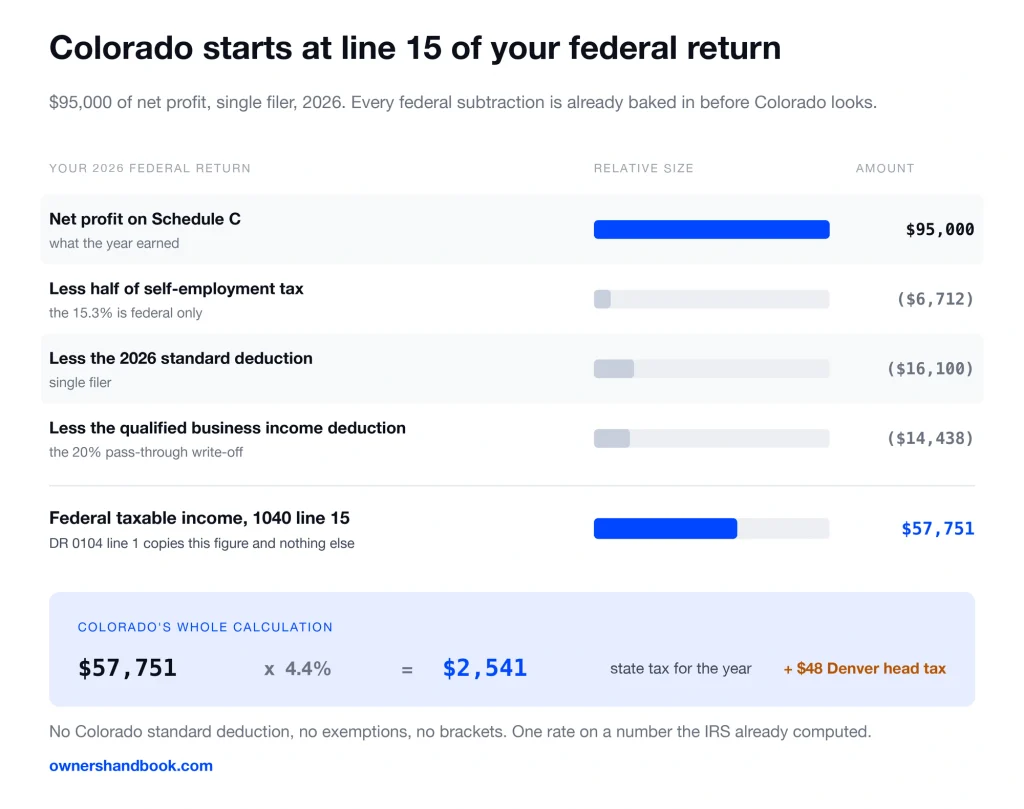
Colorado starts where your federal return ends
Line 1 of Form DR 0104, the Colorado individual return, asks for your federal taxable income from line 15 of your 1040. That is the entire starting point.
Not revenue. Not adjusted gross income. The number that is left after your standard deduction and your qualified business income deduction have already come off.
So every federal choice flows straight through. A bigger Schedule C deduction shrinks your Colorado bill at 4.4% without your doing anything on the state form.
That also means Colorado has no standard deduction of its own, no personal exemption, and no brackets. One rate, applied to a number the IRS already computed.
The general state tax guide covers how other states handle this. Colorado is on the simple end of that spectrum.
What $95,000 of Denver profit costs
Take a single filer, no other income, working from an apartment in Denver.
Self-employment tax runs $13,423 for the year, and half of it comes off before the federal taxable income line is reached. That is the 15.3% the IRS charges, and Colorado does not repeat it.
| Step | Amount |
|---|---|
| Net profit on Schedule C | $95,000 |
| Less half of self-employment tax | ($6,712) |
| Less the 2026 standard deduction | ($16,100) |
| Less the qualified business income deduction | ($14,438) |
| Federal taxable income, 1040 line 15 | $57,751 |
| Colorado tax at 4.4% | $2,541 |
| Denver occupational privilege tax, $4 x 12 | $48 |
| Total Colorado state and local | $2,589 |
That is 2.7% of profit. The federal bill on the same $95,000 is several times larger.
Notice what did the heavy lifting. The qualified business income deduction is a federal 20% write-off for pass-through business owners, and Colorado lets it through untouched for anyone under $500,000 of AGI.
Colorado adds back things your Schedule C already deducted
Flowing through is not the same as flowing through unchanged. Colorado bolts a short list of additions onto that federal number, and one of them is aimed squarely at freelancers.
Line 5 of the DR 0104 is the business meals addback. Enter the full amount you deducted on line 24b of Schedule C, and Colorado taxes it.
Deduct $2,000 of client lunches federally and Colorado charges you $88 on money the IRS agreed was a business expense.
Two other addbacks exist but start high. The qualified business income deduction gets added back entirely above $500,000 of AGI, single or joint at $1,000,000.
And above $300,000 of federal AGI in tax year 2025, Colorado claws back your standard or itemized deduction above $12,000 for a single filer, $16,000 filing jointly.
Going the other way, there is a subtraction most freelancers miss. If you take the standard deduction federally, Colorado still lets you deduct charitable contributions above $500 on line 12.
TABOR is why the rate is not a fixed number
The Taxpayer’s Bill of Rights is an amendment to the Colorado constitution that caps how much revenue the state may keep. Collect more than the cap and the excess must be returned.
One of the ways it comes back is a temporary cut to the income tax rate itself. Not a credit. The rate.
That happened for tax year 2024, when the booklet rate read 4.25% instead of 4.4%. It went back to 4.4% for 2025.
| Tax year | Colorado rate | Where it is stated |
|---|---|---|
| 2024 | 4.25% | DR 0104 booklet, temporary TABOR reduction |
| 2025 | 4.4% | DR 0104 booklet |
| 2026 | 4.4% | DR 0104EP worksheet, line 2 |
Plan at 4.4% and treat any reduction as a refund you did not budget for. The 2026 estimated payment form was published in June 2025 and uses 4.4%, which is the only number available while the year is running.
The other half of TABOR is a line on your return
The second mechanism is the state sales tax refund, and you claim it on line 38 of the DR 0104.
It is not automatic. There is a box you have to check, and you must be a full-year resident, generally 18 or older, filing by the extension deadline.
The amount is set by a six-tier table keyed to your modified adjusted gross income. How much sits in those tiers swings hard from year to year.
For tax year 2024 a single filer got between $177 and $565. For 2025 the same table paid between $19 and $59.
The $95,000 freelancer above, with modified AGI of $88,288, would have collected $240 for 2024 and $25 for 2025. Same income, same state, an order of magnitude apart.
Four cities charge a flat dollar amount for working there
Colorado has an occupational privilege tax, and the cities that levy it call it a head tax. A head tax is a flat monthly dollar amount per person, not a percentage of anything.
It does not appear on your state return. It has nothing to do with income tax. It is a separate registration with a separate city.
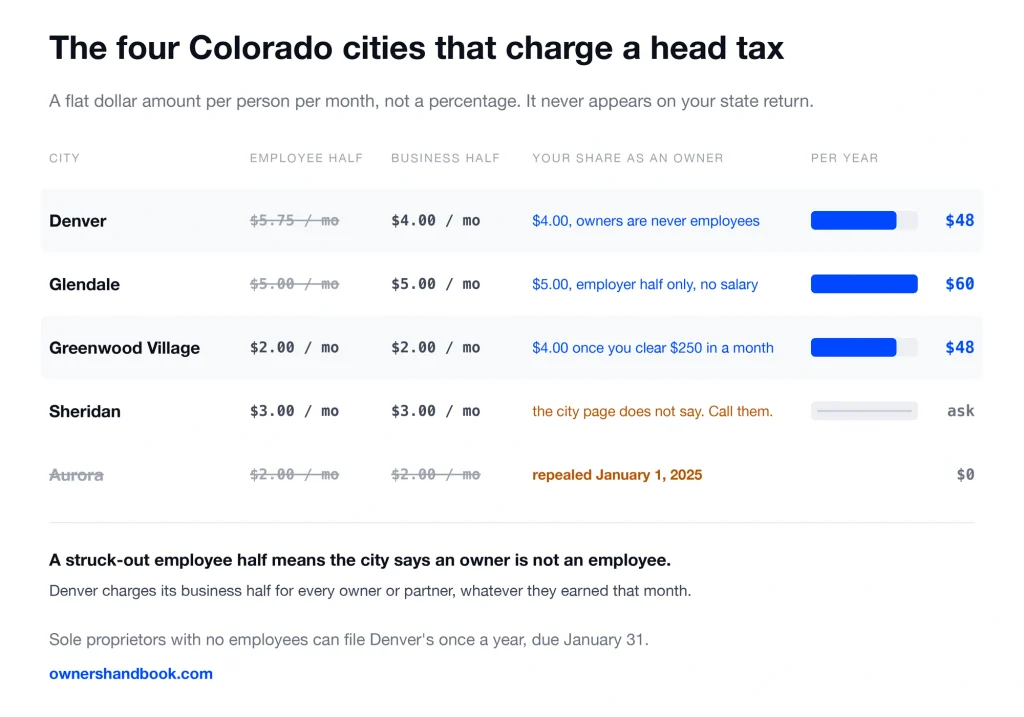
Four cities still levy one: Denver, Glendale, Sheridan, and Greenwood Village. Aurora repealed its version effective January 1, 2025, and the December 2024 return was the last one due.
Every version has two halves, an employee portion withheld from a paycheck and a business portion paid by the business. Which halves reach a self-employed person depends on the city.
Glendale states it outright. Self-employed individuals, owners, partners, and officers who are not paid a salary or commission owe only the employer portion, $5 a month.
Greenwood Village runs the other way. Both $2 halves apply once you earn $250 in a calendar month, and only owners below that floor drop to the employer half alone.
Sheridan’s page describes $3 plus a $3 employer match without addressing self-employed people at all. Call the city before assuming either answer.
Denver bills a freelancer $4 a month, forever
Denver’s rule is the one worth reading closely, because the earnings test everybody quotes does not apply to you.
The $500-a-month threshold governs the Employee OPT of $5.75. Denver’s own tax guide says the $500 test does not apply to owners or partners, since they are not employees.
Instead, the Business OPT of $4.00 a month is owed for each owner, partner, or manager engaged in business in Denver, regardless of how much they earn. A single-member LLC counts as an owner.
You owe it in a month with one $200 invoice. You owe it in a month with no invoices at all, as long as you had any business activity in the city.
The one kindness is the filing schedule. Sole proprietors and partnerships with no taxable employees may pay for the whole calendar year at once, due January 31.
Colorado wants its own quarterly payments
The form is DR 0104EP, and the trigger is expecting to owe more than $1,000 in net Colorado tax after withholding and credits.
Our $95,000 freelancer clears that easily. Four payments of about $635.
The dates match the federal ones exactly: April 15, June 15, September 15, and January 15 of the following year. That is the whole schedule, no reordering, unlike some states.
Colorado’s safe harbor is friendlier than the federal one. Pay 70% of this year’s actual tax and you are protected, against the IRS’s 90%.
The prior-year route is the usual pair. 100% of last year’s Colorado tax if your prior-year federal AGI was $150,000 or less, 110% above that.
Pay at Colorado.gov/RevenueOnline and the DR 0104EP is not required at all. Skipping a payment triggers an estimated tax penalty, computed on form DR 0204.
None of this replaces your federal quarterly estimated taxes. If the IRS side is not set up yet, start with how to pay estimated taxes and then copy the same four dates into a Revenue Online schedule.
Frequently asked questions
Does Colorado charge self-employment tax?
No. Social Security and Medicare are federal, so the 15.3% does not repeat. Colorado charges income tax only, at 4.4% of federal taxable income.
I live in Denver but all my clients are out of state. Do I owe the occupational privilege tax?
Yes. It attaches to where you perform the work, not where your clients are. Working from a Denver apartment is business activity in Denver.
How do I actually pay Denver’s $48?
Register for an OPT account with Denver’s Department of Finance and file. With no taxable employees you may file once a year, due January 31.
Will the rate drop to 4.25% again in 2026?
The 2026 estimated tax form says 4.4%, and any TABOR reduction is determined after the fact. Budget at 4.4% and treat a cut as a surprise refund.
Does Colorado follow the federal qualified business income deduction?
Yes, below $500,000 of AGI, because it is already subtracted inside federal taxable income. Above that threshold you add the entire deduction back.
Can I skip the TABOR sales tax refund if the amount is small?
You can, but there is no reason to. It is a checkbox on the DR 0104 and it reduces your tax bill before any refund is calculated.
Sources
Colorado Department of Revenue, DR 0104EP 2026 Individual Estimated Income Tax Payment Form
https://tax.colorado.gov/sites/tax/files/documents/DR_0104EP_2026.pdf
Colorado Department of Revenue, 2025 DR 0104 Booklet
https://tax.colorado.gov/sites/tax/files/documents/Book104_2025.pdf
Colorado Department of Revenue, 2024 DR 0104 Booklet
https://tax.colorado.gov/sites/tax/files/documents/DR0104_book_2024.pdf
Colorado Department of Revenue, TABOR Sales Tax Refund
https://tax.colorado.gov/TABOR
Colorado Department of Revenue, Individual Income Tax
https://tax.colorado.gov/individual-income-tax
City and County of Denver, Tax Guide Topic No. 61, Occupational Privilege Taxes
City of Glendale, Occupational Privilege Tax
https://www.glendale.co.us/355/Occupational-Privilege-Tax
City of Greenwood Village, Occupational Privilege Tax (OPT)
https://www.greenwoodvillage.com/1220/Occupational-Privilege-Tax-OPT
City of Sheridan, Occupational Privilege Tax
https://www.ci.sheridan.co.us/288/Occupational-Privilege-Tax
City of Aurora, Occupational Privilege Tax
https://www.auroragov.org/business_services/taxes/occupational_privilege_tax
IRS, Revenue Procedure 2025-32
https://www.irs.gov/pub/irs-drop/rp-25-32.pdf
IRS, Estimated Taxes
https://www.irs.gov/businesses/small-businesses-self-employed/estimated-taxes