How to Actually Pay Your Estimated Taxes
Use IRS Direct Pay. It is free, it needs no account, it takes about three minutes, and it pulls the money straight out of your checking account.
On a $5,500 payment the comparison is not close. Direct Pay costs nothing. A debit card costs $2.10 or $2.15. A credit card costs $96.25 or $101.75, depending on which processor you land on.
This page is the mechanics only. Which service, which dropdown, what it costs, and how to tell the money actually posted. For the four dates and how much to send, see the quarterly estimated taxes article.
It assumes you already know your number: the self-employment tax and income tax you owe on this quarter’s profit.
Everything below was checked against IRS.gov on September 7, 2026. Processor fees change, so re-check the card page before you trust a figure you read anywhere, including here.
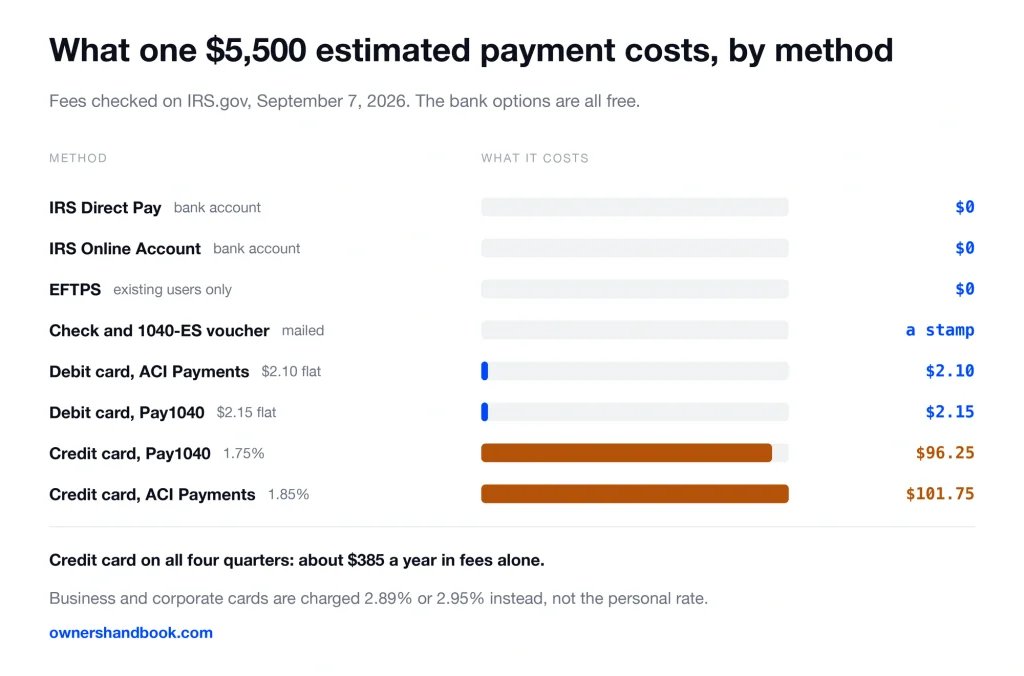
What each option costs on one $5,500 payment
The IRS never charges you to pay it. Every fee below belongs to an outside company, and the IRS states plainly that no part of the card service fee goes to the IRS.
| How you pay | Fee on $5,500 | The catch |
|---|---|---|
| IRS Direct Pay | $0 | No account needed. Bank account only. |
| IRS Online Account | $0 | Registration required. Keeps history. |
| EFTPS | $0 | Closed to new individual sign-ups |
| Check and 1040-ES voucher | Postage | No receipt, no confirmation |
| Debit card, ACI Payments | $2.10 | Flat, whatever the amount |
| Debit card, Pay1040 | $2.15 | Flat, whatever the amount |
| Credit card, Pay1040 | $96.25 | 1.75%, minimum $2.50 |
| Credit card, ACI Payments | $101.75 | 1.85%, minimum $2.50 |
Pay1040 and ACI Payments, Inc. are the only two processors the IRS listed as of September 7, 2026. Both take digital wallets as well as plastic.
Both also charge more for a business card. A commercial or corporate card runs 2.89% at Pay1040 and 2.95% at ACI, which on $5,500 is $158.95 or $162.25.
Run a personal credit card four times a year at $5,500 and you have spent about $385 on fees. That is the entire argument.
Direct Pay, start to finish
Direct Pay sits on IRS.gov behind a button that says “Pay now with Direct Pay.” There is no username and no password.
Instead of a login it verifies you against an old tax return. It does not have to be the year you are paying for.
It can be a return from five or six years back. The IRS recommends using your most recent one.
That has one consequence worth knowing in advance. Direct Pay does not work if you have never filed a federal return, so a first-year freelancer with no filing history has to use a registered Online Account or mail a voucher.
You can schedule a payment up to 365 days ahead and cancel it until two business days before the date. The limits are five payments per 24 hours and nothing over $9,999,999.99.
At the end you get a confirmation number. Take the option to have it emailed to you.
Direct Pay cannot retrieve that number once you close the page. Without it you cannot look up, change, or cancel the payment you just scheduled.
EFTPS closed to new individuals, and what replaced it
EFTPS, the Electronic Federal Tax Payment System, is the Treasury’s free payment portal. For years it was the standard advice for anyone paying quarterly estimated taxes on a schedule.
That advice is now out of date. As of the IRS EFTPS page on September 7, 2026, individual taxpayers can no longer create new EFTPS accounts.
The IRS sends individuals to their Online Account instead, or to Direct Pay. People who already have an EFTPS login can keep using it.
If that is you, it is still a good tool. Enrollment took up to five business days and the PIN arrived by U.S. Mail. You get 365-day advance scheduling, 15 months of payment history, and a phone line at 800-555-3453.
One EFTPS deadline that trips people: payments have to be scheduled by 8 p.m. Eastern the day before the due date to count as on time.
For everyone else, the Individual Online Account is the real upgrade over Direct Pay. Registration takes photo identification, and in exchange it stores your bank accounts and shows five years of payment history.
It also accepts one to five payments in a single transaction, up to four transactions a day. Direct Pay does one payment at a time and forgets you between visits.
Cards cost real money, and twice a year that is fine
Nothing about the card fee is a trick. It is the interchange cost passed through, and the processor has to show it to you before you commit.
There are two situations where handing over $96 is a reasonable trade.
The first is a signup bonus. If a new card pays $750 for hitting $6,000 of spend in three months, pushing a $5,500 estimated payment through it nets you about $654.
The second is timing. A $96 fee to move $5,500 into next month’s billing cycle can beat being short on the due date. That logic dies the moment you carry the balance, because card interest overtakes the fee within weeks.
There is a hard limit either way. The IRS caps card payments at two per quarter for Form 1040-ES, so you cannot split one quarter across five different cards.
On deductibility, be careful. The IRS says the processing fee is deductible for business taxes, but a 1040-ES payment is personal income tax, so do not assume yours qualifies.
The three dropdowns that decide where the money lands
This is where payments go wrong. Almost never the amount, almost always the routing.
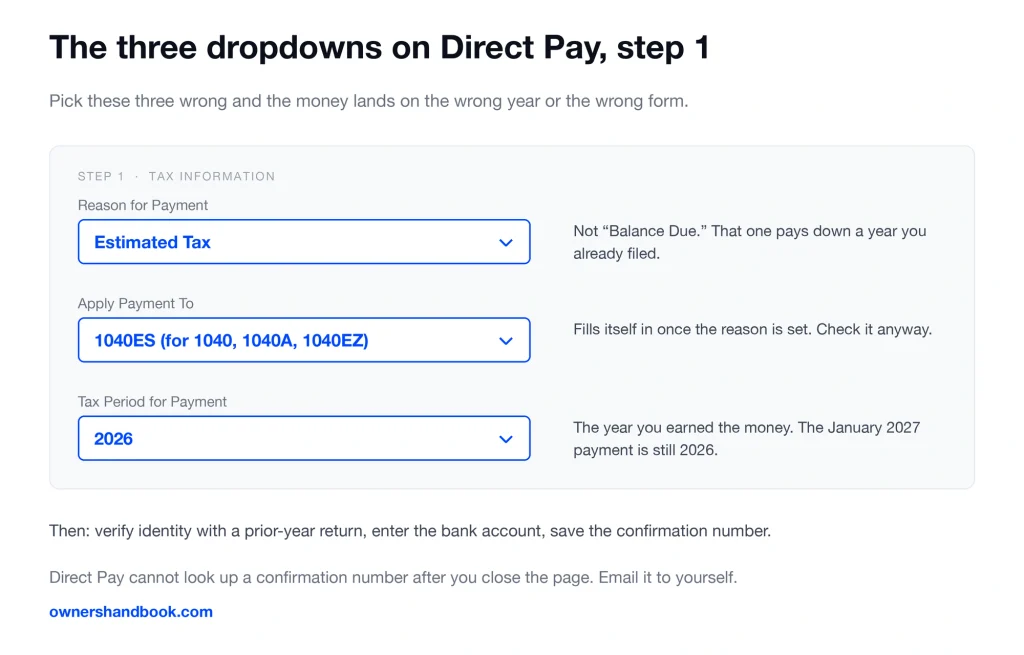
Direct Pay’s first screen asks three questions in a row. A wrong answer to any of them files your money perfectly, against the wrong thing.
| Field | What to select | Why it matters |
|---|---|---|
| Reason for Payment | Estimated Tax | “Balance Due” pays down a year you already filed |
| Apply Payment To | 1040ES | Fills in on its own once the reason is set |
| Tax Period for Payment | 2026 | The year you earned it, not the year you file |
The third one catches everybody. The fourth-quarter payment is due January 15, 2027, and it is still a 2026 payment.
Select 2027 and the money parks on a year you have not earned yet. Your 2026 return then shows a payment missing, the IRS bills you for it, and you spend an afternoon on the phone getting it moved.
Mailing a voucher, and the address that changed
Form 1040-ES comes with four preprinted payment vouchers. You tear one off, clip nothing to it, and mail it with a check.
Make the check payable to U.S. Treasury. Write your Social Security number, your daytime phone number, and “2026 Form 1040-ES” on it.
Do not staple or paper-clip the check to the voucher, and never mail cash.
Then the part almost nobody checks. The address depends on your state, and it changed this year.
The IRS corrected the mailing addresses printed in the 2026 Form 1040-ES effective February 13, 2026. One set of states now mails to Charlotte, North Carolina, the other to Louisville, Kentucky.
If you downloaded or printed the form before that date, the address on your voucher is wrong. Read the correction notice in the sources below before you send anything.
The real cost of mailing is not the stamp. It is that you get no confirmation number, no email, and no way to know the payment arrived until it shows up in your account weeks later.
How to confirm it posted
A confirmation number is not proof the money moved. The IRS is explicit: it confirms only that you approved the withdrawal.
Check your IRS Online Account two business days after the scheduled date. The payment activity page shows pending, scheduled, canceled, returned, and processed payments from every channel at once.
If it still reads “Pending” after that, wait three more business days. If it came back returned or reversed, resubmit right away, because interest runs from the original due date and a returned payment you never noticed becomes a missed payment.
One timing quirk to expect. A payment submitted after 8 p.m. Eastern usually appears in your account as the next business day, but you still get credit for the date you selected.
Check the bank side too. If your statement shows the debit and the IRS account still shows nothing two business days later, that is the moment to call rather than wait.
Frequently asked questions
Can I schedule all four payments at once?
Not in one Direct Pay session, which handles a single payment at a time. Your Online Account takes one to five payments per transaction, and both let you schedule up to 365 days ahead.
Do I still mail Form 1040-ES if I pay online?
No. The voucher exists so a human can tell where to apply a paper check. Paying electronically carries the same information in the dropdowns.
I picked the wrong tax year. Can I fix it myself?
No. Once the payment processes, neither Direct Pay nor your Online Account can move it between years. Call the IRS and ask them to reapply it.
Can I pay from a foreign bank account?
Not directly. Direct Pay needs a nine-digit U.S. routing number and does not accept SWIFT codes. A foreign bank with a U.S. affiliate may be able to supply one.
Is the card processing fee deductible?
The IRS says card fees are deductible for business taxes. An estimated payment on Form 1040-ES is personal income tax, so treat that as a question for your preparer rather than a yes.
Does paying the IRS cover my state?
No. Your state tax has its own portal, its own voucher, and sometimes its own due dates. A federal payment does nothing for a state balance.
Sources
IRS, Pay your taxes by debit or credit card or digital wallet
https://www.irs.gov/payments/pay-your-taxes-by-debit-or-credit-card
IRS, Direct Pay with bank account
https://www.irs.gov/payments/direct-pay-with-bank-account
IRS, Direct Pay help
https://www.irs.gov/payments/direct-pay-help
IRS, Frequency limit table by type of tax payment
https://www.irs.gov/payments/frequency-limit-table-by-type-of-tax-payment
IRS, EFTPS: The Electronic Federal Tax Payment System
https://www.irs.gov/payments/eftps-the-electronic-federal-tax-payment-system
IRS, Online account for individuals
https://www.irs.gov/payments/online-account-for-individuals
IRS, Pay by check or money order
https://www.irs.gov/payments/pay-by-check-or-money-order
IRS, Correction to the mailing addresses in the 2026 Form 1040-ES
https://www.irs.gov/forms-pubs/correction-to-the-mailing-addresses-in-the-2026-form-1040-es
IRS, About Form 1040-ES, Estimated Tax for Individuals