1099-NEC vs 1099-K: Why You Might Get Both
A 1099-NEC comes from a client who paid you for work. A 1099-K comes from a payment platform that moved the money. When a client pays you through PayPal, both can report the same $5,000, and adding them together would double your income on paper. Report what you actually earned and keep records that prove it.
What each form actually reports
The difference is who is doing the reporting, and it is not a small distinction.
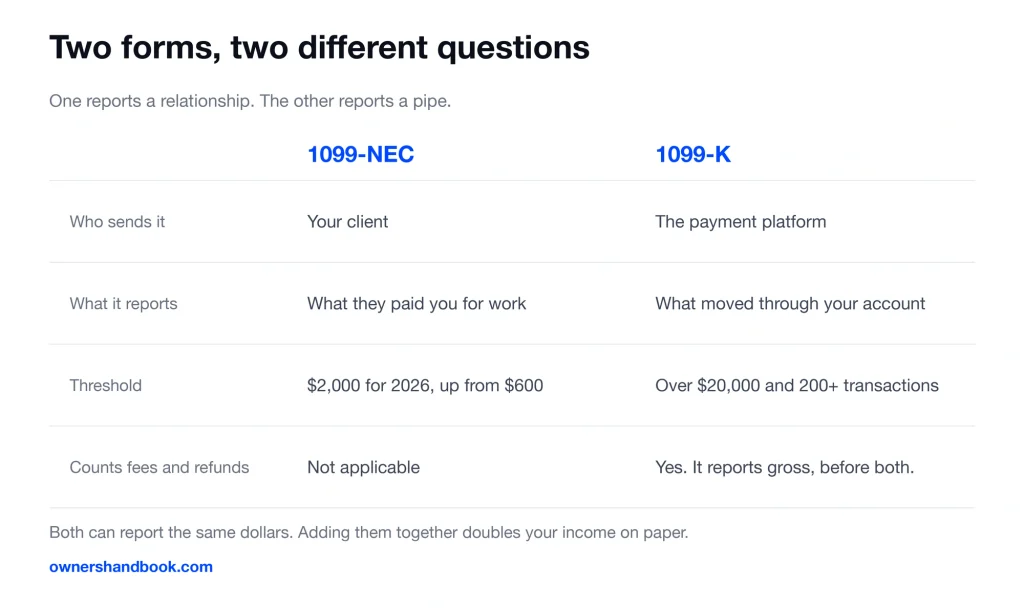
A 1099-NEC reports a relationship. Your client hired you, paid you $2,000 or more during 2026, and is telling the IRS about it. The form says: this person did work for us.
A 1099-K reports a pipe. PayPal, Stripe, Etsy, Venmo for business.
A client outside the US usually sends neither form. You still report the income, and what the transfer costs you depends entirely on the method, which is a separate subject in the guide to getting paid by overseas clients.
The platform is telling the IRS how much money moved through it. It has no idea whether that money was payment for work, a refund you processed, or three clients bundled together.
| The question | 1099-NEC | 1099-K |
|---|---|---|
| Who sends it to you | The client who hired you | The platform that moved the money |
| What the number means | What that one client paid you for work | Everything that passed through your account |
| When they have to send one | They paid you $2,000 or more in 2026 | Over $20,000 and more than 200 payments |
| Are fees and refunds taken out first | There are none to take out | No. The number is before both. |
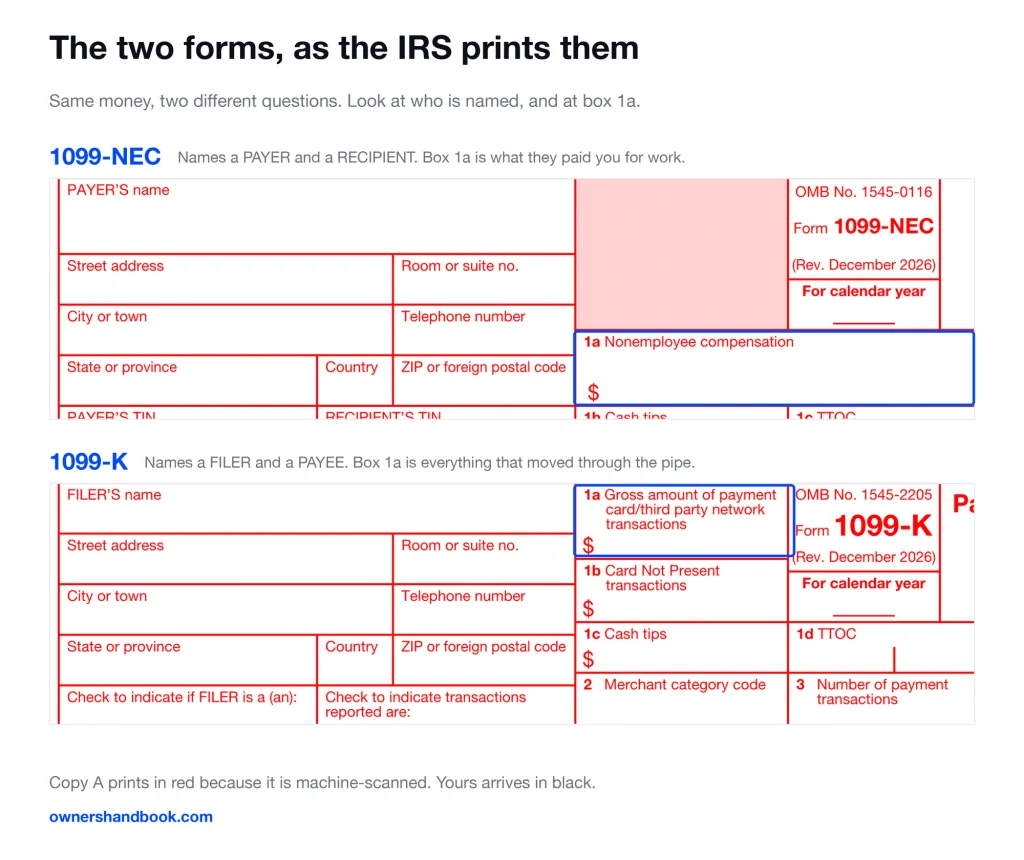
The NEC floor moved this year, and almost nothing online says so yet. It sat at $600 from 1954 until the end of 2025. For payments made from January 1, 2026 onward it is $2,000, and it gets adjusted for inflation after that.
One is about what you earned. The other is about what flowed.
The threshold went back up, and most articles have not caught up
This is the part worth reading twice.
For a few years the 1099-K threshold was heading toward $600, with no minimum number of transactions. That came from the American Rescue Plan Act of 2021.
The IRS then delayed it. Three times. $5,000 for 2024. $2,500 for 2025. And $600 was scheduled to finally land in 2026.
Then it was reversed. The One Big Beautiful Bill, the tax law passed in 2025, threw the $600 rule out and put the old one back.
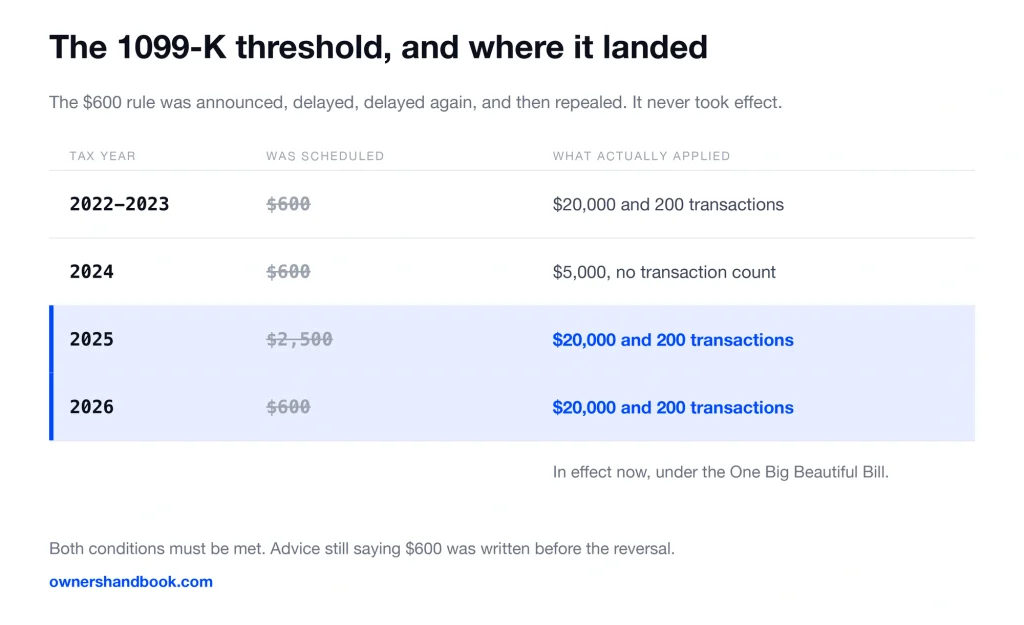
The threshold is back to more than $20,000 in payments and at least 200 transactions, for tax year 2025 and beyond.
| Tax year | Was scheduled | What actually applied |
|---|---|---|
| 2022-2023 | $600 | $20,000 and 200 transactions |
| 2024 | $600 | $5,000, no transaction count |
| 2025 | $2,500 | $20,000 and 200 transactions |
| 2026 | $600 | $20,000 and 200 transactions |
Both conditions have to be met. Twenty-five thousand dollars across 40 transactions does not trigger a 1099-K. Neither does 300 transactions totaling $8,000.
A great deal of the advice online still says $600. It was written while that was the plan and never updated.
If your income comes through a delivery, rideshare, or marketplace app, the form you get and the deduction that matters most both depend on which kind of gig work it is.
What this does not change
Your income is taxable whether or not a form reports it.
A higher threshold means fewer forms in the mail. It does not mean the money below it is invisible or optional. Someone who earns $12,000 through Stripe and receives no 1099-K owes exactly the same tax as someone who receives one.
Platforms can also issue forms below the federal threshold. Some states set lower thresholds and require reporting anyway, and some platforms simply send them to everyone because it is easier than tracking exceptions.
Why you can get both for the same money
Picture a $5,000 project. Your client sends payment through PayPal.
Your client sees: we paid this contractor $5,000. They issue a 1099-NEC.
PayPal sees: $5,000 moved through this account. If the account crosses $20,000 and 200 transactions for the year, PayPal issues a 1099-K that includes it.
Neither is wrong. They are describing the same money from two angles, and nobody coordinates between them.
The IRS knows this happens. What it wants on your return is your actual gross income, not the sum of every form you received.
What to do when the numbers do not match
Start from your own records, not from the forms.
Add up what you actually earned from your invoices or bookkeeping. That number goes on your Schedule C as gross receipts, the line for everything you took in before expenses.
Then reconcile. Take each form, find the payments it covers in your records, and confirm the overlap. Every dollar of difference should have a name.
Here is the arithmetic with real numbers.
Your books say $60,000. That is what you actually earned.
Stripe sends a 1099-K for $62,000. It is $2,000 higher because you refunded a client in March, and the form reports what came in, not what stayed.
Your biggest client sends a 1099-NEC for $18,000. That client paid you through Stripe, so those same dollars are already sitting inside the $62,000.
The forms add up to $80,000. You report $60,000, and you can explain the gap in two lines: $18,000 counted twice, $2,000 refunded.
Keep that reconciliation. You do not send it with your return. You want it if a letter arrives eighteen months later.
Two things commonly inflate a 1099-K beyond what you earned:
Refunds and chargebacks. A chargeback is when a customer disputes a payment and their bank pulls the money back out of your account. Most platforms report gross, before any of that came out.
Platform fees. If Stripe took 2.9% plus 30 cents, the 1099-K reports what the customer paid, not what landed in your account. On $60,000 spread across 60 invoices that is about $1,760 in fees. Real money, fully deductible, and invisible on the form.
What to do if a form is wrong
Contact whoever issued it and ask for a corrected form. That is the clean path, and if there is time before filing it is worth taking.
If a corrected form is not coming, you still report your actual income. Do not inflate your return to match a bad form. Keep the documentation showing why the numbers differ.
Never ignore a form you believe is wrong. The IRS received a copy. Silence looks like omission.
One more direction to think about. If you paid another freelancer $2,000 or more during 2026, you are the issuer, and a 1099-NEC is your obligation, not theirs.
If a form shows up after you already filed, check your return before you panic. If you reported what you actually earned and the form is the thing that is wrong, there is nothing to amend. You already reported correctly.
You only need Form 1040-X, the amended return, if the number you filed was itself wrong.
A note on personal payments
If someone reimburses you for dinner through Venmo, that is not income, and it should not be on a business 1099-K.
The way to keep it that way is separation. Use a personal account for personal transfers and a business account for business ones.
Mixing them is how a dinner reimbursement ends up on a form that reports business income. Untangling that in April is far more work than keeping two accounts.
Frequently asked questions
Do I report income if I never received a form?
Yes. Income is taxable regardless of whether anyone reported it. The form is a notification, not the thing that creates the obligation.
I got a 1099-K for under $20,000. Is it a mistake?
Probably not. Several states set their own thresholds below the federal one, and some platforms issue forms to everyone rather than track exceptions. Neither makes the form wrong. Report your actual income either way.
What if the same money appears on both forms?
Report it once. Keep a reconciliation showing which payments appear on which form.
Does a 1099-K mean I owe tax on the full amount?
No. It reports gross payments. Your taxable income is what remains after business expenses, including the platform fees the form did not subtract.
When do these forms arrive?
Issuers generally have until January 31 to send them. If one has not arrived by mid-February, ask.
What if I get a 1099-NEC for work I did not do?
Contact the issuer immediately. It may be an error or identity misuse, and both need addressing before you file.
Sources
IRS, Understanding Your Form 1099-K
https://www.irs.gov/businesses/understanding-your-form-1099-k
IRS, About Form 1099-NEC
https://www.irs.gov/forms-pubs/about-form-1099-nec
IRS, Form 1099-K Frequently Asked Questions
https://www.irs.gov/businesses/understanding-your-form-1099-k/form-1099-k-frequently-asked-questions
IRS, Reporting Payments to Independent Contractors
IRS, Schedule C