Washington Has No Income Tax. Freelancers Still Owe B&O.
Washington has no income tax on your freelance profit. It taxes your gross receipts instead, through the business and occupation tax — 1.5% on service work, with no deduction for what it cost you to earn the money.
On $90,000 of receipts that is $1,350, the same whether you cleared $60,000 or $5,000. A small business credit wipes that out for most freelancers. This is Washington state tax, sitting on top of United States federal tax.
What the B&O tax actually taxes
Every list of states with no income tax puts Washington on it. Every one of those lists is describing your personal return and stopping there.
Washington runs a second system for the business side, and a sole proprietor is a business.
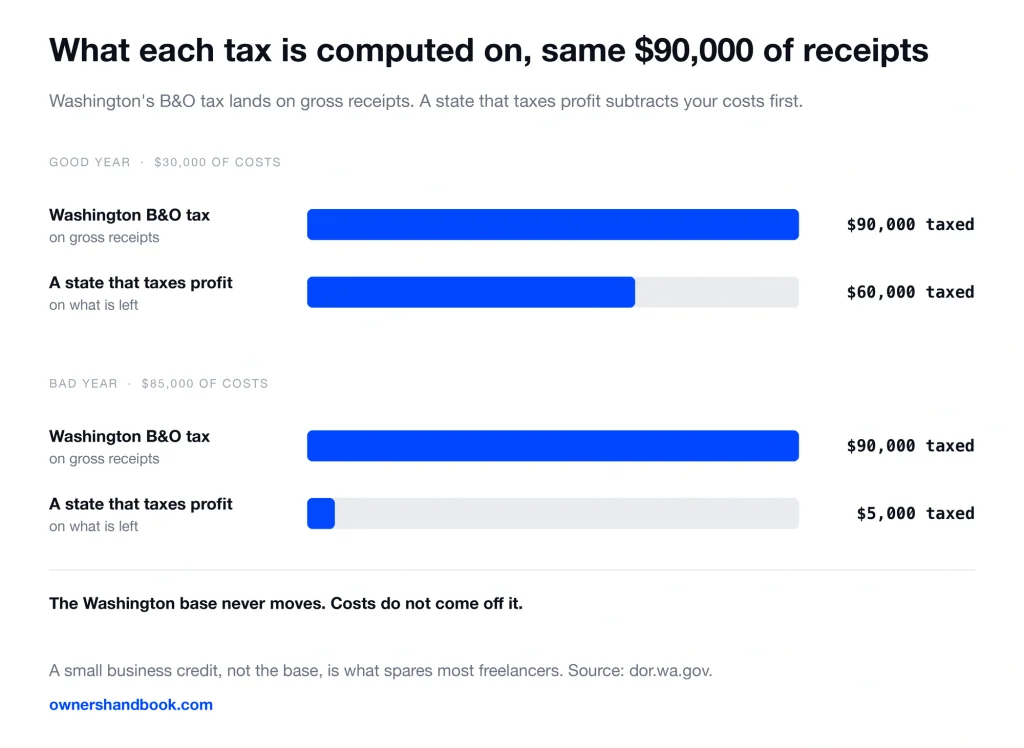
The B&O tax is charged on gross receipts — everything that came in, before you paid for anything. The Department of Revenue says it plainly: you cannot deduct labor, materials, taxes, or other costs of doing business.
That single sentence is the whole difference between this and an income tax.
An income tax state waits to see what is left. Washington charges on what arrived.
The same $90,000, three different years
Here is what that means when a year goes badly.
Say you invoice $90,000. In a good year your software, contractors, and travel come to $30,000, leaving $60,000 of profit.
In a bad year the same $90,000 of work costs you $85,000 to deliver. You cleared $5,000.
| Your year | Receipts | Costs | Washington taxes | A state taxing profit taxes |
|---|---|---|---|---|
| Good year | $90,000 | $30,000 | $90,000 | $60,000 |
| Slow year | $90,000 | $60,000 | $90,000 | $30,000 |
| Bad year | $90,000 | $85,000 | $90,000 | $5,000 |
The last column keeps shrinking as the year gets worse. Washington’s number does not move at all.
At 1.5%, all three of those years produce a B&O bill of $1,350 before credits. A state charging 5% on profit would want $3,000, $1,500, and $250.
So Washington is cheaper in a good year and more expensive in a bad one. That is what a gross receipts tax does.
Your rate depends on last year, not this year
Freelance services fall under the classification the Department of Revenue calls service and other activities. It has three rate tiers.
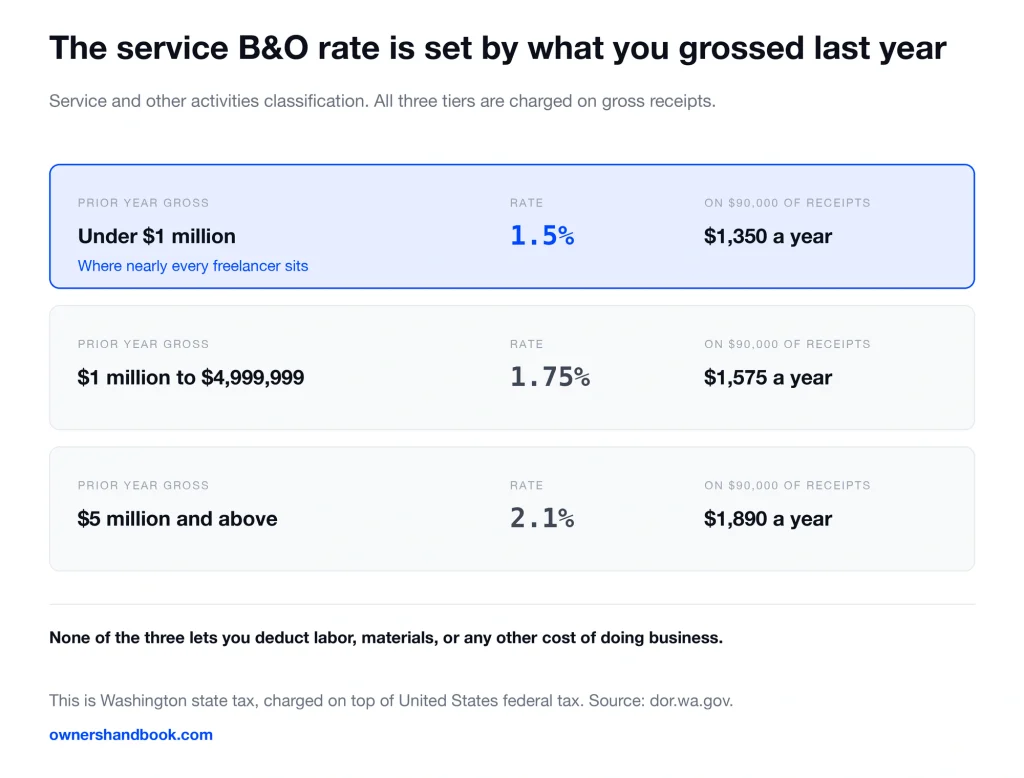
The tier is set by your gross income in the prior year, not the year you are reporting.
Under $1 million puts you at 1.5%. From $1 million to $4,999,999 it is 1.75%. At $5 million and above it is 2.1%.
You will be in the first tier. Use 1.5% for every calculation on this page.
The small business credit is why most freelancers owe nothing
Now the part the “no income tax” lists never get to, and the part that decides your actual bill.
Washington gives a small business B&O tax credit that shrinks as your tax grows. Below a ceiling, the credit equals your tax exactly, and you owe zero.
Which table you use depends on your mix. If half or more of your taxable income is reported under service and other activities, you get the larger one.
The ceiling depends on how often you file. Monthly filers are covered in full up to $160 of tax, quarterly filers to $480, annual filers to $1,920.
All three work out to the same place: $128,000 of annual gross receipts at 1.5%.
Below that, the credit and the tax cancel. Our $90,000 freelancer owes $0.
When you file electronically, Washington calculates the credit for you. You do not have to read the table yourself.
Above $128,000 the credit unwinds fast
Past the ceiling, the credit does not stop. It falls by a dollar for every extra dollar of tax, which is worse.
Gross $150,000 and your B&O tax is $2,250. The credit drops to $1,590. You owe $660.
Gross $256,000 and the credit hits zero. You owe the full $3,840.
| Gross receipts | B&O tax at 1.5% | Small business credit | You actually owe |
|---|---|---|---|
| $90,000 | $1,350 | $1,350 | $0 |
| $128,000 | $1,920 | $1,920 | $0 |
| $150,000 | $2,250 | $1,590 | $660 |
| $200,000 | $3,000 | $840 | $2,160 |
| $256,000 | $3,840 | $0 | $3,840 |
In that stretch every additional dollar you invoice costs three cents, not one and a half. You pay the tax on it and lose the same amount of credit.
One more trap for quarterly filers. The ceiling is per return, so a year where $150,000 arrives in a single quarter loses more credit than the same $150,000 spread evenly.
Under $125,000 you may not have to file at all
Washington has a status called active non-reporting. It means you are legitimately in business here and are not required to file returns.
For calendar years beginning January 1, 2023 or later, gross income under $125,000 a year qualifies you for B&O purposes.
Two conditions come with it. You cannot be collecting retail sales tax, and you cannot owe the Department of Revenue any other tax or fee.
If you do have a filing frequency assigned, you must file even in a quarter with no income. Washington calls that reporting no business activity, and there is an express file option that takes a minute.
A return you do not file is the expensive kind of mistake. A zero return costs nothing.
If you are above the line, the Department of Revenue picks your filing frequency from your expected annual tax liability.
At $1,050 or less you file annually. From $1,051 to $4,800 you file quarterly. Above $4,800 you file monthly.
Annual returns are due April 15. Quarterly returns are due at the end of the month after the quarter closes. Monthly returns are due the 25th.
None of those dates match the federal quarterly schedule, so keep them in the same calendar and do not assume one covers the other.
The business license comes first, at $12,000
Before any of this, there is a registration step.
You need a Washington business license once your gross income reaches $12,000 a year. Several other things trigger it too, including hiring, using a name other than your own, and collecting sales tax.
The processing fee to open a business is $50. Renewal runs $5 per location, and adding an endorsement later is $10.
That $12,000 floor sits far below the $125,000 point where returns start. Plenty of freelancers are required to be licensed and not required to file anything.
Some freelance services now collect sales tax too
This one is new and catches people who never thought about sales tax.
Effective October 1, 2025, Washington extended retail sales tax to a list of services that reads like a freelancer directory.
Advertising services. Information technology services. Custom website development. Live presentations, including webinars. Temporary staffing. Investigation and security services. Custom software and customizing prewritten software.
If your work is on that list, you are collecting tax from your clients and remitting it, which also disqualifies you from active non-reporting.
Check the current list before you assume your service is exempt. The categories are broader than their names suggest.
What Washington still does not charge you
None of this is an income tax, and the distinction is not just wording.
Your Schedule C profit is not taxed by Washington. Your deductions still matter enormously, because they cut your federal bill — self-employment tax at 15.3% plus income tax on top.
There is no Washington state quarterly estimated payment on your earnings, and no state return in April.
Washington does tax long term capital gains at 7% above a deduction that adjusts for inflation. That reaches investment sales, not invoices.
Compared with a state that taxes income at 5%, a Washington freelancer under $128,000 of receipts is paying a state business tax of exactly nothing. The obligation is the paperwork, not the money.
Frequently asked questions
Does Washington have a self-employment tax?
No. Self-employment tax is federal, 15.3%, and goes to the IRS through Schedule SE. Washington’s B&O tax is a separate state tax on your gross receipts.
I lost money this year. Do I still owe B&O tax?
Yes in principle, because the tax is on receipts and not profit. In practice, if your receipts were under $128,000 the small business credit reduces the bill to zero.
Do I need a business license if I only made $8,000 freelancing?
Not on the income trigger alone, which starts at $12,000 of annual gross income. Other conditions can still require one, such as using a business name that is not your legal name.
Can I deduct the B&O tax I pay?
On your federal return, yes. State business taxes and license fees are ordinary business expenses on Schedule C, unlike state income tax, which is not.
What if I live in Washington but all my clients are elsewhere?
The B&O tax follows where the business activity happens, not where the client sits. Working from a desk in Washington generally puts the receipts here.
Do I have to file a return in a quarter with no income?
If you have an assigned filing frequency, yes. File a no business activity return through express file or My DOR. Skipping it is what turns nothing owed into a penalty.
Sources
Washington Department of Revenue, Business & Occupation Tax
https://dor.wa.gov/taxes-rates/business-occupation-tax
Washington Department of Revenue, Business & Occupation Tax Classifications
https://dor.wa.gov/taxes-rates/business-occupation-tax/business-occupation-tax-classifications
Washington Department of Revenue, Credits (Small Business B&O Tax Credit)
https://dor.wa.gov/taxes-rates/tax-incentives/credits
Washington Department of Revenue, Annual Small Business Credit Table, REV 41 0058
https://dor.wa.gov/sites/default/files/2023-12/SBC_A_2023.pdf
Washington Department of Revenue, Quarterly Small Business Credit Table, REV 41 0057
https://dor.wa.gov/sites/default/files/2023-01/SBC_Quarterly_2023.pdf
Washington Department of Revenue, Monthly Small Business Credit Table, REV 41 0056
https://dor.wa.gov/sites/default/files/2023-01/SBC_Monthly_2023.pdf
Washington Department of Revenue, Active Non-Reporting Businesses
https://dor.wa.gov/file-pay-taxes/filing-frequencies-due-dates/active-non-reporting
Washington Department of Revenue, Report No Business Activity
https://dor.wa.gov/file-pay-taxes/report-no-business-activity
Washington Department of Revenue, Filing Frequencies & Due Dates
https://dor.wa.gov/file-pay-taxes/filing-frequencies-due-dates
Washington Department of Revenue, Apply for a Business License
https://dor.wa.gov/open-business/apply-business-license
Washington Department of Revenue, Variable Business License Processing Fees
https://dor.wa.gov/open-business/apply-business-license/variable-business-license-processing-fees
Washington Department of Revenue, Services Newly Subject to Retail Sales Tax
https://dor.wa.gov/taxes-rates/retail-sales-tax/services-newly-subject-retail-sales-tax
Washington Department of Revenue, Capital Gains Tax
https://dor.wa.gov/taxes-rates/other-taxes/capital-gains-tax
IRS, Self-Employment Tax