Maryland Adds a County Tax to Every Dollar You Earn
Maryland taxes your freelance profit twice on one return. The state takes a bracketed rate that lands at 4.75% for most self-employed people, and your county takes another 2.25% to 3.30% on top of it.
Every one of the 23 counties levies that second tax, and so does Baltimore City. There is no zero-rate county to move to.
On $90,000 of net profit a single freelancer owes Maryland roughly $5,344 in Worcester County and roughly $6,153 in Kent County. All of it sits on top of United States federal income tax and the 15.3% federal self-employment tax.
One return, two taxes
Maryland does not send you a separate county bill. The county income tax is computed on Form 502, the same resident return you use for the state, on Line 28.
Line 21 is your state tax. Line 28 is your local tax. Line 34 adds them and calls the result “Total Maryland and local tax.”
Both are income taxes on the same number. You multiply your Maryland taxable net income by your county’s rate and write it down. There is no second form, no second agency, and no second deadline.
That design is why the county rate is easy to forget. It never arrives as its own envelope.
Every county charges, and none charges zero
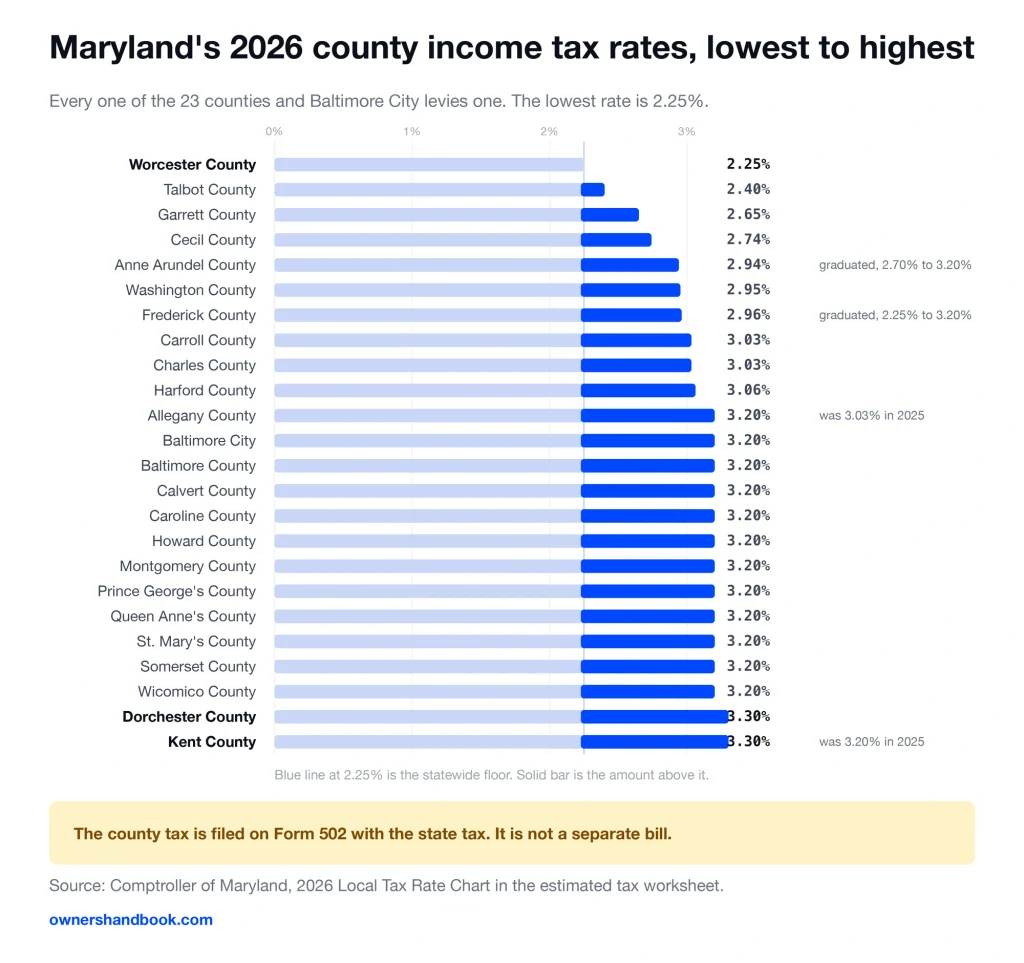
For tax year 2026 the local rates run from 2.25% in Worcester County to 3.30% in Dorchester and Kent Counties. The 2025 legislature raised the ceiling counties may charge from 3.20% to 3.30%.
Two counties moved for 2026. Allegany went from 3.03% to 3.20%, and Kent went from 3.20% to 3.30%.
| Where you live | 2026 local rate | Local tax on $77,092 |
|---|---|---|
| Worcester County | 2.25% | $1,735 |
| Talbot County | 2.40% | $1,850 |
| Garrett County | 2.65% | $2,043 |
| Cecil County | 2.74% | $2,112 |
| Washington County | 2.95% | $2,274 |
| Carroll and Charles Counties | 3.03% | $2,336 |
| Harford County | 3.06% | $2,359 |
| Baltimore City | 3.20% | $2,467 |
| Baltimore County | 3.20% | $2,467 |
| Montgomery County | 3.20% | $2,467 |
| Dorchester and Kent Counties | 3.30% | $2,544 |
Two counties do not use one flat rate. Anne Arundel and Frederick run graduated local brackets, so your rate there depends on your taxable net income rather than only on your address.
Nonresidents who owe Maryland tax on Maryland-source income pay a special nonresident rate of 2.25% instead of a county rate.
The state brackets underneath all of it
Maryland’s own rate schedule starts at 2% and climbs quickly through four small brackets before flattening out.
For a single filer, everything between $3,001 and $100,000 of taxable net income is taxed at $90 plus 4.75% of the excess over $3,000. Most freelancers spend their whole working life in that one bracket.
Above that, the rate steps to 5.00%, 5.25%, 5.50%, and 5.75%. The 2025 legislature added two more: 6.25% over $500,000 and 6.50% over $1,000,000 for single filers.
There is also a 2% surtax on net capital gains for anyone with federal adjusted gross income over $350,000. That one rarely touches Schedule C profit, which is ordinary income, not capital gain.
Maryland’s standard deduction for the 2026 estimated tax worksheet is $3,350 single and $6,700 joint. You also get a $3,200 personal exemption if your federal adjusted gross income is $100,000 or less.
$90,000 of profit, two counties
Start with $90,000 of net profit on your federal Schedule C — the form where your business income and expenses land.
Half of your federal self-employment tax comes off before Maryland sees anything, because Maryland starts from your federal adjusted gross income. That deduction is $6,358, leaving $83,642.
Subtract the $3,350 standard deduction and the $3,200 exemption. Your Maryland taxable net income is $77,092.
The state tax on that is $90 plus 4.75% of $74,092, or $3,609. That part is identical everywhere in Maryland.
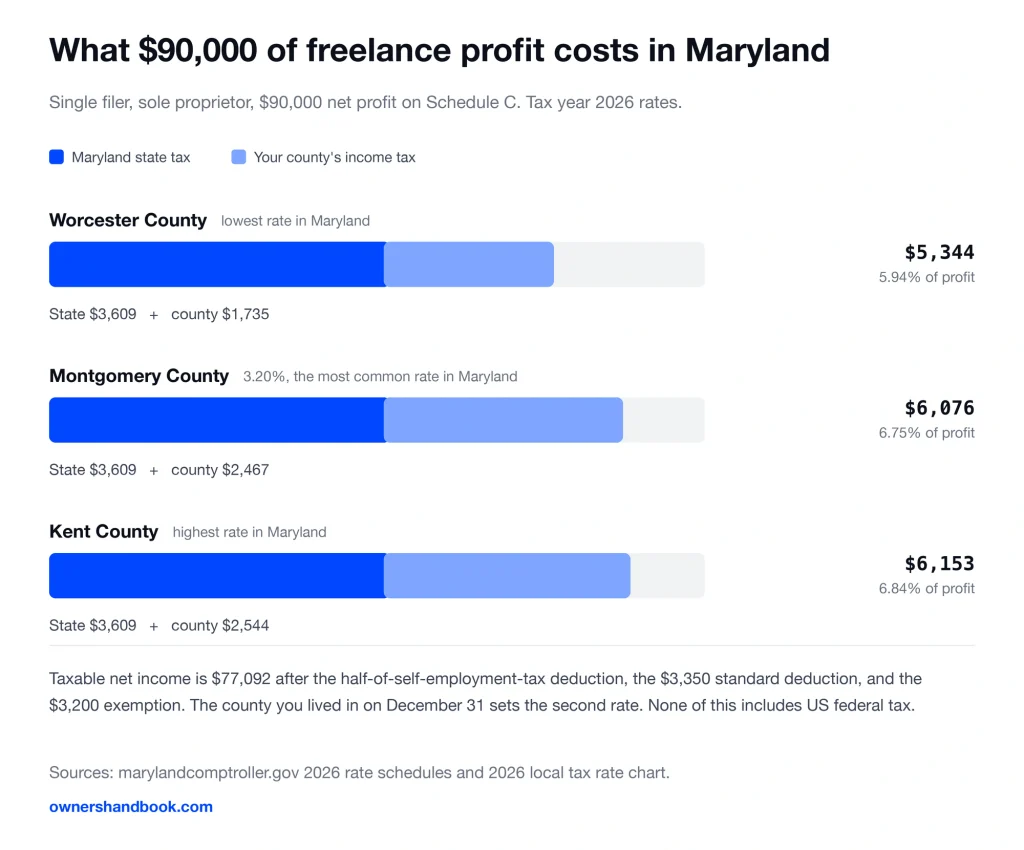
Now the county. Worcester takes 2.25%, which is $1,735. Kent takes 3.30%, which is $2,544.
| Where you lived on December 31 | Local rate | State tax | Local tax | Total to Maryland |
|---|---|---|---|---|
| Worcester County | 2.25% | $3,609 | $1,735 | $5,344 |
| Anne Arundel County | graduated | $3,609 | $2,147 | $5,756 |
| Montgomery County | 3.20% | $3,609 | $2,467 | $6,076 |
| Kent County | 3.30% | $3,609 | $2,544 | $6,153 |
The spread between the cheapest and the most expensive county is $809 on this profit. That is the entire cost of the address, and it repeats every year.
Your county is decided on December 31
Maryland assigns you to a taxing area based on your residence on the last day of the taxable period. Not where you earned the money, and not where you lived for most of the year.
Form 502 asks for a four-digit political subdivision code along with your physical address. Get it wrong and the state computes your local tax at the wrong rate.
The codes are finer than ZIP codes. Maryland’s instructions warn that most people with an Upper Marlboro ZIP code do not actually live in the Town of Upper Marlboro.
If you move across a county line in December, the December county is the one that taxes your whole year.
Maryland wants its own quarterly payments
Federal quarterly estimated taxes do not cover this. Maryland runs a parallel schedule and expects its own money.
You must file a declaration of estimated tax if you have to file a Maryland return and your income will produce more than $500 of tax beyond what Maryland withholding covers. For a freelancer with no withholding, that threshold arrives early.
Pay at least one-fourth of the total by April 15, 2026. The rest is due June 15, 2026, September 15, 2026, and January 15, 2027.
The payment voucher is Form PV. Box 1 on it is labeled “Estimated Payment/Quarterly (502D),” which is why the old 502D number still shows up in search results.
Instead of making the January payment, you may file your full 2026 return and pay the balance by January 31, 2027.
Maryland’s safe harbor is 110%, not 100%
A safe harbor is the amount you can pay in advance to be immune from an underpayment charge, no matter what you finally turn out to owe. Maryland’s is stricter than the federal one.
Federally, paying 100% of last year’s total tax protects you unless your prior-year income was high. Maryland does not offer the 100% version at all.
Maryland charges no interest if each quarterly payment equals at least one-fourth of 110% of last year’s tax, or if your payments reach 90% of this year’s tax.
There is also a floor. You generally owe no interest if you owe less than $500 of tax on income that was not subject to Maryland withholding.
Underpayment interest is computed on Form 502UP, and the result goes on Line 51 of Form 502.
Whether you have to file at all
Maryland has its own filing threshold, separate from the federal one, based on Maryland gross income.
For tax year 2025, the most recent published table, a single person under 65 must file at $15,750 of Maryland gross income. Joint filers file at $31,500 and heads of household at $23,625.
One line in the instructions matters more than the numbers. If deductions or modifications drop your income below the filing level, you still have to file.
So a freelancer who bills $40,000 and expenses it down to $12,000 of profit is still a Maryland filer.
What Maryland does not charge you
There is no Maryland self-employment tax. Social Security and Medicare are federal programs, and Schedule SE goes to the IRS alone.
Maryland also has no separate business income tax for sole proprietors. Your profit flows onto the same personal return everyone else files.
The state tax guide covers what other states do, and the quarterly estimated taxes guide covers the federal half. Maryland’s twist is that the second tax is unavoidable and built into the first return.
If you are unsure how to pay estimated taxes on both levels, the state takes card and bank payments through its own portal, and the IRS takes its own separately.
Frequently asked questions
Which county rate applies if I moved during 2026?
The county where you lived on the last day of the taxable period. Maryland uses your December 31 address to set the local rate for the entire year.
Can I avoid the county tax by living somewhere with no local income tax?
Not inside Maryland. All 23 counties and Baltimore City levy one, and the lowest rate for 2026 is Worcester County’s 2.25%.
Do I file a separate county return?
No. The local tax is computed on Line 28 of Form 502 and added to your state tax on Line 34 of the same return.
Is 3.30% really the maximum a county can charge?
Yes for tax years beginning after December 31, 2025. The 2025 Budget Reconciliation and Financing Act raised the cap from 3.20% to 3.30%.
What if my Maryland income is uneven across the year?
The 110% safe harbor is the simplest protection. Maryland also allows relief when income is received unevenly, described in Instruction 23 of the resident booklet.
Does the county tax apply to gross receipts or net profit?
Neither directly. Both the state and the county rate apply to your Maryland taxable net income, which is what remains after your business expenses, the standard deduction, and exemptions.
Sources
Comptroller of Maryland, 2025 Maryland Resident Income Tax Booklet, including the 2026 estimated tax worksheet, 2026 local tax rate chart, and 2026 rate schedules
https://www.marylandcomptroller.gov/content/dam/mdcomp/tax/instructions/2025/resident-booklet.pdf
Comptroller of Maryland, Maryland Tax Alert, Changes to Standard and Itemized Deductions and to State and Local Income Tax Rates from the 2025 Legislative Session, revised December 22, 2025
Comptroller of Maryland, Form 502, Maryland Resident Income Tax Return
https://www.marylandcomptroller.gov/content/dam/mdcomp/tax/forms/2025/502.pdf
Comptroller of Maryland, Form PV, Personal Tax Payment Voucher for Form 502/505, Estimated Tax and Extensions, tax year 2026
https://www.marylandcomptroller.gov/content/dam/mdcomp/tax/forms/2026/pv.pdf
Comptroller of Maryland, 2025 Tax Updates
https://www.marylandcomptroller.gov/individuals/2025-tax-updates.html
IRS, Self-Employment Tax