You Did Not Pay Estimated Taxes. Now What?
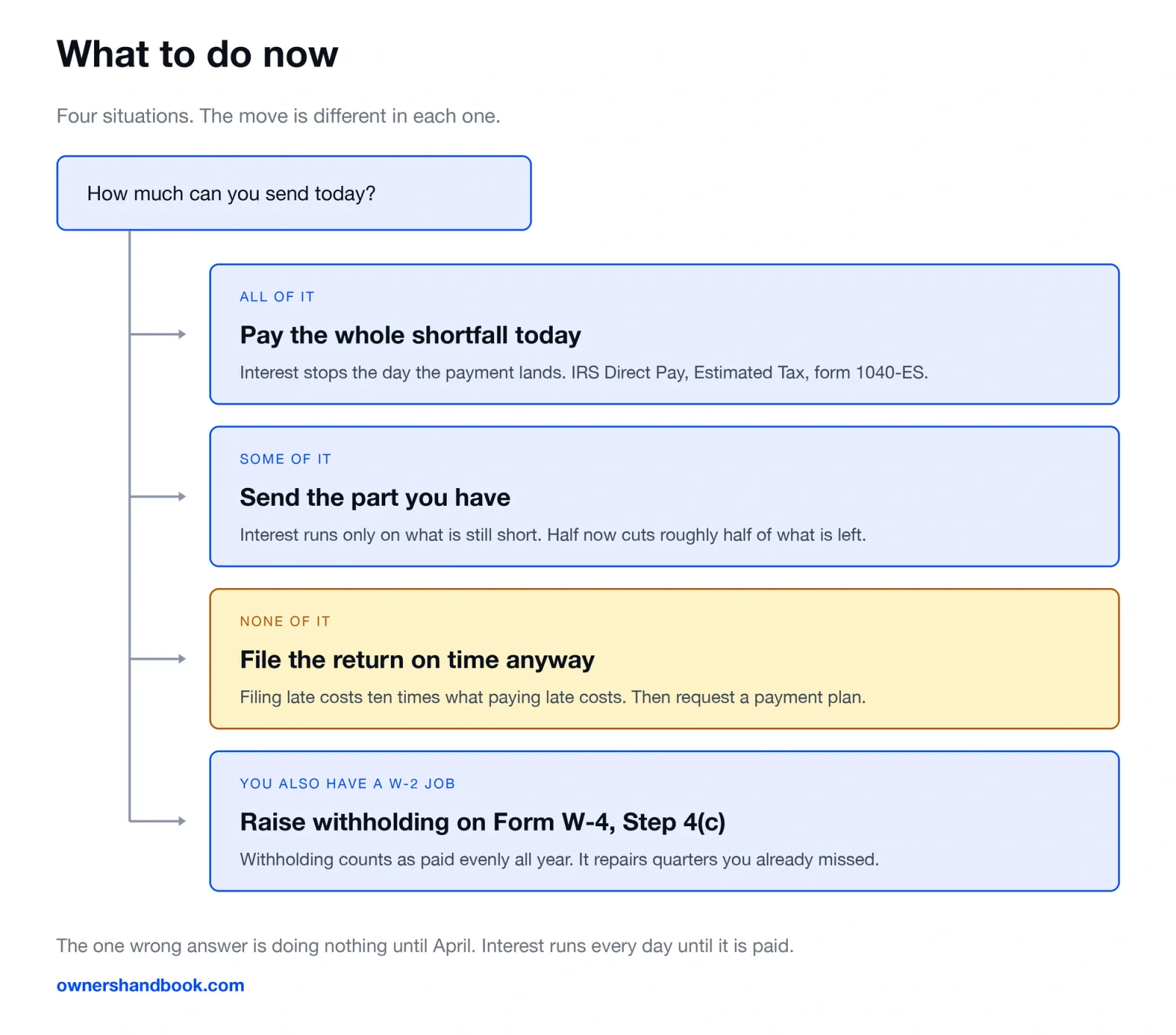
You owe interest, not a fine. The IRS charges the federal short-term rate plus three percentage points on whatever you were short, and only for the days you were short. Skipping all four payments on an $8,000 tax bill costs about $372. Send what you have today and that number gets smaller. And if you also draw a W-2 paycheck, raising your withholding right now can erase the quarters you already missed.
The charge is interest, not a fine
There is no flat penalty for missing an estimated payment. There is a charge that behaves exactly like interest on a loan, because that is what it is.
The rate is the federal short-term rate plus three percentage points. The IRS resets it every quarter and compounds it daily.
In 2026 it has run 7%, then 6%, then 7% again.
Here is what four missed payments actually cost. You should have sent $2,000 each quarter and you sent nothing.
| Payment you skipped | Days late as of April 15 | Interest at 7% |
|---|---|---|
| $2,000 due April 15 | 365 | $140 |
| $2,000 due June 15 | 304 | $117 |
| $2,000 due September 15 | 212 | $81 |
| $2,000 due January 15 | 90 | $35 |
| $8,000 skipped | About $372 |
Three hundred seventy-two dollars on $8,000 you never sent. Under 5%.
The $8,000 itself is still due, and that part does not shrink. But the punishment for being late is small enough that panic is the wrong response to it.
It is figured per payment, and that has two consequences
This is the part that surprises people, and it is the reason the arithmetic above is split into four rows rather than one.
The IRS states it directly: the penalty is figured separately for each installment due date, so you may owe it for an earlier due date even if you paid enough tax later to make up the underpayment. And then the sentence that catches everyone — this is true even if you are due a refund when you file.
A refund in April does not mean you were on time. It means you were short in June and generous in December, and the June shortfall was charging interest the whole way.
The second consequence is about how a catch-up payment lands. Your payments are applied first to any underpayment on an earlier installment, even if you designate them for a later period.
So sending a big payment in September does not clear September. It back-fills April first, then June, and September stays short. You are still better off sending it — the earlier days stop accruing either way — but do not expect the current quarter to come out clean.
There is also no cap here. Failure to pay stops at 25% of the unpaid tax. This one does not stop; it simply runs on the days.
Paying part of it now cuts the bill
The charge runs on the gap, not on what you were supposed to have paid. Close half the gap and you cut roughly half the interest still to come.
So the worst available move is waiting until April because you cannot cover the whole thing today.
Send $3,000 today against an $8,000 shortfall and every day after that accrues on $5,000 instead.
Use IRS Direct Pay. Choose Estimated Tax as the reason and 1040-ES as the form, then pick the current tax year and pay from a checking account.
There is no rule against making an estimated payment on a random Tuesday. The four dates are deadlines, not the only days the window is open.
One thing to check before you send anything. If you will owe less than $1,000 for the year after withholding and credits, there is no penalty at all.
If you have a W-2 job, you can still fix earlier quarters
This is the part that surprises people, and it is the most useful rule on this page.
Federal income tax withheld from a paycheck is treated as though one quarter of it was paid on each of the four due dates, no matter when it actually came out.
Estimated payments get no such treatment. They are credited on the day they land.
The consequence is strange and entirely in your favor. Withholding you set up in October reaches backward to April. An estimated payment made in October does not.
| Money you send | The date the IRS gives it | Can it repair a missed quarter? |
|---|---|---|
| Estimated payment | The day you paid it | No |
| Paycheck withholding | One quarter on each of the four due dates | Yes |
File a new Form W-4 with your employer and put a dollar amount on Step 4(c), the line labeled Extra withholding. That amount comes out of every remaining paycheck.
If you are $6,000 short with eight paychecks left, that is $750 each. The IRS Tax Withholding Estimator will produce the number for you.
On a joint return, a spouse’s withholding counts the same way. So does tax withheld from a retirement account distribution.
The deadline that still matters when you have no money
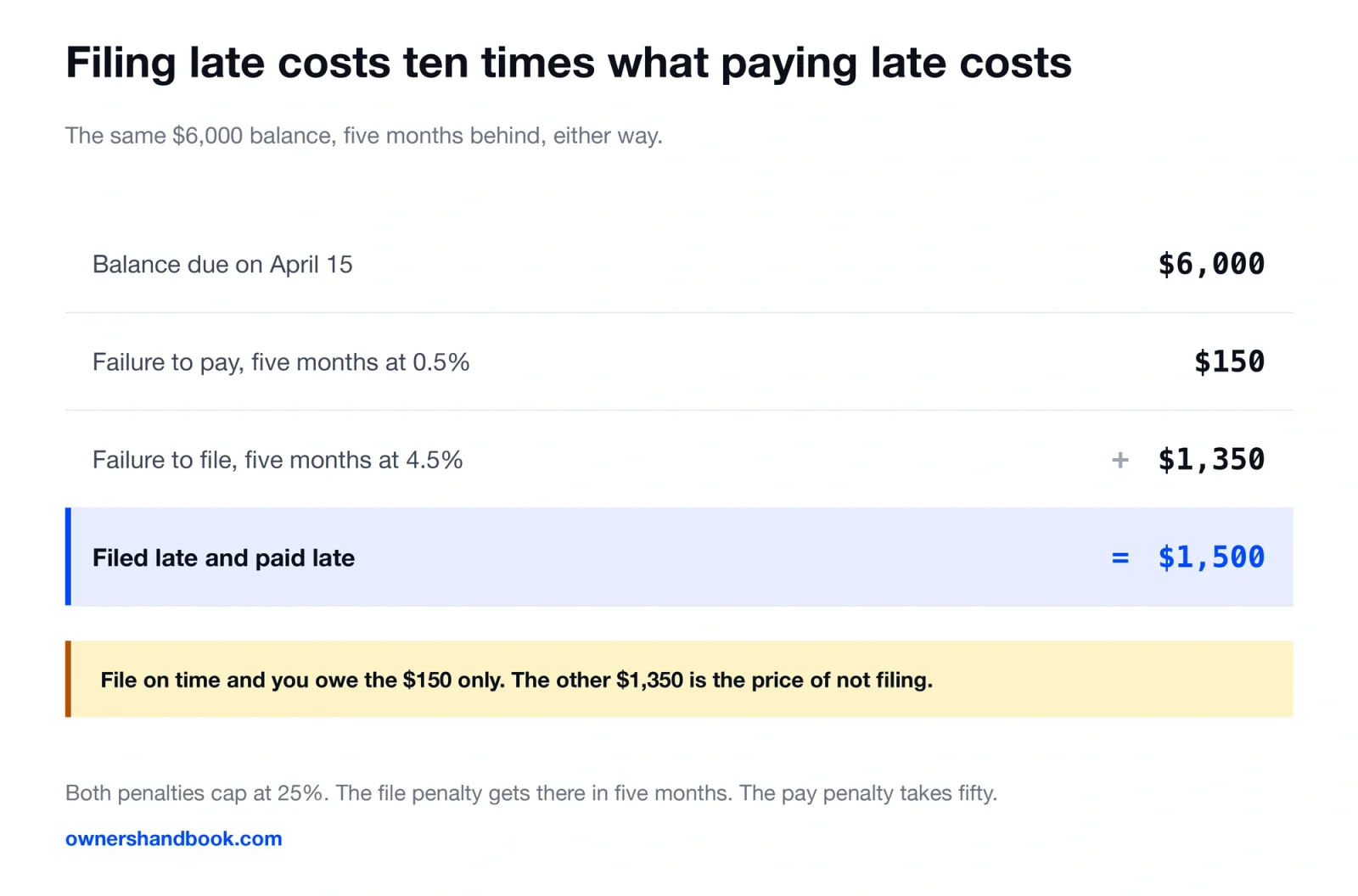
File the return on time even if you cannot send a dollar with it. The two penalties are not remotely the same size.
Failure to file is 5% of the unpaid tax for each month or part of a month it is late, capped at 25%.
Failure to pay is 0.5% for each month or part of a month, capped at that same 25%.
Ten times the rate, for a piece of paper you could have mailed.
On a $6,000 balance, being five months late on both runs about $1,500. Filing on time and paying five months late runs $150.
When both apply in the same month, the file penalty is reduced by the pay penalty, so it charges 4.5% rather than 5%. That is the only mercy in the arithmetic.
Two more numbers. File more than 60 days late and the minimum penalty is $525 or 100% of the unpaid tax, whichever is smaller.
And once you have an approved payment plan, the failure-to-pay rate drops from 0.5% to 0.25% a month.
If you cannot get the return finished, an extension on Form 4868 moves the filing deadline to October 15. It moves the filing deadline only. The tax is still due in April.
If you cannot pay the balance in April
The IRS will set up a payment plan online in about ten minutes, and nobody has to talk to you to approve it.
| Plan | You qualify if you owe | How long | Setup fee online |
|---|---|---|---|
| Short-term | Under $100,000 in tax, penalties and interest | 180 days or less | $0 |
| Long-term, direct debit | $50,000 or less | Monthly | $29 |
| Long-term, no direct debit | $50,000 or less | Monthly | $69 |
Applying by phone, mail, or in person costs $107 and $178 for those two long-term versions. Apply online.
The direct debit fee is waived for low-income applicants, meaning an adjusted gross income at or below 250% of the federal poverty level.
Form 9465 is the paper version of the same request. You need it if you owe more than $50,000, which also means attaching Form 433-F, a statement of what you earn and what you spend.
Interest keeps running the whole time. A payment plan is a schedule, not a discount.
When the penalty goes away
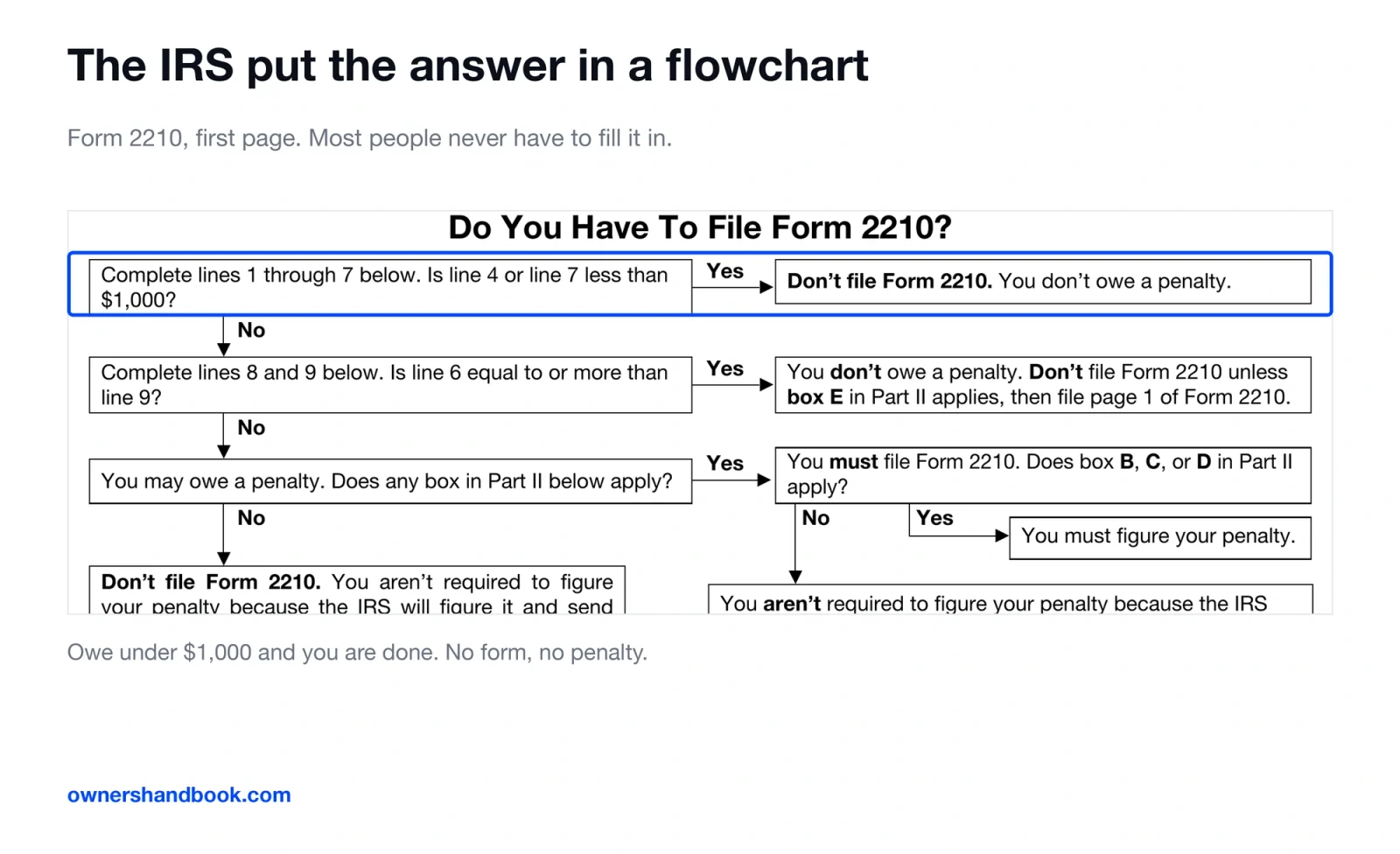
You do not have to compute any of this. Leave it alone and the IRS figures the underpayment penalty and sends you a bill.
Form 2210 exists for the cases where that automatic calculation comes out wrong in your favor. There are three.
Your income was seasonal. The annualized income installment method matches each payment to what you actually earned in that stretch of the year instead of splitting the year into four equal parts. It lives on Schedule AI, and it gets its own section below.
A casualty, a disaster, or another unusual circumstance stopped you from paying, and charging the penalty would be inequitable.
You retired after turning 62, or became disabled, during the tax year or the one before, and the underpayment was reasonable cause rather than willful neglect.
For those last two you check a box in Part II of Form 2210 and attach page one. You are not required to figure the waived amount yourself.
One relief that does not apply here. First Time Abate, the IRS waiver for a clean compliance record, covers failure to file and failure to pay. It explicitly excludes the estimated tax penalty.
Schedule AI, for the year that arrived all at once
The default calculation assumes your income came in evenly. For a freelancer it often did not, and that assumption is what manufactures the penalty.
Earn $8,000 in the first quarter and $90,000 in the fourth, and the standard method treats you as having underpaid April, June and September — on money you had not been paid yet.
Schedule AI recomputes each installment against income you had actually received by that point. Four periods, and they are not the quarters you would guess.
| Period | What it covers | Months | Annualized by |
|---|---|---|---|
| 1st | January 1 – March 31 | 3 | ×4 |
| 2nd | January 1 – May 31 | 5 | ×2.4 |
| 3rd | January 1 – August 31 | 8 | ×1.5 |
| 4th | January 1 – December 31 | 12 | ×1 |
Two things to notice. The periods are cumulative — each one starts again at January 1 rather than picking up where the last left off. And they are three, five, eight and twelve months, not three, six, nine and twelve.
Schedule AI also annualizes self-employment tax separately in Part II, which matters more than it sounds. For most freelancers self-employment tax is the largest single piece of an estimated payment, so a method that handled only income tax would miss most of the problem.
What it costs you. The IRS normally figures the underpayment penalty for you and you file nothing. Choose Schedule AI and that stops — you complete Schedule AI, Part III Section A, and the penalty worksheet, and file Form 2210 with your return.
More to the point, it requires your books closed at March 31, May 31, August 31 and December 31. Not approximately. Those are the figures the form runs on.
Who it does not help. Anyone with steady income — it will produce the same answer or a worse one. And anyone already inside the prior-year safe harbor, who has no penalty to reduce and no reason to do the work.
What to do for the rest of this year
Stop the bleeding first, then stop it happening again.
The next due date is January 15, 2027. A dollar sent on time there costs nothing extra. The same dollar sent in April carries three more months of interest.
There is also a published alternative to that January payment: file your return by February 1, 2027 and pay the whole balance with it, and the January 15 installment is not required at all. That is a good trade only if your records are already in order.
If you have a job, file the W-4 now rather than in December. More paychecks left means a smaller bite out of each one.
Then set next year up so this does not repeat. Pay 100% of this year’s total tax, split into four, and the penalty cannot reach you no matter what you end up earning.
That number sits on the line labeled total tax, near the bottom of page two of your Form 1040. If your adjusted gross income was over $150,000, or $75,000 filing married separately, the safe harbor is 110% of it instead.
Frequently asked questions
Will the IRS come after me for missing estimated payments?
No. Missing them is not an enforcement event. You settle up when you file, and the underpayment interest is added to your balance then.
Can I just pay everything in April instead?
You can. You will owe interest running from each missed due date to April 15, which on $8,000 of skipped payments is roughly $372.
Does one big payment now count for the quarters I already missed?
No. An estimated payment is credited on the day you make it. Only paycheck withholding is treated as paid evenly across the year.
What if I cannot pay anything at all by April 15?
File the return anyway and apply for a payment plan. Filing costs nothing, and not filing costs 5% a month, ten times the rate for paying late.
Do I have to fill out Form 2210?
Usually not. The IRS calculates the penalty and bills you. Use the form only to claim a waiver or to run the annualized method for seasonal income.
Does any of this apply to my state taxes?
Most states with an income tax run their own estimated payment schedule and their own interest charge. Fixing the federal side does not fix that one.
Sources
IRS, Topic 306: Penalty for Underpayment of Estimated Tax
https://www.irs.gov/taxtopics/tc306
IRS, Quarterly Interest Rates
https://www.irs.gov/payments/quarterly-interest-rates
IRS, Interest
https://www.irs.gov/payments/interest
IRS, Failure to File Penalty
https://www.irs.gov/payments/failure-to-file-penalty
IRS, Failure to Pay Penalty
https://www.irs.gov/payments/failure-to-pay-penalty
IRS, Instructions for Form 2210
https://www.irs.gov/instructions/i2210
IRS, Payment Plans and Installment Agreements
https://www.irs.gov/payments/payment-plans-installment-agreements
IRS, Instructions for Form 9465
https://www.irs.gov/instructions/i9465
IRS, Penalty Relief due to First Time Abate
https://www.irs.gov/payments/penalty-relief-due-to-first-time-abate-or-other-administrative-waiver
IRS, Get an Extension to File Your Tax Return
https://www.irs.gov/filing/get-an-extension-to-file-your-tax-return
IRS, Tax Withholding Estimator
https://www.irs.gov/individuals/tax-withholding-estimator
IRS, Direct Pay