App Developer Taxes: Your Payout Is Not Your Income
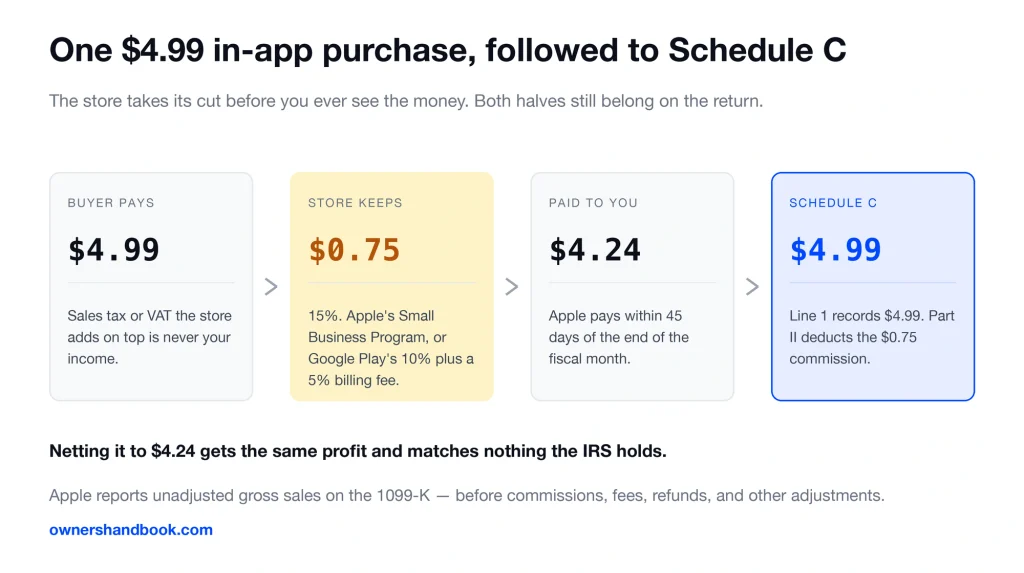
Apple deposits $27,200 and you earned $32,000. The $4,800 gap is Apple’s commission, and both numbers belong on Schedule C — the $32,000 as gross receipts on line 1, the $4,800 as a deduction below it.
Report only the deposit and your return will not match the 1099-K Apple already filed. Same profit, wrong paperwork, and that mismatch is what generates the letter.
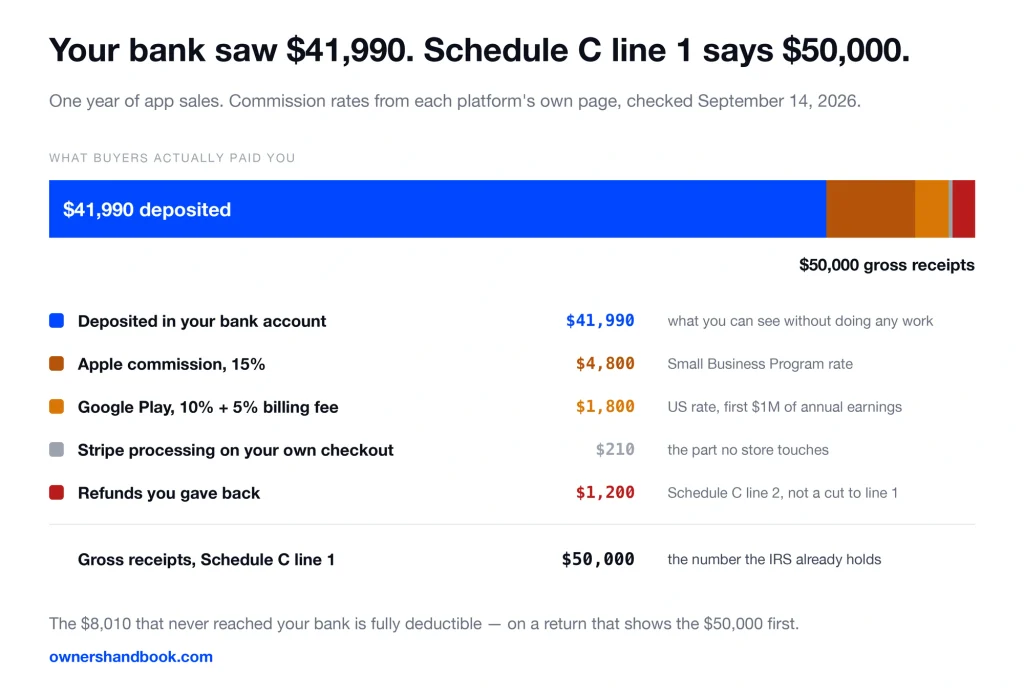
The number your bank shows is not your revenue
Gross receipts — what the buyer paid, not what landed in your account.
That distinction barely matters to an invoicing freelancer, because the invoice and the deposit are the same number. On an app store they are never the same number.
Apple tells you this in its own documentation. The 1099-K it issues reports your sales “unadjusted for Apple’s commissions, fees, refunds, and other adjustments.”
The IRS instructions for the form say the same thing in colder language. Box 1a is the gross amount “without regard to any adjustments for credits, cash equivalents, discount amounts, fees, refunded amounts, shipping amounts, or any other amounts.”
So the IRS holds a number your bank statement will never show. Your books have to produce it too.
The tax you owe does not change. Netting the commission gets you to the same profit — it just gets there in a way nobody can reconcile, and it quietly hides a deduction you were entitled to.
What each store actually keeps
Rates below were checked on each company’s own page on September 14, 2026.
Apple’s Small Business Program charges a reduced 15% on paid apps and in-app purchases. You qualify if you and your associated accounts made up to $1 million in proceeds in the prior calendar year.
Cross $1 million and the standard rate applies to future sales. For auto-renewing subscriptions Apple states you receive 70% during a subscriber’s first year, then 85% after a year of paid service.
Google Play changed its US structure on June 30, 2026, and it now depends on when the user installed your app.
| What the store keeps | Rate | On $50,000 of sales |
|---|---|---|
| Apple, Small Business Program | 15% | $7,500 |
| Apple, subscription, first year | 30% | $15,000 |
| Apple, subscription, after one year | 15% | $7,500 |
| Google Play US, first $1M | 10% + 5% billing fee | $7,500 |
| Google Play US, standard, existing installs | 25% + 5% billing fee | $15,000 |
| Google Play outside the US, first $1M | 15% | $7,500 |
Google’s 5% billing fee applies when the purchase runs through Google Play Billing, or on the initial purchase of a paid app. Outside the US the old 15% and 30% tiers still run.
Run $50,000 all the way down
One developer, one year. Thirty-two thousand through the App Store at the 15% small business rate, twelve thousand through Google Play at 10% plus the 5% billing fee, six thousand through their own Stripe checkout.
Commissions: $4,800 to Apple, $1,800 to Google, about $210 in Stripe processing. Refunds across the year came to $1,200.
Deposits totaled $41,990. Gross receipts were $50,000.
| Schedule C | What goes there | Amount |
|---|---|---|
| Line 1, gross receipts | What buyers paid, every store | $50,000 |
| Line 2, returns and allowances | Refunds and chargebacks | $1,200 |
| Part II, commissions and fees | Apple, Google, Stripe | $6,810 |
| Part II, everything else | Hosting, APIs, fees, a contractor | $8,696 |
| Line 31, net profit | The number you are taxed on | $33,294 |
Self-employment tax runs on 92.35% of that $33,294, at 15.3%. About $4,704, before any income tax.
The $8,010 that never reached your bank is fully deductible — but only on a return that showed the whole $50,000 first.
Which forms actually arrive
Apple issues a 1099-K to US developers whose unadjusted gross sales for the calendar year were at least $5,000. Apple also states plainly that it will not issue a 1099-MISC, because you are the seller of copyrighted works.
Stripe files a 1099-K when an account clears both federal tests: more than $20,000 in gross volume and more than 200 transactions. The IRS states the same threshold.
Google Play publishes no equivalent page on developer tax forms that I could find. Do not plan around a form arriving; your Play Console earnings reports are the record either way.
In the $50,000 example only Apple’s $32,000 gets reported. The forms add up to less than your income, and you still report all of it — the same rule that governs every gig platform.
Refunds and chargebacks land in the year they happen
You are almost certainly on the cash method, which means you report income actually or constructively received during the year.
A December sale refunded in February is income in the first year and a sales return in the second. You do not go back and amend.
Schedule C has a line for this. Line 2 is returns and allowances, and the instructions define a sales return as “a cash or credit refund you gave to customers.”
Chargebacks work the same way, plus the processor’s dispute fee, which is an ordinary business expense in the year it is charged.
Practical version: pull a full-year refund total from each platform before you file, and put it on line 2 rather than shaving it off line 1.
Sales tax may already be handled, or may not
This is the one place where the platform you chose decides whether you have an obligation at all.
Google states that for Play purchases in more than forty US states it is “responsible for determining, charging, and remitting sales tax,” and that you “don’t need to calculate and send sales tax separately.”
That is a marketplace facilitator doing your job, and it is the difference between having no obligation and having a real one.
Apple runs a tax calculation service that computes tax on customer transactions and reports it back to you in a transaction tax report.
A Stripe checkout on your own domain is different. Nobody is standing between you and the buyer, so the obligation is yours if a state’s threshold is crossed.
Stripe Tax will calculate tax and monitor where you are approaching registration, but registering and filing stay with you. The thresholds and which digital goods are taxable are their own subject.
Foreign buyers do not change that it is US income
A US person is taxed on worldwide income. A sale to a buyer in Berlin is ordinary gross receipts, converted to dollars.
The stores handle most foreign consumption taxes themselves. Google states that it determines, charges, and remits VAT for EU purchases, and that in India it deducts GST from your proceeds and remits it.
Sometimes the withholding is on you. Apple notes that a Nepal-based bank account has 5% advance income tax deducted by the local correspondent bank, and that Apple is not responsible for remitting it.
Foreign tax actually withheld from your income may become a foreign tax credit on Form 1116. Whether it does depends on the treaty and the type of tax, and that is a question for a professional, not a blog post.
The mechanics of getting foreign money into dollars without losing 8% to spread deserve their own read.
What you get to deduct
The Apple Developer Program is $99 a year. Google Play charges a $25 one-time registration fee. Both are ordinary business expenses.
Then the running costs: hosting, domains, API and model usage, error monitoring, analytics, design assets and icon licenses, and any test devices.
A contractor developer is deductible too, and if you paid one $2,000 or more during 2026 you owe them a 1099-NEC. That threshold rose from $600.
A home office and the hardware you write code on follow the general rules for deductions, not app-store rules. A machine at $2,500 or less is expensed outright under the de minimis safe harbor; a more expensive one is a depreciation decision you make on the return.
Section 174, and when to stop reading and call someone
Software development costs were, for four painful years, not immediately deductible. The Tax Cuts and Jobs Act required research and experimental expenditures to be capitalized and amortized over five years.
That changed. The One Big Beautiful Bill Act added section 174A.
The IRS revenue procedure implementing it states that 174A(a) allows “a deduction for any domestic research or experimental expenditures which are paid or incurred by the taxpayer during the taxable year.”
It applies to amounts paid or incurred in taxable years beginning after December 31, 2024. So domestic development costs in 2026 are deductible when paid.
Two catches. You may instead elect under 174A(c) to capitalize and amortize over not less than 60 months, and research attributable to foreign work still amortizes over 15 years.
Small business taxpayers — those meeting the section 448(c) gross receipts test, $31 million for a year beginning in 2025 — can elect to apply this retroactively to 2022 and amend.
If you paid a contractor overseas to build the thing, that is exactly the fact pattern that needs a CPA rather than a search result.
And when profit gets large and steady, the structure question arrives on its own. An LLC changes liability but not this math; an S corp election changes how the 15.3% applies, and it has a threshold worth checking before you elect.
Frequently asked questions
Apple paid me $27,200. Why would I write $32,000 anywhere?
Because Apple reported $32,000 to the IRS, unadjusted for its commission. Line 1 shows $32,000 and the $4,800 commission comes off as an expense. Your profit is identical.
Does Apple send a 1099-K?
Yes, to US developers with at least $5,000 of unadjusted gross sales for the calendar year, mailed by January 31. Apple does not issue a 1099-MISC.
I got no forms at all. Is the income still taxable?
Yes. Reporting thresholds govern the platform’s paperwork, not your obligation. Your own records are what you file from.
A customer refunded in January for a December purchase. Which year?
Income in December, sales return in January on line 2. The cash method reports what you received when you received it.
Do I have to collect sales tax on app store sales?
Generally not for App Store and Play purchases, where the store acts as the facilitator. A self-hosted Stripe checkout is a different answer and depends on state thresholds.
Can I deduct the year I spent building it before launch?
Domestic development costs paid in a tax year beginning after 2024 are deductible under section 174A. Startup costs before the business began operating follow separate rules — ask a professional.
Sources
Apple, App Store Small Business Program
https://developer.apple.com/app-store/small-business-program
Apple, Auto-renewable subscriptions (85% net revenue after one year)
https://developer.apple.com/app-store/subscriptions
Apple, App Store Connect Help — Manage invoices and other tax documents
Apple, App Store Connect Help — Overview of receiving payments
https://developer.apple.com/help/app-store-connect/getting-paid/overview-of-receiving-payments
Apple, App Store Connect Help — Set a tax category
https://developer.apple.com/help/app-store-connect/manage-app-information/set-a-tax-category
Apple, Developer Program enrollment fee
https://developer.apple.com/support/enrollment
Google Play Console Help, Service fees
https://support.google.com/googleplay/android-developer/answer/112622
Google Play Console Help, Tax rates and value-added tax (VAT)
https://support.google.com/googleplay/android-developer/answer/138000
Google Play Console Help, Register for a developer account
https://support.google.com/googleplay/android-developer/answer/6112435
Stripe, 1099-K forms issued by Stripe
https://support.stripe.com/questions/1099-k-forms-issued-by-stripe
Stripe, Stripe Tax documentation
IRS, Instructions for Form 1099-K
https://www.irs.gov/instructions/i1099k
IRS, Understanding your Form 1099-K
https://www.irs.gov/businesses/understanding-your-form-1099-k
IRS, What to do with Form 1099-K
https://www.irs.gov/businesses/what-to-do-with-form-1099-k
IRS, Instructions for Schedule C (Form 1040)
https://www.irs.gov/instructions/i1040sc
IRS, Revenue Procedure 2025-28 (section 174A)
https://www.irs.gov/pub/irs-drop/rp-25-28.pdf
IRS, Foreign Tax Credit
https://www.irs.gov/individuals/international-taxpayers/foreign-tax-credit
IRS, About Form 1116
https://www.irs.gov/forms-pubs/about-form-1116
IRS, Self-Employment Tax