Bookkeeping Yourself vs Hiring a CPA — What Each One Costs
Four ways to handle your books and your tax return. They run from $16 a year to about $2,500, and the cheapest one costs the most of your time.
Before the prices, the thing that decides more than they do: you cannot hand over all of it. Recording what happened stays your job in every one of the four.
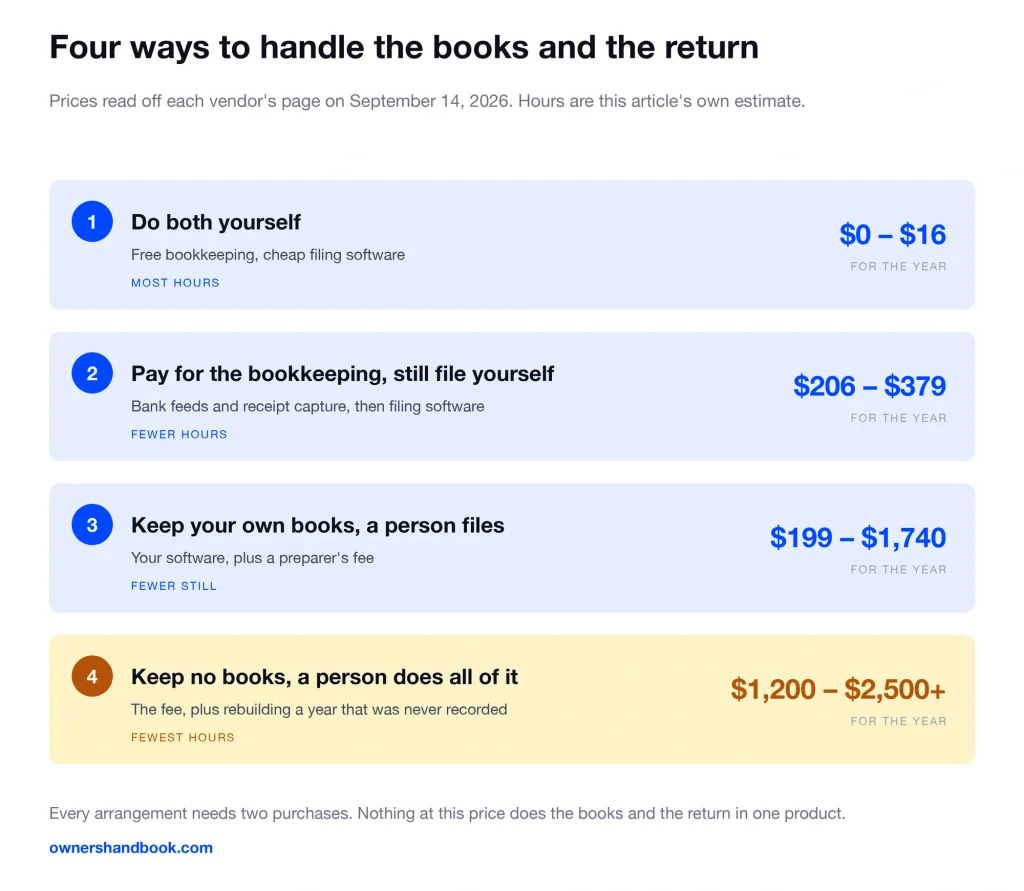
The four, side by side
| The arrangement | For the books you use | To file you use | For the year | Your hours |
|---|---|---|---|---|
| 1. Both yourself | free software, by hand | filing software | $0 to $16 | most |
| 2. Pay for the bookkeeping | bank feeds, receipt capture | filing software | $206 to $379 | fewer |
| 3. Your books, a person files | free or paid software | a preparer | $199 to $1,740 | fewer still |
| 4. Hand over everything | a firm rebuilds the year | a preparer | $1,200 to $2,500+ | fewest |
All four are two purchases. Nothing priced for a freelancer does both jobs in one product.
Prices came off each vendor’s page on September 14, 2026, and every one will be wrong eventually — six of six companies were running a promotion that day. Preparer fees move more. The IRS says they “vary extensively depending on the tax situation of the taxpayer, the type of software or professional preparer used, and the geographic location.” The hours are this article’s arithmetic, not an IRS figure.
1. Both yourself
Cost. $15.99 — Wave’s free tier plus FreeTaxUSA at $0 federal and $15.99 a state. Or $0 with Cash App Taxes, or IRS Free File if your adjusted gross income is $89,000 or less.
Hours. The most. Free means manual: Wave Starter has no bank import, no auto-categorisation, no receipt capture. Budget fifteen minutes a week.
Good at. Price, and keeping the file. In October you can open last year’s return, change the profit to what this year will really be, and watch the tax number move.
Fails at. The lines with no default answer — home office, vehicle, whether an S corp election pays, which state may tax work done elsewhere.
Fits. One Schedule C, one state, a couple hundred transactions, nothing bought over $2,500.
Do not pay the filing fee out of your refund. FreeTaxUSA charges $24.99 for that and TurboTax $40. Card is free at both.
2. Pay for the bookkeeping, still file yourself
Cost. $206 with Wave Pro and FreeTaxUSA. $379 if you buy both halves from Intuit — QuickBooks Solopreneur at $240 a year plus TurboTax Premium at $139.
Hours. Fewer. Bank feeds and auto-categorisation remove the typing, not the deciding.
Good at. Knowing where the year stands in June and who has not paid you. That is why you buy it, and it is not a tax reason.
Fails at. Arithmetic, if you buy it from Intuit. The identical Schedule C gets filed for $206, or $16 without bank feeds. There is no bundle discount for staying in one company.
Fits. Anyone invoicing regularly. And if you drive for work, QuickBooks is the only one here that tracks mileage — Wave has none at any tier.
3. Keep your own books, a person files
Cost. Your software at $0 to $240, plus a fee nobody publishes. Firms that will file a Schedule C list $199 (Keeper, federal plus two states), $1,000 (Pilot, single-member LLC), $1,500 (Bookkeeper360, business and personal). Same underlying return, and that spread is the point.
Hours. Fewer still. You record the year and hand over categorised totals in spring.
Good at. Judgment and representation. Attorneys, CPAs and enrolled agents can represent you before the IRS. Software cannot appear for you when a letter arrives.
Fails at. Timing. A preparer meets your year in February, when every decision inside it is already made.
Fits. Multi-state work, an S corp question, depreciation, or an IRS letter.
About the $199 end. Keeper buys a signature on a machine-prepared return, not an advisor — the dedicated accountant is $399. No mileage tracking, no corporate or S corp returns, and three or more states pushes you to $399. It is also not bookkeeping: income tracking is “Coming soon,” so it cannot produce a profit and loss statement. Your books still need a home.
4. Hand over everything
Cost. The fee, plus rebuilding a year nobody recorded. That rebuild is sold separately and priced: Bookkeeper360 lists prior bookkeeping at “starting at $1,000 per project”; Bench charges $55 an hour plus $1,200 onboarding, and offers payment plans “of up to 12 months – interest free.”
Nobody finances a $300 charge over twelve months.
Hours. The fewest, but not zero. A bookkeeper rebuilding your year has to ask you what forty ambiguous transactions were, and that interview lands as an interruption on a deadline.
Good at. Buying back five to eight hours of your own organizing, for about $1,000. Above a personal rate of roughly $125 to $200 an hour that is defensible.
Fails at. Value below that rate. You are paying someone else’s hourly rate for work you could have done at your own.
Fits. One case — a first year so small there is almost nothing to record. Past that it is a convenience purchase, and an honest one.
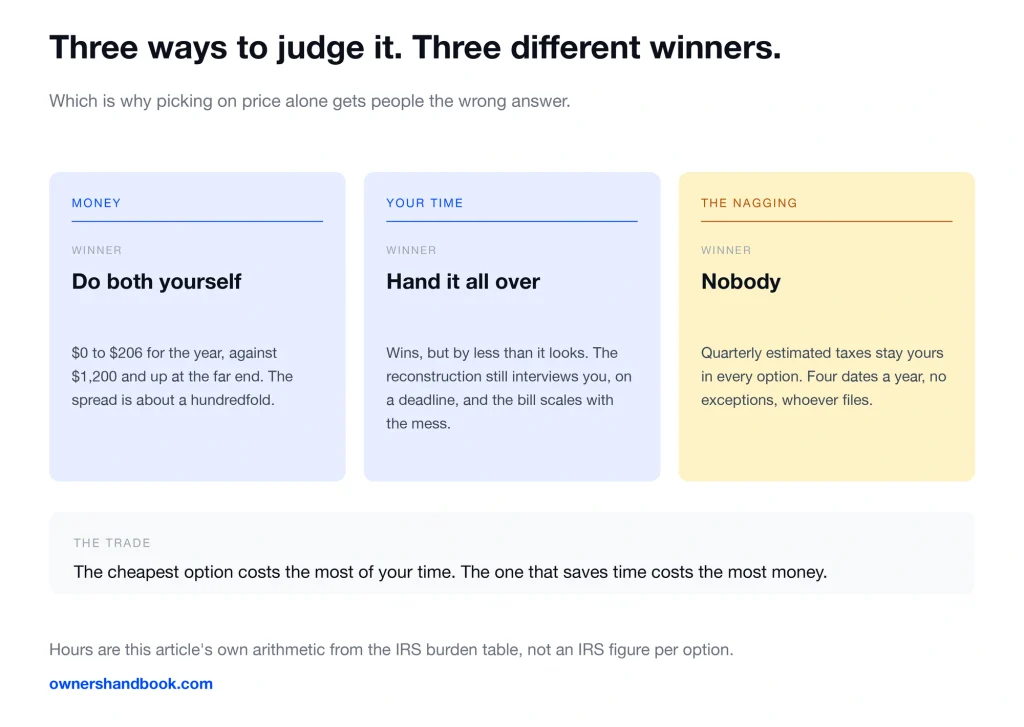
Three ways to judge it, three different winners
Money. Number 1, and not close. About a hundredfold from cheapest to dearest.
Your hours. Number 4, but by less than the table suggests, for the reason above.
The nagging. Nobody. Quarterly estimated taxes are yours in all four — four dates a year, no exceptions, whoever files.
That last one is worth separating from raw hours. Ten minutes of receipts every week is fewer total hours than one brutal April weekend, but you carry it all year. Number 4 is the lightest for eleven months and then concentrates into a fortnight with a deadline and a bill that scales with the mess. Some people would rather have the bad fortnight. That is a preference, not a mistake.
Why you can never hand over all of it
The work is three things, not two. Capture is writing down what happened. Organize is turning it into reconciled books. File is turning books into a return.
You can buy your way out of organizing and filing. Capture is yours in all four.
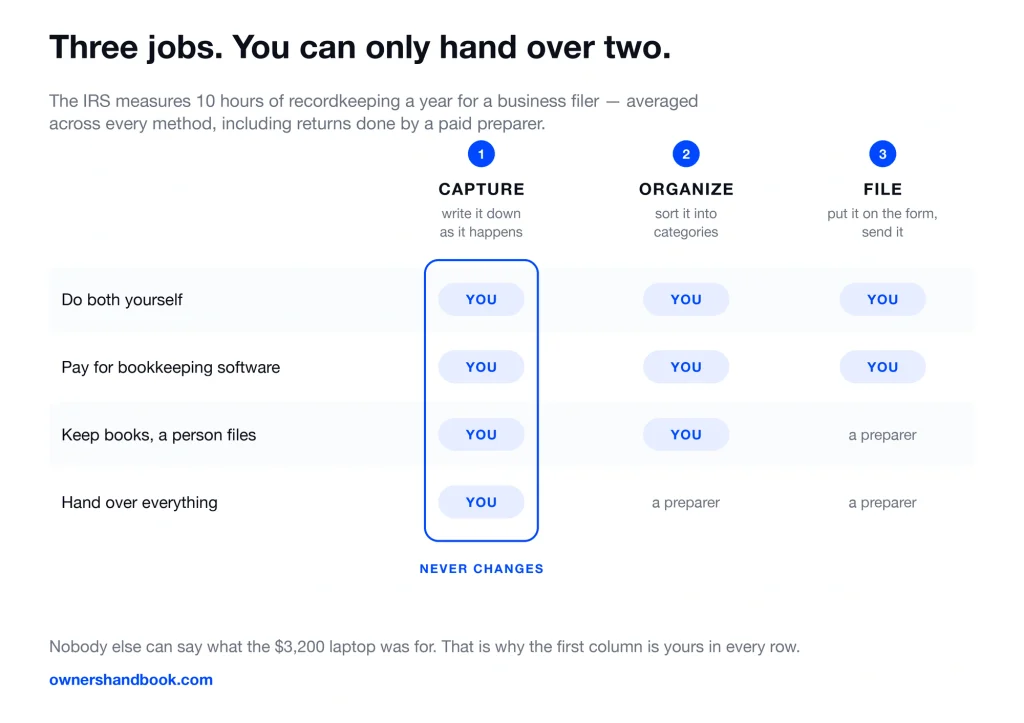
The IRS’s numbers show it. A business filer spends about 21 hours a year and 10 are recordkeeping, and the instructions say that average covers “all associated forms and schedules, across all tax return preparation methods.” Every return filed by a paid preparer is inside that average, and the recordkeeping hours are still there.
There is a sharper reason. Your preparer does not have to check your numbers. Circular 230 §10.34(d): a practitioner “generally may rely in good faith without verification upon information furnished by the client.”
So hiring someone raises the stakes on your records rather than lowering them. Between your spreadsheet and the filed return, nobody is checking.
Form 1040 makes it official. You declare, under penalties of perjury, that the return is “true, correct, and complete.” The preparer declares only that their part “is based on all information of which preparer has any knowledge.” Two oaths, one line, not the same oath. Tax Topic 254 puts it plainly: “Although the tax return preparer always signs the return, you’re ultimately accountable for the accuracy of every item reported on your return.”
What you actually hand over
Not a shoebox. Schedule C Part II is about twenty category lines, each taking one number, totalled on line 28. The IRS’s own preparer intake form asks the Schedule C client for one figure on one line: “Schedule C expenses $.”
Receipts are not for the preparer. They are what you produce years later if the return is examined.
| The step | What it means on a Tuesday in March | Can someone else do it? |
|---|---|---|
| 1. Capture | Photograph the receipt. Log the drive. Write down that the $3,200 laptop is 80% for work. | No. Only you were there. |
| 2. Organize | File that receipt under Supplies. Match the month against the bank statement. | Yes — software, or a bookkeeper |
| 3. File | Carry about twenty totals onto Schedule C, sign it, send it. | Yes — software, or a preparer |
Four record rules that apply whichever you picked
A bank statement is not enough. Publication 583, under a caution icon: “Proof of payment of an amount, by itself, does not establish you are entitled to a tax deduction.” It proves you paid a merchant, not that it was business. Business purpose is the element only you hold.
Under $75 excuses the receipt, not the record. You still need the entry showing amount, time, place and business purpose. Lodging needs a receipt at any amount.
Travel, gifts and vehicles get no estimates. Most expenses have a fallback — a court may approximate where it is satisfied you spent something deductible. Regulation 1.274-5T removes that for these three, saying section 274(d) “supersedes the doctrine found in Cohan.” Drive 14,000 business miles with nothing written down and the deduction does not shrink. It disappears. At the 2025 rate, roughly $9,800.
Computers are no longer listed property, for anything placed in service after 2017. Older articles still get this wrong. Your laptop is an ordinary expense. Your car is not.
And the mileage log is looser than you were told. Regulation 1.274-5T: “A contemporaneous log is not required.” Rebuild it later and your corroboration must carry “a high degree of probative value” instead. Weekly counts as timely — the same regulation says a log kept weekly “shall be considered a record made at or near the time of such use.”
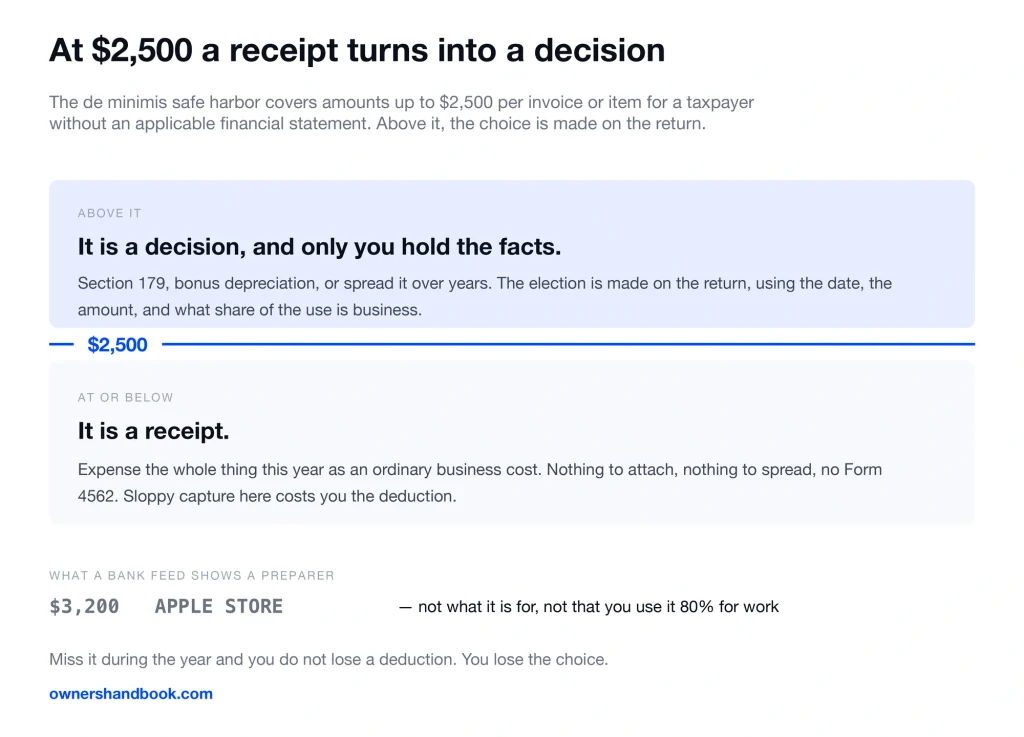
At $2,500 a receipt becomes a decision
Below the line, equipment is an expense — deduct it all this year, nothing attaches, no Form 4562. The de minimis safe harbor covers “amounts up to $2,500 per invoice or item.”
Above it you choose between Section 179, bonus depreciation, and spreading it over years, on the return, using the purchase date, the amount, and the business-use share.
A bank feed shows a preparer $3,200 and a store name. It cannot say the machine is for work or that you use it 80% for work. Miss that during the year and you do not lose a deduction. You lose the choice.
The trap inside the rule makes the article’s whole point. The IRS requires the amounts be expensed “in accordance with a consistent accounting procedure or policy existing at the beginning of the taxable year.” A preparer meeting you in April cannot create that retroactively.
Others lock the same way. Standard mileage must be chosen the first year the car is used for business — “you can’t revoke the choice.” The simplified home office method, “once made, is irrevocable.” A solo 401(k) can be adopted after year end, but the employee deferral “must be elected by the end of the tax year.”
Nobody sells both halves at a freelancer price
Intuit says it on its own page: “Tax preparation or filing services are not included in either Expert Assisted or Expert Full Service Bookkeeping, but are available to be purchased separately via Intuit Expert Assisted Business Tax, powered by TurboTax.”
The one company selling both still sells them twice. Wave, FreshBooks and Xero do not file at all. Found generates a Schedule C and makes quarterly federal payments, and still does not file.
Products that do both are priced for larger businesses — Collective at $2,388 a year, Bench at $5,750. Between the poles, two publish no price: FlyFin says pricing is “in the latest version of the app,” and 1-800Accountant’s page would not load.
So every product that keeps books and files a return either costs over $2,000 a year or refuses to publish a price. At freelancer prices, you buy two things.
One note on the free filer, because its name tells you nothing. Cash App Taxes is the former Credit Karma Tax. When Intuit bought Credit Karma for $7.1 billion, the Justice Department made it sell the tax business to Square, now Block, so a free competitor to TurboTax would survive — that is in the court record. Block also owns Square and the Cash App payments app, so the name is a brand rather than a description. It is genuinely $0 for federal and state, its own page states it is an Authorized IRS e-file provider, and it supports Schedule C, Schedule SE, depreciation, home office and QBI. Two limits: you must install the Cash App mobile app to create an account, though filing then works in a browser, and it will not file multiple states, a part-year state, or a non-resident return. Its accuracy and refund guarantees pay out in gift cards rather than money, capped at $1,000 and $100.
If you earn well, the answer changes for a different reason
The obvious argument is that your time is expensive. That argument weakens as income rises, because the time saved is fixed — filing takes about five hours whether you make $60,000 or $400,000.
What scales is the decisions.
Cross $150,000 of prior-year adjusted gross income and your safe harbor becomes 110% of last year’s tax instead of 100%. Nothing on this page changes at a sharper edge.
Fund a solo 401(k) and you meet a circular calculation: the employer share is 25% of compensation, but for a sole proprietor compensation means net earnings after deducting both half your self-employment tax and the contribution itself. The IRS routes you to worksheets rather than a formula. The 2026 deferral is $24,500 and total additions cap at $72,000.
The industry marks the transition better than any income number. Bookkeeper360 prices business tax at “starting at $1,000 per year” and planning and strategy at “starting at $1,200 per year.” The moment you need the second line rather than the first, you have left all four.
Which one is you
| If this is you | Which of the four |
|---|---|
| AGI $89,000 or less, evenings free | IRS Free File, $0 |
| One Schedule C, one state, nothing over $2,500 | 1, at $15.99 |
| You invoice regularly and need to know who has paid | 2 — buy it for that, not for tax |
| You drive to clients | 2, QuickBooks. It is the only one with mileage |
| You want a signature and cannot justify four figures | 3, Keeper at $199, books still elsewhere |
| Multi-state, S corp question, depreciation, IRS letter | 3, a real person. Floor $750 to $1,000 |
| It is March and you have no books | 4, or rebuild it yourself first and pay your own rate |
Two things no arrangement fixes. Anything over $2,500 is a decision, not a receipt — capture the date, amount and business-use share now. And if your AGI is over $150,000, your safe harbor is 110%.
How to get a real fee quote in fifteen minutes
No national fee schedule is published. The NSA and NATP surveys are members-only.
The IRS number people quote is not what they think. That $610 is out-of-pocket cost for a business filer, defined by the IRS as including “tax return preparation and submission fees, postage and photocopying costs, and tax return preparation software costs.” It averages in every self-filer paying $15.99. It is not a preparer fee, and the IRS adds that “most taxpayers experience lower than average burden.”
Get your own instead. Call three local preparers. Ask for a flat quote on a 1040 with one Schedule C and one state return. Say whether your books are in software or a folder. Ask whether billing is per form, hourly or flat — that question separates a $400 quote from a $900 invoice. Ask what would push it higher. Confirm the state return is in scope.
Then check the PTIN in the IRS directory before handing anything over.
When you call, these are the eight things that actually move the number. Count how many of your answers sit in the right-hand column — that, more than your zip code, is why one person pays $400 and another pays $900 for the same form.
| What they will ask you | Cheaper answer | Costs more |
|---|---|---|
| How many states do you file in? | One | Two or more |
| What shape are the books in? | Reconciled in software | A folder, or nothing |
| How do you claim the car? | Standard mileage | Actual expenses |
| Did you buy anything over $2,500? | No | Yes, so depreciation or Section 179 |
| Do you hold inventory? | No, services only | Yes |
| Is the S corp question settled? | Sole proprietor, no question open | Still deciding |
| Any trouble in prior years? | Clean | An amendment, or an IRS notice |
| When are you filing? | Before March | Late, or on extension |
Frequently asked questions
Do I have to give my accountant my receipts?
No, and most do not want them. They need categorised totals — the roughly twenty numbers on Schedule C Part II. Receipts stay with you, because they are what substantiates the return if it is examined years later.
Is a photo of a receipt good enough for the IRS?
Digitising is permitted under conditions. Revenue Procedure 97-22 requires an indexing system, controls for integrity and accuracy, legible reproduction, and an audit trail cross-referencing images to your books. A camera roll has none of that. An app that indexes receipts and links them to ledger entries is much closer.
The IRS never mentions thermal paper, but it does require records you can still read years later, and a faded receipt fails that on its own terms.
How long do I keep all this?
Three years by default. Six if you left out more than 25% of gross income, and no limit for a fraudulent return or a year you never filed. Property records run longer — keep them until the limitations period expires for the year you dispose of the asset.
Can my accountant pay my quarterly taxes for me?
Partly. Up to four Form 1040-ES payments can be scheduled alongside an e-filed return, including when a professional files it. But you authorise the transfer from your own account, and scheduled payments do not adjust themselves. Land a large contract in July and nobody recalculates. The penalty accrues by period, so paying in full next April does not undo it.
Is 3 better than 4?
On money, 3 wins by about $1,000 — the published floor for reconstruction. On time, 4 wins by five to eight hours. Divide and you are paying north of $125 an hour for the convenience. That is a real purchase if your hours are worth more than that.
Sources
IRS, Instructions for Form 1040 (2025)
https://www.irs.gov/pub/irs-pdf/i1040gi.pdf
IRS, Publication 583, Starting a Business and Keeping Records
https://www.irs.gov/pub/irs-pdf/p583.pdf
IRS, Publication 463, Travel, Gift, and Car Expenses
https://www.irs.gov/pub/irs-pdf/p463.pdf
IRS, Publication 946, How To Depreciate Property
https://www.irs.gov/pub/irs-pdf/p946.pdf
IRS, Publication 587, Business Use of Your Home
https://www.irs.gov/pub/irs-pdf/p587.pdf
IRS, Form 1040-ES, Estimated Tax for Individuals
https://www.irs.gov/pub/irs-pdf/f1040es.pdf
IRS, Tangible Property Final Regulations
https://www.irs.gov/businesses/small-businesses-self-employed/tangible-property-final-regulations
IRS, Tax Topic 254, How to choose a tax return preparer
https://www.irs.gov/taxtopics/tc254
IRS, Treasury Department Circular No. 230
https://www.irs.gov/pub/irs-pdf/pcir230.pdf
IRS, Revenue Procedure 97-22
https://www.irs.gov/pub/irs-irbs/irb97-13.pdf
IRS, Free File
https://www.irs.gov/filing/irs-free-file-do-your-taxes-for-free
Intuit, QuickBooks Live
https://quickbooks.intuit.com/live
Wave, Pricing
https://www.waveapps.com/pricing
Keeper, Pricing
https://www.keepertax.com/pricing
Bookkeeper360, Pricing
https://www.bookkeeper360.com/pricing
Bench, Pricing