Taxes for YouTubers, Streamers, and Influencers
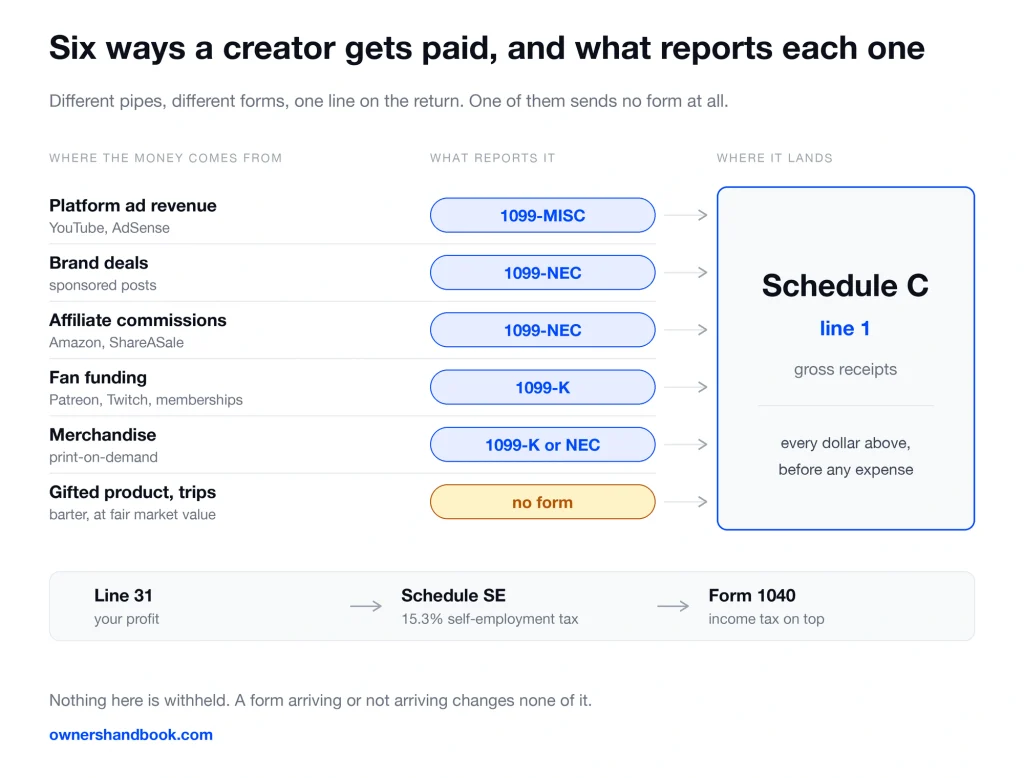
A creator’s money arrives through six different pipes, and only some of them send a form. Ad revenue, brand deals, affiliate links, fan funding, merchandise, and free product. All six are taxable income.
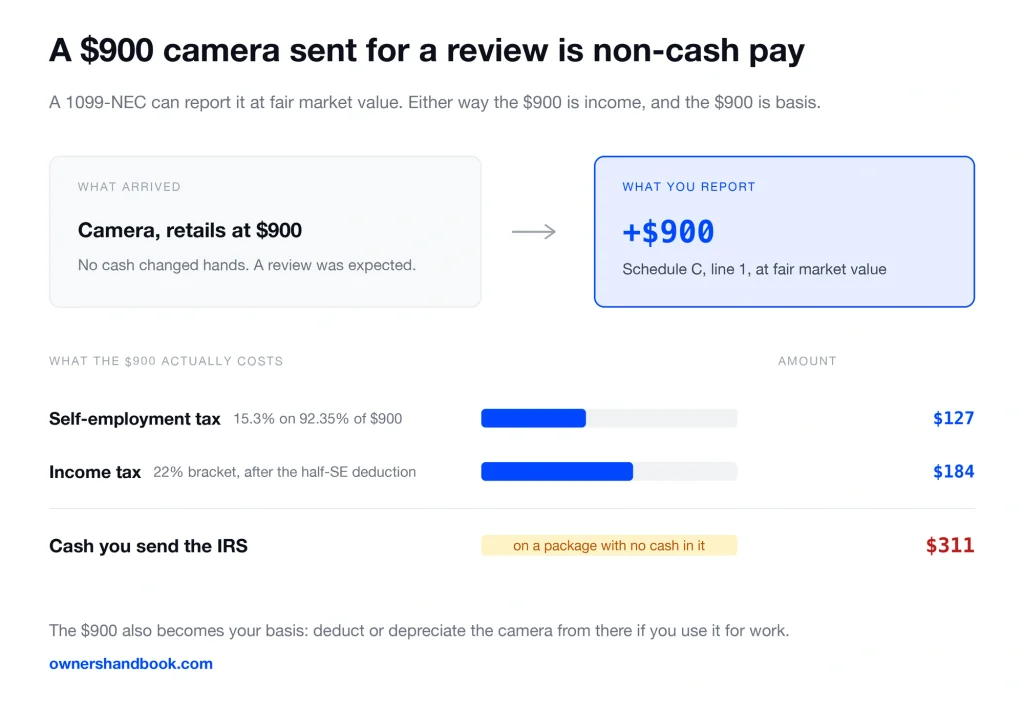
The one that surprises people is the last one. A $900 camera sent to you for a review is $900 of income, and no form will ever tell you so.
Every pipe ends at the same line
You are a sole proprietor, the default status of anyone earning without a corporation behind them. Every pipe empties into the same place.
Everything you took in goes on Schedule C, line 1, as gross receipts. Expenses come off below it, and line 31 is your profit.
That profit pays self-employment tax at 15.3%, on top of income tax. Nothing is withheld from any of it, which is why creators send quarterly estimated taxes four times a year.
The form that shows up in January changes only whether the IRS already has its own copy of the number.
The IRS says so on its gig economy page. You report income not covered by an information return, and income “paid in any form, including cash, property, goods, or virtual currency.”
Ad revenue comes from Google, not from YouTube
YouTube Partner Program money is not paid by YouTube. It is paid by Google through AdSense, and Google is the name on the tax form.
Google’s publisher help page lists the forms it issues: 1099-MISC, 1099-K, and 1042-S. Most US creators see the 1099-MISC.
One quirk matters. Royalties are reportable on a 1099-MISC at $10 or more, while most other boxes on that form start at $2,000 for 2026.
So a channel earning $340 in ad revenue can get a form while a $1,800 brand deal gets none. Size does not predict paperwork.
Other platforms run creator programs out of their own pocket rather than as a payment processor. That is nonemployee compensation, which puts it on a 1099-NEC instead.
| Where the money came from | What reports it | Before a form appears |
|---|---|---|
| Platform ad revenue | 1099-MISC from Google | $10 as royalties, $2,000 otherwise |
| Brand deal paid to you directly | 1099-NEC from the brand | $2,000 in 2026 |
| Affiliate commissions | 1099-NEC, per network | $2,000 per network |
| Fan funding through a processor | 1099-K | Over $20,000 and 200 payments |
| Merch on a print-on-demand site | 1099-K or 1099-NEC | Depends on the platform |
| Gifted product, free trips | Nothing. Ever. | There is no form for this |
Brand deals and the $2,000 hole
A brand paying you for a sponsored post is paying nonemployee compensation. The form is a 1099-NEC.
That floor moved this year, and almost nothing online says so. It was $600 from 1954 through the end of 2025. For payments made on or after January 1, 2026 it is $2,000, indexed for inflation after that.
Run the arithmetic. Four sponsorships at $1,500 each is $6,000 of income and zero forms in the mail.
The money is fully taxable anyway. All the higher floor changed is how much of your income the IRS hears about from somebody other than you, which makes your own record of every deal the only complete one.
Affiliate commissions
Amazon Associates, ShareASale, Impact, and a brand’s in-house program all pay a commission on sales you referred.
Commission is nonemployee compensation, so the form is generally a 1099-NEC once you cross $2,000 with that one network.
Each network counts its own threshold separately, so five networks at $1,200 apiece is another $6,000 with nothing in the mail.
On the cash method, which nearly every creator uses, a commission is income in the year the money actually reached you.
Amazon pays roughly sixty days after the month the sale closed. Your strong December is usually next year’s tax problem.
Fan funding and merchandise
Patreon, Ko-fi, Buy Me a Coffee, Twitch subscriptions and bits, YouTube channel memberships, Super Chat. Fans call these tips. The tax code does not.
Which form arrives depends on the plumbing, not the word the platform uses. Where it is moving a fan’s money as a processor, that is 1099-K territory, over $20,000 and more than 200 payments.
Where the platform pays you from its own account, the 1099-NEC rules apply instead. Many fan-funding sites do both, which is why one site can send two forms.
Merchandise has its own trap, the same one that catches Etsy sellers. Your print-on-demand payout is net of printing and shipping. The reporting may be gross.
Say you sold $4,000 of shirts, the printer kept $2,600, and $1,400 landed in your bank. Report $4,000 on line 1 and deduct the $2,600 as cost of goods sold.
Your profit is $1,400 either way. Only one version matches the form the IRS is holding, and the gross-versus-payout mechanics are worked through in the gig platform taxes article.
Free product, and whether a form was filed
Free product is income. That rule alone changes nothing. The question that matters is whether a form went to the IRS with your name on it.
Non-cash pay is reportable on a 1099-NEC. The instructions cover “other forms of compensation for services performed” and name fair market value outright.
So a brand or an agency that treats a $2,400 ambassador package or a hosted trip as payment can file one, at $2,000 or more.
Once it is filed, the IRS holds the number before you do. Leaving it off is the exact mismatch that generates a CP2000 notice, and the audit triggers article covers what that letter is.
When no form arrives the rule does not change, and in practice nobody holds a number to match your return against.
The line worth knowing is unconditional gift against payment. Samples mailed to a hundred people with nothing asked are a gift. A $900 camera sent because you agreed to post a review is payment shaped like an object.
| What happened | Gift or payment | What follows |
|---|---|---|
| Samples mailed to 100 people, nothing asked | Gift | Usually not income |
| $900 camera sent for an agreed review | Payment | $900 of income, $900 of basis |
| Hosted trip with a required post | Payment | FMV income, travel deductible |
| Ambassador package from an agency | Payment | A 1099-NEC may be filed |
| A viewer mails you a birthday present | Gift | Not income |
Reporting it is not purely a cost. The $900 becomes your basis in the camera, so you can deduct or depreciate it as equipment, which the creator deductions article picks up.
Prizes, contests, and creator-fund bonuses
Publication 525 is direct about this. “If the prize or award you receive is goods or services, you must include the FMV of the goods or services in your income.”
Prizes and awards get reported in box 3 of a 1099-MISC, at $2,000 or more for 2026. Below that, no form, same tax.
A $3,000 contest prize is $3,000 of income whether it arrives as a check or as a laptop.
Creator-fund payments and platform bonuses come out of the platform’s own money rather than a customer’s. That makes them nonemployee compensation, exactly like a delivery driver’s quest bonus.
When both forms report the same money
A brand pays you $5,000 for a sponsorship and sends it through PayPal.
The brand reports a 1099-NEC for $5,000. PayPal counts the same $5,000 toward your 1099-K. Nobody coordinates between them.
Add the forms together and you have doubled your income on paper. Creators hit this more than most freelancers, because the money often crosses an agency, a platform, and a processor first.
Start from your own books. Report what you actually earned, then match each form against your records until every dollar of difference has a name. The worked example is in the 1099-NEC vs 1099-K article.
Foreign platforms and the hobby line
A platform based outside the US usually sends no US form at all. A US taxpayer owes tax on worldwide income anyway, so nothing there is optional.
Report it in dollars. The IRS says to use the exchange rate prevailing when you receive the payment, and to keep the rate you used.
The last question is whether this is a business yet. If you are not running the channel to make money, the income is still taxable and your expenses are worth nothing.
That is the hobby line, drawn with nine factors rather than a dollar amount. It has its own article, worth reading before your first loss year.
Frequently asked questions
A sponsor never sent me a 1099. Do I still report the money?
Yes. A brand only has to issue a 1099-NEC at $2,000 for 2026, and the IRS says income is reportable whether or not a form covers it.
A company sent me a product I never asked for. Is that income?
Usually not, if nothing was required of you and no agreement was made. Save the email showing there were no conditions. The moment you owe them a post, it is income at fair market value.
How do I put a value on a free trip?
Use what it would have cost you to book. Room rate, flights, and any meals or activities the host covered, priced at what a stranger would have paid.
Are Twitch bits and Patreon pledges gifts?
Not in the tax sense. They are paid because of what you make, which makes them business income. Whether the platform sends a form changes nothing.
I got a 1099-NEC from a brand and a 1099-K from PayPal for the same deal. What do I report?
The income once. Keep a reconciliation showing which payments sit on which form, so the gap has an explanation if a letter arrives later.
Do I owe self-employment tax on a gifted product?
Yes. Barter income from your business is gross receipts on Schedule C, and Schedule C profit carries to Schedule SE like every other dollar.
Sources
IRS, Topic No. 420, Bartering Income
https://www.irs.gov/taxtopics/tc420
IRS, Publication 525, Taxable and Nontaxable Income
https://www.irs.gov/publications/p525
IRS, Gig Economy Tax Center
https://www.irs.gov/businesses/gig-economy-tax-center
IRS, Instructions for Forms 1099-MISC and 1099-NEC
https://www.irs.gov/instructions/i1099mec
IRS, About Form 1099-NEC
https://www.irs.gov/forms-pubs/about-form-1099-nec
IRS, Understanding Your Form 1099-K
https://www.irs.gov/businesses/understanding-your-form-1099-k
IRS, Schedule C (Form 1040)
https://www.irs.gov/forms-pubs/about-schedule-c-form-1040
IRS, Self-Employment Tax
IRS, Understanding Your CP2000 Notice
https://www.irs.gov/individuals/understanding-your-cp2000-notice
IRS, Foreign Currency and Currency Exchange Rates
https://www.irs.gov/individuals/international-taxpayers/foreign-currency-and-currency-exchange-rates
Google AdSense Help, Tax information