The Five Legal Ways to Cut a Freelance Tax Bill, Ranked
Five things cut a freelance tax bill. Take every real deduction, fund a retirement plan, claim the qualified business income deduction, deduct your health premiums, and elect S corporation taxation once your profit is high enough.
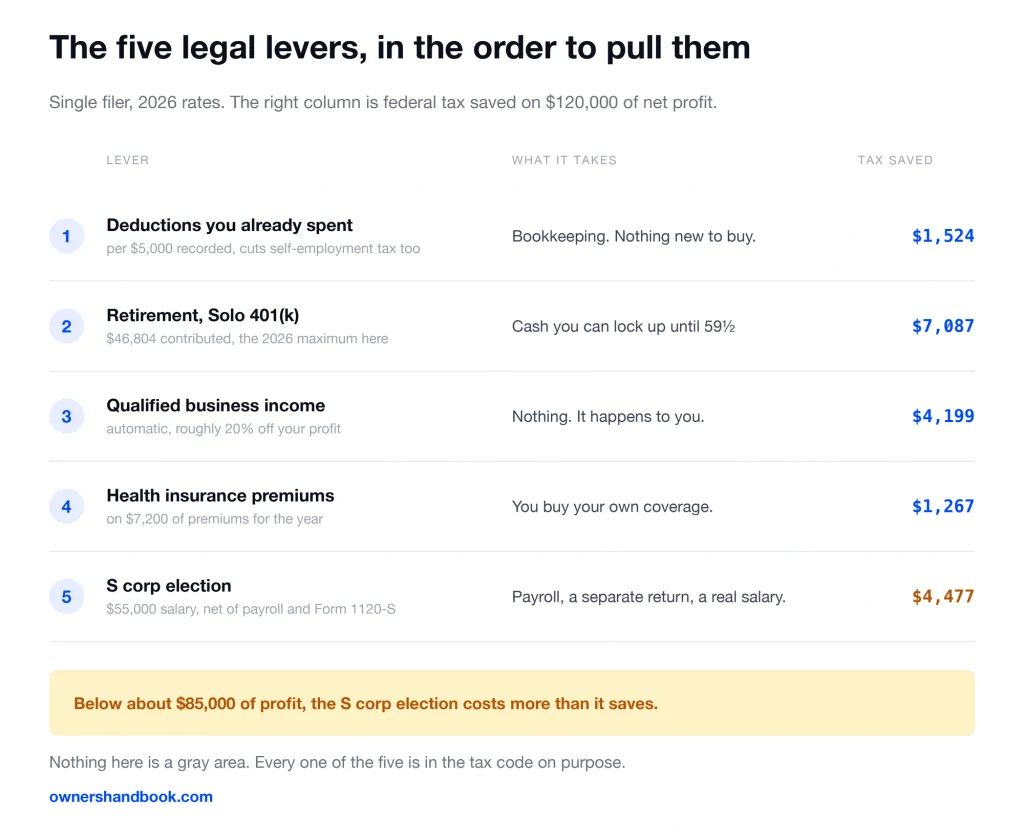
On $120,000 of net profit, a single filer saves roughly $305 in tax per $1,000 of expenses recorded, $7,087 from a maxed Solo 401(k), $4,199 from the qualified business income deduction, and $1,267 on $7,200 of premiums.
Everything else is one of these five wearing a costume, or it is not legal. There is no sixth thing.
A deduction and a credit are not the same thing
A deduction comes off your income before tax is figured. A credit comes off the tax itself, after.
At a 22% marginal rate, a $1,000 deduction saves you $220. A $1,000 credit saves you $1,000.
Four of the five levers below are deductions, worth your bracket rather than their face value.
So spending $1,000 you did not need to spend, to save $220, leaves you $780 poorer. Buy the thing because the work requires it.
What each one is worth
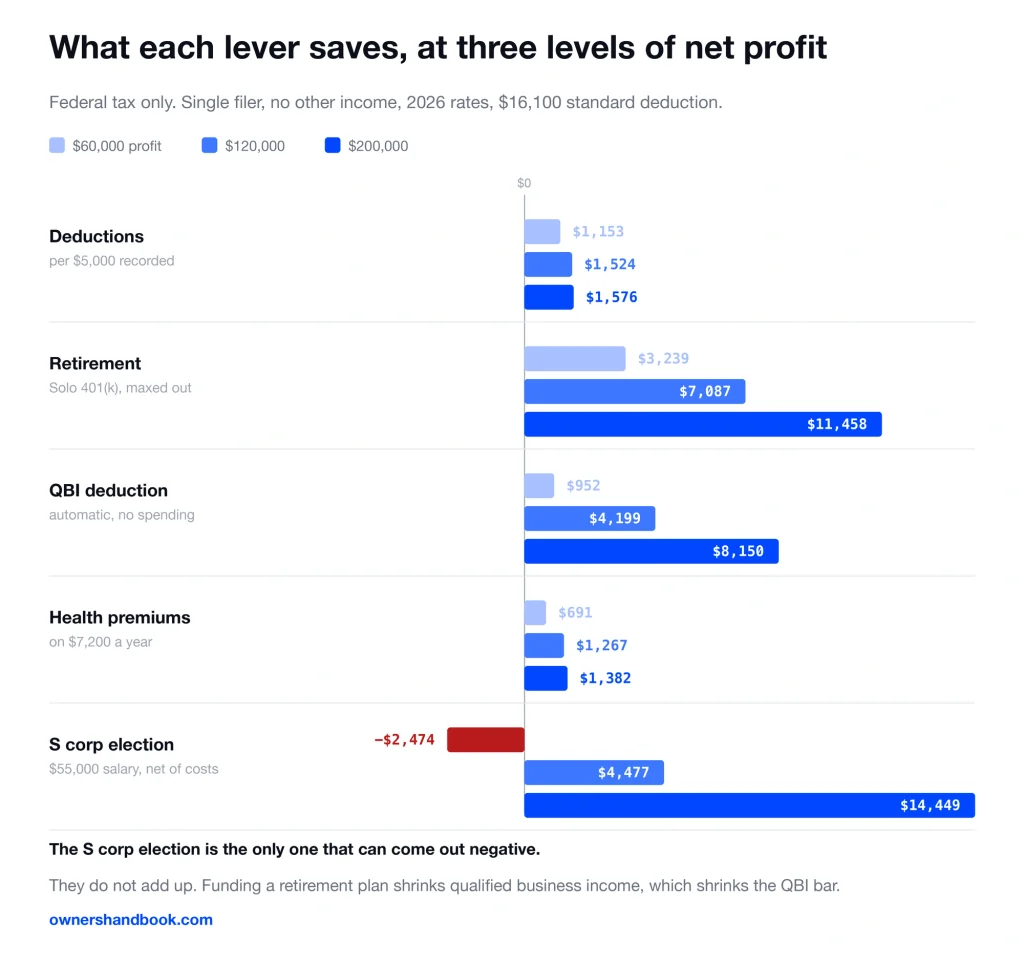
Every figure below is a single filer, 2026 rates, the $16,100 standard deduction, nothing itemized.
| Lever | $60,000 profit | $120,000 profit | $200,000 profit |
|---|---|---|---|
| 1. Deductions, per $5,000 recorded | $1,153 | $1,524 | $1,576 |
| 2. Retirement, maxed Solo 401(k) | $3,239 | $7,087 | $11,458 |
| 3. Qualified business income deduction | $952 | $4,199 | $8,150 |
| 4. Health premiums of $7,200 | $691 | $1,267 | $1,382 |
| 5. S corp, $55,000 salary, after costs | −$2,474 | $4,477 | $14,449 |
The numbering is the order to work through them, not the order of size at every income. Notice row five is negative at $60,000.
They also do not add up. Fund a retirement plan and your qualified business income shrinks, which shrinks row three.
One: the deductions you already earned
This is the unglamorous one, and for most freelancers it is where the money leaks.
Business expenses come off on Schedule C, above the line where self-employment tax is calculated. That is the important part.
Every other lever here, except the S corp election, cuts income tax only. A Schedule C expense cuts income tax and the 15.3% self-employment tax both.
In dollars: $1,000 of recorded expenses is worth $231 at $60,000 of profit, $305 at $120,000, and $297 at $200,000.
The test is two words from section 162 of the tax code: ordinary and necessary. Ordinary means common and accepted in your line of work. Necessary means helpful and appropriate for it.
The money is usually lost to bookkeeping, not to the rules. The home office deduction, the mileage log, the subscriptions nobody wrote down.
Mileage is the clearest example. The 2026 business rate is 72.5 cents a mile through June 30 and 76 cents from July 1, and an untracked mile is worth nothing.
Two: retirement, the largest lever you control
With cash to spare, this moves more money than anything else here.
A Solo 401(k) lets you contribute twice. Up to $24,500 as an employee deferral in 2026, plus an employer contribution of 20% of your net self-employment earnings.
A SEP IRA takes only the employer half. Both stop at $72,000 for 2026.
Maxed out, a Solo 401(k) holds $35,652 at $60,000 of profit, $46,804 at $120,000, and $61,677 at $200,000. That is the $3,239, $7,087, and $11,458 in the table.
A SEP at the same incomes saves $1,071, $3,926, and $7,138. The gap is the deferral, and it is the reason to prefer the 401(k).
Two caveats. It does not touch self-employment tax, and the money is locked until 59½ in most cases.
A $35,652 contribution on $60,000 of profit is arithmetic, not a plan. At a realistic $10,000, the saving is $960, $1,760, and $1,920.
Three: the qualified business income deduction
This one happens to you. No spending, no election, no form beyond what your software already files.
Roughly 20% of profit comes off your income. The deduction is $7,932, $19,084, and $33,957 at the three levels, worth $952, $4,199, and $8,150 in tax.
It became permanent starting with the 2026 tax year, and the thresholds matter only high up. Below $201,750 of taxable income single, or $403,500 joint, your line of work is irrelevant and you take the 20%.
Above those lines, limits phase in over $75,000 single and $150,000 joint, and consultants and a few other named fields start losing it.
It does not reduce self-employment tax either.
Four: your health insurance premiums
If you buy your own coverage, the premiums come off on Schedule 1, not on Schedule C.
That placement makes it an above-the-line deduction, meaning it reduces adjusted gross income. On $7,200 of premiums it saves $691, $1,267, and $1,382.
Two rules kill it. The deduction cannot exceed the net earnings of the business the plan is tied to.
And you lose it for any month you were eligible to join a subsidized plan through your own employer or your spouse’s, even if you declined.
Five: the S corp election, above a line
This is the only structure change that moves a number. Forming an LLC does not.
You go on payroll, pay yourself a reasonable salary, and take the rest as distributions that carry no self-employment tax.
Netted against a payroll service, Form 1120-S, and the qualified business income you give up on wages, the election is worth −$2,474 at $60,000 of profit, $4,477 at $120,000, and $14,449 at $200,000, on a $55,000 salary.
Read that last number carefully. The saving is the gap between profit and a defensible salary, and at $200,000 a $55,000 salary is hard to defend.
What does not work
| What people try | Why it fails |
|---|---|
| A Delaware LLC to escape home-state tax | You are taxed where you live and work. You still register at home as a foreign LLC, so you now have two filings |
| Calling a personal purchase a business expense | Ordinary and necessary is the test, not the label on the receipt |
| Writing off a car used mostly personally | Only the business-use share is deductible, and commuting to a regular workplace is not business |
| Paying your kids without the paperwork | The wages are deductible only if the work is real and documented |
| The spare room that is also a guest room | Exclusive use means exclusive. There is no partial credit |
Three of those deserve more than a table row.
A Delaware LLC is the most persistent of them. Delaware does not tax income you earn elsewhere, but your own state does, and it does not care where the paperwork was filed.
Hiring your children is real, not a myth, and it has requirements. The work has to be actual work, the pay reasonable for that work, and you issue a W-2.
The payoff in a sole proprietorship is specific. Wages to your child under 18 are not subject to Social Security and Medicare tax, and under 21 they are exempt from federal unemployment tax.
Income tax withholding applies at any age. If your business is a corporation, or a partnership with anyone other than the child’s parents, none of the exemptions apply.
The home office rule is the one people talk themselves past. The space must be used regularly and exclusively for business, and a desk in the corner of a bedroom does not clear it.
Nothing here is a gray area. Every item is in the code on purpose, and the goal is paying the correct amount, not the smallest one you can argue for.
Where to start
Fix the bookkeeping first. It costs nothing, it cuts both taxes, and it sets the profit figure every other lever is calculated from.
The qualified business income deduction then takes care of itself, and health premiums come off if you qualify.
Once profit is reliably above $50,000 and you have cash you do not need, open a Solo 401(k).
Look at the S corp election last, and only when profit runs well clear of what you would pay someone else to do your job.
This is general information about how these provisions work, not advice about your situation. Run your own numbers past someone licensed to sign a return.
Frequently asked questions
Which one should I do first?
Bookkeeping. A recorded expense cuts self-employment tax and income tax, which none of the others do, and it is worth about $300 per $1,000 at $120,000 of profit.
Does a deduction get my money back?
No. A deduction reduces the income you are taxed on, so it returns your marginal rate, not the full amount. Only a credit comes off the tax dollar for dollar.
Do any of these lower self-employment tax?
Only Schedule C expenses, and the S corp election. Retirement contributions, the qualified business income deduction, and the health insurance deduction all sit below where self-employment tax is figured.
Can I deduct health insurance if my spouse’s employer offers a plan?
Not for any month you were eligible to participate in that plan, whether or not you enrolled. The deduction is also capped at the net earnings of the business the policy is tied to.
Can I really put my kids on payroll?
Yes, with real work, reasonable pay, and a W-2. In a sole proprietorship, wages to a child under 18 escape Social Security and Medicare tax, and under 21 escape federal unemployment tax.
At what profit does an S corp start paying?
Above about $85,000 in the worked example, and only when a fair salary for your work sits well below your profit. At $60,000 it loses money.
Sources
IRS, Deducting Business Expenses
https://www.irs.gov/businesses/small-businesses-self-employed/deducting-business-expenses
IRS, Publication 535, Business Expenses
https://www.irs.gov/forms-pubs/about-publication-535
IRS, Credits and Deductions for Individuals
https://www.irs.gov/credits-and-deductions-for-individuals
IRS, Standard Mileage Rates
https://www.irs.gov/tax-professionals/standard-mileage-rates
IRS, 401(k) limit increases to $24,500 for 2026, IRA limit increases to $7,500
https://www.irs.gov/newsroom/401k-limit-increases-to-24500-for-2026-ira-limit-increases-to-7500
IRS, COLA Increases for Dollar Limitations on Benefits and Contributions
IRS, Publication 560, Retirement Plans for Small Business
https://www.irs.gov/publications/p560
IRS, One-Participant 401(k) Plans
https://www.irs.gov/retirement-plans/one-participant-401k-plans
IRS, Qualified Business Income Deduction
https://www.irs.gov/newsroom/qualified-business-income-deduction
IRS, Revenue Procedure 2025-32, inflation adjustments for 2026
https://www.irs.gov/pub/irs-drop/rp-25-32.pdf
IRS, Instructions for Form 7206, Self-Employed Health Insurance Deduction
https://www.irs.gov/instructions/i7206
IRS, Home Office Deduction
https://www.irs.gov/businesses/small-businesses-self-employed/home-office-deduction
IRS, Family Help
https://www.irs.gov/businesses/small-businesses-self-employed/family-help
IRS, S Corporations
https://www.irs.gov/businesses/small-businesses-self-employed/s-corporations
IRS, Self-Employment Tax (Social Security and Medicare Taxes)