What to Save and How Long
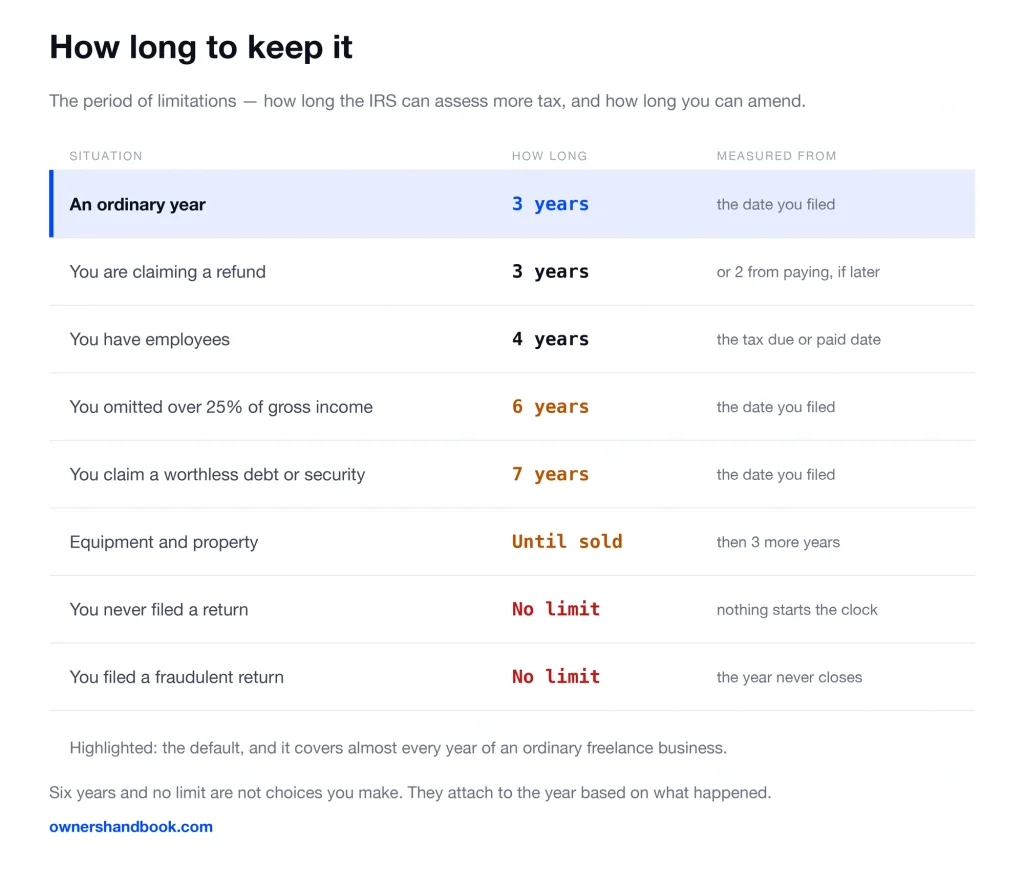
Three years is the default. Keep everything that supports a return for three years after you file it. Six years if you left out more than 25% of the gross income you reported. And with no end date at all if you never filed that year, or filed something fraudulent — those years never close.
Three years, and where the three years starts
The window has a name. Period of limitations — the stretch of time in which the IRS can assess more tax against you, and in which you can amend the return to claim a refund.
When it closes, the year is closed. That is what you are counting down to.
The three years runs from the date you filed, not from the end of the tax year.
File your 2026 return on April 15, 2027, and the window shuts around April 15, 2030. Three filing seasons, not three calendar years.
Filing early does not shorten it. A return filed before the due date is treated as filed on the due date.
Filing late does lengthen it. The clock does not start until the IRS actually has the return in hand.
There is a second clock running the other direction. To claim a refund on an amended return you get three years from filing or two years from paying the tax, whichever is later.
When three years becomes six
The six-year rule has one specific trigger. You left income off the return, and what you left off is more than 25% of the gross income you did report.
Gross income means the top line, before any expenses come out.
So report $60,000 of receipts, leave out $16,000, and you are past the line. Six years, not three.
You do not opt into this. It attaches to the year based on what actually happened, whether or not you knew at the time.
For a freelancer the usual cause is not fraud. It is a 1099 mailed to an old address, or a payment platform you stopped using in March and forgot about.
Which is the real argument for keeping six years of anything you are not certain about. The rule turns on facts you may not learn for years.
When the clock never starts
| The situation | How long | Measured from |
|---|---|---|
| An ordinary year | 3 years | the date you filed |
| You are claiming a refund | 3 years | or 2 from paying, whichever is later |
| You have employees | 4 years | the tax due or paid date |
| You omitted over 25% of gross income | 6 years | the date you filed |
| You claim a worthless security or bad debt | 7 years | the date you filed |
| Equipment and property | Until sold | then 3 more years |
| You never filed, or filed a fraudulent return | No limit | nothing starts the clock |
Two situations have no deadline whatsoever.
You never filed. There is no return, so nothing starts the count. A year you skipped in 2019 is as open today as it was then.
You filed a fraudulent return. Same result, open indefinitely.
This is the strongest practical reason to file a year you cannot pay. Filing starts a clock. Not filing leaves it stopped, and a stopped clock never runs out.
The receipt proves the amount. It does not prove why.
Here is the part that decides most disputes, and almost nobody sets up for it.
A receipt proves an amount, a date, and a place. It does not prove a business purpose.
Purpose is the element that gets tested. It is also the only one no merchant will ever print for you.
A $340 charge from an electronics store proves you spent $340 at an electronics store. It says nothing about whether the thing in the bag was for work.
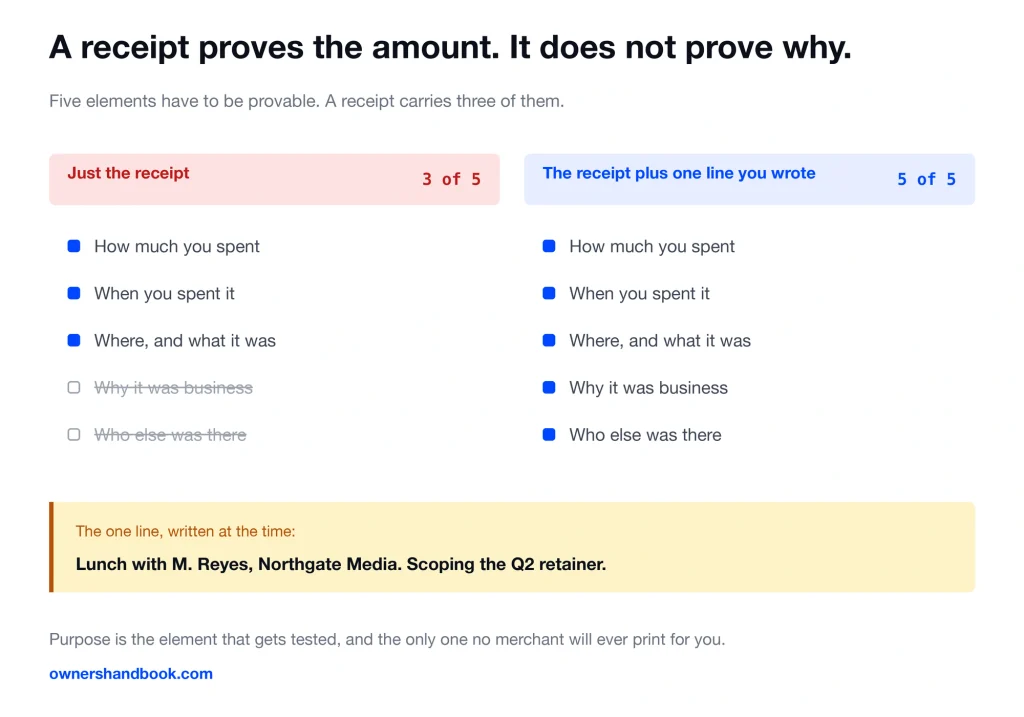
The fix is one written line, added at the time. What it was, and what it was for.
For travel, meals, gifts, and listed property such as a car, this is not merely good practice. It is written into the statute, at section 274(d) of the tax code.
Substantiation is the word for what that section demands — proving each separate element of an expense, rather than just the total.
There are five elements: how much, when, where, the business purpose, and, if someone else was involved, who they were and your business relationship to them.
Miss the purpose and the deduction can be denied even though the money plainly left your account.
The IRS states the timing rule directly: record the elements at or near the time of the expense. A timely kept record has more value than a statement prepared later, when there is generally a lack of accurate recall.
That is why a mileage log written in April from memory is worth so little. The problem is not that the miles are invented. It is that nothing about the document says you were there.
You do not have to write it the same day. A log kept on a weekly basis counts as timely kept.
On receipts themselves, there is a threshold. You need documentary evidence for lodging, and for any other expense of $75 or more. Below $75, an adequate record can carry the item on its own.
What to save
| A record has to show | A receipt gives you |
|---|---|
| How much you spent | Yes |
| When you spent it | Yes |
| Where, and what it was | Yes |
| Why it was business | No |
| Who else was there | No |
Name the actual things and this stops being abstract.
Income. Every 1099-NEC and 1099-K, your own invoices, deposit records, and the payout reports from every platform that paid you.
Your invoices matter more than the 1099s do. They are the only document covering the clients who never sent a form.
Expenses. Receipts and invoices, bank and card statements, and for anything ambiguous, the line you wrote saying what it was for.
Statements on their own are thin. They show that money moved and to whom, not what it bought.
Vehicle. A log with the date, the miles, where you went, and the business reason. Plus your odometer reading at the start and end of the year.
Home office. The square footage of the room and of the whole place. If you use actual expenses, also rent or mortgage interest, utilities, insurance, and repairs.
Equipment. What you paid, the date you bought it, and how you wrote it off.
Filings. The return itself, every schedule attached to it, proof of each estimated payment, and the acceptance confirmation.
Keep copies of the returns themselves permanently. They are small files, and you will need an old number more often than you would guess.
Records that outlive the three years
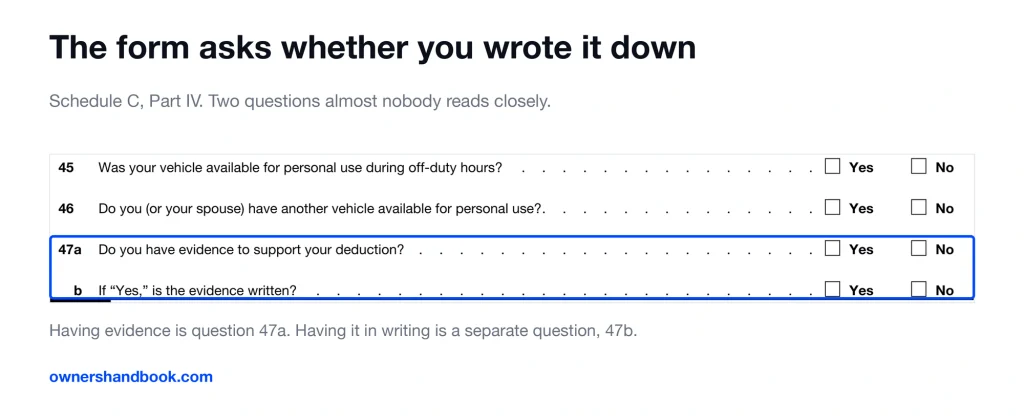
A few categories run on their own clocks, independent of the return.
Equipment and property. Keep the purchase records for as long as you own the item, and then through the limitations period for the year you sell or scrap it.
A camera bought in 2022 and sold in 2029 has records that stay live into 2033. The depreciation you claimed across those years is what determines the gain on the sale.
Worthless securities and bad debts. Seven years, if you file a claim for a loss from either.
For most cash-basis freelancers this one rarely bites. You cannot deduct an unpaid invoice as a bad debt, because you never counted it as income to begin with.
Employment taxes. If you have actual employees, keep those records at least four years after the tax was due or was paid, whichever is later.
Paying another freelancer does not create employment tax records. Putting someone on payroll does.
Records exist to back up what you claimed. Which means the thing worth recording is whatever made the expense ordinary and necessary in the first place.
A filing setup you can put in place this week
None of this requires software. It requires a place things go, and the habit of writing one line.
One business bank account and one business card. Everything runs through them. That single change does most of the sorting for you.
One folder per tax year in cloud storage. Four folders inside it: Income, Expenses, Vehicle, Filings.
Photograph a receipt the moment it exists, and rename the file the same way every time. Date, vendor, amount, purpose.
So: 2026-03-14 Apple 340 monitor for editing suite.
That filename is the record. It carries the purpose the receipt left out, and it makes the whole folder searchable by keyword.
One spreadsheet for mileage, five columns: date, start, end, miles, reason. Fill it in every Friday, never in April.
Set a weekly phone reminder that says one word. Receipts. It is fifteen minutes.
At year end, zip the folder and put a copy somewhere other than that same cloud account.
Scans are enough. The IRS has accepted records kept in an electronic storage system since Revenue Procedure 97-22, issued in 1997, and everything that applies to paper applies to the images.
The condition is that the system produces a complete and legible copy, and that you can hand it over when asked. An unsorted camera roll technically qualifies and practically does not.
Frequently asked questions
Can I throw away the paper after I scan it?
Generally yes, if the electronic copy is complete, legible, and something you can actually retrieve. The IRS holds electronic records to the same standard as the paper they replaced.
Do bank and credit card statements count as records?
They help, and they are much better than nothing. But they show an amount and a payee, not what was bought or why it was business, so they rarely stand alone for an expense that gets questioned.
How long do I keep the tax returns themselves?
Keep the returns permanently, even though the supporting documents can go after three or six years. Old returns settle questions about carryovers, basis, and prior-year income that nothing else can answer.
I never filed for a year several years back. Am I past the deadline?
No. A year with no return filed has no limitations period at all, so it stays open indefinitely. Filing it, even very late, is what finally starts the clock.
I did not keep a mileage log. Can I write one now?
You can reconstruct an estimate, and it is better than claiming nothing. But a record built from memory is weak evidence, and it is the first thing to fall apart if the deduction is examined.
What if I am asked for records I no longer have?
Rebuild what you can from bank statements, calendars, emails, and vendor account histories. The burden of proving what is on your return sits with you, so a partial reconstruction is worth the effort even when it is not ideal.
Sources
IRS, How long should I keep records?
https://www.irs.gov/businesses/small-businesses-self-employed/how-long-should-i-keep-records
IRS, Recordkeeping
https://www.irs.gov/businesses/small-businesses-self-employed/recordkeeping
IRS, Burden of proof
https://www.irs.gov/businesses/small-businesses-self-employed/burden-of-proof
IRS, Time IRS can assess tax
https://www.irs.gov/filing/time-irs-can-assess-tax
IRS, Publication 463, Travel, Gift, and Car Expenses
https://www.irs.gov/publications/p463
IRS, Publication 583, Starting a Business and Keeping Records
https://www.irs.gov/publications/p583
IRS, Automated records
https://www.irs.gov/businesses/automated-records
IRS, Revenue Procedure 97-22