Should a Freelancer Form a Delaware LLC? Almost Never.
Almost certainly not. Form the LLC in the state where you live and work — one filing, one annual fee, one registered agent — and skip Delaware entirely.
Filing in Delaware while you live somewhere else does not replace your home state. It adds one.
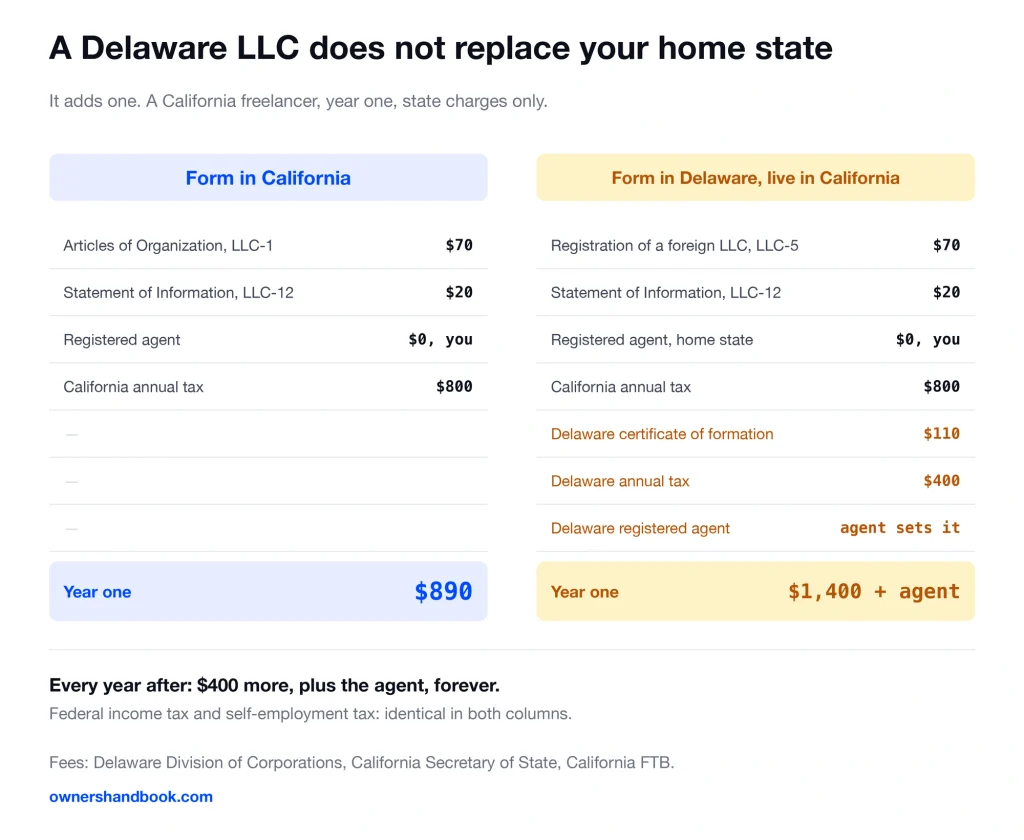
A California freelancer pays Delaware $110 to form and $400 every year after, on top of everything California already charges. That is $510 extra in year one and $400 a year forever.
The rule behind it is the one nobody mentions in the thread that sent you here. An LLC is formed in one state, then registers again in every state where it does business.
What Delaware actually sells
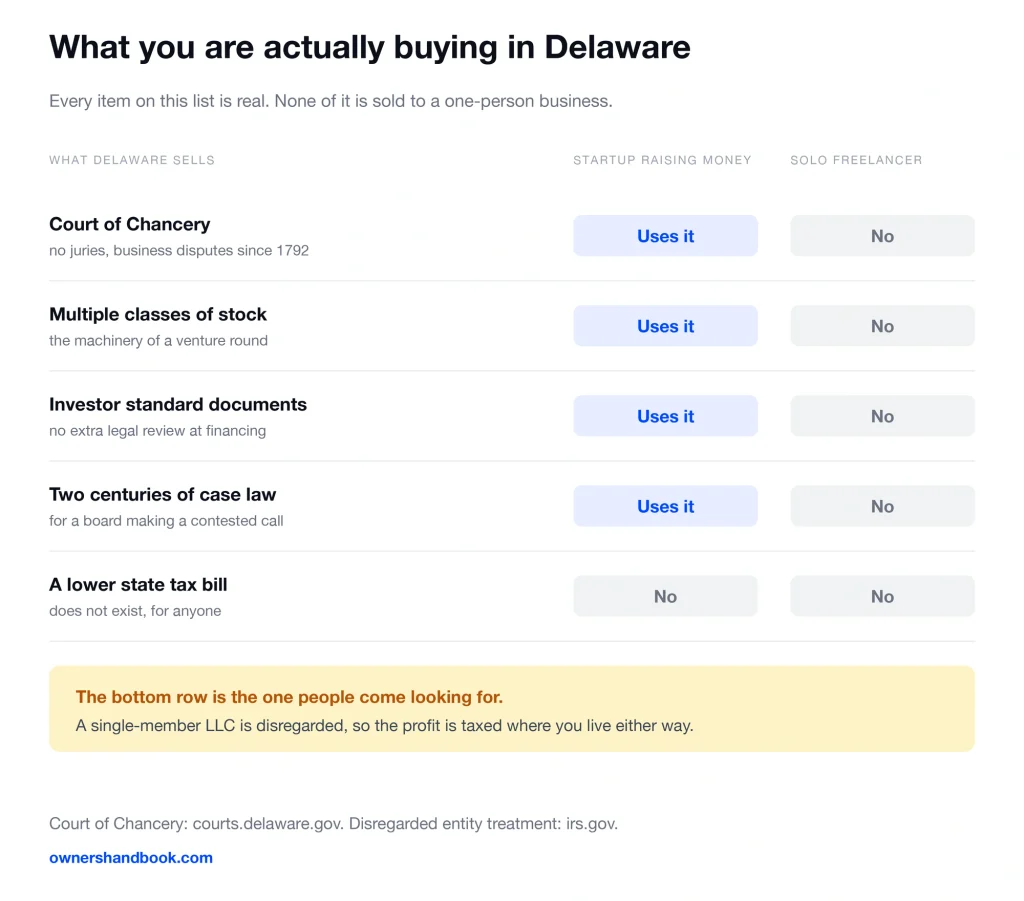
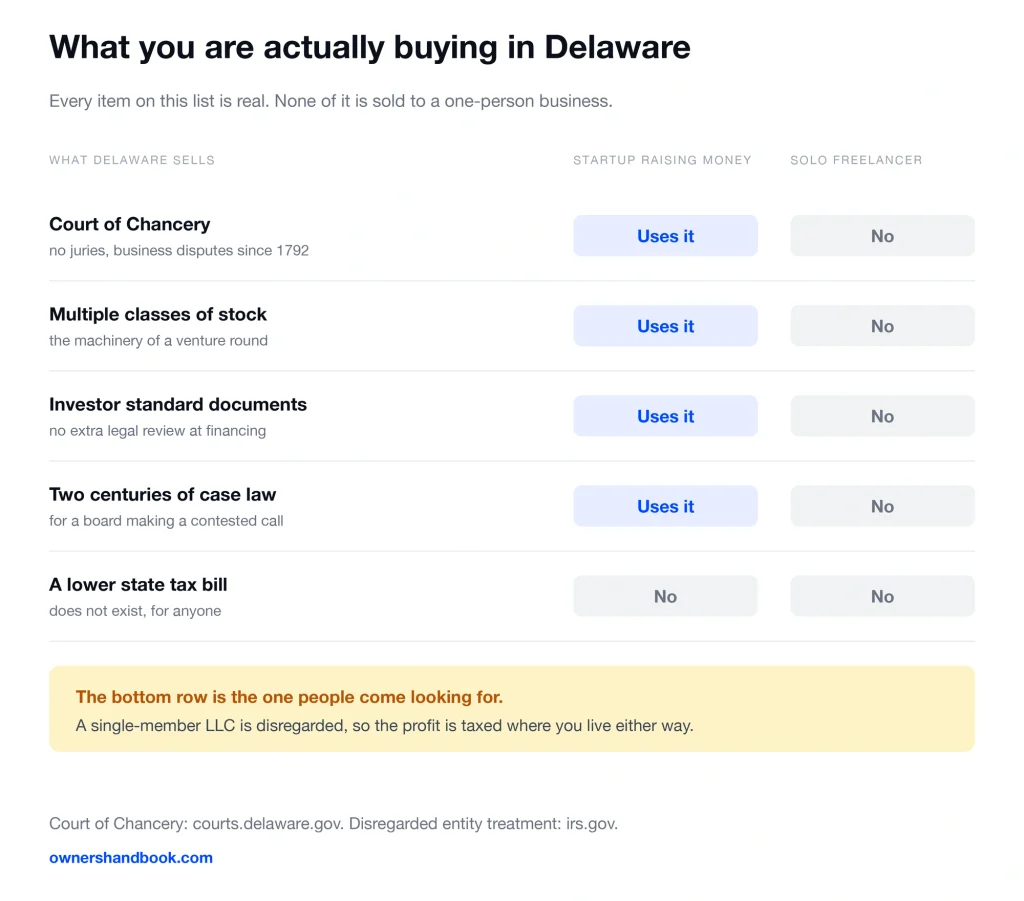
Delaware’s reputation is real. The first reason is the Court of Chancery, a court of equity created in 1792.
It hears disputes about the internal affairs of Delaware business entities, and it has no juries. For a company facing a shareholder suit, a judge who has seen the same fight many times is worth a great deal.
The second is the statute. Delaware corporate law lets a company issue multiple classes of stock, which is the machinery a venture round runs on.
The third is familiarity. Investors and their lawyers assume Delaware, so anywhere else adds legal review to a financing.
Now read that list as a one-person business.
Your LLC still has to register where you work
Foreign LLC — your own LLC, seen from a state that is not the one you formed it in. It has nothing to do with other countries.
California’s version of the rule is the least forgiving, so start there. The Franchise Tax Board says you are doing business in California if you engage in any transaction for the purpose of financial gain within California.
Sending an invoice from your kitchen table in Oakland is a transaction for financial gain within California.
California Corporations Code section 17708.02 then tells a foreign LLC to apply for a certificate of registration before transacting business in the state.
So the Delaware LLC registers in California anyway, at the same fee, with one extra state on top.
What the detour costs a California freelancer
The comparison that matters is not Delaware against doing nothing. It is Delaware against the LLC you would form at home.
| Line item | California LLC | Delaware LLC, living in California |
|---|---|---|
| Formation filing | $70, Form LLC-1 | $110 to Delaware, plus $70 for Form LLC-5 |
| Statement of Information, first 90 days | $20 | $20 |
| Registered agent | $0 if it is you | A paid Delaware agent, rate set by the agent |
| California annual tax | $800 | $800, unchanged |
| Delaware annual tax | $0 | $400, due June 1 |
| Year one, state charges | $890 | $1,400, plus the agent |
California’s $800 does not shrink because you filed in Delaware.
The Franchise Tax Board charges it to any LLC doing business in California or registered with the Secretary of State. Delaware puts you in the second category on purpose.
The $400 is Delaware’s annual tax on LLCs, and it is flat. Delaware does not prorate it and does not ask whether the company earned anything.
Five years in, the detour has cost $2,110 in extra state charges plus five years of agent bills. The savings column is still empty.
You also lose the free option. At home you can be your own registered agent; a Delaware agent needs a Delaware street address, so you rent one.
New York, where the publication bill follows you
New Yorkers try this most, because the publication requirement is genuinely expensive and Delaware looks like the exit.
It is not. Section 802 of New York‘s LLC law puts the same requirement on foreign LLCs, within 120 days of filing the application for authority.
Publish once a week for six successive weeks, in two newspapers of the county, one daily and one weekly, designated by the county clerk. Miss it and your authority to do business in New York is suspended as of day 121.
The newspapers set their own rates and the state does not publish them. The one number New York fixes is $50, for the certificate of publication afterward.
The filing fees move the wrong way too. New York charges $200 for domestic articles of organization and $250 for a foreign LLC’s application for authority.
So the Delaware route costs $110 plus $250, against $200 for a plain New York LLC. That is $160 extra before Delaware’s $400 a year starts.
What a single-member LLC actually is
One owner, one member. Member is simply what an LLC calls an owner, the way a corporation says shareholder.
The IRS gives it a default classification. An LLC with only one member is treated as an entity disregarded as separate from its owner.
Disregarded means the IRS looks straight through the company to you. The profit lands on the same Schedule C, and self-employment tax applies in the same manner as a sole proprietorship.
So the LLC by itself saves zero dollars in tax. Not in Delaware, not in Ohio, not anywhere, and that misconception is what sends people looking for a clever state.
What it buys is a wall and a name. Company debts stop at the company instead of reaching your savings, and the bank account, the contracts and the W-9 carry the business’s name rather than yours.
Your state then taxes the profit where you live. Delaware taxes non-residents only on Delaware-source income, and a freelancer working in Sacramento has none.
$90,000 of profit is $90,000 of California income whether the certificate sits in Dover or Sacramento. State tax follows the person, not the paperwork.
The two Delaware stories that are true anyway
Delaware does not charge shoppers a sales tax. It taxes the seller’s gross receipts instead, at 0.0945% to 1.9914%, and only when you engage in business in the State of Delaware.
Operate elsewhere and you neither owe that tax nor benefit from its absence.
The Delaware loophole people read about is corporate structuring, not an LLC trick. A large company parks trademarks in a Delaware holding company and pays it royalties, moving deductible expense out of the states where it operates.
That needs a corporate income tax worth sheltering. A disregarded single-member LLC does not have one.
When Delaware actually is the right answer
Three situations, and they are narrow.
You are raising venture money. Investors will want a Delaware C corporation rather than an LLC, and your lawyer handles that conversion.
You have co-owners in different states. One neutral body of law governing the operating agreement is worth real money when the owners eventually disagree.
You are outside the United States with no US state nexus — no office, no employees, no property. This one genuinely needs a professional rather than a blog, because treaty questions and withholding decide it.
Notice that none of the three is about paying less tax. All three are about ownership and law.
The answer for almost everyone is one state
Be precise about what the mistake is. It is not forming an LLC. It is forming one somewhere you do not live.
A freelancer in Ohio forms an Ohio LLC. One filing fee, one registered agent — you, at your own address, for nothing — one annual obligation, and no foreign qualification in any state.
The same shape holds in Texas, Kentucky, New York and California. The fees differ enormously; the structure does not.
None of that is a compromise. A home-state LLC gives a one-person business everything a Delaware LLC would — the liability wall — at half the paperwork.
Here is how to form an LLC in five steps. Before that, settle whether you need one at all, because LLC or sole proprietor is a liability question rather than a tax question.
Sole proprietor, then LLC, then the S corp election
There is a real path here, and every step happens in the state you already live in.
| Stage | What you file | What changes | When it makes sense |
|---|---|---|---|
| Sole proprietor | Nothing at all | Schedule C and self-employment tax on your profit | The default, from your first invoice |
| Single-member LLC, your own state | One formation filing, one annual filing | A liability wall and a name to bank under. Tax unchanged. | When your own savings are worth walling off |
| S corp election, same LLC | Form 2553. No new entity. | Salary plus distributions. Self-employment tax stops at the salary. | Once profit covers payroll and a second return |
Read the third row twice. The S corp election is filed on the LLC you already own.
An entity eligible to elect corporate treatment that files Form 2553 is treated as a corporation as of the election’s effective date, and does not have to file Form 8832 first.
No new company, no new state, no second registration. Same EIN, same bank account, same clients, a different tax classification.
Timing is tight. Not more than 2 months and 15 days after the start of the tax year it takes effect, or any time during the year before.
It only pays once your profit covers running payroll and filing a second return. The S corp election article works out where that line falls.
Two other things lower real tax where you already live. A solo 401(k) or SEP-IRA moves money off this year’s taxable income, and so do the deductions you already have — home office, mileage, equipment, health insurance.
Growing means electing differently on the entity you already own. It never means moving it.
This page is general information, not legal or tax advice for your situation. Fees and filing rules are set by each state and change.
Frequently asked questions
Can I form in Delaware and just not register in my home state?
Not legally, and not quietly. California requires a foreign LLC to register before transacting business in the state, and New York suspends an unregistered company’s authority to do business there.
Does forming an LLC lower my taxes?
No. A one-member LLC is a disregarded entity, so the same Schedule C and the same self-employment tax apply to the same profit. Only an S corporation or C corporation election changes federal tax.
Does Delaware require an annual report for an LLC?
No. Delaware requires a $400 annual tax by June 1 and states plainly that there is no requirement to file an annual report. Late payment adds a $200 penalty plus 1.5% interest a month.
I already formed a Delaware LLC. What now?
Register it as a foreign LLC in your home state so you are compliant, then decide whether to keep paying two states. Cancelling costs $220, and the annual taxes must be paid first.
Is Wyoming or Nevada different?
Mechanically, no. Any state that is not the one you work in gives you a second registration and a second annual fee, and your state tax is still decided by where you live.
Do I need a new company to become an S corporation?
No. You file Form 2553 on the LLC you already have, in the state you already formed it in. The company does not move and does not change its name.
Sources
IRS, Single Member Limited Liability Companies
IRS, Limited Liability Company (LLC)
IRS, Instructions for Form 2553
Delaware Division of Corporations, Fee Schedule, revised August 1, 2026
https://corpfiles.delaware.gov/Fee_Schedule/AugustFee2026.pdf
Delaware Division of Corporations, LLC/Partnership Tax Information
Delaware Division of Corporations, How to Form a New Business Entity
Delaware Division of Corporations, Registered Agents
Delaware Division of Corporations, Certificate of Formation of a Limited Liability Company
https://corpfiles.delaware.gov/LLCFormation.pdf
Delaware Division of Revenue, Gross Receipts Tax FAQs
Delaware Division of Revenue, Personal Income Tax
Delaware Court of Chancery
California Franchise Tax Board, Limited Liability Company
California Franchise Tax Board, Doing Business in California
California Secretary of State, Business Entities Fee Schedule
https://bpd.cdn.sos.ca.gov/pdf/be-fee-schedule-062018.pdf
California Corporations Code section 17708.02
https://leginfo.legislature.ca.gov/faces/codes_displaySection.xhtml?lawCode=CORP§ionNum=17708.02
New York Limited Liability Company Law section 802, Publication
New York Limited Liability Company Law section 1101, Fees
Almost certainly not. Form the LLC in the state where you live and work — one filing, one annual fee, one registered agent — and skip Delaware entirely.
Filing in Delaware while you live somewhere else does not replace your home state. It adds one.
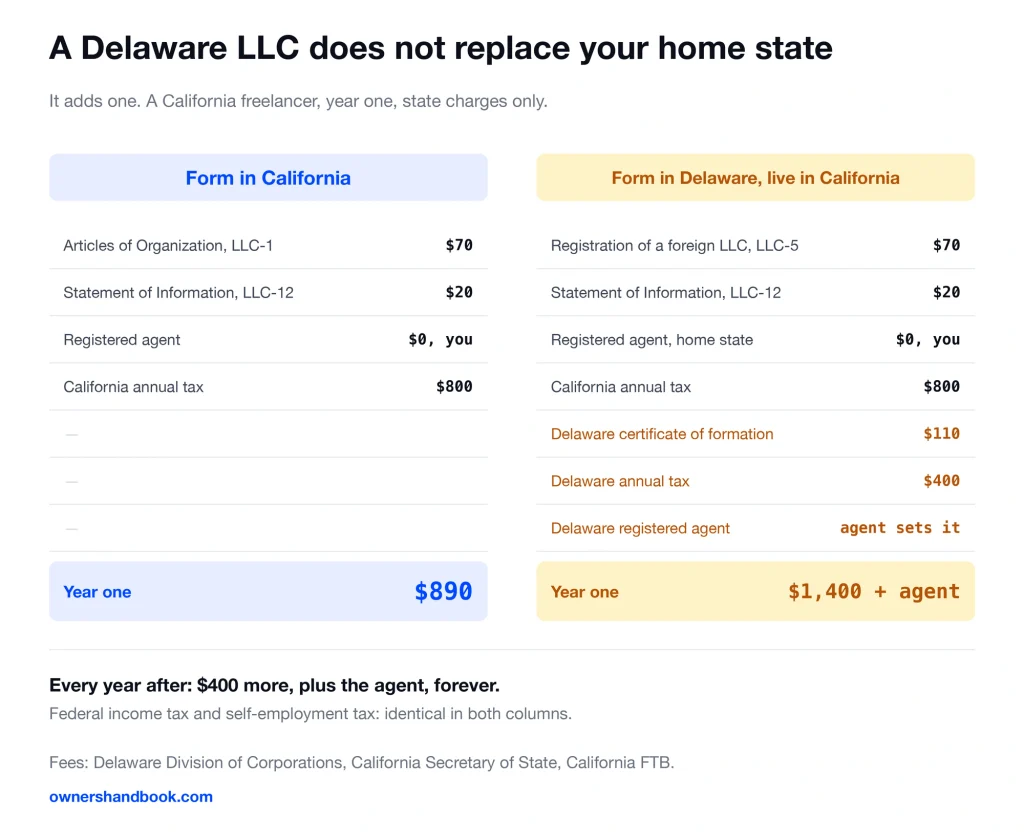
A California freelancer pays Delaware $110 to form and $400 every year after, on top of everything California already charges. That is $510 extra in year one and $400 a year forever.
The rule behind it is the one nobody mentions in the thread that sent you here. An LLC is formed in one state, then registers again in every state where it does business.
What Delaware actually sells
Delaware’s reputation is real. The first reason is the Court of Chancery, a court of equity created in 1792.
It hears disputes about the internal affairs of Delaware business entities, and it has no juries. For a company facing a shareholder suit, a judge who has seen the same fight many times is worth a great deal.
The second is the statute. Delaware corporate law lets a company issue multiple classes of stock, which is the machinery a venture round runs on.
The third is familiarity. Investors and their lawyers assume Delaware, so anywhere else adds legal review to a financing.
Now read that list as a one-person business.
Your LLC still has to register where you work
Foreign LLC — your own LLC, seen from a state that is not the one you formed it in. It has nothing to do with other countries.
California’s version of the rule is the least forgiving, so start there. The Franchise Tax Board says you are doing business in California if you engage in any transaction for the purpose of financial gain within California.
Sending an invoice from your kitchen table in Oakland is a transaction for financial gain within California.
California Corporations Code section 17708.02 then tells a foreign LLC to apply for a certificate of registration before transacting business in the state.
So the Delaware LLC registers in California anyway, at the same fee, with one extra state on top.
What the detour costs a California freelancer
The comparison that matters is not Delaware against doing nothing. It is Delaware against the LLC you would form at home.
| Line item | California LLC | Delaware LLC, living in California |
|---|---|---|
| Formation filing | $70, Form LLC-1 | $110 to Delaware, plus $70 for Form LLC-5 |
| Statement of Information, first 90 days | $20 | $20 |
| Registered agent | $0 if it is you | A paid Delaware agent, rate set by the agent |
| California annual tax | $800 | $800, unchanged |
| Delaware annual tax | $0 | $400, due June 1 |
| Year one, state charges | $890 | $1,400, plus the agent |
California’s $800 does not shrink because you filed in Delaware.
The Franchise Tax Board charges it to any LLC doing business in California or registered with the Secretary of State. Delaware puts you in the second category on purpose.
The $400 is Delaware’s annual tax on LLCs, and it is flat. Delaware does not prorate it and does not ask whether the company earned anything.
Five years in, the detour has cost $2,110 in extra state charges plus five years of agent bills. The savings column is still empty.
You also lose the free option. At home you can be your own registered agent; a Delaware agent needs a Delaware street address, so you rent one.
New York, where the publication bill follows you
New Yorkers try this most, because the publication requirement is genuinely expensive and Delaware looks like the exit.
It is not. Section 802 of New York‘s LLC law puts the same requirement on foreign LLCs, within 120 days of filing the application for authority.
Publish once a week for six successive weeks, in two newspapers of the county, one daily and one weekly, designated by the county clerk. Miss it and your authority to do business in New York is suspended as of day 121.
The newspapers set their own rates and the state does not publish them. The one number New York fixes is $50, for the certificate of publication afterward.
The filing fees move the wrong way too. New York charges $200 for domestic articles of organization and $250 for a foreign LLC’s application for authority.
So the Delaware route costs $110 plus $250, against $200 for a plain New York LLC. That is $160 extra before Delaware’s $400 a year starts.
What a single-member LLC actually is
One owner, one member. Member is simply what an LLC calls an owner, the way a corporation says shareholder.
The IRS gives it a default classification. An LLC with only one member is treated as an entity disregarded as separate from its owner.
Disregarded means the IRS looks straight through the company to you. The profit lands on the same Schedule C, and self-employment tax applies in the same manner as a sole proprietorship.
So the LLC by itself saves zero dollars in tax. Not in Delaware, not in Ohio, not anywhere, and that misconception is what sends people looking for a clever state.
What it buys is a wall and a name. Company debts stop at the company instead of reaching your savings, and the bank account, the contracts and the W-9 carry the business’s name rather than yours.
Your state then taxes the profit where you live. Delaware taxes non-residents only on Delaware-source income, and a freelancer working in Sacramento has none.
$90,000 of profit is $90,000 of California income whether the certificate sits in Dover or Sacramento. State tax follows the person, not the paperwork.
The two Delaware stories that are true anyway
Delaware does not charge shoppers a sales tax. It taxes the seller’s gross receipts instead, at 0.0945% to 1.9914%, and only when you engage in business in the State of Delaware.
Operate elsewhere and you neither owe that tax nor benefit from its absence.
The Delaware loophole people read about is corporate structuring, not an LLC trick. A large company parks trademarks in a Delaware holding company and pays it royalties, moving deductible expense out of the states where it operates.
That needs a corporate income tax worth sheltering. A disregarded single-member LLC does not have one.
When Delaware actually is the right answer
Three situations, and they are narrow.
You are raising venture money. Investors will want a Delaware C corporation rather than an LLC, and your lawyer handles that conversion.
You have co-owners in different states. One neutral body of law governing the operating agreement is worth real money when the owners eventually disagree.
You are outside the United States with no US state nexus — no office, no employees, no property. This one genuinely needs a professional rather than a blog, because treaty questions and withholding decide it.
Notice that none of the three is about paying less tax. All three are about ownership and law.
The answer for almost everyone is one state
Be precise about what the mistake is. It is not forming an LLC. It is forming one somewhere you do not live.
A freelancer in Ohio forms an Ohio LLC. One filing fee, one registered agent — you, at your own address, for nothing — one annual obligation, and no foreign qualification in any state.
The same shape holds in Texas, Kentucky, New York and California. The fees differ enormously; the structure does not.
None of that is a compromise. A home-state LLC gives a one-person business everything a Delaware LLC would — the liability wall — at half the paperwork.
Here is how to form an LLC in five steps. Before that, settle whether you need one at all, because LLC or sole proprietor is a liability question rather than a tax question.
Sole proprietor, then LLC, then the S corp election
There is a real path here, and every step happens in the state you already live in.
| Stage | What you file | What changes | When it makes sense |
|---|---|---|---|
| Sole proprietor | Nothing at all | Schedule C and self-employment tax on your profit | The default, from your first invoice |
| Single-member LLC, your own state | One formation filing, one annual filing | A liability wall and a name to bank under. Tax unchanged. | When your own savings are worth walling off |
| S corp election, same LLC | Form 2553. No new entity. | Salary plus distributions. Self-employment tax stops at the salary. | Once profit covers payroll and a second return |
Read the third row twice. The S corp election is filed on the LLC you already own.
An entity eligible to elect corporate treatment that files Form 2553 is treated as a corporation as of the election’s effective date, and does not have to file Form 8832 first.
No new company, no new state, no second registration. Same EIN, same bank account, same clients, a different tax classification.
Timing is tight. Not more than 2 months and 15 days after the start of the tax year it takes effect, or any time during the year before.
It only pays once your profit covers running payroll and filing a second return. The S corp election article works out where that line falls.
Two other things lower real tax where you already live. A solo 401(k) or SEP-IRA moves money off this year’s taxable income, and so do the deductions you already have — home office, mileage, equipment, health insurance.
Growing means electing differently on the entity you already own. It never means moving it.
This page is general information, not legal or tax advice for your situation. Fees and filing rules are set by each state and change.
Frequently asked questions
Can I form in Delaware and just not register in my home state?
Not legally, and not quietly. California requires a foreign LLC to register before transacting business in the state, and New York suspends an unregistered company’s authority to do business there.
Does forming an LLC lower my taxes?
No. A one-member LLC is a disregarded entity, so the same Schedule C and the same self-employment tax apply to the same profit. Only an S corporation or C corporation election changes federal tax.
Does Delaware require an annual report for an LLC?
No. Delaware requires a $400 annual tax by June 1 and states plainly that there is no requirement to file an annual report. Late payment adds a $200 penalty plus 1.5% interest a month.
I already formed a Delaware LLC. What now?
Register it as a foreign LLC in your home state so you are compliant, then decide whether to keep paying two states. Cancelling costs $220, and the annual taxes must be paid first.
Is Wyoming or Nevada different?
Mechanically, no. Any state that is not the one you work in gives you a second registration and a second annual fee, and your state tax is still decided by where you live.
Do I need a new company to become an S corporation?
No. You file Form 2553 on the LLC you already have, in the state you already formed it in. The company does not move and does not change its name.
Sources
IRS, Single Member Limited Liability Companies
IRS, Limited Liability Company (LLC)
https://www.irs.gov/businesses/small-businesses-self-employed/limited-liability-company-llc
IRS, Instructions for Form 2553
https://www.irs.gov/instructions/i2553
Delaware Division of Corporations, Fee Schedule, revised August 1, 2026
https://corpfiles.delaware.gov/Fee_Schedule/AugustFee2026.pdf
Delaware Division of Corporations, LLC/Partnership Tax Information
Delaware Division of Corporations, How to Form a New Business Entity
Delaware Division of Corporations, Registered Agents
Delaware Division of Corporations, Certificate of Formation of a Limited Liability Company
https://corpfiles.delaware.gov/LLCFormation.pdf
Delaware Division of Revenue, Gross Receipts Tax FAQs
https://revenue.delaware.gov/business-tax/gross-receipts-tax
Delaware Division of Revenue, Personal Income Tax
https://revenue.delaware.gov/personal-income-tax
Delaware Court of Chancery
https://courts.delaware.gov/chancery
California Franchise Tax Board, Limited Liability Company
https://www.ftb.ca.gov/file/business/types/limited-liability-company/index.html
California Franchise Tax Board, Doing Business in California
https://www.ftb.ca.gov/file/business/doing-business-in-california.html
California Secretary of State, Business Entities Fee Schedule
https://bpd.cdn.sos.ca.gov/pdf/be-fee-schedule-062018.pdf
California Corporations Code section 17708.02
https://leginfo.legislature.ca.gov/faces/codes_displaySection.xhtml?lawCode=CORP§ionNum=17708.02
New York Limited Liability Company Law section 802, Publication
https://www.nysenate.gov/legislation/laws/LLC/802
New York Limited Liability Company Law section 1101, Fees