Self-Employment Taxes in New York: Two Taxes Nobody Warns You About
A self-employed New Yorker can owe four separate taxes to New York, and two of them are not income taxes at all. Every dollar of it sits on top of US federal tax.
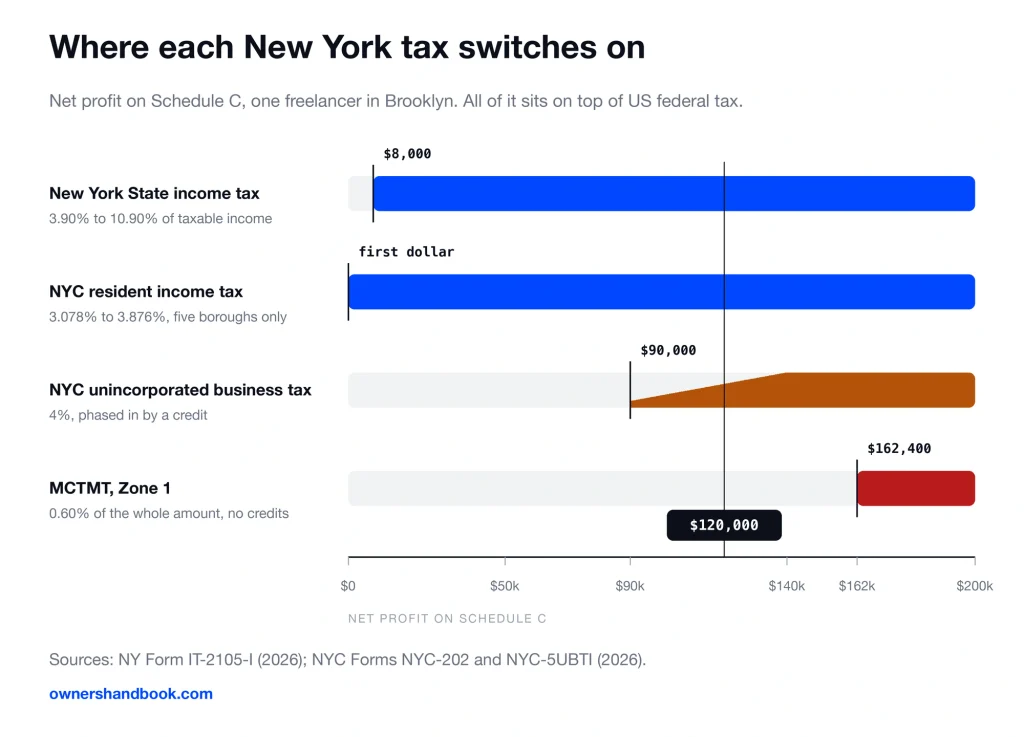
State income tax starts at 3.90%. New York City adds its own if you live in the five boroughs. The MCTMT switches on above $150,000 of self-employment earnings. And the unincorporated business tax starts biting at $90,000 of profit.
The layer everyone expects
New York State taxes your income on a graduated schedule. For 2026 it runs from 3.90% on the first dollars to 10.90% at the very top.
A single filer with $103,522 of New York taxable income sits in the 5.90% bracket. The tax is $4,191 plus 5.90% of everything over $80,650, which comes to about $5,540.
New York starts from your federal adjusted gross income, so the deduction for half your self-employment tax carries through. The standard deduction is $8,000 single, $16,050 married filing jointly.
There is no New York version of self-employment tax. Social Security and Medicare are federal programs, and that 15.3% does not repeat at the state level.
New York City taxes residents separately, and this is not the UBT
Live in Manhattan, the Bronx, Brooklyn, Queens or Staten Island and you owe a second income tax, to the city.
It runs 3.078% to 3.876%, and it is collected on the same state return you already file. Move one stop into Westchester and you owe none of it.
People confuse this with the unincorporated business tax constantly. They are different taxes, with different bases, different forms and different collectors.
City income tax is charged on you. The UBT is charged on your business. Both can land in the same year.
The MCTMT, and the cliff hiding inside it
Metropolitan Commuter Transportation Mobility Tax. It funds the MTA across the twelve counties the transit district covers, and it is charged by zone.
Zone 1 is the five boroughs, at 0.60%. Zone 2 is Rockland, Nassau, Suffolk, Orange, Putnam, Dutchess and Westchester, at 0.34%.
It applies to your net earnings from self-employment — Schedule SE, Part I, line 6 — allocated to that zone, and only when they exceed $150,000.
That threshold is new. It was $50,000 for 2025 and earlier years, and it rose to $150,000 for tax year 2026.
Here is the part that will catch you. The rate applies to the whole amount, not to the excess over the line.
Cross into Zone 1 by one dollar and you owe $900. At $149,999 of net earnings you owe nothing at all.
Two more details. The $150,000 test is computed per individual even on a joint return, and no tax credit can be used to offset the MCTMT.
Because the test runs on Schedule SE line 6, which is 92.35% of your profit, you need roughly $162,400 of net profit before this reaches you.
| Layer | What it taxes | Rate | Switches on at |
|---|---|---|---|
| New York State income tax | Your personal income | 3.90% to 10.90% | Income above the standard deduction |
| NYC resident income tax | Your personal income | 3.078% to 3.876% | Any income, if you live in the five boroughs |
| MCTMT | Net earnings from self-employment | 0.60% Zone 1, 0.34% Zone 2 | Schedule SE line 6 over $150,000 |
| NYC unincorporated business tax | The business itself | 4%, less a credit | About $90,000 of net profit |
The unincorporated business tax is a tax on the business, not on you
The UBT is 4% on the net income of an unincorporated business carried on in New York City. Sole proprietors, single-member LLCs and partnerships.
Read that again: on the business. It has nothing to do with your filing status, your dependents, or the personal return you file in April.
A person performing services as an employee is exempt. That is the line the city draws, and being genuinely self-employed puts you on the wrong side of it.
Take $5,000 off your net business income first, the flat exemption every unincorporated business gets. Then apply 4%.
Why $90,000 is the number to watch
Almost nobody actually pays the full 4%. A business tax credit wipes the tax out entirely when it comes to $3,400 or less.
$3,400 of tax means $85,000 of taxable business income, which means $90,000 of net profit. Below that line, your UBT is exactly zero.
Above $3,400 the credit shrinks on a formula: the tax multiplied by ($5,400 minus the tax), divided by $2,000. At $5,400 of tax the credit disappears.
$5,400 of tax means $140,000 of net profit. That is where the phase-in ends and you simply pay 4% on the whole taxable amount.
So $50,000 of profit between $90,000 and $140,000 generates $5,400 of brand new tax. The marginal rate inside that band starts at 6.8% and finishes at 14.8%.
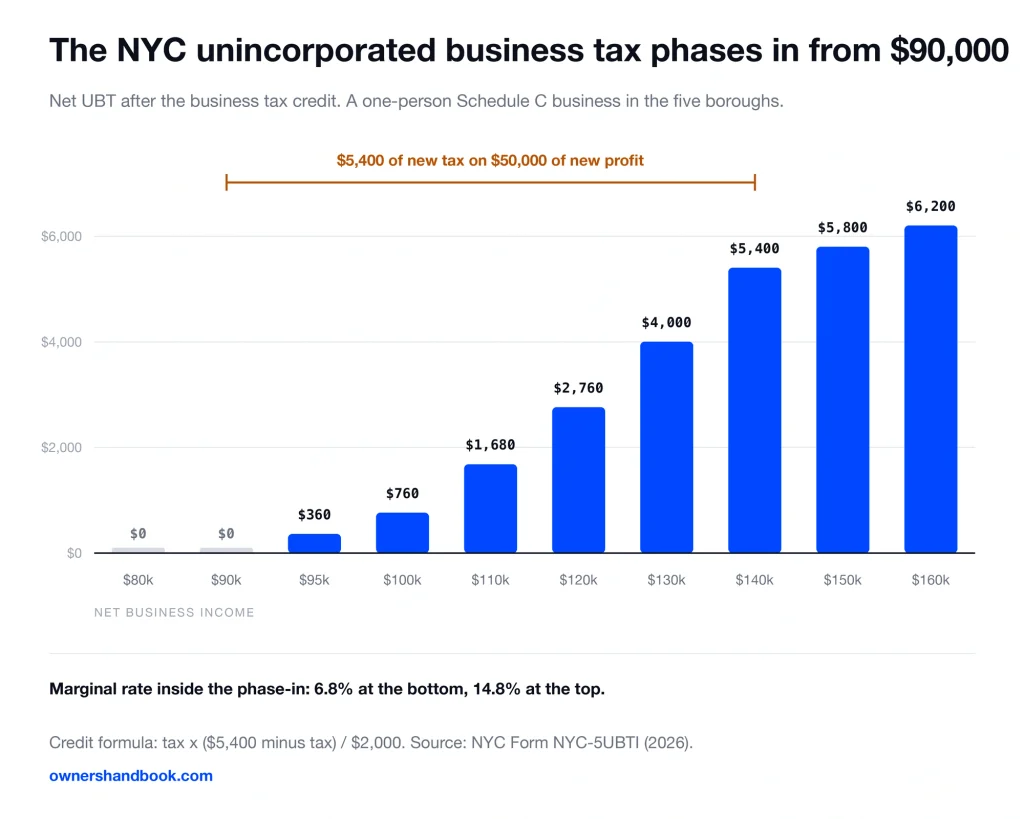
That stretch is the most expensive fifty thousand dollars a New York City freelancer earns, and nobody warns you about it in advance.
One Brooklyn freelancer at $120,000
Single, works from an apartment in Brooklyn, $120,000 of net profit on Schedule C, no other income. Here is what each layer actually adds.
Net earnings from self-employment are $110,820, which is 92.35% of $120,000. That figure drives both the federal tax and the MCTMT test.
| Layer | Charged on | What it costs |
|---|---|---|
| Federal self-employment tax | $110,820 net earnings | $16,955 |
| New York State income tax | $103,522 taxable income | about $5,540 |
| NYC resident income tax | $103,522 taxable income | about $3,888 |
| MCTMT Zone 1 | $110,820, under the $150,000 line | $0 |
| NYC unincorporated business tax | $115,000 after the exemption | $2,760 |
| New York’s share, before the UBT credit | $12,188 |
The MCTMT costs nothing here. That is not luck. It is the $150,000 threshold, and it is the single reason this bill is not worse.
The UBT number is the surprise. $2,760 on a business that most people would describe as one person with a laptop.
More than half the UBT comes back, but only for residents
Form IT-219, Credit for New York City Unincorporated Business Tax. It gives a New York City resident part of the UBT back against city income tax.
The credit is 100% of the UBT if your city taxable income is $42,000 or less, and 23% at $142,000 or more. In between it slides on a straight line.
Our Brooklyn freelancer, at $103,522 of city taxable income, gets 52.6%. That is $1,453 back, leaving $1,307 of UBT actually paid.
New York’s real total on that $120,000, then, is about $10,735. Roughly 8.9% of profit, entirely separate from what the IRS takes.
The credit cannot exceed your city income tax, is not refundable, and does not carry forward to next year.
And it is only for residents. Live in New Jersey, keep a desk in Manhattan, and you pay the full UBT with nothing coming back.
Three governments, two forms, four dates
New York State estimated payments are due April 15, June 15 and September 15 of 2026, then January 15 of 2027. The same dates as the federal ones.
One voucher, Form IT-2105, carries state tax, city tax, Yonkers tax and MCTMT together. You have to make estimated payments if you expect to owe at least $300 after withholding and credits.
The UBT does not ride along. It has its own declaration, Form NYC-5UBTI, filed with the New York City Department of Finance.
That declaration is required once your 2026 UBT is expected to exceed $3,400. Same four dates, different form, different government.
Paying the IRS does not pay Albany. Paying Albany does not pay the Department of Finance. Nothing is forwarded between any of them.
Frequently asked questions
I live in Brooklyn and cleared $70,000. Do I owe the UBT?
No tax. The business tax credit covers the whole amount below roughly $90,000 of net profit, so the UBT comes to zero.
Does the MCTMT apply only to the part over $150,000?
No. Once net earnings from self-employment allocated to a zone exceed $150,000, the rate applies to the entire amount. Zone 1 at $150,001 is $900.
I live in Westchester and all my clients are in Manhattan. Which zone am I in?
Zone follows where the business is carried on, not where clients sit. Working from Westchester is Zone 2 at 0.34%. Regular use of a Manhattan workspace allocates part to Zone 1.
I formed an LLC. Does that get me out of the UBT?
No. A single-member LLC is exactly what the unincorporated business tax was written for. Electing corporate treatment moves you to New York City’s corporate taxes instead.
Do I make separate quarterly payments for the UBT?
Yes. Form NYC-5UBTI goes to the Department of Finance on its own, once you expect to owe more than $3,400. Form IT-2105 covers everything else.
I moved out of New York City in June. Do I still owe the city?
Partly. UBT applies to the business carried on in the city, and city income tax applies to your resident months. Form IT-360.1 handles the change of city resident status.
For the federal layer underneath all of this, see the guides on self-employment tax, quarterly estimated taxes, how to pay estimated taxes, what belongs on Schedule C, and how state tax works everywhere else.
Sources
New York State Department of Taxation and Finance, Instructions for Form IT-2105, Estimated Tax Payment Voucher for Individuals (2026)
https://www.tax.ny.gov/pdf/current_forms/it/it2105i.pdf
New York State Department of Taxation and Finance, Metropolitan Commuter Transportation Mobility Tax
https://www.tax.ny.gov/bus/mctmt/default.htm
New York State Department of Taxation and Finance, MCTMT for Self-Employed Individuals
https://www.tax.ny.gov/bus/mctmt/selfemp.htm
New York State Department of Taxation and Finance, New York City and Yonkers Tax
https://www.tax.ny.gov/pit/file/nyc_yonkers_residents.htm
New York State Department of Taxation and Finance, Estimated Taxes
https://www.tax.ny.gov/pit/estimated_tax/default.htm
New York State Department of Taxation and Finance, Instructions for Form IT-219, Credit for New York City Unincorporated Business Tax
https://www.tax.ny.gov/pdf/current_forms/it/it219i.pdf
New York State Department of Taxation and Finance, Form IT-219
https://www.tax.ny.gov/pdf/current_forms/it/it219_fill_in.pdf
New York City Department of Finance, Business Taxes: Unincorporated Business Tax
https://www.nyc.gov/site/finance/business/business-unincorporated-business-tax-ubt.page
New York City Department of Finance, Form NYC-5UBTI, Declaration of Estimated Unincorporated Business Tax (2026)
https://www.nyc.gov/assets/finance/downloads/pdf/26pdf/business_tax_forms/nyc-5ubti_2026.pdf
New York City Department of Finance, Form NYC-202, Unincorporated Business Tax Return for Individuals and Single-Member LLCs
https://www.nyc.gov/assets/finance/downloads/pdf/25pdf/business_tax_forms/nyc-202_2025.pdf