Self-Employment Taxes in California: The Parts the IRS Does Not Warn You About
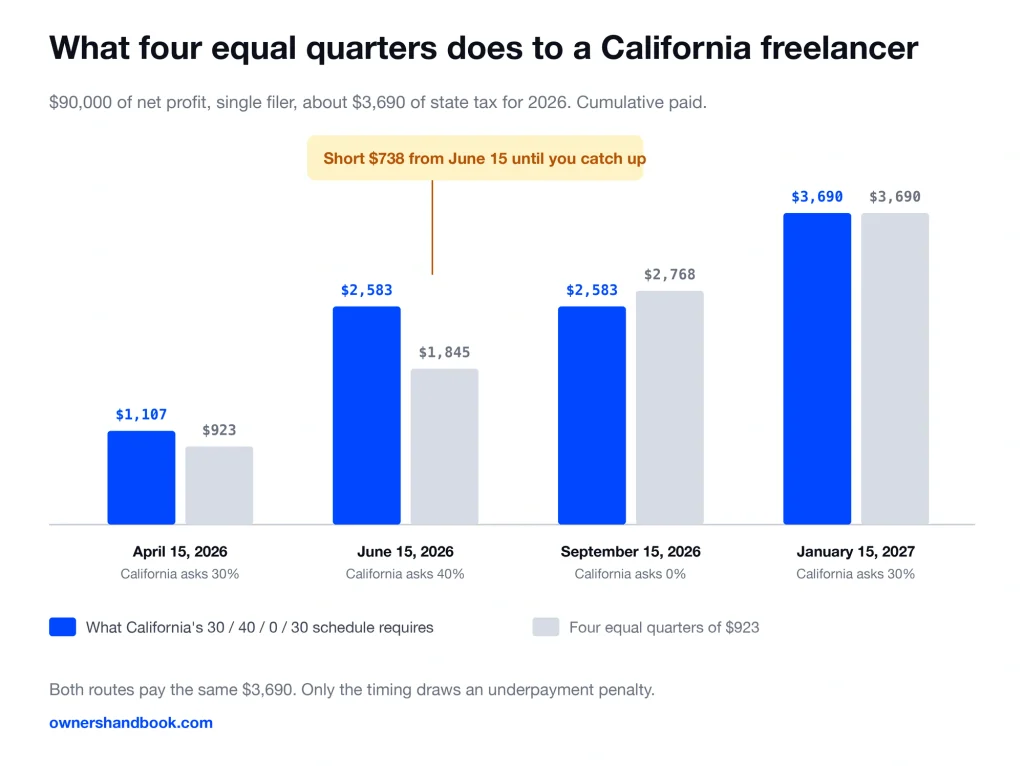
California wants 30% of your year’s state tax by April 15, another 40% by June 15, nothing at all in September, and the last 30% by January 15.
That is state income tax stacked on top of what you already owe the United States. Pay four equal quarters and you are short all summer.
The schedule is 30, 40, zero, 30
The Franchise Tax Board, the agency that collects California income tax, sets the installments at 30%, 40%, 0%, and 30% of your required annual payment. No other state splits the year this way.
The dates themselves match the federal ones. April 15, June 15, September 15, January 15. Only the amounts differ.
Seventy percent of the year is due before July. That is the whole trap, and every calculator that assumes equal quarters walks you into it.
None of this replaces the federal side. Your quarterly estimated taxes to the IRS still run on their own schedule, and neither agency forwards anything to the other.
What that does to $90,000 of profit
Take a single filer with $90,000 of net profit and no other income.
Self-employment tax comes to $12,717 for the year. Half of it, $6,358, is deductible and comes off before California starts counting, leaving $83,642 of California adjusted gross income.
Subtract the 2026 standard deduction of $5,706 and you have $77,936 of taxable income. Run that through Schedule X and the state tax is about $3,690 before credits.
Now split that number two ways.
| Due date | California’s share | You send | A naive equal quarter |
|---|---|---|---|
| April 15, 2026 | 30% | $1,107 | $923 |
| June 15, 2026 | 40% | $1,476 | $923 |
| September 15, 2026 | 0% | $0 | $923 |
| January 15, 2027 | 30% | $1,107 | $923 |
Same $3,690 either way. The timing is the only thing that gets penalized.
By the evening of June 15, California expects $2,583 in hand. Equal quarters would have delivered $1,845. You are $738 short, and the underpayment clock starts running there.
Then it flips. By late September the equal-quarter payer is ahead by $185, which earns exactly nothing. Underpaid first, overpaid later, for no gain in either direction.
Nothing is due in September, and that is not a typo
The Form 540-ES instructions do list a third payment date of September 15, 2026. The installment amount next to it is zero.
The date exists so California’s form stays parallel to the federal one. Nothing is required on it.
Send money anyway and it is not lost. It sits as a credit against the January installment. You have simply lent California that $923, interest free, for four months.
An LLC pays $800 a year to exist
This one is not a timing problem. It is a bill.
Every LLC doing business in California, or organized here, owes an $800 annual tax. It is due the 15th day of the fourth month of the taxable year, on Form FTB 3522. Profit is irrelevant.
A year with a $10,000 loss still costs $800. So does a year with no clients at all, right up until you formally cancel with the Secretary of State.
A sole proprietor pays none of it. That is the largest single number in the choice between an LLC and a sole proprietorship in this state.
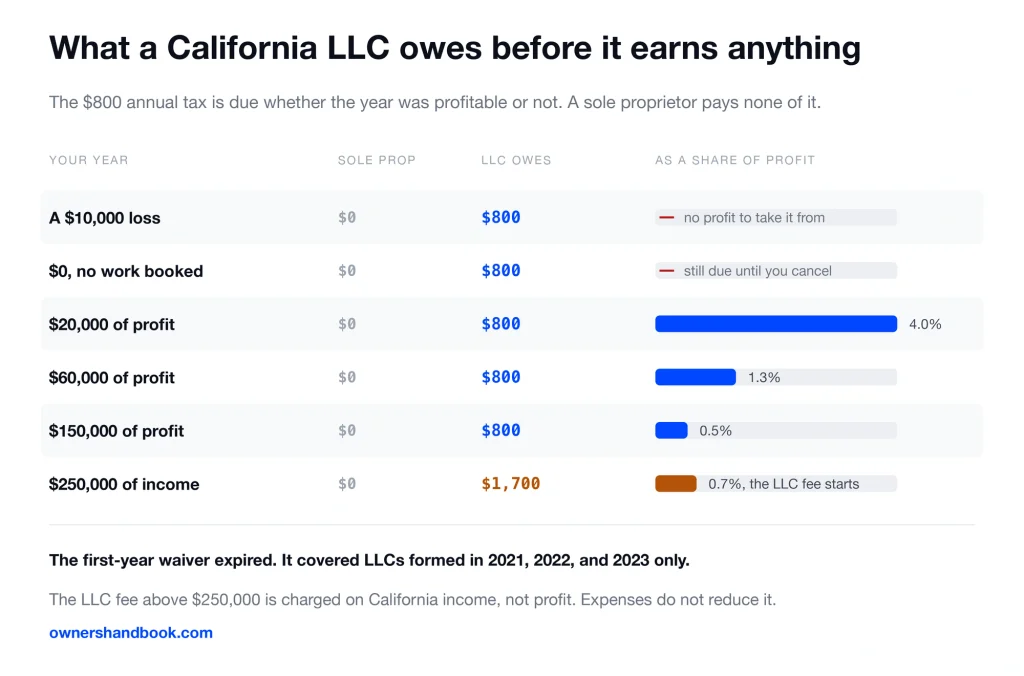
The first-year waiver people still repeat is gone. It applied only to LLCs that registered in tax years beginning on or after January 1, 2021 and before January 1, 2024.
Past $250,000 a second charge appears, called the LLC fee. It is separate from the $800 and you pay both.
| Total California income | Annual tax | LLC fee | Total |
|---|---|---|---|
| Under $250,000 | $800 | $0 | $800 |
| $250,000 to $499,999 | $800 | $900 | $1,700 |
| $500,000 to $999,999 | $800 | $2,500 | $3,300 |
| $1,000,000 to $4,999,999 | $800 | $6,000 | $6,800 |
| $5,000,000 or more | $800 | $11,790 | $12,590 |
Read that first column carefully. The fee is charged on California income, not profit. Your expenses do not reduce it.
The fee has its own deadline, the 15th day of the sixth month, on Form FTB 3536. Two charges, two forms, two dates.
Past a certain size, paper checks stop being allowed
California calls this mandatory e-pay, and the trigger is permanent once you hit it.
You cross the line by making one estimate or extension payment over $20,000, or by filing a return with a total tax liability over $80,000.
For a freelancer the June installment usually trips it first, since 40% is the largest single payment of the year. That takes roughly $50,000 of annual California tax.
After that, every payment must be electronic. Every tax type, every year, regardless of amount. A paper check draws a 1% noncompliance penalty.
The payment that triggers the rule does not itself have to be electronic. Everything after it does.
Above a million, the safe harbor disappears
The usual protection is the prior-year safe harbor, meaning you pay 100% of last year’s tax and no underpayment penalty can be charged no matter what this year turns out to be.
California raises that to 110% once your prior-year California AGI passes $150,000, or $75,000 if married filing separately. So far this mirrors the federal rule.
At $1,000,000 of current-year California AGI it stops existing entirely. You must base estimates on 90% of your actual 2026 tax, a number you do not know until the year is over.
That is why one unusually good year in California is harder to plan than a steady large one. There is nothing safe to fall back on.
The 1% Behavioral Health Services Tax
Above $1,000,000 of taxable income, California adds 1% on the excess. It was called the Mental Health Services Tax until the name changed.
On $1,300,000 of taxable income that is $3,000. It sits on top of a top bracket of 12.3%, which is where the 13.3% figure you see quoted comes from.
California’s brackets start at 1% and climb through nine steps to that 12.3%. A $90,000 freelancer tops out in the 9.3% bracket, not anywhere near the headline.
It is not a filing-season surprise either. The 540-ES worksheet folds it into your estimated tax, so it gets split 30, 40, 0, 30 like everything else.
Where you actually pay
Web Pay, at ftb.ca.gov/pay, takes a bank account for free and lets you schedule a payment up to a year in advance.
Do all three in one January sitting. Scheduling ahead defeats the uneven schedule completely, because the amounts are locked in before you get a chance to misremember them.
The rules kick in when you expect to owe at least $500, or $250 if married filing separately, after withholding and credits. Below that, no estimates are required.
If you also hold a W-2 job in California, raising withholding works here the same way it does federally. The form is EDD Form DE 4, which is separate from the federal W-4.
Frequently asked questions
Do I pay self-employment tax to California?
No. Social Security and Medicare are federal programs, so the 15.3% does not repeat at the state level. California charges income tax only.
I already paid four equal quarters this year. How bad is it?
The penalty is interest on the shortfall for the months it was short. On $738 that is a small number, not a disaster. Fix the pattern next year.
Can I just pay the whole year on April 15?
Yes. Paying early is never penalized in California. Only paying late is.
My LLC made nothing. Do I really still owe $800?
Yes, until you cancel with the Secretary of State. Registration creates the bill, not profit. The state also charges $250 if you skip your Statement of Information.
I moved out of California in June. Do I still make the January payment?
You will file a part-year resident return, and your estimates should cover the California income from the months you were there. Recalculate rather than skipping.
Does California follow the federal qualified business income deduction?
No. That 20% deduction is federal only, so your California taxable income runs higher than your federal taxable income. The deduction for half your self-employment tax does carry over.
Sources
California Franchise Tax Board, Estimated Tax Payments
https://www.ftb.ca.gov/pay/estimated-tax-payments.html
California Franchise Tax Board, 2026 Instructions for Form 540-ES
https://www.ftb.ca.gov/forms/2026/2026-540-es-instructions.html
California Franchise Tax Board, Mandatory e-Pay for Individuals
https://www.ftb.ca.gov/pay/mandatory-e-pay.html
California Franchise Tax Board, Limited Liability Company
https://www.ftb.ca.gov/file/business/types/limited-liability-company/index.html
California Franchise Tax Board, 2025 California Tax Rate Schedules
https://www.ftb.ca.gov/forms/2025/2025-540-booklet.html
California Franchise Tax Board, 2025 Instructions for Schedule CA (540)
https://www.ftb.ca.gov/forms/2025/2025-540-ca-instructions.html
California Franchise Tax Board, Pay
https://www.ftb.ca.gov/pay/index.html
IRS, Estimated Taxes
https://www.irs.gov/businesses/small-businesses-self-employed/estimated-taxes