A Client Went Quiet. Here Is the Ladder.
Send the first message before the invoice is due, not after. Timing does more work here than wording ever will. A note on day 22 of a Net 30 reads as helpful, because nothing is wrong yet. The same sentences on day 35 read as a complaint, and the client hears an accusation instead of a reminder. What follows is a ladder that runs from that first note to a small claims filing. Most invoices come loose on the first two rungs.
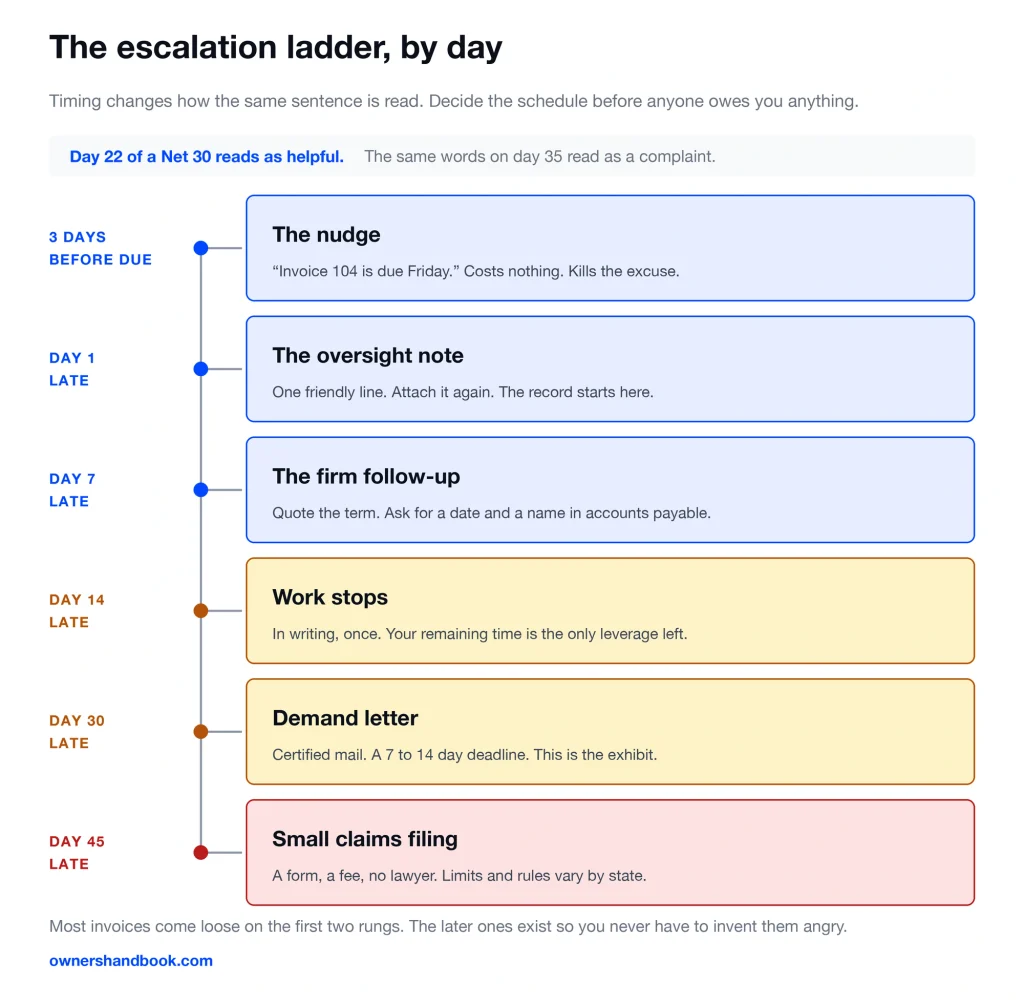
The same words land differently on day 22 and day 35
Before the due date, a reminder is a service. You are helping someone hit a deadline they may not have looked at yet.
After the due date, every message carries an accusation inside it, however you phrase it. The client now has to decide whether to feel bad before deciding whether to pay.
So the cheapest message you will ever send is the one you send three days early. It costs nothing socially and it removes the only innocent explanation for silence.
Decide the whole schedule now, while nobody owes you anything. Escalation written in advance is procedure. Escalation invented on day 40 is a mood.
| When | What you send | What it is doing |
|---|---|---|
| 3 days before due | A short note that the invoice is coming up | Removing the excuse of not having seen it |
| Day 1 late | One friendly line assuming an oversight | Starting the written record cheaply |
| Day 7 late | A firm follow-up quoting the payment term | The first message that is clearly about money |
| Day 14 late | Written notice that work stops | Turning your remaining time back into leverage |
| Day 30 late | A demand letter, sent certified, 7 to 14 days | Building the exhibit a judge will read |
| Day 45 late | A small claims filing | Moving it out of your inbox and onto a docket |
Those dates are a default, not a rule. Shorten them for a small invoice. Stretch them for a client with a real accounts payable department and a check run on the fifteenth.
The four messages, word for word
Keep every one of them short. Long messages read as anxious, and anxious reads as negotiable.
The nudge, three days out.
Hi Dana — invoice 104 is due Friday. Sending it up in case it has to go through anyone else on your side first. Copy attached.
The first follow-up, one day late.
Hi Dana — invoice 104 was due yesterday and I have not seen it land. Attaching it again in case it got buried. Let me know if anything is holding it up.
The firm one, a week late.
Hi Dana — invoice 104 is now 7 days past due. Our agreement is Net 30 from the invoice date. Can you tell me today when payment will be sent, or who I should be talking to in accounts payable?
You asked for a date and a name. A client who will not give you either has told you something worth hearing.
The work-stops notice, two weeks late.
Hi Dana — invoice 104 is 14 days past due, so I am pausing work as of today. I will pick it back up the day payment clears. Nothing else changes, and I would rather not be doing this.
Say that one once. Do not repeat it, and do not soften it the next day. Both teach the client that your deadlines move when pushed.
A late fee only exists if you wrote it down first
This is the rung that costs people real money, and it is decided before any of this starts.
There is no federal law that makes an ordinary private client owe you interest on a late invoice.
The Prompt Payment Act does force federal agencies to pay interest when they pay a contractor late. It binds the government, not your client.
So a late fee is collectible only as a contract term. If the agreement you signed says nothing about one, you cannot add it in month two and expect a court to back you.
Nolo puts the test plainly: charge a late fee only if the client was on notice at the outset that you reserved the right to do so.
The common contract term is 1.5% per month, which is 18% a year. Whether it survives a challenge turns on two things you have to check for your own state.
The first is usury — the legal ceiling your state puts on interest. Nolo’s guidance is that at 10% a year or less you probably stay inside those statutes, and rates above that get less predictable.
The second is the penalty rule. Courts enforce a stipulated damages clause that estimates a real loss and refuse one that is punitive, so an aggressive fee risks having the whole clause struck out.
The practical version: pick a number you could defend as the cost of being unpaid, put it in the contract before the work starts, and check what your state allows.
The demand letter is a document, not an email
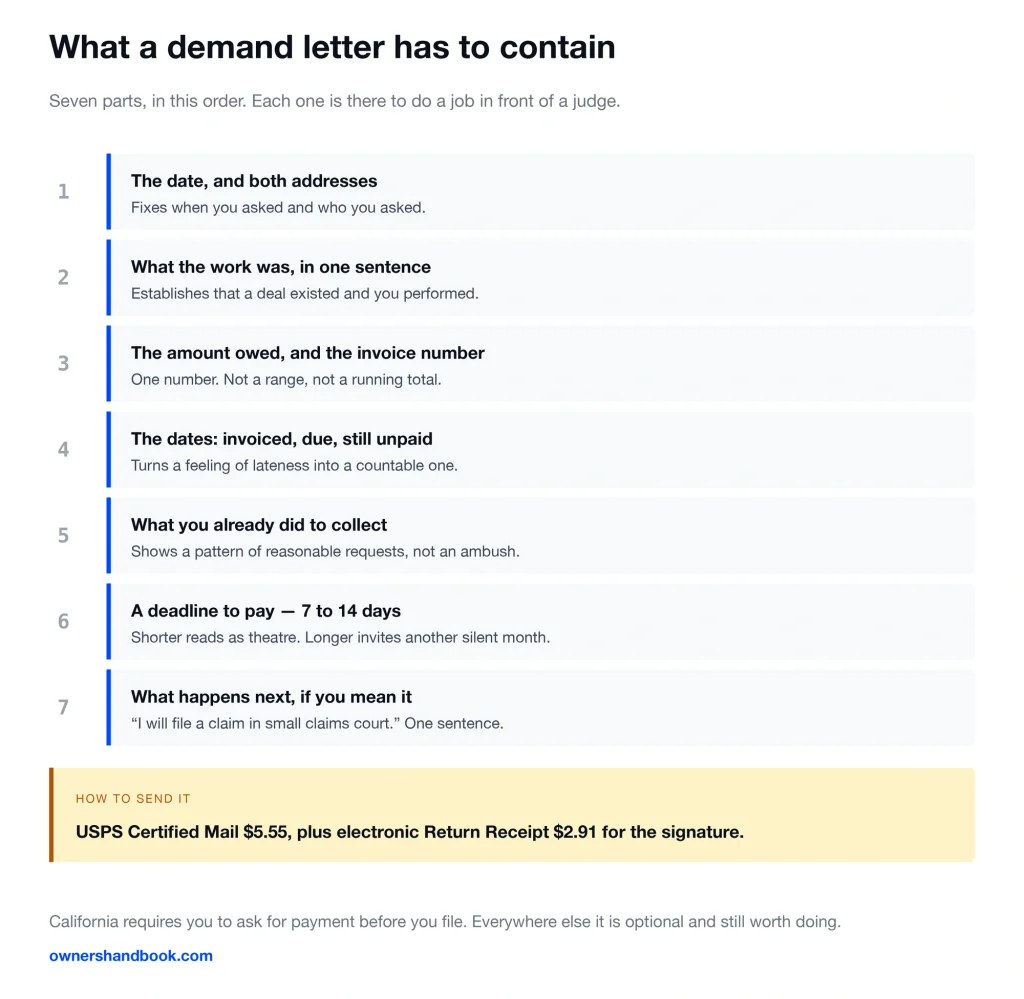
A demand letter is a short, dated letter stating what is owed, why it is owed, and by when — and creating proof that you asked.
Most states do not require one before you sue. California does. Its self-help guide says you must ask the other side to pay before you can file, and points to a demand letter as the way to do it.
Even where it is optional, send it. It turns a scattered thread of chat messages into one exhibit, and an exhibit is what a judge reads.
Send it by USPS Certified Mail, which gives you proof of mailing and a delivery record. Add Return Receipt for the recipient’s signature. Certified Mail is $5.55 and an electronic Return Receipt is $2.91.
Give a deadline of 7 to 14 days. Shorter reads as theatre. Longer invites another month of nothing happening.
Then say what you will do next, in one sentence, and only if you mean it. If payment is not received by October 3, I will file a claim in small claims court.
Email a copy the same day you mail it. The letter is the record. The email is the part that actually gets read.
Small claims court is smaller than it sounds
You fill in a form, pay a modest fee, and stand up for ten minutes without a lawyer. In California a lawyer cannot represent you at the hearing at all.
The limits vary a lot by state, and sometimes by whether you are suing as a person or as a business.
| State | The most you can sue for | Where the case is filed |
|---|---|---|
| California | $12,500 as an individual, $6,250 as a business | Small claims division of the superior court |
| Texas | $20,000 | Justice of the peace court |
| New York | $10,000 in New York City, $5,000 in other city courts, $3,000 in town and village courts | Small claims part of the local court |
The fees are small. California’s small claims filing fee runs $30 to $100, and the court can waive it if you cannot afford it.
There is a deadline to sue. In California a written agreement gives you four years from the day it was broken, and an unwritten one gives you two.
There is also a wait. California schedules the hearing no earlier than 20 days and no later than 70 days after the order.
Bring the contract, the invoice, proof you delivered the work, and every message where the client acknowledged receiving it. Paper beats memory.
Winning and collecting are two different things
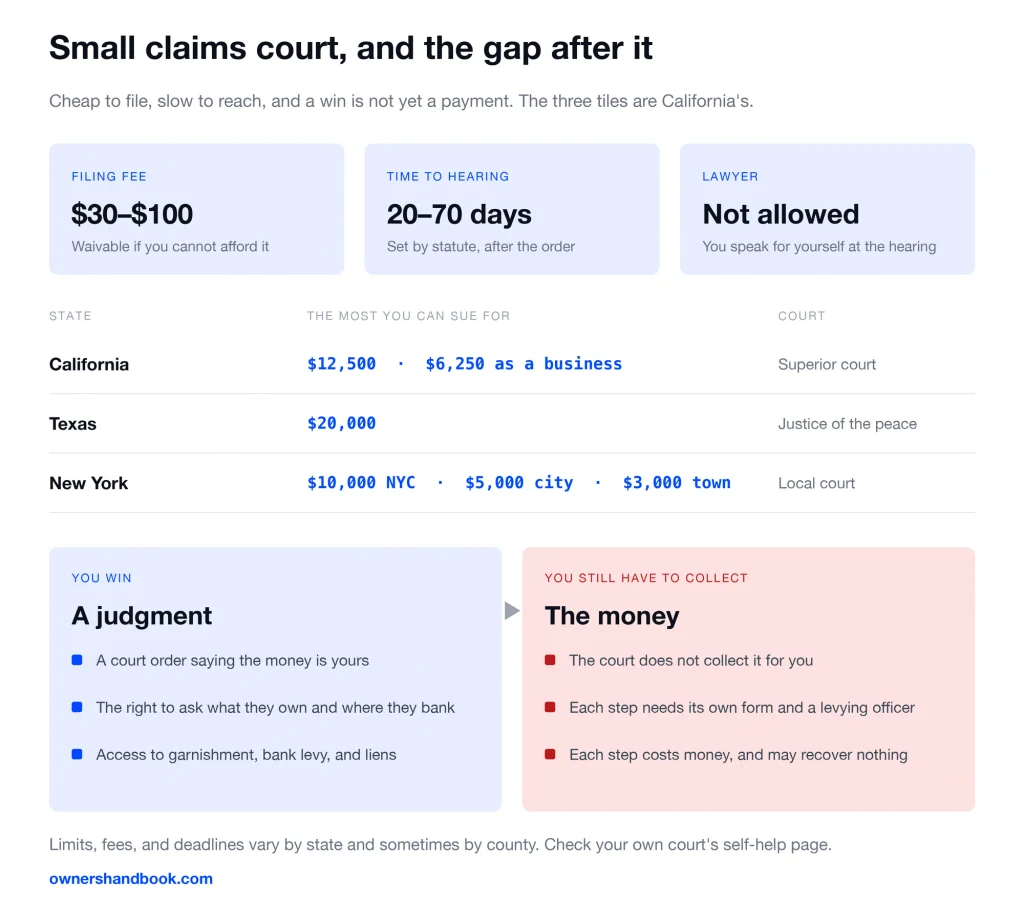
A judgment is a court saying the money is yours. It is not the money.
California’s guide is blunt about this: the court does not collect the money for you.
What the judgment buys you is access to tools. You can garnish wages, levy a bank account, or put a lien on property. Each one needs its own form and a sheriff or levying officer to carry it out.
Each of those steps costs something. California’s own guidance warns that collecting can take a lot of time and money and that you may not collect any of it.
That is not a reason to skip court. It is a reason to size up the client before you file. One with a storefront, a payroll, and a bank you can name is collectible. One that has quietly dissolved often is not.
A few states now put a statute behind you
New York‘s Freelance Isn’t Free Act took effect on August 28, 2024, and it changes the arithmetic for work done there.
It covers freelance work worth $800 or more, counting everything from the same client over the previous 120 days, and it requires a written contract.
Payment is due on the date named in the contract, or within 30 days of finishing the work if the contract names no date.
Win a claim under that payment provision and the statute entitles you to double damages plus reasonable attorneys’ fees. That last part is why a lawyer will take a small case.
Illinois, Los Angeles, and New York City have their own versions with their own numbers. This area is changing, so check whether your state added one.
None of this is legal advice. Every dollar limit, deadline, and procedure on this page varies by state, and some vary by county. Read your own court’s self-help page before you file anything.
A last point, and it surprises people. You cannot write off the money as a bad debt.
A bad debt deduction only exists for income you already reported. Almost every freelancer files on a cash basis, which means unpaid work was never income in the first place, so there is nothing to deduct on your Schedule C. What you lost is the time, and the tax code does not price your time.
Frequently asked questions
Can I add a late fee now if my contract never mentioned one?
Generally no. A late fee is a contract term, and there is no federal statute that creates one for ordinary private work. You can ask the client to agree to one in writing going forward.
Do I have to send a demand letter before I sue?
It depends on the state. California requires you to ask the other side to pay before filing and suggests a demand letter. Elsewhere it is usually optional, and still worth sending as evidence.
Can I put a lien on my client’s property?
Almost certainly not. A mechanic’s lien secures payment for labor or materials that improved real property, which is why it belongs to builders and suppliers rather than to designers, writers, or developers.
The client is in another state. Where do I sue?
Usually where the defendant lives or does business, which can mean traveling. Check your contract for a venue clause, then check the rules of the court you plan to file in.
Should I hand it to a collection agency instead?
You can, and California’s guide notes you can assign a judgment to one. The agency keeps a large share of anything it recovers, so it is a way to stop spending your own time, not a way to be made whole.
Does chasing payment make me look unprofessional?
The opposite. A scheduled, unemotional follow-up reads as a business with a process. Silence for six weeks followed by an angry email is the version that costs you the relationship.
Sources
California Courts Self Help Guide, Small claims in California
https://selfhelp.courts.ca.gov/small-claims-california
California Courts Self Help Guide, Before you start a small claims case
https://selfhelp.courts.ca.gov/small-claims/before-you-start
California Courts Self Help Guide, How to collect your money
https://selfhelp.courts.ca.gov/small-claims/after-trial/collect-money
California Code of Civil Procedure Section 116.330
https://leginfo.legislature.ca.gov/faces/codes_displaySection.xhtml?lawCode=CCP§ionNum=116.330
New York Courts, How much can I sue for in small claims court
https://www.nycourts.gov/node/1051
Texas State Law Library, Small Claims Cases
https://guides.sll.texas.gov/small-claims
Nolo, When can I charge late fees or finance charges
https://www.nolo.com/legal-encyclopedia/question-when-charge-late-fees-finance-charges-28337.html
Nolo, How to Write a Settlement Demand Letter
https://www.nolo.com/legal-encyclopedia/free-books/small-claims-book/chapter6-4.html
Legal Information Institute, Liquidated damages
https://www.law.cornell.edu/wex/liquidated_damages
Legal Information Institute, Mechanic’s lien
https://www.law.cornell.edu/wex/mechanics_lien
U.S. Treasury Bureau of the Fiscal Service, Prompt Payment
https://fiscal.treasury.gov/payments-from-government/prompt-payment
31 U.S. Code Chapter 39, Prompt Payment
https://www.law.cornell.edu/uscode/text/31/subtitle-III/chapter-39
USPS, Insurance and Extra Services
https://www.usps.com/ship/insurance-extra-services.htm
New York Department of Labor, Freelance Isn’t Free Act
https://dol.ny.gov/freelance-isnt-free-act
New York General Business Law Article 44-A