Late Fees: What You Can Charge and What Actually Works
A late fee is collectible only if it was in the signed agreement before the work started. You cannot add one in month two.
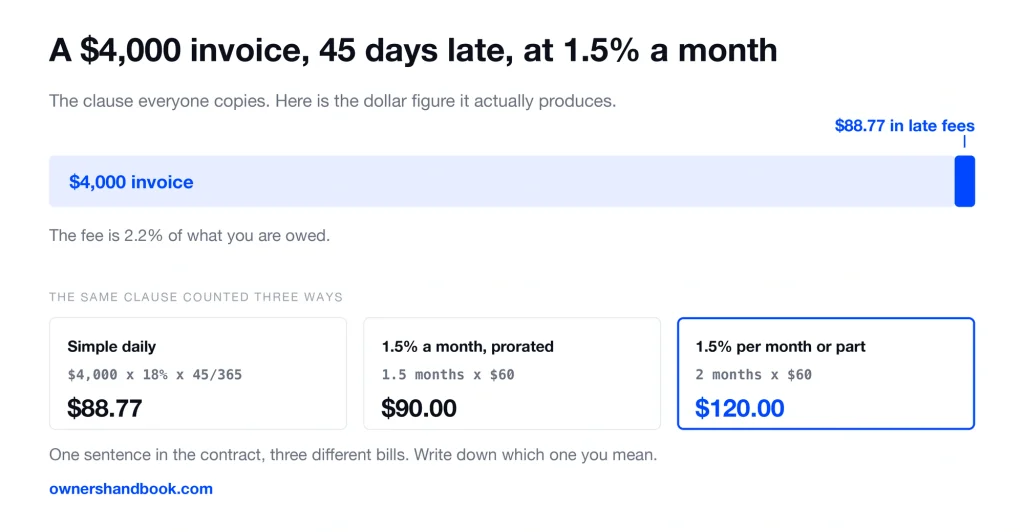
The usual clause is 1.5% a month, which is 18% a year. On a $4,000 invoice 45 days late that comes to $88.77.
Write the clause in anyway. Just do not expect it to be the thing that gets you paid.
What the fee is actually worth
Eighty-nine dollars. On four thousand.
That is 2.2% of what you are owed, for a month and a half of chasing it. At a $75 hourly rate you have already spent more than that writing the follow-up emails.
This is the number nobody puts next to the clause when they tell you to add one. The clause is worth adding. It is worth adding for reasons that have almost nothing to do with the $88.77.
The same clause, counted three ways
Here is where the sentence you copied off a template starts costing you.
“1.5% per month on overdue balances” does not say how to count a partial month. Three readings are all defensible.
Simple daily interest treats 18% a year as $1.97 a day and bills 45 of them. That is $88.77.
Prorating the monthly rate gives you a month and a half of $60, or $90.
“Per month or part of a month” counts day 31 as a whole second month. That is $120, thirty-five percent more than the first reading, from the same sentence.
Compounding is a fourth question the clause usually leaves open. 1.5% charged on a balance that already includes last month’s fee is 19.56% a year, not 18%.
Over 45 days the difference is pennies. Over a year on a large balance it is not.
Pick one and write it down. A client who reads the invoice and disputes the arithmetic has just found a reason to delay another two weeks.
It has to exist before the work does
There is no federal law that makes an ordinary private client owe you interest on a late invoice.
The Prompt Payment Act binds federal agencies. If you invoice the government and they pay late, 5 CFR 1315.10 makes them add interest without you asking.
For the second half of 2026 that rate is 4.75%. The rule computes it on a 360-day year and rolls unpaid interest into principal after 30 days.
Your private client is under no such rule. Whatever you can charge, you can charge because the contract says so.
Which means the fee is decided at the same moment as your invoice payment terms and your deposit — before anything is made.
If the signed agreement is silent, you are not out of options. But you are down to what your state hands you by default, and that is a smaller number.
What the law gives you when the contract is silent
Every state answers this differently, and the answer usually lives in a statute about judgments rather than invoices. Here is what 45 days on $4,000 is worth under each.
| What governs the rate | Rate | 45 days on $4,000 |
|---|---|---|
| A contract term you wrote | 18% a year | $88.77 |
| California, contract silent (Civ. Code 3289) | 10% after breach | $49.32 |
| New York, contract silent (CPLR 5004) | 9% prejudgment | $44.38 |
| Federal agency (5 CFR 1315.10) | 4.75% for H2 2026 | $23.75 |
| Texas, contract silent (Fin. Code 302.002) | 6%, starting day 30 | $9.86 |
Read the Texas row carefully. Section 302.002 lets a creditor charge 6% a year “beginning on the 30th day after the date on which the amount is due,” so on a 45-day-late invoice only 15 days ever accrue.
The New York rate has a carve-out. CPLR 5004 drops to 2% a year for consumer debt where the defendant is a natural person.
That means money owed for something bought primarily for personal, family, or household purposes. Design work for someone’s wedding is not the same as design work for their company.
These are the numbers you fall back to. Every one of them is smaller than the clause you could have written for free.
Two ceilings that can void the clause
An 18% clause is not automatically safe just because you wrote it.
The first ceiling is usury, the legal maximum your state puts on interest. New York sets it at 16% a year for loans and forbearances of money, under Banking Law 14-a.
Whether an unpaid service invoice counts as a forbearance is fact-specific. But 18% sits above that line, and that is worth knowing before you print it on a contract.
The second ceiling is the penalty rule, and it applies everywhere. Courts enforce a liquidated damages clause that is a genuine advance estimate of a real loss. They strike one that exists to punish.
A fee you can explain as the cost of being unpaid survives. A fee that looks designed to hurt gets the whole clause thrown out, and then you are back to the state default in the table above.
State caps vary enough that a national number would be useless. Look up your own, and if you work across state lines, look up the one named in your contract’s governing-law clause.
Why the fee rarely collects
Now the honest part.
A client who is late because they forgot will pay the invoice and probably pay the fee without arguing, because it is $89 and they are embarrassed.
A client who is late because they are out of money cannot pay $4,000. Adding $88.77 does not change that. It makes the number they cannot pay slightly larger.
A client who is late because they have decided you are low priority is running a queue. Your $89 is not enough to move you up it. Their bank charges them more to be overdrawn for a weekend.
So the fee lands hardest on the one client who was going to pay you anyway, and does nothing to the two who were not.
That is the whole problem with pricing a late fee as if it were interest. Interest works on borrowers who care about the rate. Your late client is not shopping for a rate.
What actually moves the money
The lever is not the fee. It is the ladder, and the rung that works is the one where your time stops being available.
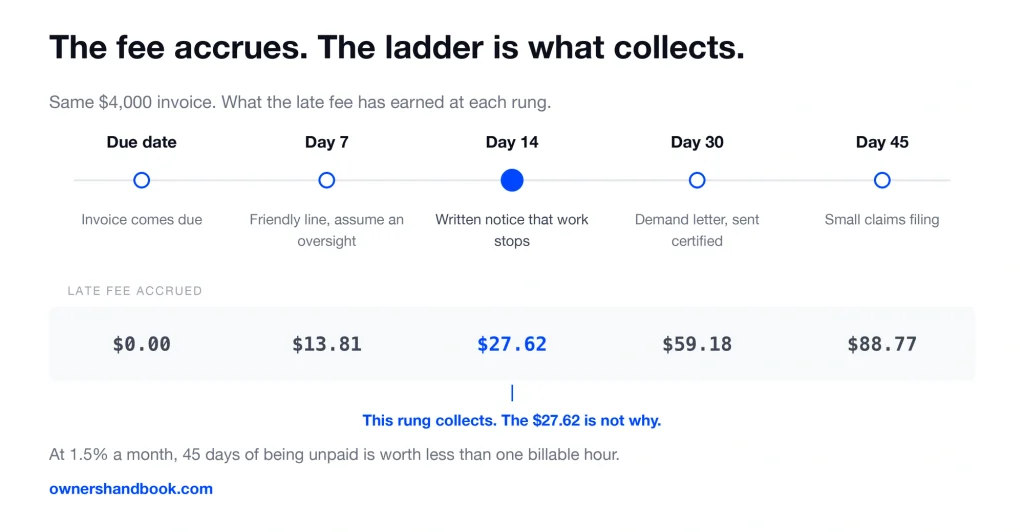
Stopping work is the only thing on that timeline that changes the client’s cost of waiting. Everything before it is a message. Everything after it is a process.
In some states there is a much bigger lever than either. New York’s Freelance Isn’t Free Act covers freelance work worth $800 or more, counting everything from the same hiring party over the previous 120 days.
Payment is due on the contract date, or within 30 days of finishing if no date is named.
Win on that payment provision and General Business Law 1414 gives you double damages plus reasonable attorney’s fees. On a $4,000 invoice that is $8,000 and a lawyer who will take the case.
Compare that to $88.77. If your work touches a state with one of these statutes, the statute is the leverage and the late fee is a rounding error.
The full escalation path, including what to do when a client is not paying at all, is a longer subject than this page.
How to write it so it survives
Five things the clause has to settle. Leave any of them out and you have written an argument, not a term.
| What the clause must say | What it settles |
|---|---|
| The rate, in words and as an annual figure | “1.5% per month (18% per year)” removes the first thing a client disputes |
| When it starts | Day one, or after a grace period of five or ten days. Silence means the client assumes the later one |
| How a partial month counts | The difference between billing $90 and billing $120 on the same invoice |
| Whether it compounds | Simple, or on the running balance. 1.5% compounded is 19.56% a year |
| That work stops until the balance clears | The sentence that actually collects |
Then use it consistently. A fee you waive for three clients and enforce on the fourth is a fee your fourth client will contest, and they will have a point.
One tax note. A late fee you collect is ordinary business income and goes into gross receipts on your Schedule C.
A late fee you never collect is nothing at all. A cash-basis filer never recorded it as income, so there is no bad debt to deduct.
And if the real problem is that you are financing the work, the fee is the wrong tool. A 50% deposit collected before you start moves the exposure to the front of the job, where it costs you nothing to hold.
Frequently asked questions
Can I add a late fee to an invoice if my contract does not mention one?
You can print it. Collecting it is another matter.
Absent a term the client agreed to before the work, you are limited to whatever your state provides by default. That is typically 6% to 10% a year, and often only recoverable through a court.
Is 1.5% per month legal everywhere?
No. Caps vary by state, and some are well under 18% a year. New York’s statutory maximum for loans and forbearances is 16%. Check your own state, and check the state named in your governing-law clause if it is different.
Should I offer a grace period?
Usually yes, five to ten days. It costs you almost nothing in fees and it removes the “the check was in the mail” argument entirely, because the client already had the buffer.
Does a late fee hurt the relationship?
Enforcing one on a good client who slipped once will annoy them more than $89 is worth. Waive it and say you are waiving it. The clause did its job by being there.
What if the client pays the invoice but not the fee?
Decide in advance whether you apply payments to fees first or principal first, and say so in the contract. Most freelancers should take the principal, close the invoice, and drop the fee rather than keep a $89 dispute alive.
Can I charge a flat late fee instead of a percentage?
Yes, and on small invoices it is often the better clause. A flat $50 on a $600 invoice is far more than 1.5% a month would ever produce. Keep it defensible as an estimate of your cost, not a punishment.
Sources
California Legislative Information, Civil Code Section 3289
https://leginfo.legislature.ca.gov/faces/codes_displaySection.xhtml?lawCode=CIV§ionNum=3289
New York State Senate, CPLR 5004 — Rate of interest
https://www.nysenate.gov/legislation/laws/CVP/5004
New York State Senate, Banking Law 14-a — Maximum rate of interest
https://www.nysenate.gov/legislation/laws/BNK/14-A
Texas Constitution and Statutes, Finance Code Chapter 302
https://statutes.capitol.texas.gov/Docs/FI/htm/FI.302.htm
Electronic Code of Federal Regulations, 5 CFR 1315.10 — Late payment interest penalties
https://www.ecfr.gov/current/title-5/chapter-III/subchapter-B/part-1315/section-1315.10
U.S. Treasury Bureau of the Fiscal Service, Prompt Payment interest rates
https://fiscal.treasury.gov/prompt-payment/rates.html
New York State Senate, General Business Law 1410 — Definitions
https://www.nysenate.gov/legislation/laws/GBS/1410
New York State Senate, General Business Law 1411 — Contracted compensation payments
https://www.nysenate.gov/legislation/laws/GBS/1411
New York State Senate, General Business Law 1414 — Violations
https://www.nysenate.gov/legislation/laws/GBS/1414
New York Department of Labor, Freelance Isn’t Free Act
https://dol.ny.gov/freelance-isnt-free-act
Legal Information Institute, Liquidated damages
https://www.law.cornell.edu/wex/liquidated_damages
IRS, Publication 334, Tax Guide for Small Business