The Rate Formula That Accounts for Taxes
The formula is (what you want to keep + your tax set-aside + your business costs) ÷ your billable hours. The trap is the last number. Almost every rate calculator divides by 2,080 — 40 hours times 52 weeks — and leaves the tax line out entirely. You do not bill 2,080 hours, and about 28 cents of every dollar of profit is spoken for before you ever see it.
Start from what you want to keep
A rate is not a number you pick. It is a number you solve for.
So start at the end. You want $80,000 in your bank account this year, after tax and after everything the business costs you to run.
That figure is the only one you get to choose. Everything after it is arithmetic.
Be clear about what $80,000 is not. It is not revenue, and it is not your Schedule C profit. It is what survives after the IRS and the business have both been paid.
If you are not sure what to put there, look up what your occupation pays as a salary.
The Bureau of Labor Statistics publishes median wages for around 800 occupations. Treat that as a starting point for what you want to keep, not as a rate to copy.
The tax layer that breaks most calculators
Self-employment tax is 15.3% — 12.4% for Social Security and 2.9% for Medicare, the two halves an employer used to split with you. Federal income tax sits on top of it.
It is charged on 92.35% of your profit rather than all of it, which pulls the real bite down to about 14.1%.
Add income tax, add state tax if yours has one, and most people at this income level land between 25% and 30%. Use 28% for the example.
Now the part that trips people up. Tax comes out of what you earn, so you cannot add 28% to $80,000. You have to divide by what is left after tax.
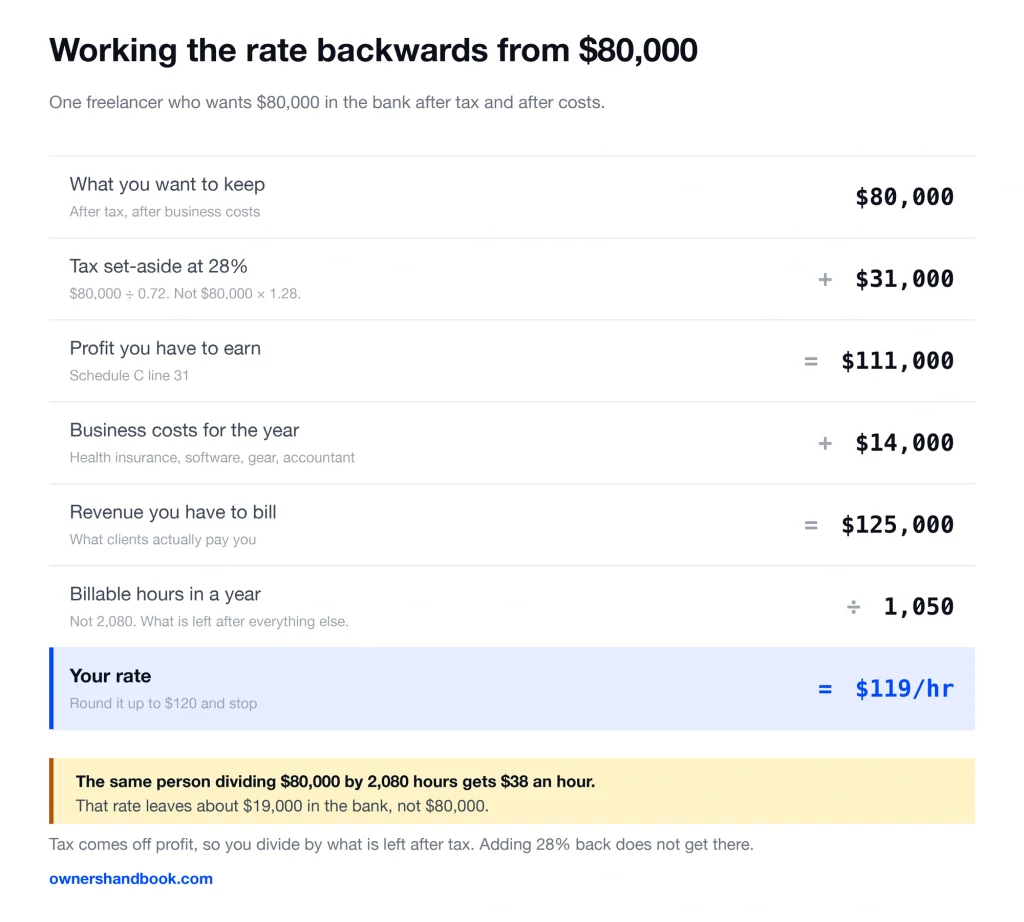
$80,000 ÷ 0.72 = $111,111. Call it $111,000 of profit.
Adding 28% instead gives you $102,400. Bill that, pay the tax, and you keep about $74,000. You would be $6,000 short and would not find out until April.
One mercy in the other direction. Business expenses come off before tax is figured, so the $14,000 in the next section is not taxed. You have to bill it, not earn it twice.
And the set-aside is not an annual event. The IRS wants estimated tax payments four times a year, so the rate you set has to fund them as the work is invoiced.
The costs an employer used to cover
Your old salary was never what you cost your employer.
In March 2026 the Bureau of Labor Statistics put total compensation for private industry workers at $46.60 an hour. Wages were $32.60 of that. The other $14.01 was benefits — 30.1% of the bill.
That 30% bought health insurance, a retirement match, paid leave, and the employer half of payroll tax. Nobody buys it for you now.
So put it in the price. For this freelancer, one modest year looks like this. Health insurance at $600 a month is $7,200. Software and subscriptions, $1,800. Equipment spread over its useful life, $1,500.
Then the accountant at $1,200, liability insurance at $600, the business share of phone and internet at $900, and the website at $800.
That comes to $14,000, and it is on the low side. Yours could easily be double.
One footnote. Health insurance is not a Schedule C expense — it comes off further down the return, on Schedule 1 — but it is still money you have to earn before you can spend it.
$111,000 of profit plus $14,000 of costs means you have to bill $125,000.
You do not bill 2,080 hours
2,080 describes an employee. Someone with a manager assigning the work, a sales team finding it, and paid vacation when they stop.
You have none of that.
The Bureau of Labor Statistics puts the private-industry average at eight paid holidays and eleven vacation days after a year. You still take those days. Nobody pays you for them.
Take the rest of the year apart the same way.
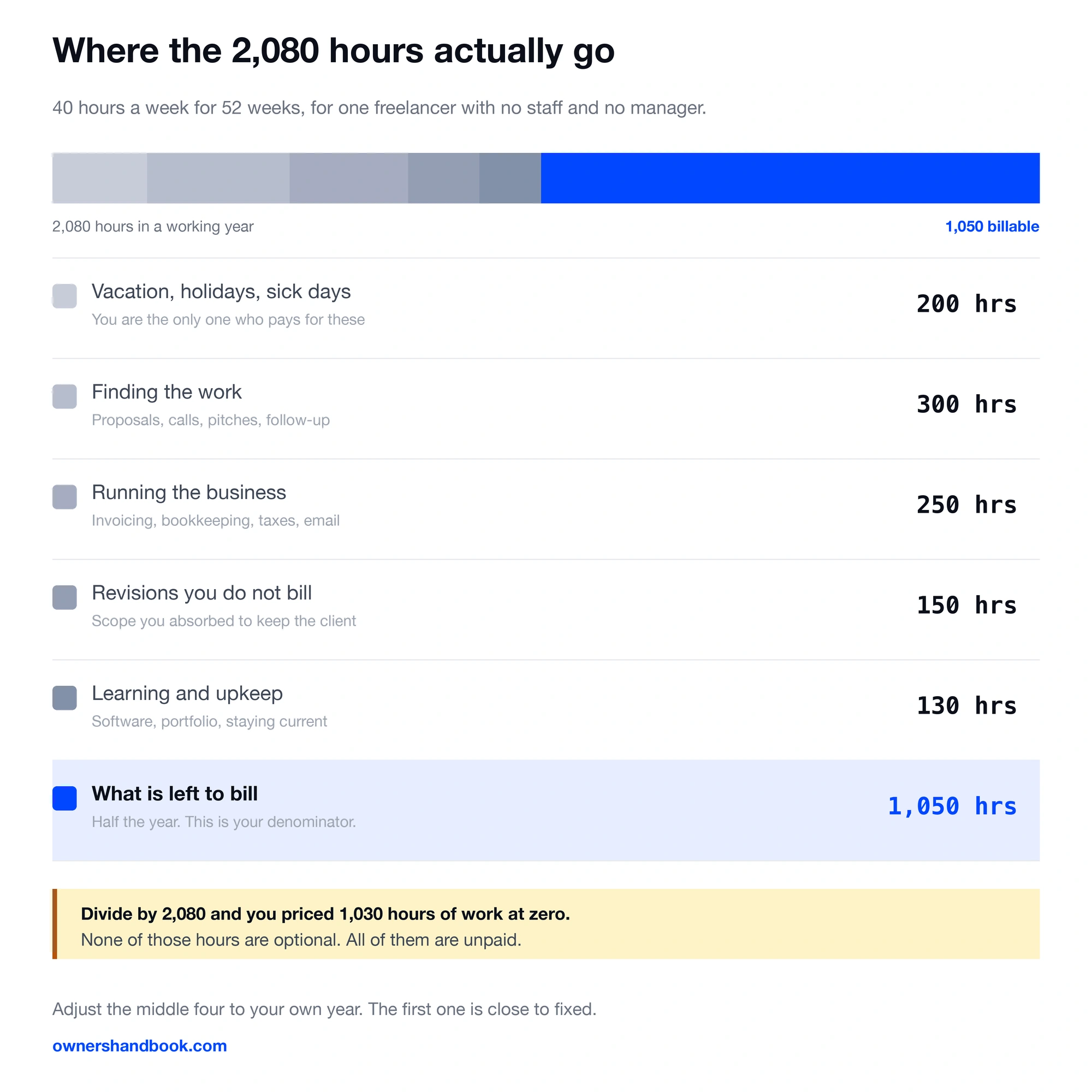
| Where the hour goes | Hours a year |
|---|---|
| Vacation, holidays, sick days | 200 |
| Finding the work — proposals, calls, follow-up | 300 |
| Running the business — invoicing, books, email | 250 |
| Revisions you absorbed | 150 |
| Learning and upkeep | 130 |
| What is left to bill | 1,050 |
1,050 hours is a little over 20 billable hours in each week you actually work. That sounds low until you try to hold 30 and see what it costs you.
Every one of those unbilled 1,030 hours is real work. Divide by 2,080 and you have priced all of it at zero.
You do not have to take my numbers. Track billable and non-billable time honestly for one month, then multiply out. Most people are surprised, and almost always in the same direction.
The whole calculation, in order
| Step | Amount |
|---|---|
| What you want to keep | $80,000 |
| Divide by 0.72 to cover 28% tax | $111,000 of profit |
| Add the year’s business costs | $125,000 you have to bill |
| Divide by billable hours | 1,050 |
| Your rate | $119 an hour |
$125,000 ÷ 1,050 = $119.05.
Round it up to $120 and stop negotiating with yourself.
What $38 an hour actually produces
$80,000 ÷ 2,080 = $38.46. That is the number a simple calculator hands you, and it is worth running forward to see where it lands.
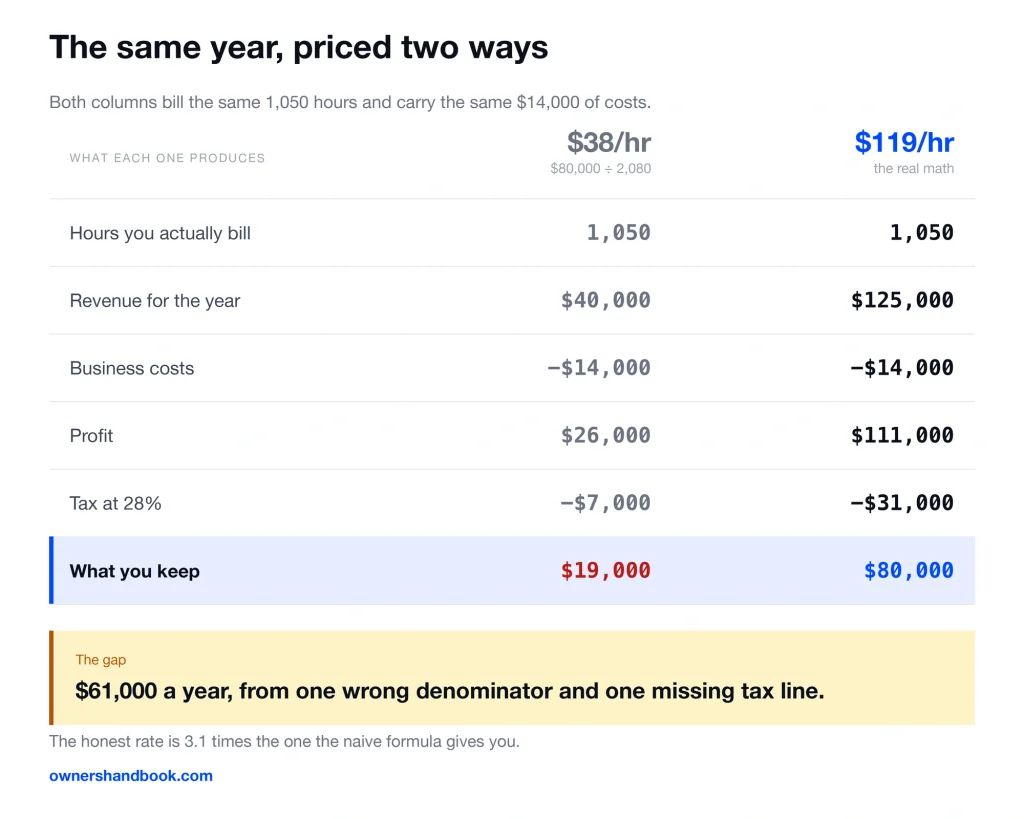
1,050 billable hours at $38 is about $40,000 billed. Take out $14,000 of costs and $26,000 of profit is left. Take out 28% for tax and you keep roughly $19,000.
You wanted $80,000. You got $19,000.
The honest rate is 3.1 times the naive one. The gap is not a rounding error. It is the entire difference between a business and an expensive hobby.
This is a floor, not a price
Everything above tells you what you need. None of it tells you what the work is worth.
Your floor is what you have to charge to survive the year. Your price is what a client will pay for the result. Those are different numbers, and the second one is often higher.
Check yours against your field. The Editorial Freelancers Association surveys more than 1,100 working editors and publishes the spread, and most trades have something similar.
If the market sits below your floor, lowering the floor does not fix anything. Cut costs, raise billable hours, or find better clients.
Raise your rate on the next client rather than on everyone at once. A floor you cannot say out loud without flinching is a floor you will discount away in the first negotiation.
The real use of this number is the word no. When a project pays under your floor, you now know exactly what saying yes will cost you.
Frequently asked questions
What if I only freelance part time?
Scale the hours, not the rate. If you work fifteen hours a week you might bill 400 hours a year, and the same costs spread over fewer hours push the rate up, not down.
Should retirement savings go in the number?
Yes, if you want any. Add your target contribution to the $80,000 you want to keep, or add it to the cost list. Either works as long as it is somewhere.
Is 28% the right tax rate for me?
It is a starting point for profit between $40,000 and $120,000. Nine states have no income tax and some cities add their own, so check yours before you rely on the number.
Do I have to tell clients an hourly rate?
No. Most experienced freelancers quote a flat project fee and keep the hourly figure private. The rate is how you check whether the fee is high enough.
What if my market will not pay my floor?
Then the floor is telling you something. Either your costs are too high, your billable hours are too low, or you are selling to clients who cannot afford the work.
How often should I redo this?
Once a year, and any time your costs jump. Health insurance renewals and a bad utilization year are the two things most likely to move the answer.
Sources
IRS, Self-Employment Tax
IRS, About Schedule SE (Form 1040)
https://www.irs.gov/forms-pubs/about-schedule-se-form-1040
Bureau of Labor Statistics, Employer Costs for Employee Compensation
https://www.bls.gov/news.release/ecec.nr0.htm
Bureau of Labor Statistics, Employee Benefits in the United States
https://www.bls.gov/ebs/publications/employee-benefits-in-the-united-states-march-2025.htm
Bureau of Labor Statistics, Occupational Employment and Wage Statistics
https://www.bls.gov/oes/current/oes_nat.htm
U.S. Small Business Administration, Calculate Your Startup Costs
https://www.sba.gov/business-guide/plan-your-business/calculate-your-startup-costs
Editorial Freelancers Association, Editorial Rates