Raising Your Rate on a Client You Already Have
Give thirty days’ notice for an ordinary increase and sixty for a large one. Ten to twenty percent is the range that goes through without a fight. Put the new rate and its start date in one short email, tie the date to a boundary the client already has on their calendar — a renewal, a quarter, January 1 — and send it. The one thing not to do is apologize, because an apology opens a negotiation you did not have to open.
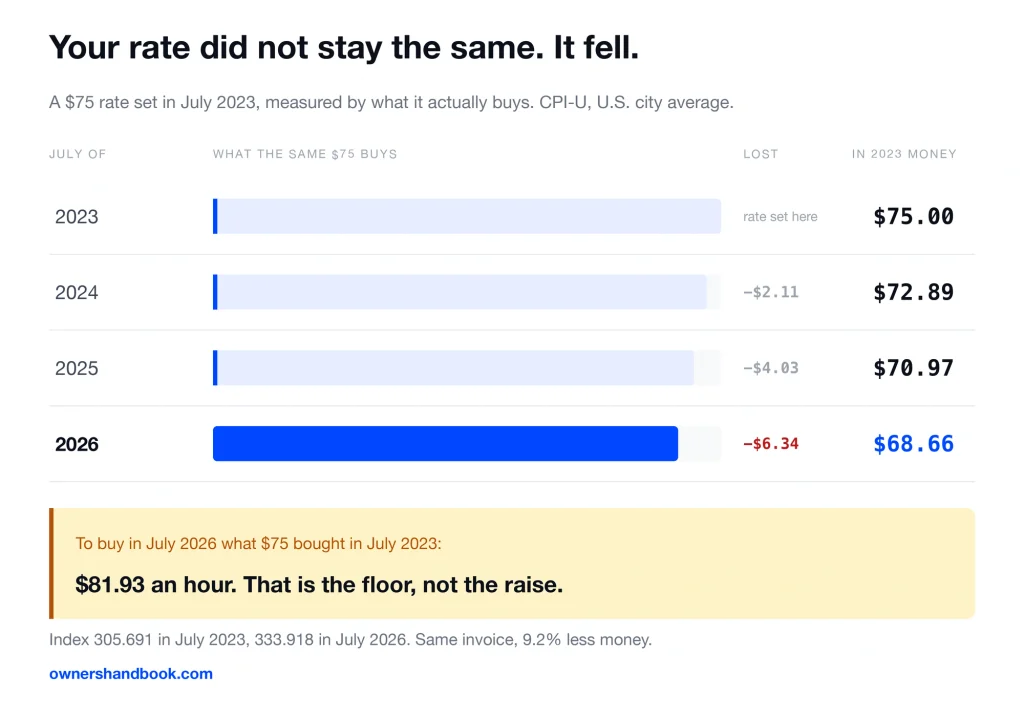
Holding your rate flat is a pay cut
A rate you set three years ago and never touched is not a rate you held steady. It is a rate that fell.
The Bureau of Labor Statistics publishes the Consumer Price Index — CPI, a monthly measure of what the same basket of goods costs over time.
In July 2023 the CPI-U index stood at 305.691. In July 2026 it stood at 333.918. That is 9.2% more money for the same basket.
So $75 an hour set in July 2023 buys what $68.66 bought then. You handed yourself a $6.34 pay cut, and nobody had to ask you for it.
| Last time you raised | CPI-U that July | What your $75 buys now | Rate that only breaks even |
|---|---|---|---|
| July 2023 | 305.691 | $68.66 | $81.93 |
| July 2024 | 314.540 | $70.65 | $79.62 |
| July 2025 | 323.048 | $72.56 | $77.52 |
| July 2026 | 333.918 | $75.00 | $75.00 |
Read the last column as your floor, not your ask. Getting back to $81.93 is standing still. Everything above it is the actual raise.
The number matters less than the frame. You are not asking for a favor. You are correcting a drift that already happened to you.
How much notice, and when to send it
Thirty days for a routine increase. Sixty when the jump is big enough that someone has to move budget to pay it.
Read your contract before you pick a date. If it names a term, a renewal date, or a notice period for changing terms, that clause sets your calendar instead of your preference.
A rate change to a signed agreement is an amendment — a written change to one part of a contract, leaving the rest alone. Established legal publishers all say the same thing about it.
Put it in writing, have both sides sign, and state that the amendment takes precedence over the original term it replaces.
In New York this is not optional housekeeping. Since August 2024 the state’s Freelance Isn’t Free Act has required a written contract for freelance work worth $800 or more, and the contract has to state the rate of pay.
Then choose the date, and anchor it to something the client already recognizes.
A contract renewal. The first day of a quarter. January 1. The next statement of work.
The anchor does the work. A new rate that starts January 1 reads as procedure. The same rate starting on the 14th of a random month reads as a personal request, and personal requests get negotiated.
How big the raise should be
Ten to twenty percent goes through quietly in most working relationships. Below ten, you will be doing this again in a year. Above twenty, expect a conversation and plan for it.
| Size of the increase | Notice to give | How to handle it |
|---|---|---|
| Under 10% | 30 days | An annual adjustment. One line, no explanation offered. |
| 10 to 20% | 30 days | A standard rate change, effective at the renewal or the quarter. |
| 20 to 40% | 60 days | Name the gap out loud. Offer a phased date or a smaller scope. |
| Over 40% | 60 days | You are repricing, not raising. Quote the work again from scratch. |
Before you pick the number, recalculate your floor. The SBA teaches this as break-even: what the work costs you to deliver, divided across the hours you can actually bill.
Your costs moved with everything else. Software, insurance, and the tax you set aside on every dollar all went up while your rate sat still.
Round to a clean number. Seventy-five to eighty-five is easier to say than seventy-five to eighty-two fifty, and the odd figure invites someone to meet you at seventy-nine.
The email
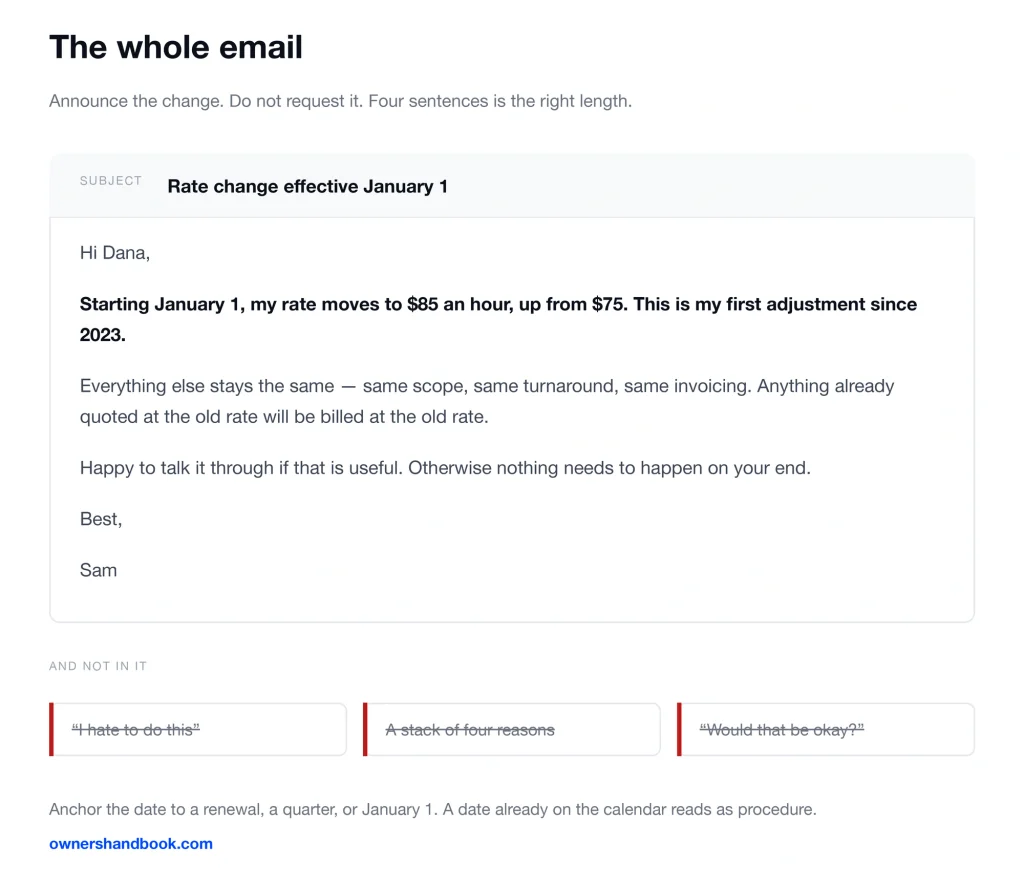
Announce, do not request. The whole difference lives in the verb.
Subject: Rate change effective January 1
Hi Dana,
Starting January 1, my rate moves to $85 an hour, up from $75. This is my first adjustment since 2023.
Everything else stays the same — same scope, same turnaround, same invoicing. Anything already quoted at the old rate will be billed at the old rate.
Happy to talk it through if that is useful. Otherwise nothing needs to happen on your end.
Best,
Sam
Four sentences of substance. What is missing from it matters more than what is in it.
No apology. No “I hate to do this,” no “I know this is bad timing.” Both hand the client a reason to say the timing is indeed bad.
No stack of justifications. Inflation, a course you took, rising demand, a new certification. One reason sounds settled. Four reasons sound like a defense, and a defense can be argued with.
No question mark. “Would you be okay with” gives the client a decision they were not otherwise going to make.
The line about already-quoted work earns its place. It tells them nothing in flight is about to cost more, which removes the objection most likely to come back.
When you are underpriced by a lot
Sometimes the honest number is not fifteen percent higher. It is double.
That happens when you quoted your first client at a beginner’s rate and then got good, or when a small project turned into a standing retainer and nobody repriced it.
Do not sneak up on it with three small raises. That is three years underpaid and the same awkward conversation three times.
Say the size of the gap plainly, then give them a way to absorb it.
Two options fit in one email. A phased date: the new rate in sixty days, or half of it now and the rest in six months.
Or the same money for less work. That second one is the exit that saves relationships.
If the new rate does not fit the budget, offer to hold their current monthly total and drop something real — the weekly report, the second revision round, the standing call.
That sentence changes the question. It is no longer whether you get paid more. It is which version of the work they are buying.
Clients who genuinely cannot move budget can almost always move scope.
If they say no
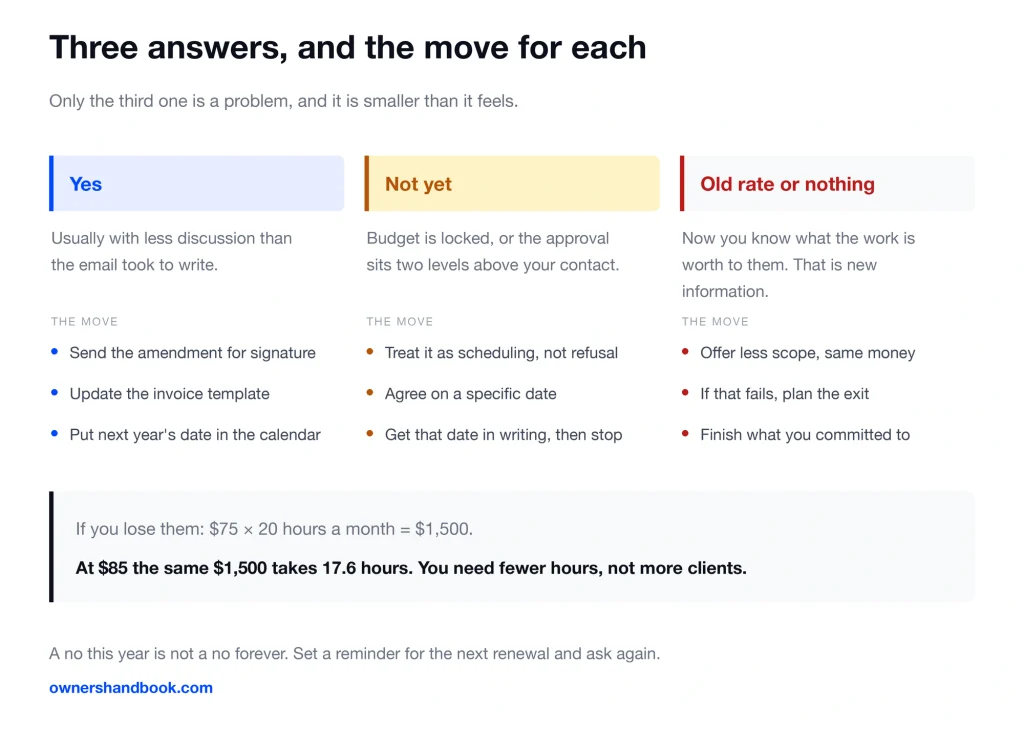
Three answers come back, and only one of them is actually a problem.
Yes, usually with less discussion than you spent writing the email. Send the amendment, update your invoice template, and stop thinking about it.
Not yet. Budget is locked through June, or the approval sits two levels above the person you email. That is a scheduling answer, not a refusal.
Agree on a specific date, get it in writing, and stop negotiating once you have it.
No, old rate or nothing. You now know what the work is worth to them, which is information you did not have last week.
Run the arithmetic before you react. A client paying $75 for twenty hours a month is $1,500. At $85 that same $1,500 takes 17.6 hours.
Replacing them does not require finding more work. It requires finding fewer hours.
If you do leave, leave properly. Finish what you committed to, hand over the files, and give them time to find someone. Freelancers who exit cleanly over money still get referred.
And a no this year is not a no forever. Set a reminder for the next renewal and ask again then.
Before you pick the new number, check it against the floor. Work your hourly rate backwards from what you need to keep after tax and after costs, and you often find the raise you were nervous about asking for still lands under what the work actually requires.
Frequently asked questions
How often should I raise my rate?
Once a year, on a date you pick and keep. An annual adjustment that always lands on the same date stops being an event and starts being a policy.
Do I have to give a reason?
No. If you want one, give one sentence and stop. The longer the explanation, the more surface there is to argue with.
Should the new rate apply to work already in progress?
No. Honor whatever you quoted at the old rate and start the new one on new work. Saying so in the email removes the most common objection.
What if there is no contract, just invoices?
The notice still applies. Send the same email, then put the new rate on your next quote or statement of work so there is a written record of when it changed.
Can a client hold me to the old rate?
Under a signed contract with a fixed term and a stated rate, generally yes, until that term ends. That is exactly why the renewal date is the right place to put the change.
Should I raise everyone at once or one client at a time?
All of them, effective the same date. It is one conversation instead of five, and a rate that is the same for everyone is much harder to treat as personal.
Sources
U.S. Bureau of Labor Statistics, CPI for All Urban Consumers (CPI-U), U.S. City Average, All Items, series CUUR0000SA0
https://data.bls.gov/timeseries/CUUR0000SA0
U.S. Bureau of Labor Statistics, Consumer Price Index home page
U.S. Bureau of Labor Statistics, CPI Inflation Calculator
https://www.bls.gov/data/inflation_calculator.htm
U.S. Small Business Administration, Break-even point
https://www.sba.gov/business-guide/plan-your-business/calculate-your-startup-costs/break-even-point
Nolo, Amending an Existing Contract
https://www.nolo.com/legal-encyclopedia/amending-existing-contract-33348.html
Nolo, Sample Amendment to Contract
https://www.nolo.com/legal-encyclopedia/sample-amendment-contract-33341.html
New York State Department of Labor, Freelance Isn’t Free Act