Hourly or Flat Fee: How to Pick Per Project
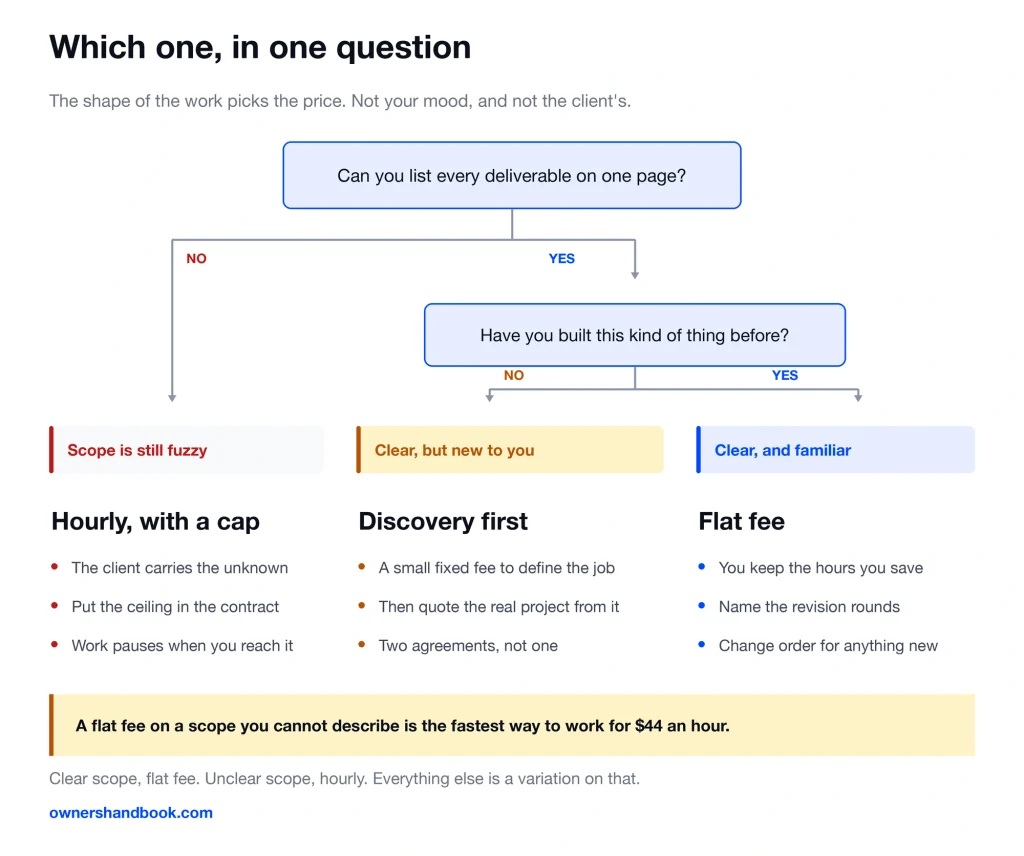
Clear scope, flat fee. Unclear scope, hourly. That is the whole rule, and the reason behind it matters more than the rule itself. The two models point your incentives in opposite directions. On a flat fee, getting faster pays you more. On an hourly rate, getting faster pays you less. Everything else follows from that.
The question that decides it
Before you pick a number, answer one question. Can you write down what you are delivering, on one page, in words the client would sign?
If yes, quote a flat fee. You know the work well enough to price the work.
If no, bill by the hour. When nobody can say how big the job is, someone has to carry that guess, and it should not be you for free.
This is not a matter of taste. It is how the federal government buys work.
A firm-fixed-price contract, in the regulation’s own words, places on the contractor maximum risk and full responsibility for all costs and resulting profit or loss.
Fixed price moves the risk to you. In exchange, it hands you the upside. The same rule says fixed price provides maximum incentive for the contractor to control costs and perform effectively.
What getting faster does to your pay
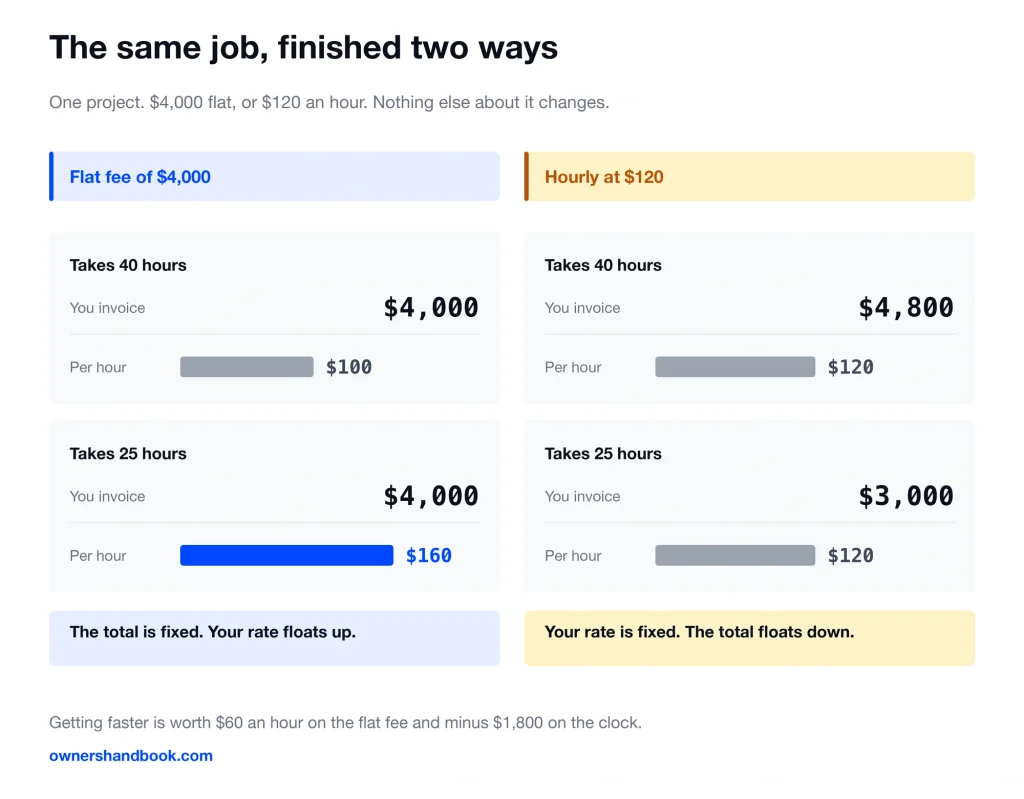
Take one job. A brand identity, a landing page, a two-minute edit. Say it takes 40 hours the first time and 25 hours once you know its shape.
Price it flat at $4,000 and the total never moves. Only your effective hourly rate moves, and it moves in your favor.
Price it hourly at $120 and your rate never moves. Only the total moves, and it moves against you.
| The same job, priced two ways | Hours | What you earn | Per hour |
|---|---|---|---|
| Flat fee of $4,000, done slowly | 40 | $4,000 | $100 |
| Flat fee of $4,000, done fast | 25 | $4,000 | $160 |
| Hourly at $120, done slowly | 40 | $4,800 | $120 |
| Hourly at $120, done fast | 25 | $3,000 | $120 |
Read the last column, then the third one. A flat fee fixes your total and lets your rate float. Hourly fixes your rate and lets your total float.
Federal contracting has a blunt name for the second half of that. Time-and-materials, the rule says, provides no positive profit incentive to the contractor for cost control or labor efficiency.
That is not an accusation. It is a description. Efficiency has nowhere to land on an hourly invoice.
The two ways this goes wrong
Here is the honest version, and it cuts both directions. A flat fee on a scope you cannot describe is the most reliable way freelancers lose money.
You quote $4,000 for a website. Nobody wrote down how many pages. Nobody wrote down who supplies the copy. Nine weeks later you are at 90 hours and earning $44 an hour.
Nothing went wrong in that story. Nobody behaved badly. The scope was never written down, so there was nothing to hold a line against.
Three tests before you quote a flat fee. You have done this kind of job before. You can list the deliverables. You know who provides what, and when.
Fail any one of them and bill hourly. Or sell a paid discovery phase first — a small fixed fee to define the work, after which you price the real thing.
Now the mirror image, which is just as expensive and much quieter.
An hourly rate on a task you have done fifty times pays you for your slowest self. You got faster, the invoice got smaller, and the client kept the difference.
A logo you can now finish in six hours is not worth less than the one that took you twenty. It is worth more. It is better, and it arrives sooner.
Hourly billing prices your time. Clients are not buying your time. They are buying the thing at the end of it.
So the rule cuts both ways. Unclear scope, hourly. Familiar work with a clear finish line, flat fee, and you keep the hours you saved.
Four shapes, not two
Most arguments about hourly versus flat fee are really arguments about who carries the risk. Once you see it that way, two more shapes appear.
| The shape | Who carries the risk | Use it when |
|---|---|---|
| Flat fee | You | The deliverables fit on one page and you have built this before |
| Hourly | The client | Nobody can honestly say yet how big the job is |
| Hourly with a cap | Split | The client needs a ceiling and you need the clock running |
| Monthly retainer | Shared | The work is ongoing and part of the value is your availability |
Hourly with a cap is the peace treaty. You bill your time, and the client knows the number cannot pass $5,000 without a conversation.
Federal time-and-materials contracts run on exactly this. They carry a ceiling price that the contractor exceeds at its own risk.
Notice who eats that overrun. If you use a cap, write down what happens when you reach it: work pauses until the cap is raised in writing.
Retainers are a subscription, not a discount
A retainer is a monthly fee for ongoing work or ongoing access. It is the right shape when the job never really ends.
There are two kinds, and mixing them up is where retainers go wrong.
An output retainer buys a defined amount of work each month. Four blog posts. Two edited videos. Ten hours of design. Unused work does not roll over unless your agreement says it does.
An availability retainer buys priority. The client pays to sit at the front of your queue whether or not they use you in a given month.
Price the second one without apologizing. You are holding a slot and turning down other work to hold it, and that costs you whether the phone rings or not.
Then write a review date into the agreement. Every three or six months both sides look at what actually happened and adjust. Retainers that never get reviewed drift into unpaid work.
When the work grows halfway through
Every flat fee leaks in the same few places. Extra revisions. New deliverables. A client who goes quiet for a month. A stakeholder who appears in week six with opinions.
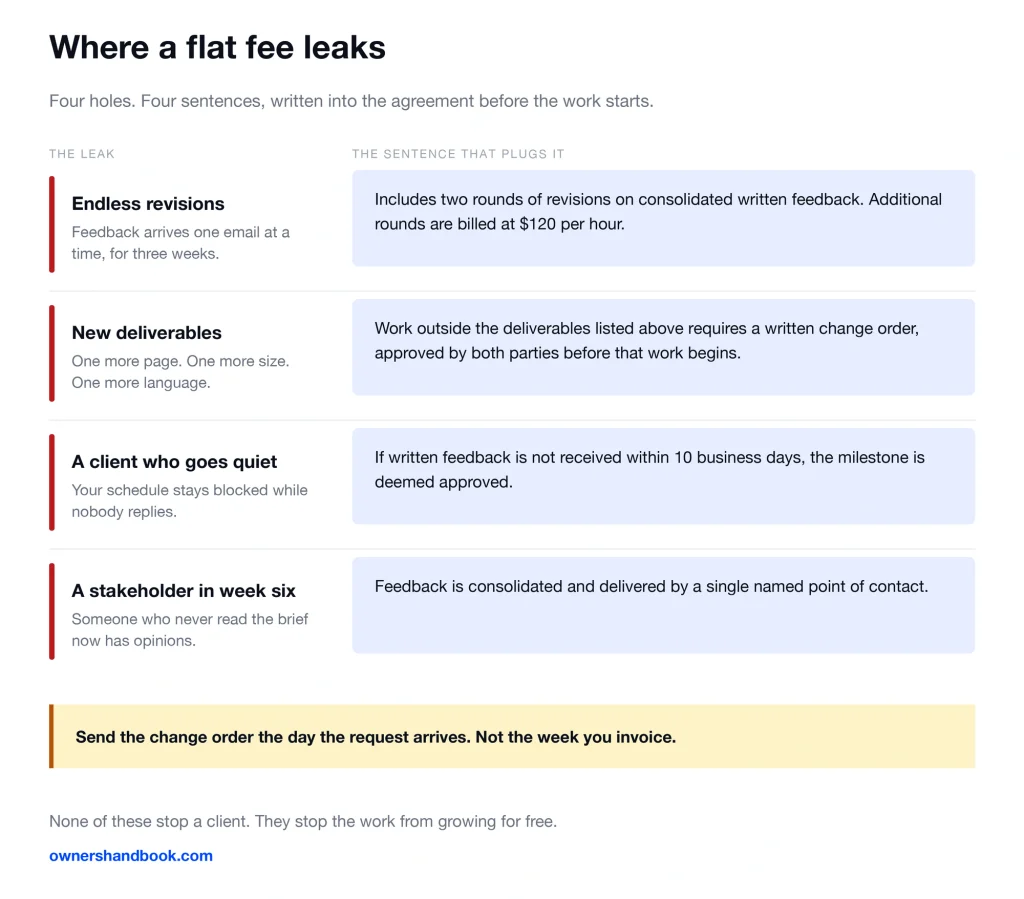
You do not plug those with goodwill. You plug them with sentences written before the work starts.
On revisions, name a number. Two rounds is standard for most creative work, and a round means one consolidated set of feedback, not a trickle of emails over nine days.
The sentence: Includes two rounds of revisions on consolidated written feedback. Additional rounds are billed at $120 per hour.
On new work, use a change order — a short written amendment that prices the addition and gets approved before you touch it.
The sentence: Work outside the deliverables listed above requires a written change order stating the added fee and the revised delivery date, approved by both parties before that work begins.
This is not freelancer folklore. Federal contracts change constantly, and the rule is that when a change affects cost or schedule, the contract is modified in writing with an equitable adjustment.
Two practical notes. Send the change order the day the request arrives, not the week you invoice. And price it at your real rate, because a friendly discount teaches the client that scope is free.
How you price does not change what you owe
One thing does not move at all. Your tax bill does not care how you quoted the job.
Hourly or flat fee, the money lands on the same line of the same form. Gross receipts at the top of Schedule C, expenses below, profit on line 31.
Profit is profit. It carries the same income tax and the same 15.3% self-employment tax either way.
The IRS does look at payment method, but for a different reason.
In its worker classification guidance, an employee is generally guaranteed a regular wage for an hourly or weekly period. An independent contractor is usually paid a flat fee for the job.
That is one factor among many, and it settles nothing on its own. The same page adds that in some professions, such as law, it is common to pay independent contractors hourly.
So bill however the work calls for. Just keep the two invoices telling the same story your contract tells.
Frequently asked questions
Should I tell a client my hourly rate when I quote a flat fee?
No. A flat fee is a price for a result. Showing the hours behind it invites a negotiation about your speed instead of the work.
What if I finish a flat-fee project in half the time I expected?
You keep the fee. That is the deal both sides signed, and that upside is what pays for the projects that run long.
How do I quote a project when the client will not define the scope?
Sell a paid discovery phase first. Charge a small fixed fee to produce the scope document, then price the real project from what it says.
Is hourly billing unprofessional?
No. It is standard in law, accounting, and consulting. It only hurts you on work that is well defined and repeatable, because there it quietly undercharges.
Should a retainer cost less per hour than my project rate?
Not automatically. A discount is fair for guaranteed volume paid in advance. It is not fair for a client who wants priority without any commitment.
The client says the new request was always included. Now what?
Point to the deliverables list in the signed agreement. If it is not there, it is a change order. If the list was vague, fix that in the next contract, not this one.
Sources
U.S. Small Business Administration, Break-even point
https://www.sba.gov/business-guide/plan-your-business/calculate-your-startup-costs/break-even-point
Federal Acquisition Regulation 16.202-1, Firm-fixed-price contracts
https://www.law.cornell.edu/cfr/text/48/16.202-1
Federal Acquisition Regulation 16.601, Time-and-materials contracts
https://www.acquisition.gov/far/16.601
Federal Acquisition Regulation 52.243-4, Changes clause
https://www.law.cornell.edu/cfr/text/48/52.243-4
Federal Acquisition Regulation 43.103, Types of contract modifications
https://www.law.cornell.edu/cfr/text/48/43.103
IRS, Independent contractor or employee: Financial control
https://www.irs.gov/businesses/small-businesses-self-employed/financial-control
IRS, Instructions for Schedule C
https://www.irs.gov/instructions/i1040sc
IRS, Publication 334, Tax Guide for Small Business
https://www.irs.gov/publications/p334
Nolo, Put Your Independent Contractor Agreements in Writing
https://www.nolo.com/legal-encyclopedia/put-independent-contractor-agreements-writing-29713.html