Getting Paid by Overseas Clients: What Each Method Costs
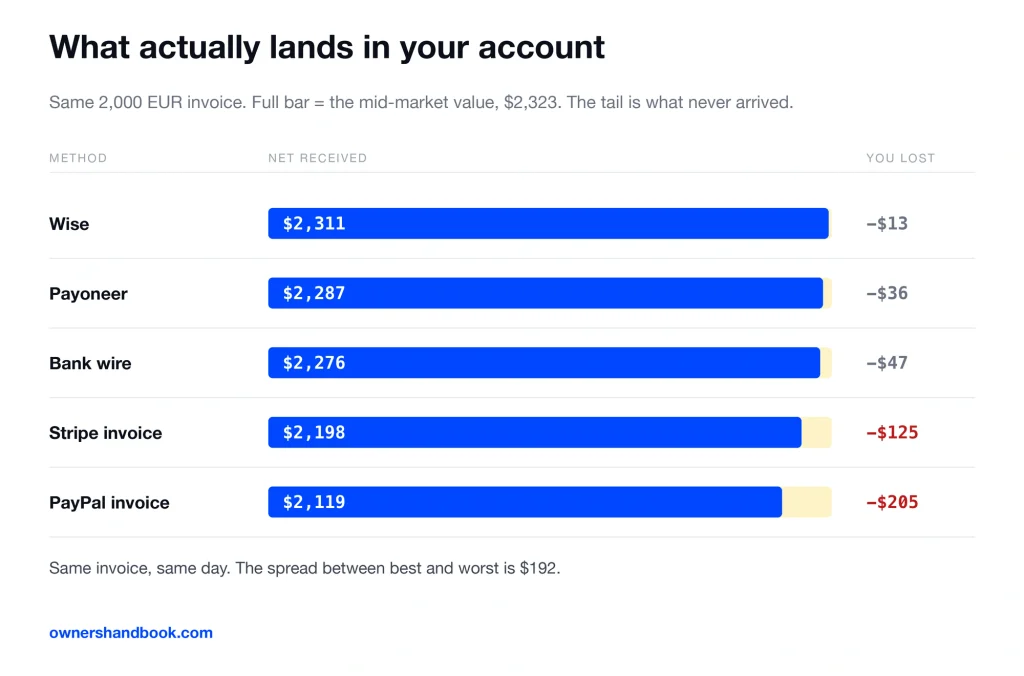
A German client owes you 2,000 EUR. Depending on how they send it, between $2,119 and $2,311 lands in your account. That is a $192 spread on one invoice, and most of it is not the fee. It is the exchange rate.
The fee you see is not the fee you pay
Every cross-border payment has two prices. One is printed on the pricing page. The other is buried in the rate you get.
The printed one is easy to compare. The buried one is not, because nobody quotes it as a number.
Here is how the buried one works. On September 7, 2026 the mid-market rate for the euro was 1 EUR = 1.1616 USD. That is the rate banks trade with each other at, the one Google shows you.
The European Central Bank’s reference rate on the preceding business day was 1.1622, so the two agree.
At mid-market, 2,000 EUR is worth $2,323.20. That is the honest value of the invoice.
Now suppose a provider converts at 1.1151 instead. Same euros, $2,230 arrives, and no line item anywhere says you were charged $93.
That gap is the spread, sometimes called the FX margin or the markup. It is a fee. It just does not look like one.
One invoice, five ways
Same 2,000 EUR. Same day. Every fee below comes from the provider’s own published pricing page, checked September 7, 2026.
| Method | What they publish | Rate margin | You receive |
|---|---|---|---|
| Wise | 10.89 EUR fee | None. Mid-market. | $2,311 |
| Payoneer | 1% + 0.50% + $1.50 | Not published | $2,287 |
| Bank wire | 0 to 37.90 EUR | 0.21% to 3.50% | $2,276 |
| Stripe invoice | 2.9% + 1.5% + $0.30 | 1.00% | $2,198 |
| PayPal invoice | 3.49% + 1.5% + 0.39 EUR | 4.00% | $2,119 |
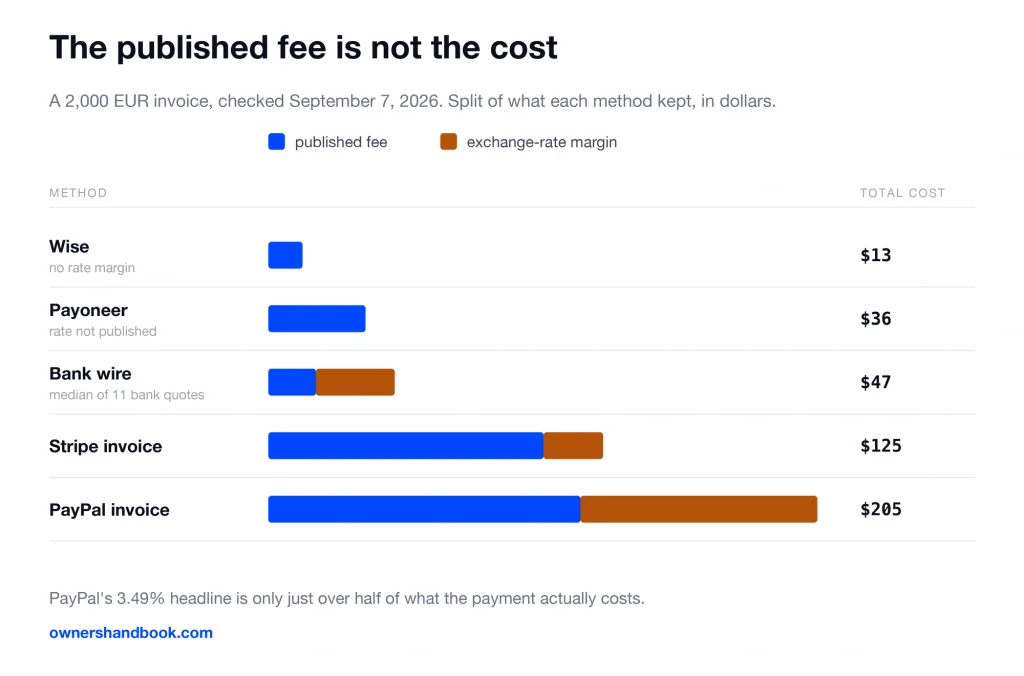
PayPal is the one worth staring at. The commercial transaction rate is 3.49% plus a fixed fee, and cross-border payments add 1.50% on top.
Then, separately, PayPal’s user agreement sets the currency conversion spread at 4.00% above its base exchange rate.
So the headline says 3.49%. The actual cost of getting those euros into your dollars is 8.8%.
Stripe is cheaper for the same shape of transaction: 2.9% plus 30 cents, plus 1.5% for an international card, plus 1% when a conversion is required.
Wise is the outlier because it does not touch the rate at all. It charged 10.89 EUR and converted at 1.1616 — the mid-market rate, to four decimals.
Payoneer publishes the fees but not the rate. Receiving into a currency that is not your local currency costs 1%. Moving between your own balances costs 0.50%. Withdrawing to a US bank in dollars costs $1.50.
Those add to about $36. Whether Payoneer also takes something in the rate itself is not stated on the pricing page, so treat $2,287 as a best case.
Eleven banks, same day, same 2,000 euros
Wire transfers are where the two prices come apart most violently.
I pulled eleven European bank quotes for the same 2,000 EUR to USD transfer on September 7, 2026. The published fees ranged from nothing to 37.90 EUR. The rate margins ranged from 0.21% to 3.50%.
They were not the same banks.
BNP Paribas charged no transfer fee at all and quoted 1.1461, which is 1.33% below mid-market. That invisible 1.33% costs $31, more than the visible fee at six of the other ten banks.
La Banque Postale did the opposite. It charged 37.90 EUR, the highest fee in the set, and quoted 1.1592, only 0.21% off mid-market.
The bank with the scariest-looking fee was one of the cheapest overall. The bank with no fee was not.
One more thing the table above leaves out: your own bank may charge an incoming international wire fee, commonly $0 to $20. US banks do not publish these consistently, so pull up your own account’s fee schedule before you compare.
Marketplace platforms take two bites
If a foreign client hires you through a marketplace, the platform takes its service fee first. Then your payout gets converted, and that conversion has its own margin.
Many of these platforms route payouts through Payoneer or a similar partner, which means the conversion cost is a second, separate charge stacked on the service fee.
I could not confirm current Upwork or Fiverr percentages from their own fee pages on the day I checked, so I have left them out of the table rather than quote a number I cannot source.
Check your platform’s fee page directly, and look for two things: the service fee, and whatever it says about currency conversion or withdrawal. The second one is the one people forget.
Your German client will not send you a 1099
The money is still taxable. All of it.
The IRS taxes US citizens and residents on worldwide income from all sources. Where the client sits, and what currency they paid in, changes nothing about that.
What does change is the paperwork. A 1099-NEC is issued by a US business paying a US contractor. A company in Munich has no US filing obligation, so no form arrives in January.
That is not a loophole. It is a gap in your records that you have to close yourself.
Report the income in dollars on your Schedule C, using the exchange rate that applied when you actually received the money. It flows into net profit like any other invoice, and self-employment tax applies at 15.3% the same way.
Keep the euro amount, the date received, the rate you used, and the dollars that landed. If you are already keeping proper records, this is one extra column.
One exception to the no-form rule: if you invoice through PayPal or Stripe, those are US payment platforms and may still send you a 1099-K. It reports gross, before their fees.
The forms point the other way
With a domestic client you hand over a W-9 so they can issue your 1099. Overseas, the direction flips, and it is a common place to get confused.
| Form | Who gives it to whom | Does it apply to you |
|---|---|---|
| W-9 | US person to a US payer | Yes for US clients. A foreign client has no US duty, but often asks anyway. |
| W-8BEN | A foreign person to a US payer | No. You are the US person. |
| 1099-NEC | US business to a US contractor | No. A foreign client will not issue one. |
| 1099-K | A US payment platform to you | Possibly, if you invoiced via PayPal or Stripe. |
| Form 6166 | IRS to you, you to the client | Only if their country wants proof of US residency. |
| Form 1116 | You to the IRS | Only if foreign tax was actually withheld. |
| FinCEN 114 | You to FinCEN | If foreign accounts topped $10,000 at any point. |
If an overseas client emails you a W-8BEN to sign, they have the form backwards. W-8BEN is filed by a foreign person receiving US-source income, to a US withholding agent. You are neither.
Send them a W-9 instead, or your business details on letterhead. Most of the time they just need something with your name, address, and taxpayer ID on it.
If their country’s tax authority wants to withhold from your payment, that is when Form 6166 matters. You request it with Form 8802, and it certifies to a treaty partner that you are a US resident for tax purposes.
That certificate is usually what stops foreign withholding at the source. It is far easier than clawing the money back later with a foreign tax credit on Form 1116.
What to change on your next invoice
Pick the rail before you send the invoice, not after the money arrives.
State the currency explicitly. “2,000 EUR” and “$2,000” are not the same invoice, and an ambiguous one gets paid in whichever currency is cheaper for the client.
Decide who eats the conversion. If you invoice in dollars, the client’s bank converts and the markup is their problem. If you invoice in euros, it is yours.
Name the account on the invoice itself. Give the client your Wise or Payoneer details directly instead of leaving the method up to them.
Put a payment method line in your payment terms alongside the due date, the same way you would specify net 30.
And run the arithmetic once, on your own numbers. On a 2,000 EUR invoice the difference is $192. On 50,000 EUR a year it is roughly $4,800, which is a month of income.
Frequently asked questions
Does a foreign client have to send me a 1099-NEC?
No. The 1099-NEC obligation falls on US businesses paying US contractors. A client with no US operations files nothing, and you still report every dollar.
What exchange rate do I use on my tax return?
The rate prevailing when you received the payment. The IRS says to use the rate in effect when you receive, pay, or accrue the item, and to report all amounts in US dollars.
My overseas client asked me to sign a W-8BEN. Should I?
No. That form is for foreign persons receiving US-source income. As a US person you use a W-9. Sign the wrong form and you have certified something untrue about your tax status.
Do I owe self-employment tax on money from a foreign client?
Yes. Self-employment tax applies to net earnings from your business regardless of where the client is. Foreign income does not get a discount on the 15.3%.
Should I invoice in dollars or in euros?
Dollars, if the client will accept it, because then the conversion cost lands on their side. Invoice in euros only when it wins you the work, and price the roughly 1% to 2% conversion cost into the rate.
Do I have to file an FBAR because I use Wise or Payoneer?
Only if the account is a foreign financial account and your foreign accounts together exceeded $10,000 at any point in the year. Check where your provider actually holds the balance before assuming either way.
Sources
Wise, Pricing — send money
https://wise.com/us/pricing/send-money
Wise, Business pricing (receiving and conversion fees)
https://wise.com/gb/pricing/business
Wise, Compare international money transfer providers
PayPal, Merchant Fees (US)
https://www.paypal.com/us/webapps/mpp/merchant-fees
Payoneer, Pricing
https://www.payoneer.com/pricing
Stripe, Pricing
European Central Bank, Euro reference exchange rate: US dollar
IRS, US Citizens and Resident Aliens Abroad
https://www.irs.gov/individuals/international-taxpayers/us-citizens-and-resident-aliens-abroad
IRS, Foreign Currency and Currency Exchange Rates
https://www.irs.gov/individuals/international-taxpayers/foreign-currency-and-currency-exchange-rates
IRS, About Form W-8 BEN
https://www.irs.gov/forms-pubs/about-form-w-8-ben
IRS, About Form 8802, Application for United States Residency Certification
https://www.irs.gov/forms-pubs/about-form-8802
IRS, Report of Foreign Bank and Financial Accounts (FBAR)