Illinois Is Flat 4.95%. Your LLC Pays 1.5% More.
Illinois taxes your freelance profit at a flat 4.95%. For a sole proprietor that is the entire state story.
Form an LLC with a second member and another Illinois tax appears. Personal Property Replacement Tax, 1.5% of the entity’s net income, filed on its own return, credited to nobody.
All of that sits on top of the federal tax the United States charges you. Illinois collects nothing for the IRS, and the IRS collects nothing for Illinois.
One rate, one bracket, nothing underneath
Illinois has charged 4.95% of net income since July 1, 2017. The 2026 IL-1040-ES worksheet still multiplies by .0495, so nothing has moved for this year.
There are no brackets. A $30,000 year and a $300,000 year face the same rate, which makes Illinois far easier to plan than a graduated state.
It is one of the flat-rate states, and it sits near the top of the 3% to 6% band most freelancers should be budgeting for state tax.
Your Illinois return starts from the adjusted gross income on your federal return. So the deduction for half your self-employment tax carries over on its own.
The 20% qualified business income deduction does not. It is taken below the AGI line federally, so it never reaches Illinois at all.
Subtract the personal exemption, $2,850 for 2025 and the most recent figure Illinois has published, then apply 4.95%.
What the replacement tax actually replaced
Replacement tax — a tax that took the place of a local property tax on business, still collected by the state and paid out to local governments.
Before 1979 Illinois businesses paid personal property taxes to counties, townships and school districts. Legislation abolished those taxes and replaced the lost revenue with a flat tax on business income.
That flat tax never went away. Partnerships, S corporations and trusts pay 1.5% of income taxable in Illinois. C corporations pay 2.5%.
Individuals pay none of it. Which is exactly why the question of whether you are a person or an entity suddenly costs money.
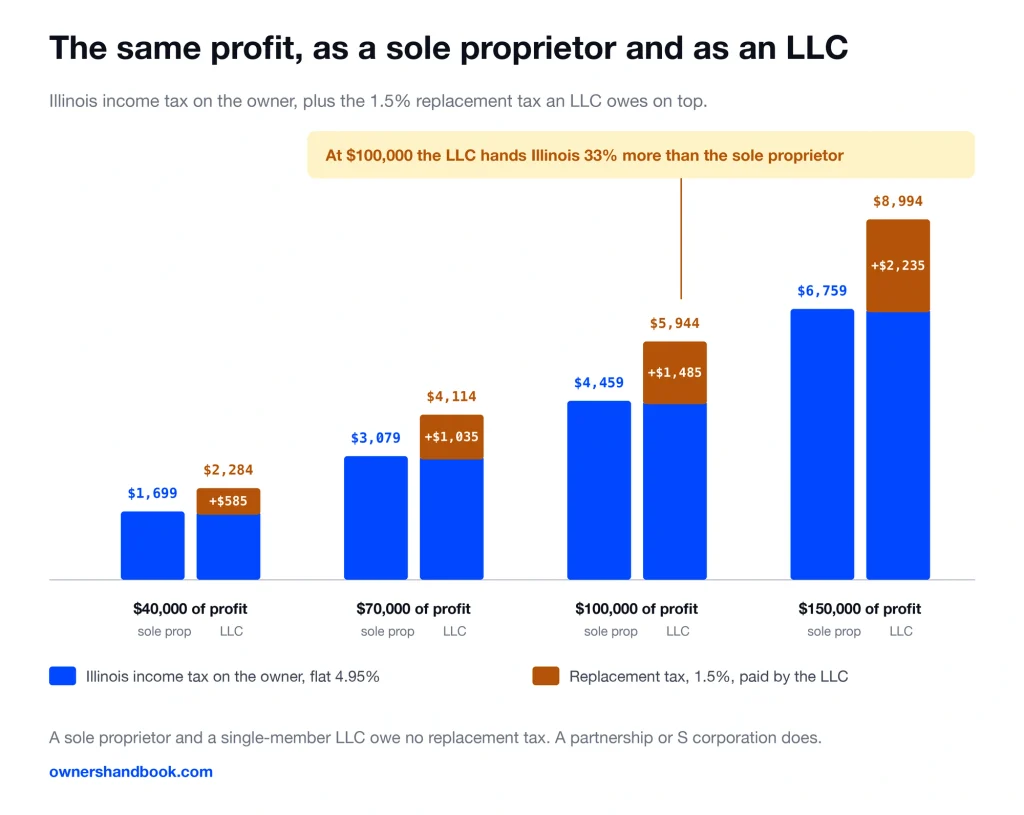
The same $100,000, two ways
Take a single filer with $100,000 of net profit in Illinois and no other income.
Self-employment tax comes to $14,130. Half of it, $7,065, comes off before Illinois starts counting, leaving $92,935 of adjusted gross income.
Subtract the $2,850 exemption and you have $90,085 of Illinois net income. At 4.95% that is $4,459 of state income tax.
A sole proprietor stops there. An LLC taxed as a partnership files a second return on the same money.
| What Illinois charges | Sole proprietor | LLC taxed as a partnership |
|---|---|---|
| Income tax on the owners, 4.95% | $4,459 | $4,459 |
| Replacement tax on the entity, 1.5% | $0 | $1,485 |
| Total to Illinois | $4,459 | $5,944 |
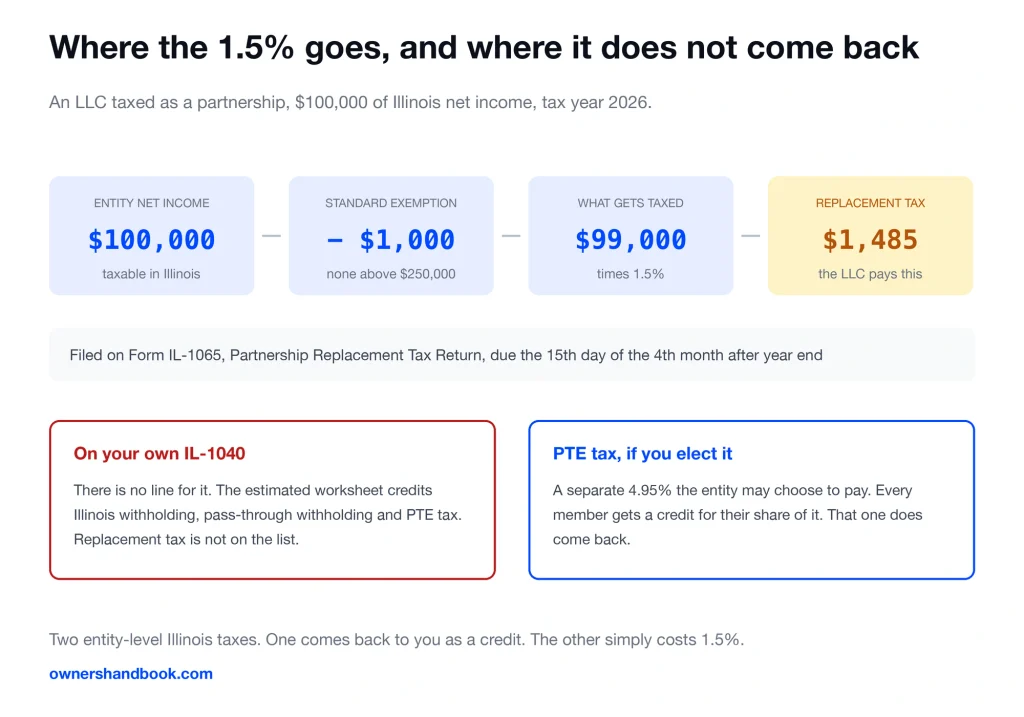
The entity’s $1,485 is 1.5% of $99,000, because a partnership gets its own $1,000 standard exemption before the rate lands.
Same profit, same state, $1,485 more. That is 33% on top of the income tax bill, for a filing most people did not know existed.
Who owes it and who does not
Illinois defines a partnership as an entity treated as a partnership for federal income tax purposes. That one sentence decides your answer.
A one-owner LLC is not treated as a partnership federally. It is disregarded, its profit lands on your Schedule C, and there is no IL-1065 to file.
Add a second member and you are a partnership. Elect S corporation status and you file IL-1120-ST instead. Either way the 1.5% starts.
| How you are set up | Illinois entity return | Replacement tax |
|---|---|---|
| Sole proprietor | None. Profit goes on your IL-1040 | None |
| Single-member LLC, no election | None. Disregarded for tax | None |
| LLC with two or more members | IL-1065 | 1.5% |
| LLC or corporation electing S corp | IL-1120-ST | 1.5% |
| C corporation | IL-1120 | 2.5% |
This is the line most Illinois LLC guides skip. Whether you have a co-owner matters more to your state tax bill than whether you have an LLC.
It never comes back on your IL-1040
You might reasonably expect a credit. Illinois taxed the same dollars twice, once at the entity and once at you.
There is none. The 2026 estimated worksheet lists every credit an individual can claim: property tax, education expenses, EITC, child tax, taxes paid to other states, pass-through withholding, PTE tax.
Replacement tax is not on that list. It is not anywhere else on the individual return either.
So treat the 1.5% the way you treat a registered agent fee. It is a cost of the structure, money out rather than money forwarded.
Where the extra 1.5% stops being worth it
At the state level an LLC buys one thing: a legal wall between business debts and your personal assets. Illinois prices the multi-member version at 1.5% of profit, every year.
Turn that into a break-even. Take whatever the protection would otherwise cost you annually, divide by 0.015, then add the $1,000 exemption.
If liability coverage you would have bought anyway runs $600 a year, the replacement tax passes it at $41,000 of profit. At $1,000 a year, $67,700.
Above those numbers the entity is costing you more in Illinois tax than the thing you are comparing it against. That does not make it wrong. It makes it priced.
Whether an LLC or a sole proprietorship fits your work is a larger question than one state’s 1.5%, and forming one has its own steps.
One thing this page does not cover. The Illinois Secretary of State runs its own business filings for LLCs, on its own schedule, with fees that have nothing to do with tax. Look those up at ilsos.gov before you organize anything.
The other entity tax, the one you get back
Illinois has a second entity-level tax that behaves the opposite way.
PTE tax — an elective 4.95% that a partnership or S corporation may choose to pay on its own net income, available for tax years ending on or after December 31, 2021.
Every member then claims a credit equal to 4.95% of their distributive share of that income. This one does come back.
The election is made on the IL-1065 or IL-1120-ST and is irrevocable after the extended due date. It also pulls the entity into quarterly estimated payments once expected tax passes $500.
Both taxes are entity-level and both are flat. Only one is a credit. Do not let the similar shape fool you.
Chicago charges no income tax
The city’s Department of Finance publishes its full tax list. Amusement, parking, restaurant, hotel, bottled water, cigarettes, checkout bags, ground transportation.
No income tax. No wage tax. No net profits tax.
That is a genuine advantage over New York City or Philadelphia, where a freelancer picks up a separate municipal filing on the same profit.
Chicago collects elsewhere instead. Its Personal Property Lease Transaction Tax went to 15% as of January 1, 2026, and it reaches the nonpossessory lease of a computer, which means your cloud software.
Your vendor normally charges it on the invoice rather than sending you a form. It is a cost line in your expenses, not a filing on your calendar.
Four dates and a $1,000 floor
You owe Illinois estimated payments if you reasonably expect your 2026 liability to exceed $1,000 after withholding and credits.
The dates are April 15, June 15 and September 15 of 2026, then January 15 of 2027. Four equal installments, matching the federal calendar exactly.
Pay at least 90% of this year’s tax or 100% of last year’s in four timely installments and the late-payment penalty does not apply. Illinois never raises that to 110%.
A partnership that has not elected PTE tax makes no estimated payments at all. It settles its replacement tax in one payment with the IL-1065, due the 15th day of the fourth month after year end.
Your federal quarterly estimated taxes run on a separate form and a separate portal. Neither agency forwards a dollar to the other.
Frequently asked questions
Does Illinois charge self-employment tax?
No. Social Security and Medicare are federal, so the 15.3% does not repeat here. Illinois charges income tax, and the replacement tax is a tax on entities rather than on you.
I have a single-member LLC. Do I file Form IL-1065?
No. Illinois follows the federal classification, and a one-owner LLC that made no corporate election is disregarded. The profit goes on your IL-1040 and nowhere else.
Can I deduct the replacement tax somewhere?
Not as a credit on your IL-1040. It is a tax on the entity and it is reported on the entity’s return. Ask your preparer how it is handled federally.
Does Illinois allow the qualified business income deduction?
No. Illinois begins from federal adjusted gross income and the QBI deduction is taken below that line. It never reduces your Illinois base income.
My LLC lost money. Do I still owe replacement tax?
The tax is 1.5% of net income, so a loss year produces none. That is unlike California, which bills every LLC $800 whether it earned anything or not.
Should I elect PTE tax to avoid the replacement tax?
It does not avoid it. An electing entity owes both, and its estimated payments are based on the sum of the two. PTE tax is about the federal deduction, not about escaping the 1.5%.
Sources
Illinois Department of Revenue, Tax Rates
https://tax.illinois.gov/research/taxrates/income.html
Illinois Department of Revenue, Publication 129, Pass-through Entity Information
https://tax.illinois.gov/content/dam/soi/en/web/tax/research/publications/pubs/documents/pub-129.pdf
Illinois Department of Revenue, Form IL-1065 Instructions
Illinois Department of Revenue, Form IL-1040-ES, Estimated Income Tax Payments for Individuals 2026
Illinois Department of Revenue, Illinois Estimated Payment Requirements for Individuals and Businesses
Illinois Department of Revenue, Business Income Tax Estimated Payments
https://tax.illinois.gov/businesses/business-income-tax-estimated-payments.html
Illinois Department of Revenue, 2025 Form IL-1040 Instructions
City of Chicago, Tax List
https://www.chicago.gov/city/en/depts/fin/supp_info/revenue/tax_list.html
City of Chicago, Personal Property Lease Transaction Tax
IRS, Self-Employment Tax
IRS, Estimated Taxes
https://www.irs.gov/businesses/small-businesses-self-employed/estimated-taxes