Do You Have to Pay Quarterly Taxes in Your First Year of Freelancing?
There is a published rule that says some first-year freelancers owe no estimated tax at all, whatever they earn. It is one sentence in Form 1040-ES, it is not conditional on income, and almost nobody mentions it.
This is how to work out whether it applies to you, and what to do if it does not.
The exception first, because it may end the question
Straight from Form 1040-ES for 2026:
You don’t have to pay estimated tax for 2026 if you were a U.S. citizen or resident alien for all of 2025 and you had no tax liability for the full 12-month 2025 tax year.
Read that again. It says nothing about how much you earn this year. Earn $200,000 freelancing in 2026 and, if the condition is met, no estimated payments are required and no underpayment penalty can reach you. You settle up in April.
The condition is no tax liability, and that is a specific number, not a feeling.
| What it means | What it does not mean |
|---|---|
| Your 2025 total tax was zero | You got a refund |
| Line 24 of your 2025 Form 1040 was zero | You broke even |
| You had no filing requirement for 2025 | You paid a small amount |
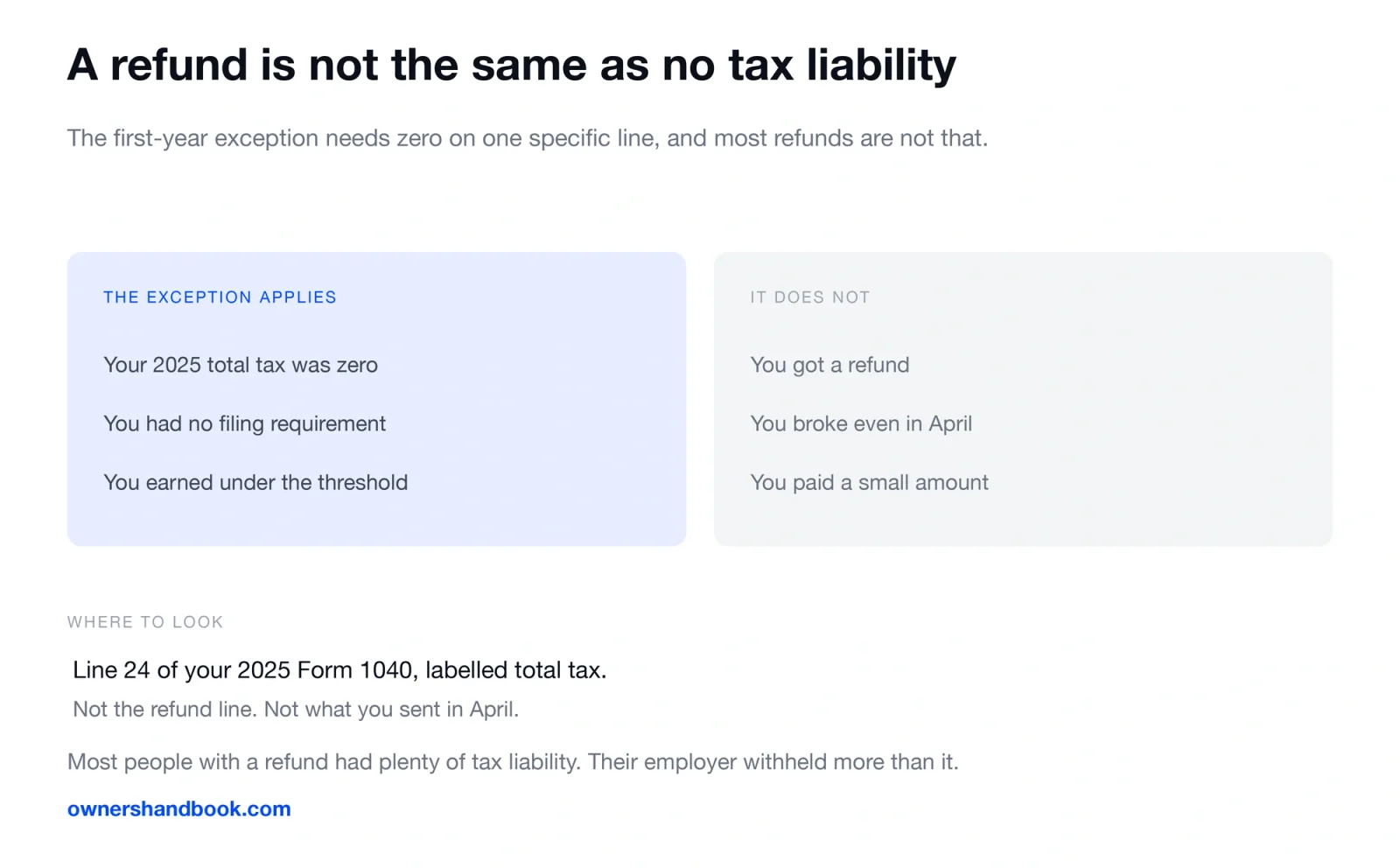
A refund is the most common misreading. Most people with a refund had plenty of tax liability — their employer simply withheld more than it. Go and look at the line labelled total tax near the bottom of page two of the return. Zero means zero.
It also has to be a full 12-month 2025 tax year. Someone who was a student all of 2025, or had no income, or earned under the filing threshold, is the typical case.
If that is not you, two things both have to be true
The general rule has two conditions, and you only owe estimated tax if both apply.
| Condition | What it says |
|---|---|
| 1 | You expect to owe at least $1,000 for 2026 after withholding and refundable credits |
| 2 | Your withholding and credits will be less than the smaller of 90% of this year’s tax, or 100% of last year’s |
The second condition is the one worth understanding, because it is the escape route as well as the trigger.
If your withholding already covers 100% of what you owed last year, you are done. No estimated payments. It does not matter that this year is bigger.
That is why a freelancer who kept a part-time job often owes nothing quarterly. The job’s withholding quietly satisfies the prior-year number, and the freelance profit rides along until April.
If your 2025 adjusted gross income was over $150,000 — or $75,000 filing married separately — substitute 110% for 100%.
Why the prior-year number is unusually kind in year one
Here is the part that makes the first year easier than the tenth, and it goes unsaid almost everywhere.
The safe harbor looks backwards. In your first freelance year, backwards is a year you were probably employed, or studying, or earning much less.
| Your 2025 | Your 2026 | Prior-year safe harbor |
|---|---|---|
| Student, no income | $70,000 freelancing | $0 — the exception applies |
| $38,000 W-2 job | $90,000 freelancing | 100% of a $38,000 year’s tax |
| $140,000 W-2 job | $90,000 freelancing | 100% of a $140,000 year’s tax |
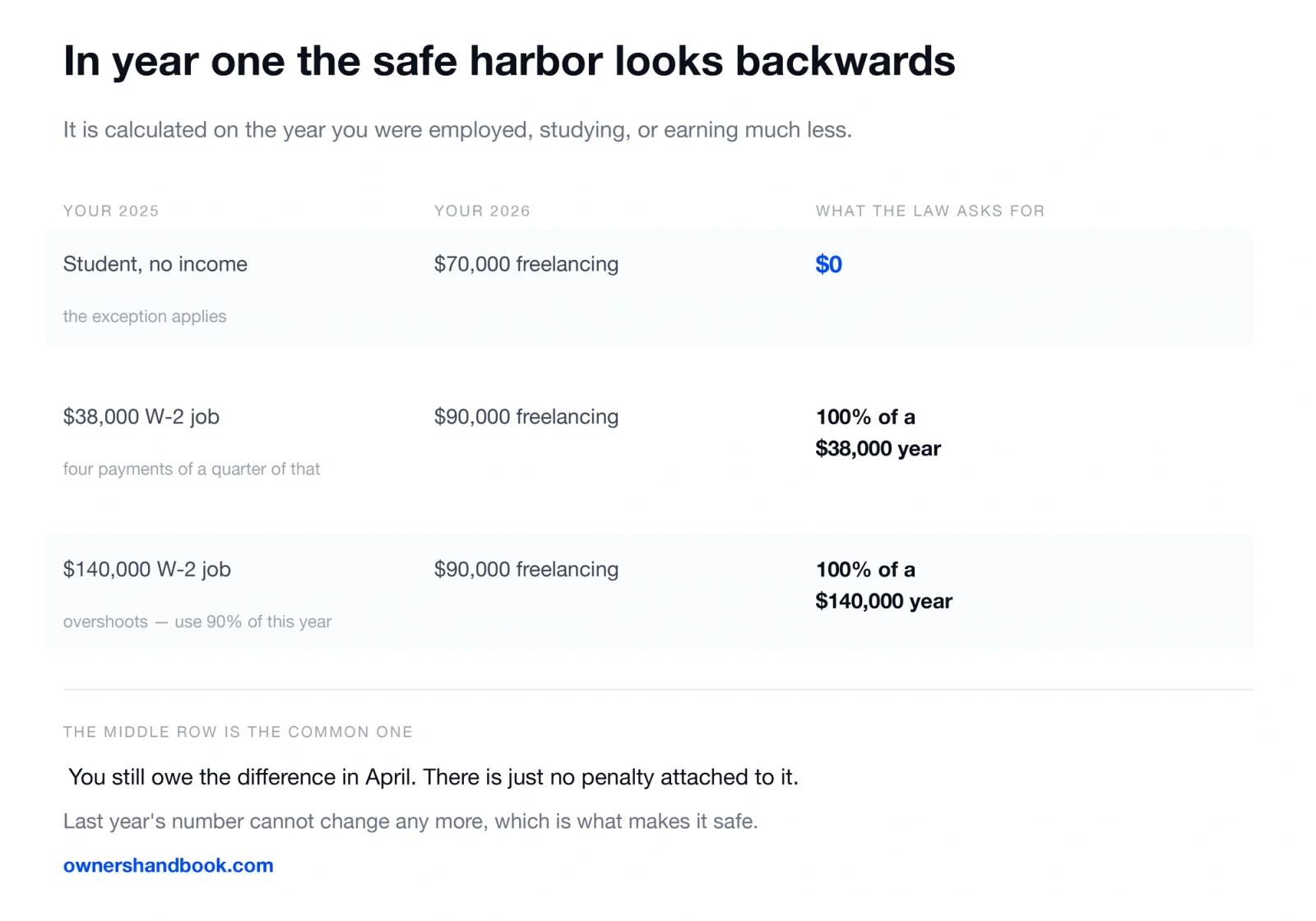
Row two is the common one. The safe harbor is calculated on the smaller year, so four payments of a quarter of that number are all the law asks — even though 2026 will produce a much bigger bill.
You will still owe the difference in April. There is simply no penalty attached to it, because you hit the harbor.
Row three is the reverse and worth watching. Leaving a well-paid job to freelance means the prior-year number is larger than what you will actually owe, and paying 100% of it would overshoot badly. That is the case for using 90% of this year’s estimate instead — and our quarterly tax calculator compares the two.
What you actually owe, if you do owe
Two taxes, not one, and the second one is the surprise.
| What | Rate | On |
|---|---|---|
| Self-employment tax | 15.3% | 92.35% of net profit, up to the ceiling |
| Income tax | Your bracket | Taxable income |
Self-employment tax is the part first-year freelancers underestimate, because a W-2 job hid half of it. The self-employment tax calculator works out the exact figure, including the way a job changes it.
The common advice is to set aside 25% to 30% of every payment. That is a reasonable default for a first year. Our guide to self-employment tax explains where the number comes from.
The four dates
| Payment | Due | Covers |
|---|---|---|
| 1st | April 15, 2026 | January 1 – March 31 |
| 2nd | June 15, 2026 | April 1 – May 31 |
| 3rd | September 15, 2026 | June 1 – August 31 |
| 4th | January 15, 2027 | September 1 – December 31 |
They are not quarters. The second period is two months and the fourth is four.
If a due date lands on a weekend or a legal holiday, the payment is on time on the next business day.
And there is a published way out of the last one: file your 2026 return by February 1, 2027 and pay the balance in full, and the January 15 payment is not required.
Starting mid-year
The question that does not get answered anywhere: you started freelancing in July, so what happens to April and June?
Nothing, if the exception applies to you. If it does not, the default calculation assumes income arrived evenly across the year, which can produce a penalty for two quarters in which you had no freelance income at all.
The fix is the annualized income installment method on Schedule AI of Form 2210, which matches each payment to income you had actually received by that point. It is real work — it needs your books closed at March 31, May 31, August 31 and December 31 — but it exists precisely for this.
It is also usually unnecessary in year one, because the prior-year safe harbor is so low. Check that first.
How to send it
IRS Direct Pay, from a checking account, free. Choose Estimated Tax as the reason and 1040-ES as the form, then the tax year.
You do not need vouchers, you do not need to mail anything, and you do not need to register. Keep the confirmation number.
There is no rule against paying on an ordinary Tuesday. The four dates are deadlines, not the only days the window is open — and paying early costs nothing.
What happens if you get it wrong
Less than people fear. The charge is interest, not a fine: the federal short-term rate plus three points, on what you were short, for the days you were short. It ran 7% for most of 2026.
Skipping $8,000 of payments across a whole year costs roughly $372. The $8,000 is still due; the punishment for lateness is under 5% of it.
Our guide to missed estimated payments covers what to do from here, including the fact that raising withholding on a W-2 job can retroactively fix quarters you already missed.
Frequently asked questions
I had a refund last year. Does the first-year exception apply to me?
Probably not. A refund usually means you had tax liability and overpaid it. The exception needs total tax of zero — check line 24 of last year’s Form 1040.
I made $4,000 freelancing this year. Do I have to pay quarterly?
Almost certainly not. The first condition requires expecting to owe at least $1,000 after withholding, and $4,000 of profit will not get there on its own. You still report it, and you still owe self-employment tax on it if net earnings reach $400.
Can I just pay it all in April instead?
You can pay it, but if you were required to make quarterly payments the penalty for the earlier periods still applies — it is figured separately for each due date. Being square in April does not undo having been short in June.
What if I have no idea what I will earn?
Use the prior-year safe harbor. Take last year’s total tax, divide by four, send that. It requires no forecasting and it cannot fail, because last year’s number can no longer change.
Does an extension give me more time to pay these?
No. An extension is for filing, not paying, and it does not apply to estimated payments at all.
Do I need to register or set anything up first?
No. Estimated payments go under your Social Security number. An EIN and a business bank account are useful for other reasons, but neither is required to pay.
Sources
IRS, Form 1040-ES, Estimated Tax for Individuals (2026)
https://www.irs.gov/pub/irs-pdf/f1040es.pdf
IRS, Topic no. 306, Penalty for underpayment of estimated tax
https://www.irs.gov/taxtopics/tc306
IRS, Estimated taxes
https://www.irs.gov/businesses/small-businesses-self-employed/estimated-taxes
IRS, Instructions for Form 2210
https://www.irs.gov/pub/irs-pdf/i2210.pdf
IRS, Quarterly interest rates for underpayment and overpayment of tax
https://www.irs.gov/payments/quarterly-interest-rates-for-underpayment-and-overpayment-of-tax
IRS, Direct Pay with bank account