Mileage Deduction Calculator for 2026 (Both Rates)
The 2026 rate changed in the middle of the year. Most mileage calculators still multiply everything by one number, which either costs you money or puts a wrong figure on your return. This one splits the year where the IRS split it.
Mileage deduction calculator
The 2026 rate changed on July 1, so this asks for the two halves separately. A single-rate calculator gets this year wrong.
What counts is the date of the trip, not when you were paid.
These are worth more per mile.
The charitable rate is fixed by statute and did not move.
Deducted on top of the rate, not included in it.
Used to show what the deduction is actually worth in cash.
| January 1 – June 30 | $0 |
| July 1 – December 31 | $0 |
| Parking and tolls | $0 |
| Total | $0 |
| Roughly what it saves you | $0 |
If you had used one rate for the whole year
| All miles at the first-half rate understates it | $0 |
| All miles at the second-half rate overstates it | $0 |
Rates for tax year 2026 from
IRS Standard Mileage Rates.
Runs entirely in your browser — nothing you type is sent anywhere or stored.
This calculator is for informational purposes only and does not constitute legal, accounting, or tax advice.
The cash-value figure is an estimate: it applies the bracket you chose plus self-employment tax, and does not
account for the Social Security wage base, the qualified business income deduction, state tax, or the actual
expense method, which can produce a larger deduction for some vehicles. Taking the standard rate also requires
that you used it in the first year the car was available for business. Consult your own tax advisor.
Below: why the split exists, which miles count, and the one decision you can only make once per car.
The two rates, and the day between them
| When you drove | Rate per mile | 1,000 miles is worth |
|---|---|---|
| January 1 to June 30, 2026 | $0.725 | $725 |
| July 1 to December 31, 2026 | $0.76 | $760 |
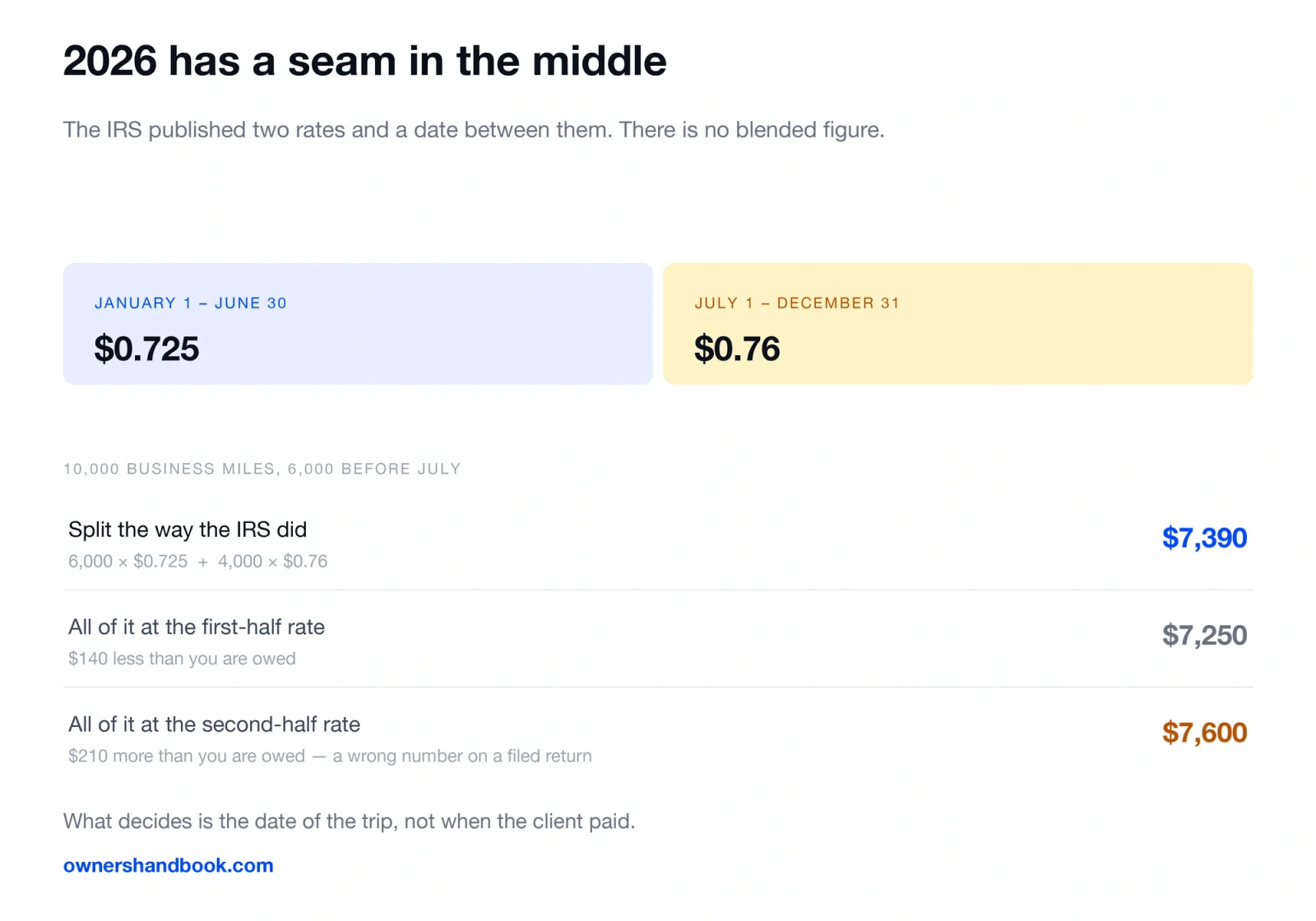
There is no blended rate. The IRS did not average the two, and neither should you.
A mile you drove on June 30 is worth 72.5 cents. A mile you drove on July 1 is worth 76 cents. What decides is the date of the trip — not the date the client paid you, and not the date you filled the tank.
On 10,000 business miles split 6,000 before July and 4,000 after, the deduction is $7,390.
Run all 10,000 at 72.5 cents and you get $7,250 — $140 handed back for nothing. Run all 10,000 at 76 cents and you get $7,600, which overstates the deduction by $210. That second one is not a rounding error. It is a wrong number on a filed return.
Why it moved, and whether it moves again
Mid-year changes are unusual. The last one was in 2022, and the cause both times was fuel.
The IRS made the change in Announcement 2026-11, which modified the original Notice 2026-10.
| Rate | First half | Second half |
|---|---|---|
| Business | $0.725 | $0.76 |
| Medical and moving | $0.205 | $0.235 |
| Charitable | $0.14 | $0.14 |
The charitable rate stayed put because it is fixed in the statute. Only Congress can change that one.
Do not assume 76 cents carries into 2027. The IRS sets a new rate each December and announces it fresh every year. Our guide to the 2026 mileage rate tracks what changed and why.
What the deduction is actually worth
Mileage is a Schedule C expense, which makes it one of the better deductions a freelancer has.
It lowers net profit. Lower net profit means less self-employment tax and less income tax — unlike the health insurance deduction, which only touches income tax.
On $7,390 of mileage in the 22% bracket, the combined saving is roughly $2,555. That is about 34 cents back on every deducted dollar, and it is why a sloppy log is expensive.
The calculator estimates this for you. It leaves out the Social Security wage base, the QBI deduction and state tax, so treat it as a floor rather than a precise figure.
Which miles actually count
This is where most of the risk sits, and it is not the arithmetic.
| Counts | Does not count |
|---|---|
| Client site, then back to the office | Home to a regular office, in either direction |
| Between two work locations in a day | A personal errand attached to a business trip |
| To the bank, post office, supplier | Miles you cannot point to a date and purpose for |
| To a conference or a client meeting | The commute, however far it is |
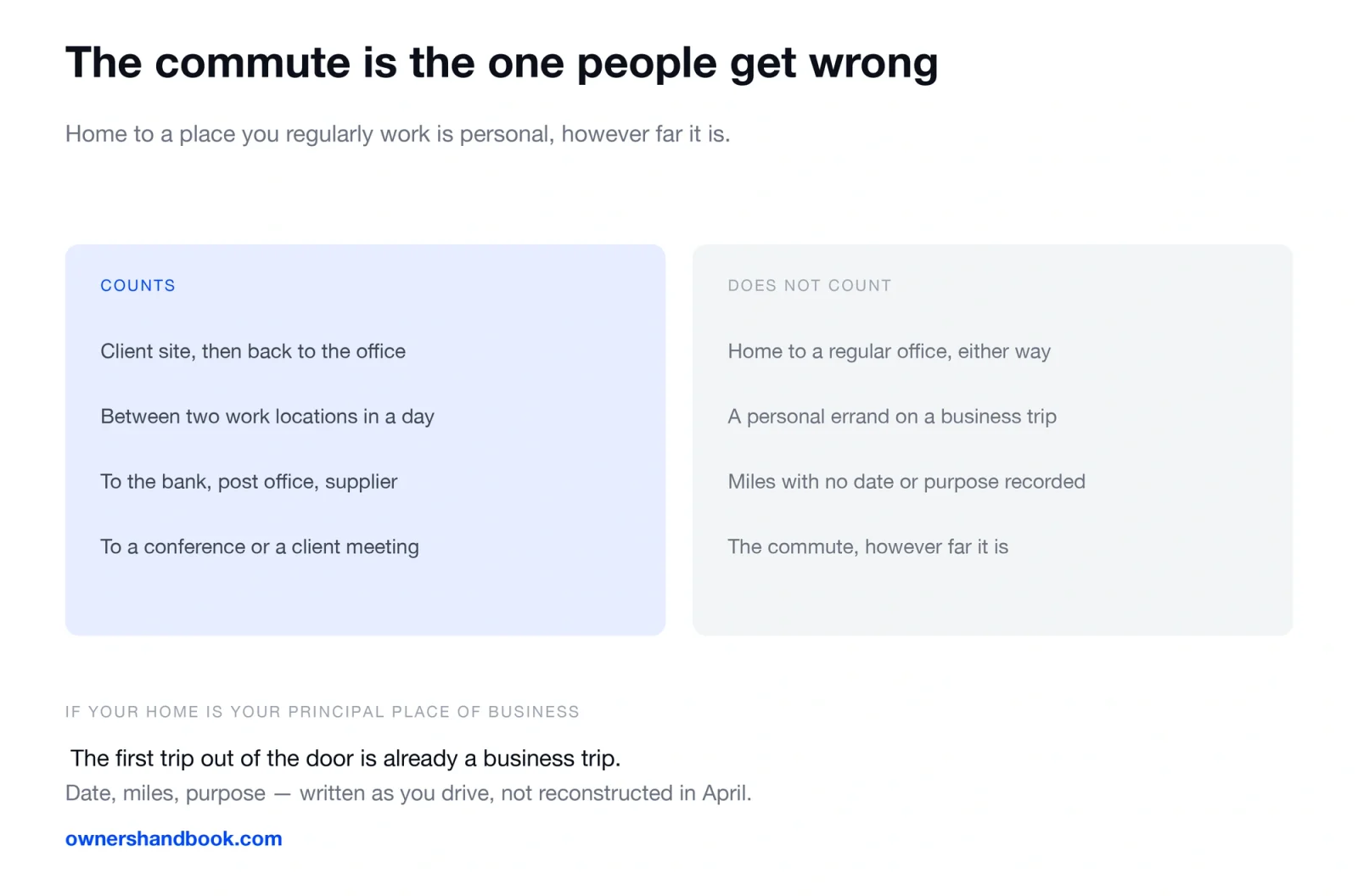
The commute is the one people get wrong. Driving from home to a place you regularly work is personal, no matter the distance.
A home office changes this. If your home is your principal place of business, the first trip out of the door is already a business trip — which is one of the quieter arguments for claiming the home office deduction.
The log has to be written as you drive
The rate is easy. Substantiation is what gets disallowed.
For each trip you need the date, the miles, and the business purpose. A spreadsheet is fine. A phone app is fine. A page of numbers reconstructed in April from memory is what auditors are trained to recognise.
| What a usable entry looks like | Why |
|---|---|
| March 4, 22 miles, client site visit — Hartwell | Date, distance, purpose, all three |
| March 4, 22 miles, “business” | Purpose is not stated |
| “About 300 miles a month” | Not a record of anything |
Keep the odometer reading at the start and end of the year as well. It shows total miles, which is what makes your business percentage credible.
More on what to keep and for how long in our guide to tax record keeping.
The choice you can only make once per car
Standard mileage is not the only method. You can instead deduct the actual costs of running the car — fuel, insurance, repairs, depreciation — multiplied by your business-use percentage.
| How they differ | Standard mileage | Actual expenses |
|---|---|---|
| What you keep | A log of miles and dates | Every receipt, plus the same mileage log |
| Parking and tolls | Deducted on top of the rate | Deducted like any other cost |
| Switching later | Yes, either direction | Only if you used standard mileage the first year |
That last row is the trap. You have to use the standard mileage rate in the first year a car is available for your business in order to keep the option at all. Claim actual expenses that first year and the standard rate is closed to that vehicle for as long as you own it.
Actual expenses usually wins on an expensive car driven few miles. Standard mileage usually wins on a cheap car driven a lot. In year one, when you do not know yet, taking the standard rate keeps both doors open.
Frequently asked questions
Which rate do I use for a trip on June 30?
The first-half rate, 72.5 cents. July 1 is the first day at 76 cents. The date of the trip decides it.
Can I deduct parking and tolls on top of the rate?
Yes. Those are separate from the per-mile rate under both methods. Fuel, insurance and repairs are not — the rate already includes them.
Do I need a log if I only drove a few hundred miles?
Yes. There is no small-amount exception. The record requirement is the same at 200 miles as at 20,000.
What if I drive for a gig platform?
The same rules apply, and the miles between deliveries count too — not just the ones with a passenger or an order in the car. Our guide to gig platform taxes covers what the platform’s own summary leaves out.
Can I use the standard rate on a car I lease?
Yes, but if you choose it you have to keep using it for the entire lease period, including renewals.
Is there a blended 2026 rate I can use instead?
No. The IRS published two rates and a date that separates them. There is no authorised average, and using one means the figure on your return does not match either published rate.
Sources
IRS, Standard Mileage Rates
https://www.irs.gov/tax-professionals/standard-mileage-rates
IRS, Publication 463, Travel, Gift, and Car Expenses
https://www.irs.gov/publications/p463
IRS, Topic no. 510, Business use of car
https://www.irs.gov/taxtopics/tc510
IRS, Instructions for Schedule C (Form 1040)