An Extension Gives You Time to File, Not to Pay
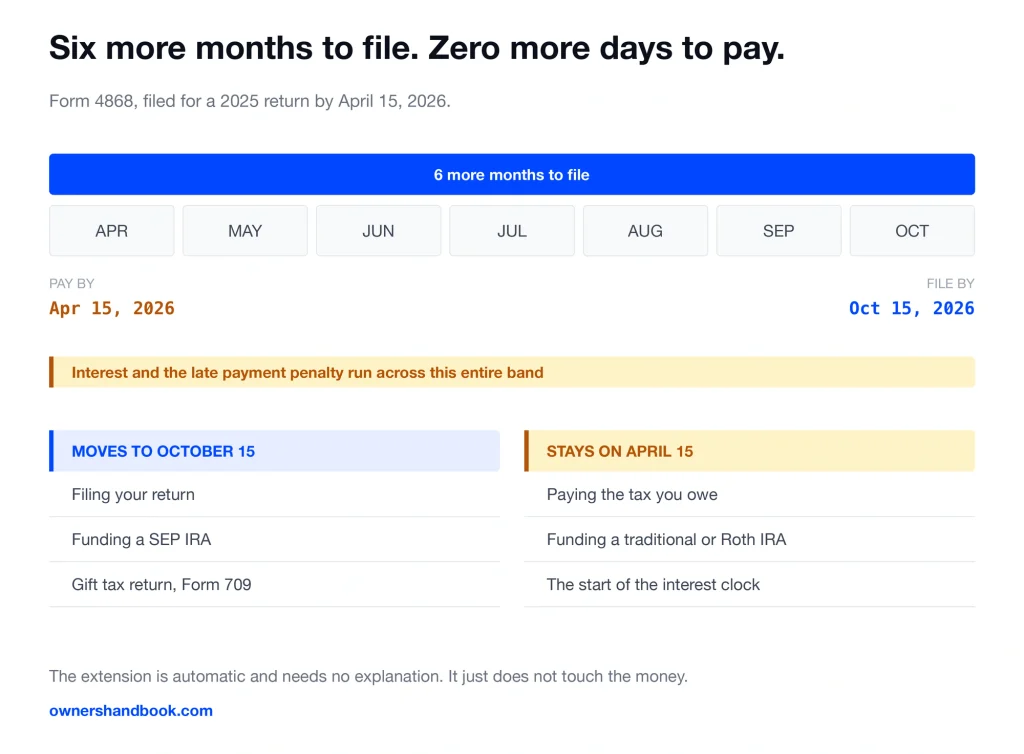
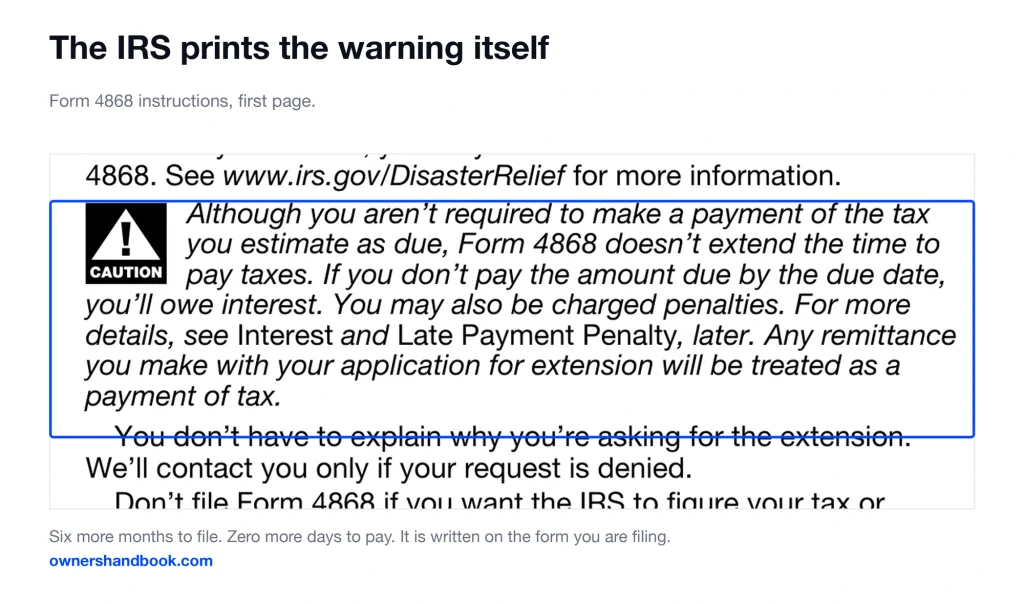
Form 4868 buys you six more months to file. Your 2025 return moves from April 15, 2026 to October 15, 2026. It does not move the payment. Whatever you owed was due April 15, and interest has been running on it since that day.
What moves and what does not
Two deadlines sit on April 15. The extension touches one of them.
The filing deadline moves. You have until October 15 to send the return.
The payment deadline does not. The IRS wants the money by April 15 even though it will not see the actual return for six more months.
That is the entire misconception in one sentence. People file the extension, feel relief, and learn in the fall that the balance has been growing since spring.
| Deadline | With Form 4868 | Without it |
|---|---|---|
| File your return | October 15, 2026 | April 15, 2026 |
| Pay what you owe | April 15, 2026 | April 15, 2026 |
| Interest starts | April 15, 2026 | April 15, 2026 |
| Contribute to a traditional or Roth IRA | April 15, 2026 | April 15, 2026 |
| Contribute to a SEP IRA | October 15, 2026 | April 15, 2026 |
The extension is automatic. You do not explain why you want it, and the IRS contacts you only if the request is denied.
One catch. Line 4 asks for your estimate of total tax liability, meaning the whole year’s tax before anything you already paid. If the IRS later decides that estimate was not reasonable, the extension is void.
The two penalties are not the same size
There are two separate penalties here, and one of them is ten times the other.
Failure to file is 5% of the unpaid tax for each month or part of a month the return is late, up to 25%.
Failure to pay is 0.5% of the unpaid tax for each month or part of a month, also up to 25%.
When both run in the same month, the failure to file penalty is reduced by the failure to pay amount. The combined charge is 5% a month, not 5.5%.
| Penalty | Rate | Cap | What triggers it |
|---|---|---|---|
| Failure to file | 5% a month | 25% | No return and no extension by April 15 |
| Failure to pay | 0.5% a month | 25% | Tax still unpaid after April 15 |
| Both in the same month | 5% a month combined | — | The file penalty drops to 4.5%, the pay penalty stays at 0.5% |
Part of a month counts as a whole month. Filing on May 16 costs exactly what filing on June 15 costs.
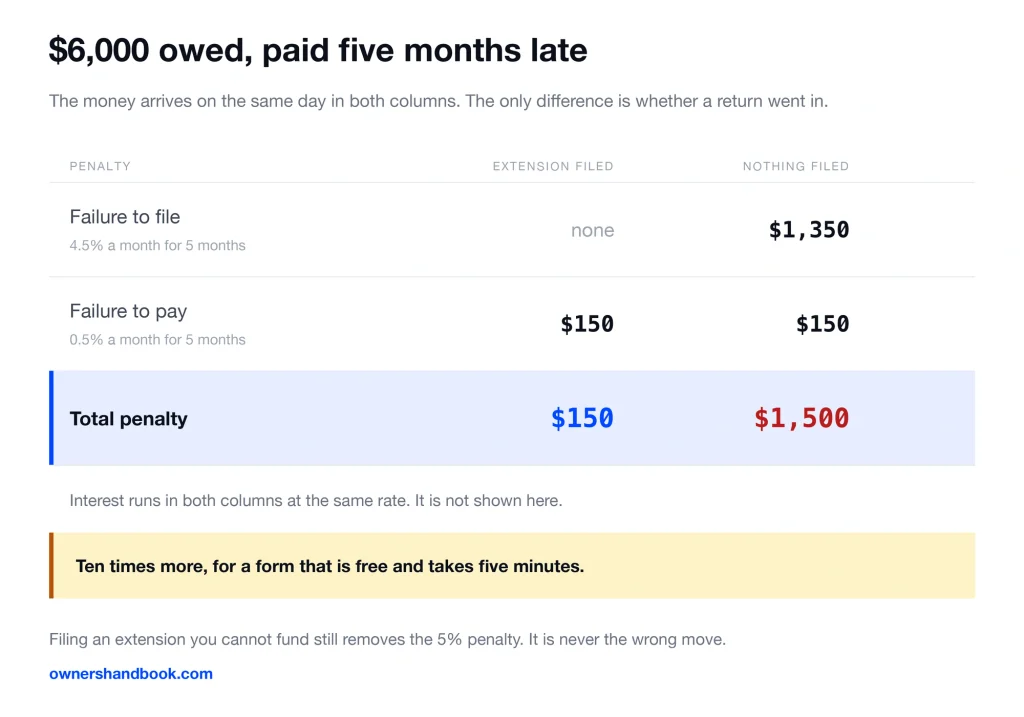
One hundred fifty dollars against fifteen hundred. Same balance, same five months, same missing cash. The only difference is whether a form went in.
There is a floor underneath it too. If your return arrives more than 60 days late, the minimum failure to file penalty is $525 or the balance of tax due, whichever is smaller.
So an extension you cannot fund is still worth filing. It does not stop the interest and it does not stop the 0.5%, but it removes the 5%.
How to file it in five minutes
There are two routes, and the second one is faster.
Free File. Go to irs.gov/freefile and submit Form 4868 electronically. Several companies offer this at no cost. You get an electronic acknowledgment, and you should keep it.
Or just pay. Make a payment through IRS Direct Pay, EFTPS, or a card, and mark it as an extension payment. The IRS processes the extension automatically and you never touch the form.
Use the second route if you owe anything. It does two jobs at once: it starts the extension and it stops the clock on the money you actually send.
Direct Pay is at irs.gov/directpay. Choose extension as the reason, pick tax year 2025, and pay from a checking account. Save the confirmation number.
Cards work too, but the processors charge a fee of roughly 2%. On a $4,000 payment that is $80 you did not need to spend.
Pay 90% and the late payment penalty disappears
This is the part almost nobody knows, and it is worth real money.
Pay at least 90% of your total tax by April 15. Withholding, estimated payments, and a payment sent with Form 4868 all count toward it.
Then pay the remaining balance with the return. Do both and you are treated as having reasonable cause for the whole extension period.
Reasonable cause means the 0.5% failure to pay penalty is not charged for those six months.
Interest is a different matter. It runs regardless. The IRS says plainly that even a good reason for not paying on time still leaves you owing interest.
The rate is the federal short term rate plus three percentage points, compounded daily. In 2026 it has run between 6% and 7%.
So the April 15 target is not perfection. It is 90%. Round your estimate up, send it, and settle the difference in October.
What an extension does not extend
Retirement contributions split in a way that catches people off guard.
A traditional or Roth IRA contribution must be in by the due date of the return, not including extensions. April 15 is the wall whether or not you filed a 4868.
A SEP IRA works the opposite way. Employer contributions are due by the filing deadline including extensions, so the extension genuinely moves it to October 15.
That asymmetry is a reason to file an extension on purpose. If you are self-employed and want a larger SEP contribution, six more months to fund it is six more months of cash flow.
One election runs with the extension rather than against it. The de minimis safe harbor, which lets you expense equipment at $2,500 or less instead of depreciating it, is made by attaching a statement to a timely filed original return including extensions. A 4868 preserves it. Filing late does not, and the election is annual, so a late return costs you that treatment for everything you bought that year.
Your state is a separate question. Some states grant an extension automatically when you have a federal one, some want their own form, and the state payment is still due on the state’s original date. Check your state revenue department.
Extensions you do not have to ask for
Two groups get more time without filing anything.
If you are out of the country on the due date and a U.S. citizen or resident, you get two extra months automatically. For a 2025 calendar year return that is June 15, 2026.
Out of the country means you live outside the United States and Puerto Rico and your main place of work is there, or you are on military or naval duty outside them.
Interest still runs from April 15 for this group. The two months cover filing and paying, not the interest clock.
Need more than that? File Form 4868 and check the box on line 8. That adds four months and brings you to October 15.
Federally declared disaster areas are the other case, and there the relief moves both the filing and the payment dates.
FEMA identifies the qualifying counties and the IRS codes accounts by zip code. If your address of record is inside the area, it happens without you doing anything.
If you were affected but live outside the area, because your records or your preparer are inside it, call the IRS disaster hotline at 866-562-5227 to identify yourself.
If you cannot pay the bill
File anyway. That is the whole answer, and the arithmetic above is the reason.
Then send whatever you can. Interest and the 0.5% penalty both run only on the unpaid part, so every dollar you send shrinks both of them.
For the remainder, the IRS has payment plans you can set up online. On an approved plan, and only if you filed on time, the failure to pay rate drops from 0.5% to 0.25% a month.
Not filing is the one move with no upside at all. It does not delay the bill, it does not shrink the bill, and it adds a penalty ten times larger than the one you were trying to escape.
Frequently asked questions
Does filing an extension raise my chance of an audit?
No. The extension is automatic and needs no explanation. The IRS contacts you only if the request is denied.
Do I still need an extension if I am getting a refund?
Both penalties are percentages of unpaid tax, so if you owe nothing there is nothing to charge them on. File the extension anyway if there is any chance you are wrong about the refund.
Can I file the extension after April 15?
No. Form 4868 has to be filed by the original due date of the return. After that the failure to file penalty has already started running.
What if I underestimate what I owe on line 4?
Make the estimate as accurate as the information you have allows. If the IRS finds the estimate was not reasonable, the extension is null and void and the return counts as late.
Does an extension give me more time for quarterly estimated payments?
No. The quarterly dates are set separately from the filing deadline and an extension does not move any of them.
Do I attach Form 4868 to the return I file in October?
No. You report the payment you made with it on Schedule 3, line 10, and keep the form and the acknowledgment with your records.
Sources
IRS, About Form 4868
https://www.irs.gov/forms-pubs/about-form-4868
IRS, Form 4868 (2025) and Instructions
https://www.irs.gov/pub/irs-pdf/f4868.pdf
IRS, Get an Extension to File Your Tax Return
https://www.irs.gov/filing/get-an-extension-to-file-your-tax-return
IRS, Topic 304: Extensions of Time to File Your Tax Return
https://www.irs.gov/taxtopics/tc304
IRS, Failure to File Penalty
https://www.irs.gov/payments/failure-to-file-penalty
IRS, Failure to Pay Penalty
https://www.irs.gov/payments/failure-to-pay-penalty
IRS, Interest
https://www.irs.gov/payments/interest
IRS, Quarterly Interest Rates
https://www.irs.gov/payments/quarterly-interest-rates
IRS, Publication 590-A, Contributions to Individual Retirement Arrangements
https://www.irs.gov/publications/p590a
IRS, Simplified Employee Pension Plan (SEP)
https://www.irs.gov/retirement-plans/plan-sponsor/simplified-employee-pension-plan-sep
IRS, FAQs for Disaster Victims
https://www.irs.gov/businesses/small-businesses-self-employed/faqs-for-disaster-victims
IRS, Direct Pay