Form 7206, Line by Line
Form 7206 is fourteen lines on one page, and it exists to turn what you paid for health coverage into one number on Schedule 1, line 17. Twelve of those lines are arithmetic. Two of them decide the answer.
The form is new enough that most of what is written about this deduction still points somewhere else. The instructions say so outright: “This form and its separate instructions have replaced the Self-Employed Health Insurance Deduction Worksheet that was previously published as a worksheet in Pub. 535, Business Expenses.” The IRS retired that publication and the worksheet went with it.
What follows walks the 2025 form with one example carried through, then the two parts that resist a worksheet — the ceiling set by your own profit, and what happens when the coverage came from the Marketplace with a subsidy attached. Where the subsidy cliff sits is a separate question, and there is a calculator for the two limits if you only want the number.
What the form is actually doing
Lines 1 through 3 add up what you paid, after throwing out the months you were not eligible.
Lines 4 through 7 decide how much of your profit this particular plan gets to lean on, which matters only if you ran more than one business. Lines 8 through 13 then reduce that profit by two Schedule 1 adjustments to produce a ceiling.
Line 14 takes the smaller of the two figures and sends it to Schedule 1, line 17.

When you need this form, and when a worksheet is enough
Many people can skip the page. The instructions: “Generally, you can use the worksheet in the Form 1040 instructions to figure your deduction. However, if any of the following apply, you must use Form 7206.”
| You must use Form 7206 if | Why |
|---|---|
| More than one source of income subject to self-employment tax | Lines 4 through 7 have to prorate |
| You file Form 2555 | Line 12 backs out foreign earned income |
| You are using qualified long-term care premiums | Line 2 has its own age-based caps |
A fourth situation is not on that list, and it is the one that traps freelancers: “See Pub. 974 if the insurance plan was considered to be established under your business and was obtained through the Marketplace, and advance payments of the premium tax credit were made or you are claiming the premium tax credit.”
Lines 1 through 3: what counts, and what gets thrown out
Line 1 is everything you paid in 2025 for medical, dental and vision coverage for you, your spouse, your dependents, and your children under 27 at the end of the year. The under-27 child does not have to be your dependent.
The form then lists three exclusions, and the first is the one people get wrong:
Amounts for any month you were eligible to participate in a health plan subsidized by your employer or your spouse’s employer or the employer of either your dependent or your child who was under the age of 27 at the end of 2025.
Eligible, not enrolled. The instructions: “You can’t take the deduction for any month you were eligible to participate in any employer (including your spouse’s) subsidized health plan at any time during that month, even if you didn’t actually participate.” A spouse’s open enrollment you declined still kills those months.
The other two exclusions are up to $3,000 from retirement plan distributions if you are a retired public safety officer, and long-term care premiums, which go on line 2 instead. Line 2 is capped per person by age at year end.
| Age at year end | 2025 limit | 2026 draft limit |
|---|---|---|
| 40 or younger | $480 | $500 |
| 41 to 50 | $900 | $930 |
| 51 to 60 | $1,800 | $1,860 |
| 61 to 70 | $4,810 | $4,960 |
| 71 or older | $6,020 | $6,200 |
For each person, enter the smaller of what you paid or the figure for their age, then total them. Line 3 adds lines 1 and 2. That is the ceiling from the premium side.
Lines 4 through 7: the proration nobody expects
These four lines only do work if you had more than one business, and they are why the form exists separately from a worksheet.
Line 4 is your net profit and other earned income from the trade or business under which the plan is established — not from all your work. Line 5 is the total of all net profits from every profitable business, with an instruction worth reading twice: “Don’t include any net losses shown on these schedules.” A money-losing second business does not drag line 5 down.
Line 6 divides line 4 by line 5. Line 7 multiplies the deductible half of your self-employment tax, from Schedule 1 line 15, by that percentage.
Two Schedule C businesses, $24,000 of profit from the one the plan sits under and $36,000 from another: line 6 is $24,000 ÷ $60,000 = 0.40, so only 40% of the $4,239 self-employment tax deduction comes off at line 7, which is $1,696. Run one business and line 6 is 1.000, which is why most people never notice these lines.
One rule sits above all of it, printed at the top of the form: “Use a separate Form 7206 for each trade or business under which an insurance plan is established.”
Lines 8 through 14: the ceiling, and where the rest goes
| Line | What it does |
|---|---|
| 8 | Subtract line 7 from line 4 |
| 9 | Self-employed SEP, SIMPLE, and qualified plans from Schedule 1, line 16, attributable to the same business |
| 10 | Subtract line 9 from line 8 |
| 11 | Medicare wages from an S corporation in which you are a more-than-2% shareholder |
| 12 | Any amount from Form 2555, line 45 |
| 13 | Subtract line 12 from line 10 or 11, whichever applies |
| 14 | The smaller of line 3 or line 13. Goes to Schedule 1, line 17 |
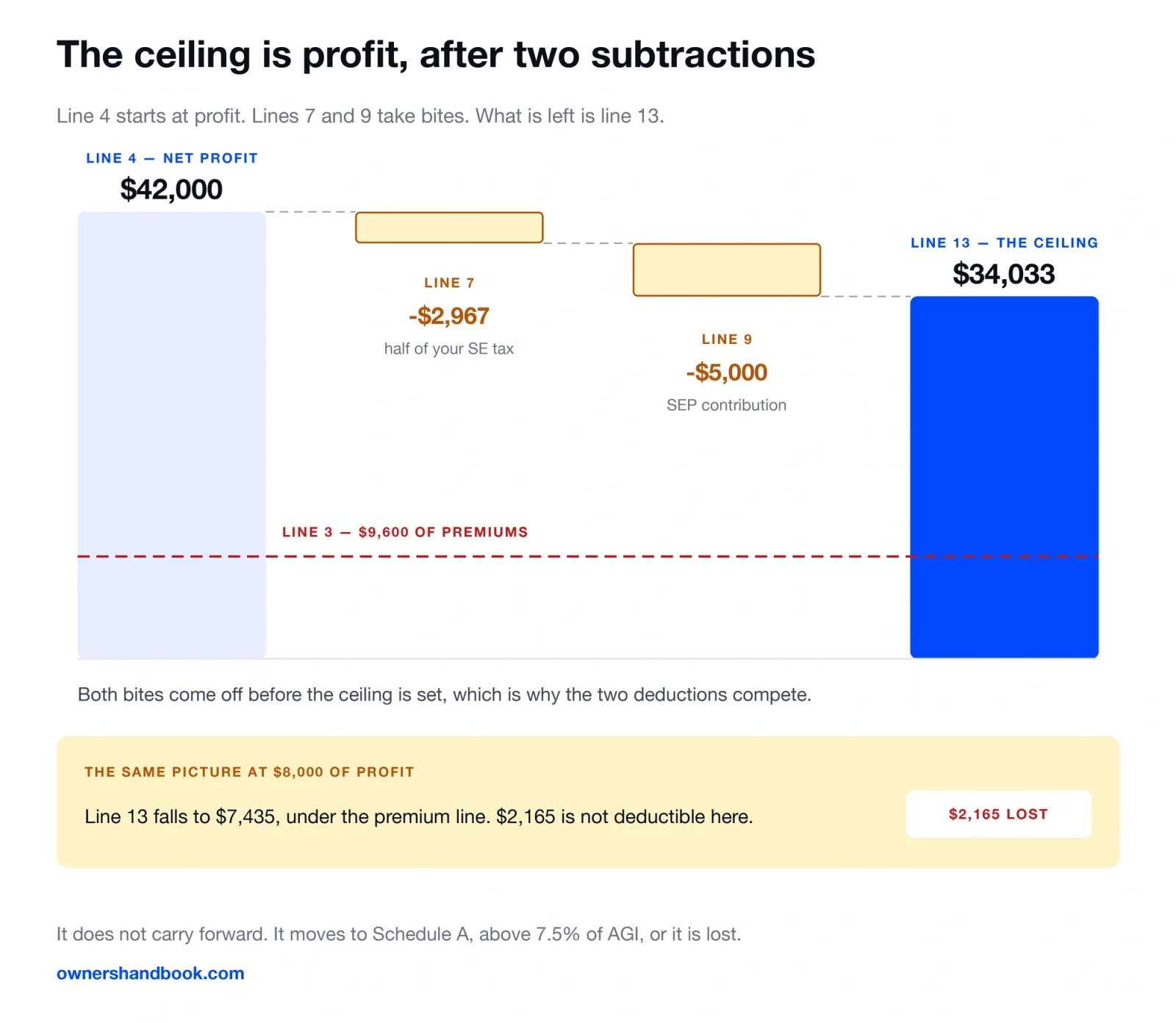
Line 9 is the surprise in a good year. A retirement contribution attributable to the same business comes off before the health insurance ceiling is set, so a large SEP contribution shrinks the room available for premiums. The two deductions compete for the same profit.
Line 11 is the S corporation route. If you took the S corp election, the form skips line 4 entirely and the ceiling becomes your Medicare wages from box 5 of your W-2.
Line 14 warns against double counting: “Don’t include this amount when figuring any medical expense deduction on Schedule A (Form 1040).” The part line 14 *did not* let you deduct is the opposite case, and the instructions allow it — “any medical insurance payments not deductible on Schedule 1 (Form 1040), line 17, can be included as medical expenses on Schedule A (Form 1040) if you itemize deductions.” Weak consolation, since Schedule A medical expenses only count above 7.5% of AGI, and not the same thing as a business expense.
A worked example, start to finish
One Schedule C business, $9,600 of premiums for the year, $42,000 of profit, and a $5,000 SEP contribution. No long-term care, no S corporation, no Form 2555.
| Line | Figure |
|---|---|
| 1. Premiums paid in 2025 | $9,600 |
| 2. Long-term care | $0 |
| 3. Add lines 1 and 2 | $9,600 |
| 4. Net profit from the business the plan is under | $42,000 |
| 5. Total of all profitable businesses | $42,000 |
| 6. Line 4 divided by line 5 | 1.000 |
| 7. Schedule 1 line 15 times line 6 | $2,967 |
| 8. Line 4 minus line 7 | $39,033 |
| 9. SEP contribution | $5,000 |
| 10. Line 8 minus line 9 | $34,033 |
| 13. Line 12 subtracted from line 10 | $34,033 |
| 14. Smaller of line 3 or line 13 | $9,600 |
The ceiling never bound. $34,033 of supported profit is far more than $9,600 of premiums, so the whole amount is deductible on Schedule 1, line 17.
Now run it again with $8,000 of profit and no retirement contribution. Line 7 becomes $565, line 8 is $7,435, and with nothing on line 9 that is line 13 as well. Line 14 takes $7,435, and of $9,600 paid, $2,165 is not deductible here. It does not carry forward the way an unused home office deduction does. It moves to Schedule A, or it is lost.
The 1095-A problem: a calculation that feeds itself
If you bought coverage on the Marketplace and advance payments of the premium tax credit went to your insurer, Form 7206 alone cannot finish the job. Publication 974 states why: “Because the amount of the self-employed health insurance deduction may affect the amount of the PTC, and the amount of the PTC may affect the amount of the deduction, a taxpayer who may be eligible for both may have difficulty determining the amounts of those items.”
The loop: your deduction lowers your adjusted gross income, household income sets the premium tax credit, a bigger credit means less premium actually borne by you, which means a smaller deduction, which raises your income again.
Publication 974 provides two ways out, and using either is optional.
| Method | How it works | Trade-off |
|---|---|---|
| Iterative Calculation Method | Compute the credit, then the deduction, then recompute both, until the change in each is under $1.00 | Longer. Produces the better answer |
| Simplified Calculation Method | One pass through three steps | “Shorter, but in some cases will not produce a result as favorable” |
The iterative method stops at Step 6: if the change in the deduction from Step 3 to Step 5 and the change in the credit from Step 2 to Step 4 are both under a dollar, you are done. Otherwise repeat Steps 4 and 5.
Neither method is mandatory. The publication allows “any computation method that results in reporting amounts that satisfy the rules for both the deduction and PTC, as long as the sum of the deduction claimed for the premiums and the PTC computed, taking the deduction into account, is less than or equal to the enrollment premiums.” That is the real constraint: deduction plus credit cannot exceed what the plan cost.
Before either method, Publication 974 sorts your premiums into *specified* and *nonspecified* and sends you through Worksheets P, W and X. If the limit already bites on Worksheet P, you stop and never reach the iteration.
Reading the loop is useful. Running six worksheets by hand to converge on a dollar is not, and it is the strongest argument on this site against filing your own return in a Marketplace year.
The repayment cap is gone
There was a safety net under all of this, and from 2026 returns onward it no longer exists.
If your advance credit payments came in larger than the credit you were entitled to, you repay the difference. Through tax year 2025 that repayment was capped by income band, in Table 5 of the Form 8962 instructions:
| Household income, percent of poverty line | Single | Any other filing status |
|---|---|---|
| Less than 200 | $375 | $750 |
| At least 200 but less than 300 | $975 | $1,950 |
| At least 300 but less than 400 | $1,625 | $3,250 |
| 400 or more | No limit | No limit |
Section 71305 of Public Law 119-21, enacted July 4, 2025, is titled “Eliminating limitation on recapture of advance payment of premium tax credit,” and its operative sentence is one line: “Section 36B(f)(2) is amended by striking subparagraph (B).” Subparagraph (B) was the cap. The effective date follows: “The amendments made by this section shall apply to taxable years beginning after December 31, 2025.”
So from 2026 there is no dollar cap at any income level. Underestimate your income to the Marketplace and you repay the full excess, on Schedule 2 line 1a as “Excess advance premium tax credit repayment.”
For a freelancer that is a planning problem, not a filing problem. Income you cannot forecast in November is exactly what this change punishes, and the fix is the boring one — estimate high, report changes during the year, and keep the records that show where you actually are by autumn.
What trips people up
Counting months you were merely eligible for a spouse’s plan. The test is eligibility during the month, not enrollment. Declining the coverage does not help.
Putting premiums on Schedule C. They do not go there. The deduction is on Schedule 1, which is why it never reduces your self-employment tax — the Form 7206 instructions say so directly.
Forgetting that line 9 competes. A retirement contribution attributable to the same business lowers the ceiling for premiums. In a thin year the two deductions cannot both be full.
Using the Publication 535 worksheet. It is gone. Anything still citing Worksheet 6A predates 2023.
Expecting a carryover. There is none. The amount line 14 blocks either moves to Schedule A or disappears.
Frequently asked questions
Does this deduction reduce my self-employment tax?
No. The Form 7206 instructions are explicit: “You can’t subtract the self-employed health insurance deduction when figuring net earnings for your self-employment tax.” It lowers income tax and your AGI only, and it also shrinks qualified business income alongside it.
My profit was too low to deduct all of it. Where does the rest go?
Schedule A, as a medical expense, if you itemize. It does not carry forward, and it only helps above 7.5% of AGI.
I bought a Marketplace plan with a subsidy. Which do I fill in first?
Neither, on its own. Go to Publication 974, sort your premiums, then pick the iterative or simplified method. The rule to satisfy is that your deduction plus your credit cannot exceed what the plan cost.
Is the repayment cap really gone for everyone?
Yes, for tax years beginning after December 31, 2025, at every income level. The 2025 bands in Table 5 still apply to a 2025 return, and your state return may handle the repayment differently again.
Sources
IRS, Form 7206, Self-Employed Health Insurance Deduction, 2025
https://www.irs.gov/pub/irs-pdf/f7206.pdf
IRS, Instructions for Form 7206, 2025
https://www.irs.gov/pub/irs-pdf/i7206.pdf
IRS, Publication 974, Premium Tax Credit (PTC), for use in preparing 2025 returns
https://www.irs.gov/pub/irs-pdf/p974.pdf
IRS, Instructions for Form 8962, Premium Tax Credit, 2025
https://www.irs.gov/pub/irs-pdf/i8962.pdf
Public Law 119-21, section 71305, Eliminating Limitation on Recapture of Advance Payment of Premium Tax Credit (July 4, 2025)
https://www.govinfo.gov/content/pkg/PLAW-119publ21/html/PLAW-119publ21.htm
IRS, Schedule 1 (Form 1040), Additional Income and Adjustments to Income, 2025
https://www.irs.gov/pub/irs-pdf/f1040s1.pdf
IRS, Schedule 2 (Form 1040), Additional Taxes, 2025