The 1099-K Threshold, and the States That Ignore It
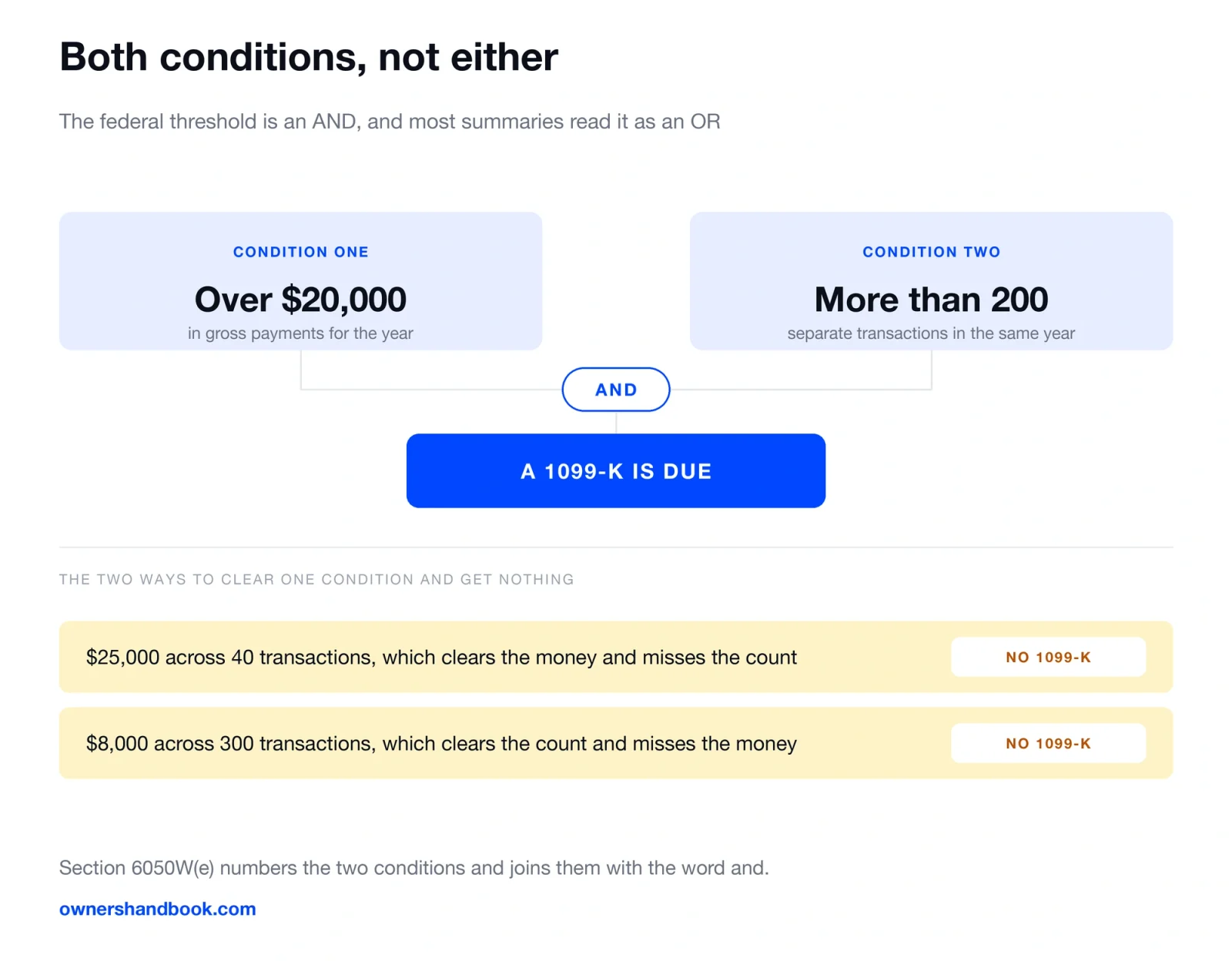
The federal 1099-K threshold is back where it was before 2021: payments over $20,000 and more than 200 transactions, both conditions, in the same year. The $600 rule that was coming never arrived, and the law that killed it was written to apply as though it had never been enacted at all.
That is the part most pages now get right. The part they skip is that the federal number is not always the number that decides whether a form shows up in your mailbox. Several states set their own, lower, and a platform reporting to those states reports at the state’s figure.
Below is the federal rule in two sentences, then the state-by-state position we were able to verify from the states’ own publications and statutes on October 13, 2026 — including which ones we could not confirm, and why.
The federal rule, and why both halves matter
The December 2026 Instructions for Form 1099-K state the obligation:
is required to report payments in settlement of third party network transactions with any participating payee that exceed $20,000, and the total number of such transactions exceeds 200
The statute behind it, section 6050W(e), is written as two numbered conditions:
(1) the amount which would otherwise be reported under subsection (a)(2) with respect to such transactions exceeds $20,000, and (2) the aggregate number of such transactions exceeds 200
The word is and. Twenty-five thousand dollars across 40 transactions does not trigger a 1099-K. Neither does 300 transactions totalling $8,000. You have to clear both.
The restoration came from the One Big Beautiful Bill, P.L. 119-21, section 70432, and the drafting is unusual: the amendment takes effect “as if included in section 9674 of the American Rescue Plan Act.” That is the 2021 provision which created the $600 rule. Striking it retroactively means the lower threshold is treated as never having applied, which is why the 2024 and 2025 interim figures you may remember reading about no longer govern anything.
Our side-by-side of the 1099-NEC and the 1099-K covers which form reports what, and why the two cannot simply be added together.
What each state actually requires
Four jurisdictions below are what we could verify from a primary state source. The last column is where the rule is written, because that is the only thing that makes a table like this checkable.
| Jurisdiction | What the rule requires | Lower than federal | Source |
|---|---|---|---|
| Federal | Over $20,000 and more than 200 transactions | — | IRC § 6050W(e) |
| Illinois | Four or more separate transactions and a cumulative total over $1,000, for a payee with an Illinois address | Yes | IDOR Publication 110 (R-01/26) |
| Vermont | $2,000 or more. No transaction count | Yes | Vermont Department of Taxes |
| Virginia | The § 6041(a) de minimis amount, which is $2,000 for payments after 2025. No transaction count | Yes | Va. Code § 58.1-356 |
| New York | Whatever § 6050W requires, filed with New York within 30 days | No | N.Y. Tax Law § 1703 |
Illinois is the most aggressive of the four and the least like the federal rule. Publication 110 requires a filer to submit Forms 1099-K issued to an Illinois-address payee electronically if the IRS requires electronic filing of them, *or* if “the payee has four or more separate transactions, and the cumulative total exceeds $1,000.” Four transactions and $1,001 is enough. Illinois also will not take them through MyTax Illinois — they have to go through the Illinois FIRE Electronic Transmission Program, and the deadline is March 31 rather than January 31.
Vermont is the surprise. The Department of Taxes now puts its figure at $2,000, not $600, and says so with an explanation aimed at people who never got one before: “You may not have received one previously because the threshold for reporting in Vermont has changed.”
New York sits in the table as a deliberate “no.” Tax Law § 1703 requires settlement entities to file duplicates of their § 6050W returns with the Department of Taxation and Finance within thirty days of the federal filing. It adds no New York threshold of its own, so a payee in New York is governed by $20,000 and 200 transactions. Our guide to New York self-employment tax covers what the state does tax.
Virginia’s threshold moved without Virginia doing anything
Virginia is the one worth understanding mechanically, because it shows how a state number can change while the state’s own website still says something else.
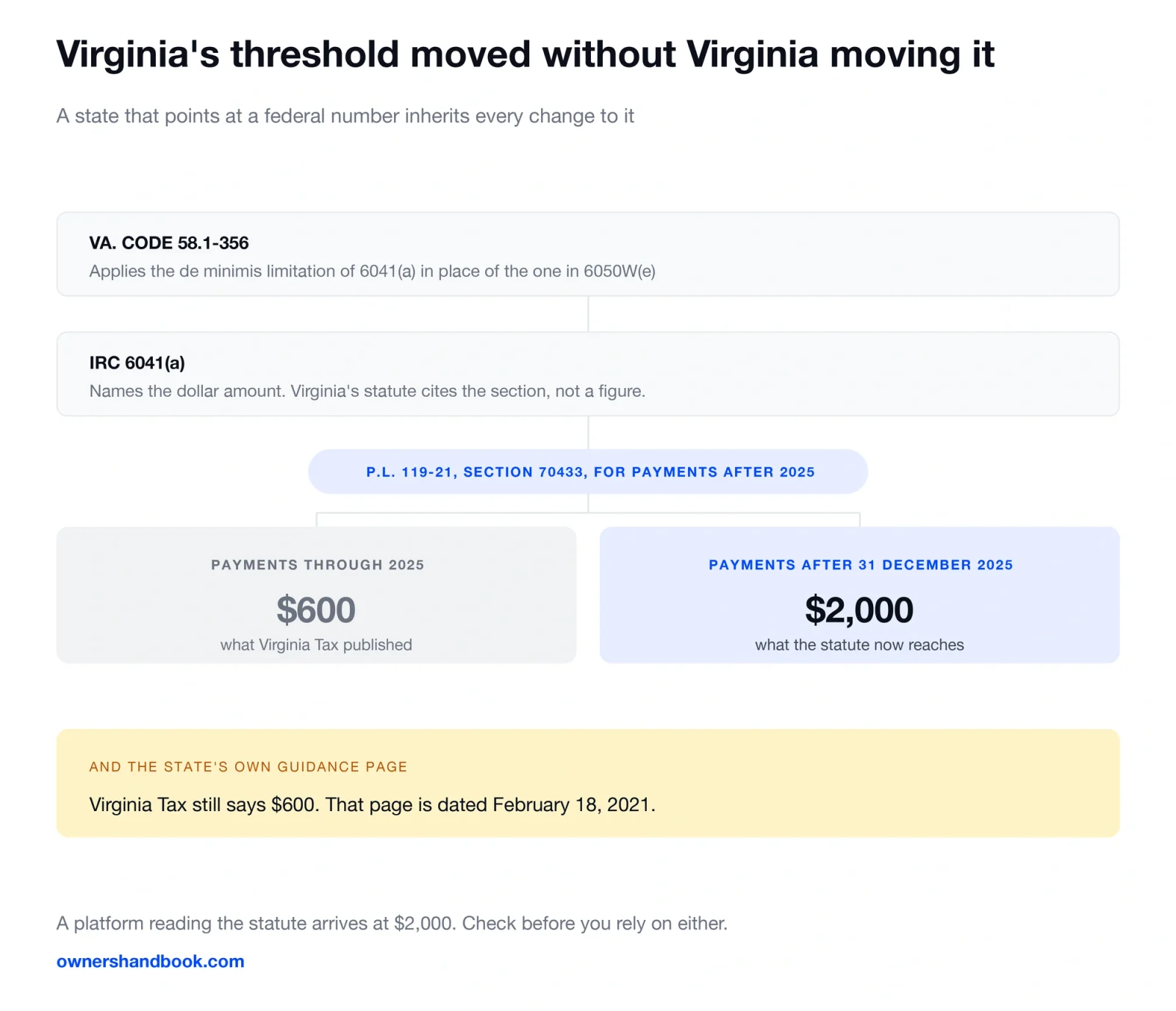
Section 58.1-356 does not name a dollar amount. It says:
Any third-party settlement organization shall report to the Department, and to any participating payee, all information required by § 6050W of the Internal Revenue Code with respect to reportable payment transactions made on or after January 1, 2020, to such participating payee. For the purposes of this requirement, the de minimis limitations of § 6041(a) of the Internal Revenue Code shall apply in lieu of the de minimis limitations of § 6050W(e) of the Internal Revenue Code. This section shall apply only with respect to participating payees with a Virginia mailing address.
So Virginia swapped out the 1099-K threshold and swapped in the 1099-NEC one. For years that meant $600, and Virginia Tax told people exactly that: “TPSOs are required to send you a Form 1099-K when they pay $600 or more to you in the previous calendar year.” That page is dated February 18, 2021.
Section 6041(a) now reads “$2,000 or more in any calendar year.” P.L. 119-21, section 70433(a), substituted $2,000 for $600 for payments made after December 31, 2025, and added an inflation adjustment for calendar years after 2026.
The cross-reference in the Virginia statute is to the section, not to a frozen figure. Read plainly, Virginia’s floor for 2026 payments is $2,000. Virginia Tax has not published updated guidance saying so, and the five-year-old page still says $600, so check before you rely on it — but a platform reading the statute arrives at $2,000.
The states we could not verify
This is the honest part, and it matters more than a longer table would.
Massachusetts, Maryland, New Jersey, the District of Columbia, Arkansas, Connecticut, Rhode Island, Tennessee and Michigan are all cited around the web as having their own 1099-K thresholds. We could not confirm any of them from a primary source on October 13, 2026. In each case the obstacle was access rather than content: mass.gov, michigan.gov and tax.ri.gov refused automated requests outright, marylandtaxes.gov was returning a server error, and the Connecticut, New Jersey, DC and Tennessee revenue sites render their publication lists through scripts that do not resolve to a readable page.
Rather than copy figures from aggregator sites, we have left those states out. If your state is on that list, the rule to follow is the one that produced the four rows above:
Look for the state revenue department’s electronic filing specification or publication for Forms W-2 and 1099, not its news page. Illinois’ threshold is in Publication 110, a four-page filing-requirements document. That is where this information lives.
Failing that, look for the state’s statute on third-party settlement organizations. Virginia’s and New York’s are both one section long and name the federal provisions they borrow from.
Treat a news item or FAQ with a date on it as a dated statement. Virginia’s says $600 and was written in 2021.
Our state guides cover what these states tax, which is a separate question from what gets reported: Massachusetts, Maryland, New Jersey, Michigan and Illinois.
A state rule does not always mean a form in your hand
Worth separating, because the two obligations are not the same thing.
Vermont’s and Virginia’s rules both run to the payee. Vermont’s department says a platform over the threshold “will issue a 1099-K and provide to the Department of Taxes.” Virginia’s statute says the organization shall report “to the Department, and to any participating payee.”
Illinois’ Publication 110 speaks only to submitting the forms to Illinois. The duty to furnish you a copy is federal, and federally you are under the threshold. In practice a platform that has built a state file usually sends the payee a copy as well, but the state rule is not what compels it.
The direction of the effect is the same either way. A low state threshold means your state revenue department has a record of money that the IRS does not, and a return that omits it is checkable against something.
If you moved during the year, which state‘s rule applies turns on the mailing address the platform has — both the Virginia and Illinois rules are written around the payee’s address, not where the work happened. Our guide to moving states mid-year covers the return side of that.
The threshold governs reporting, never what you owe
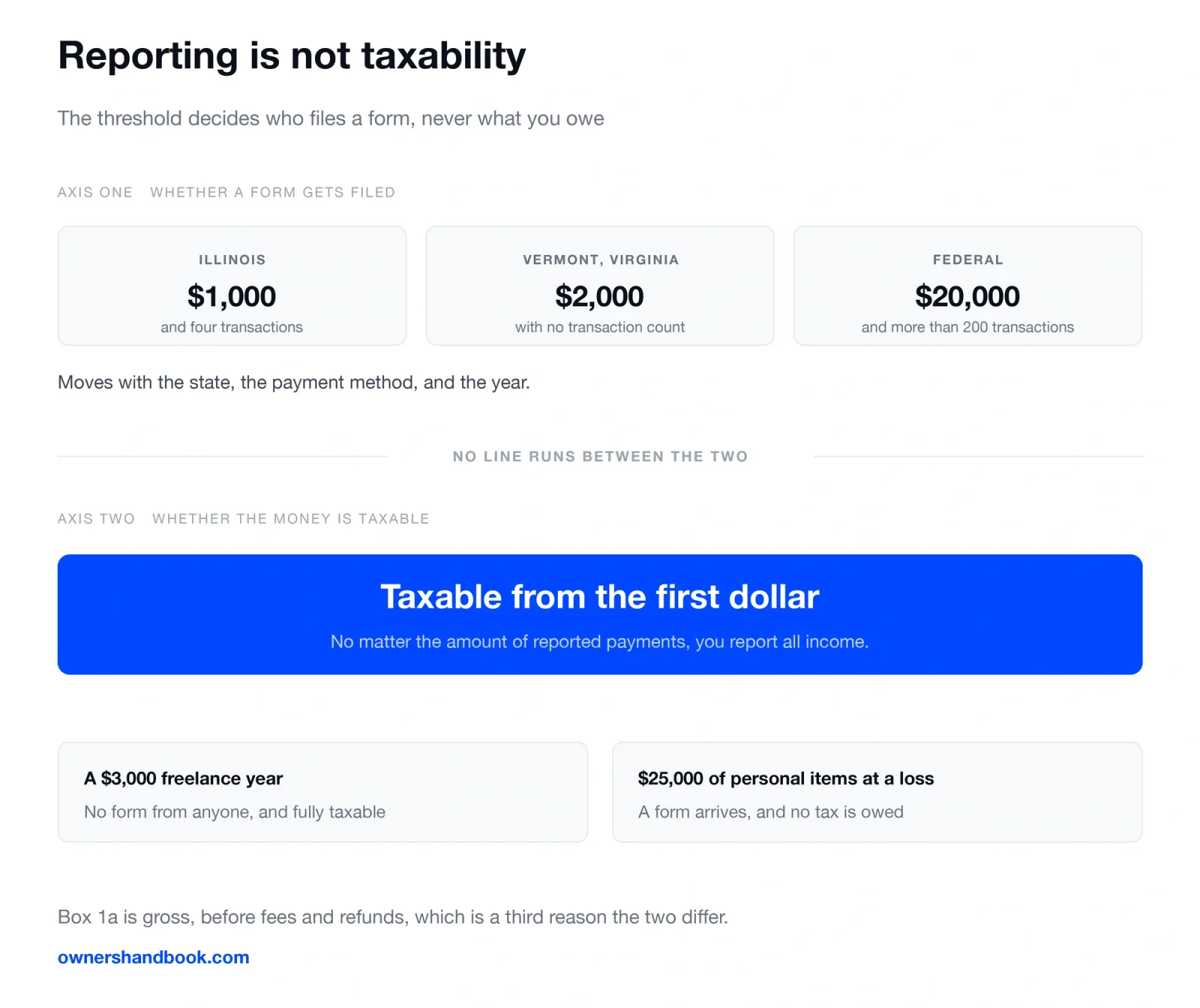
Every number on this page answers one question: who has to tell a government about the money. None of them answers whether the money is taxable.
The IRS says it in a single line on its own 1099-K page: “No matter the amount of reported payments, if you receive payments for selling goods or services, you must report all income on your tax return.”
Vermont’s department makes the inverse point for people who received a form and panicked. The notice “is not associated with any new tax. It is strictly intended to notify recipients that payments were made to them. Those payments may or may not be taxable income.”
Both directions are true at once. A $3,000 freelance year produces no 1099-K anywhere and is fully taxable. A $25,000 year of reselling personal items at a loss can produce a form and no tax. Our guide to the filing threshold covers your actual trigger, which is $400 of net earnings, and taxes by platform covers what each marketplace reports.
One more reason the figure on the form is not the figure on your return: box 1a is gross. The instructions say it is reported “without regard to any adjustments for credits, cash equivalents, discount amounts, fees, refunded amounts, shipping amounts, or any other amounts.” Platform fees come out after the number you are looking at, as deductions.
What not to do
Do not add a 1099-K to a 1099-NEC. When a client pays through a platform, both forms can describe the same money. You report what you earned once.
Do not treat the absence of a form as the absence of income. Most freelancers never clear 200 transactions and so never see a 1099-K at all. If no form came from anyone, filing without one covers how to build the figure from your own records.
Do not rely on a state threshold you read on a software vendor’s page. Several of those lists still carry $600 figures for states that have moved, and none of them cite the publication the number came from.
Do not assume a state with no income tax has no reporting rule. The two are unrelated — a state can require information returns it has no income tax to apply them to. Texas is a good example of why the state question is worth asking separately from the federal one, and our Texas guide covers what is and is not owed there.
Do not wait for January to reconstruct the year. Whether a form arrives is somebody else’s decision. Your gross receipts are yours.
Frequently asked questions
Is the federal threshold $20,000 or 200 transactions?
Both, in the same year. Section 6050W(e) joins the two conditions with “and,” so clearing one is not enough.
I thought the threshold was $2,500 for 2025. What happened?
That was the interim figure the IRS had announced while the $600 rule was being phased in. P.L. 119-21 repealed the provision retroactively, “as if included” in the 2021 law that created it, so the $20,000 and 200-transaction rule applies to 2025 and after.
My state is not in your table. What does that mean?
Only that we could not confirm its rule from a state source on the date above. It does not mean the state has no rule. The section on unverified states explains where to look.
Does Virginia’s threshold apply to me if I live in Maryland and sell to Virginians?
No. The statute applies “only with respect to participating payees with a Virginia mailing address.” These rules follow the recipient, not the customers.
If my state’s threshold is lower, do I owe more tax?
No. A lower threshold means a form gets filed at a lower amount. The tax on self-employment income does not change, and neither does the amount you report.
The form says $41,000 and I only received $37,000. Which do I use?
Yours. Box 1a is gross, before fees, refunds and chargebacks. You report your actual gross receipts and deduct the fees separately. If the gap is something other than fees, a 1099 with the wrong amount covers the dispute.
Sources
IRS, Instructions for Form 1099-K (Rev. December 2026)
https://www.irs.gov/pub/irs-pdf/i1099k.pdf
IRS, Understanding your Form 1099-K
https://www.irs.gov/businesses/understanding-your-form-1099-k
26 U.S.C. § 6050W, Returns relating to payments made in settlement of payment card and third party network transactions
https://www.law.cornell.edu/uscode/text/26/6050W
26 U.S.C. § 6041, Information at source
https://www.law.cornell.edu/uscode/text/26/6041
Illinois Department of Revenue, Publication 110, Forms W-2, W-2c, W-2G, and 1099 Filing and Storage Requirements
https://tax.illinois.gov/content/dam/soi/en/web/tax/research/publications/pubs/documents/pub-110.pdf
Vermont Department of Taxes, 1099-K Notices, Frequently Asked Questions
https://tax.vermont.gov/business-and-corp/withholding-tax/1099-k
Code of Virginia § 58.1-356, Reporting of payments by third-party settlement organizations
https://law.lis.virginia.gov/vacode/title58.1/chapter3/section58.1-356
Virginia Tax, Did You Receive a 1099-K? What You Need to Know
https://www.tax.virginia.gov/news/did-you-receive-1099-k-what-you-need-know
New York Consolidated Laws, Tax Law § 1703