Your 1099 Is Wrong and the Client Will Not Fix It
A 1099-NEC arrived with the wrong number on it. You emailed the client. They said no, or they stopped replying, or the company no longer exists. Every article you have read assumes they cooperate.
This one is about the other path — what you actually file, how to document it so the mismatch does not read as omission, and what arrives if the IRS notices.
First, check whether it is actually wrong
Three differences look like errors and are not. Rule them out before you spend goodwill on a correction request.
| What you see | Why it may be correct |
|---|---|
| The form is higher than what landed in your account | A 1099-K reports gross, before platform fees, refunds and chargebacks |
| A December payment appears on this year’s form | They report by the date they paid, which may differ from when you got it |
| The total includes reimbursed expenses | If they paid you and you paid the cost, the full amount can appear on the form |
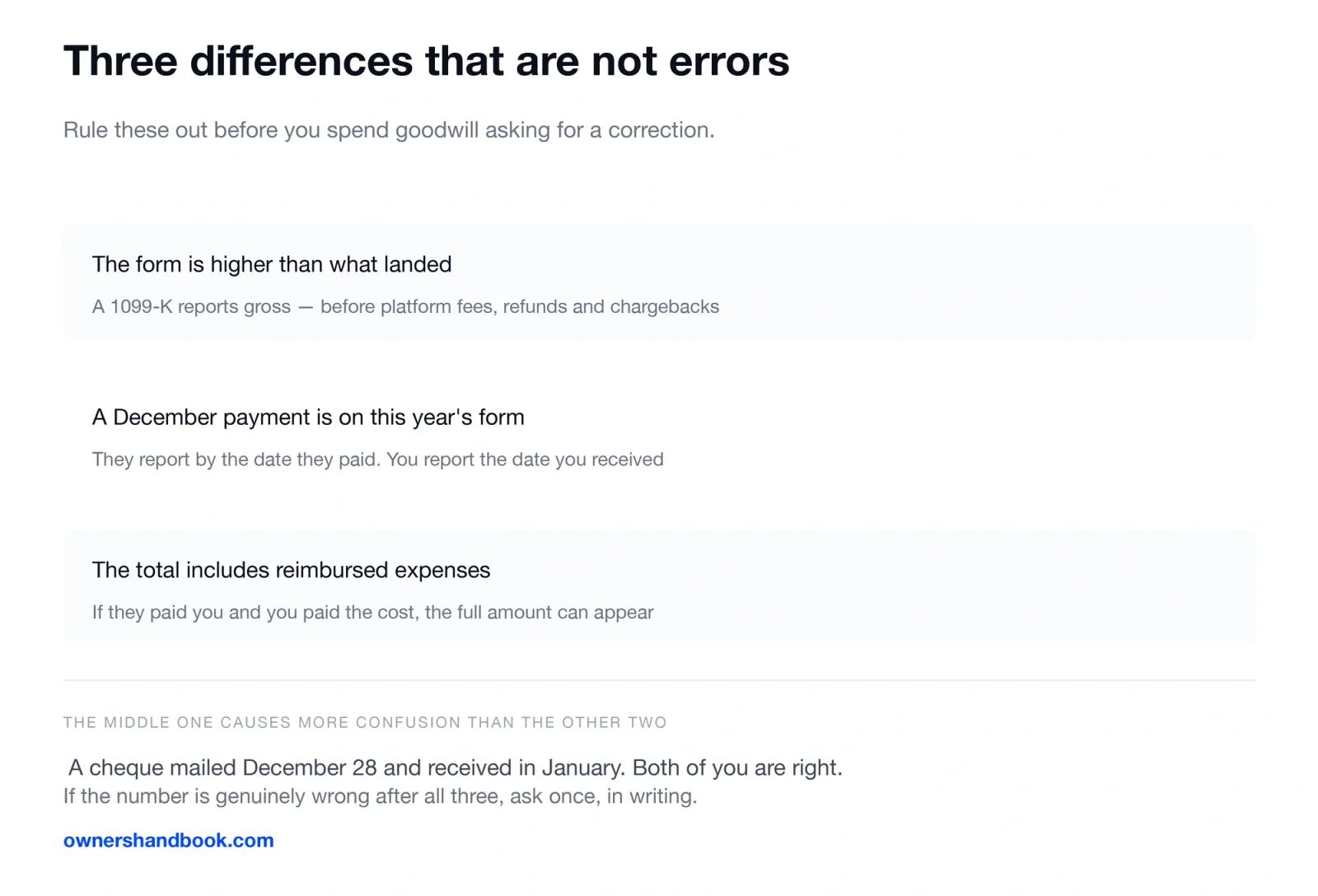
The middle one causes more confusion than the other two combined. A client who mailed a cheque on December 28 generally reports it in that year. If it reached you in January, you received it in January. Both of you can be right.
Our comparison of 1099-NEC and 1099-K covers which form reports what, and why platform fees make a 1099-K look inflated.
If the number is genuinely wrong, keep going.
Ask once, in writing, with the arithmetic attached
A correction is not difficult for the issuer — they file a corrected form with the CORRECTED box checked and send you a copy. Most refusals are not principled. They are administrative reluctance.
Make it as easy as possible to say yes:
Send a short written request, not a phone call. You want a record of having asked.
Attach your own numbers — a list of every payment with dates and amounts, and the total. Ask them to reconcile against it.
Name the specific difference. “Your form says $48,000, my records show $41,500, the difference matches three invoices dated after December 31” is actionable. “This is wrong” is not.
Give a deadline that is useful to both of you. Before you file is better than after.
Keep the email. Whether or not they respond, it becomes part of your file.
When they refuse, you report your actual income
This is the part people get wrong out of fear, so it is worth stating flatly.
**You report what you actually received. Not what the form says.**
Your tax return reports your income. A 1099 is one party’s account of what they paid you — it is evidence, not the definition. Inflating your Schedule C to match a form you know is wrong means knowingly filing an incorrect return, and it means paying tax on money you never got.
What you must not do is ignore it. The IRS received a copy of that form. Reporting less than a form shows, with no explanation on file, is the shape that generates a notice.
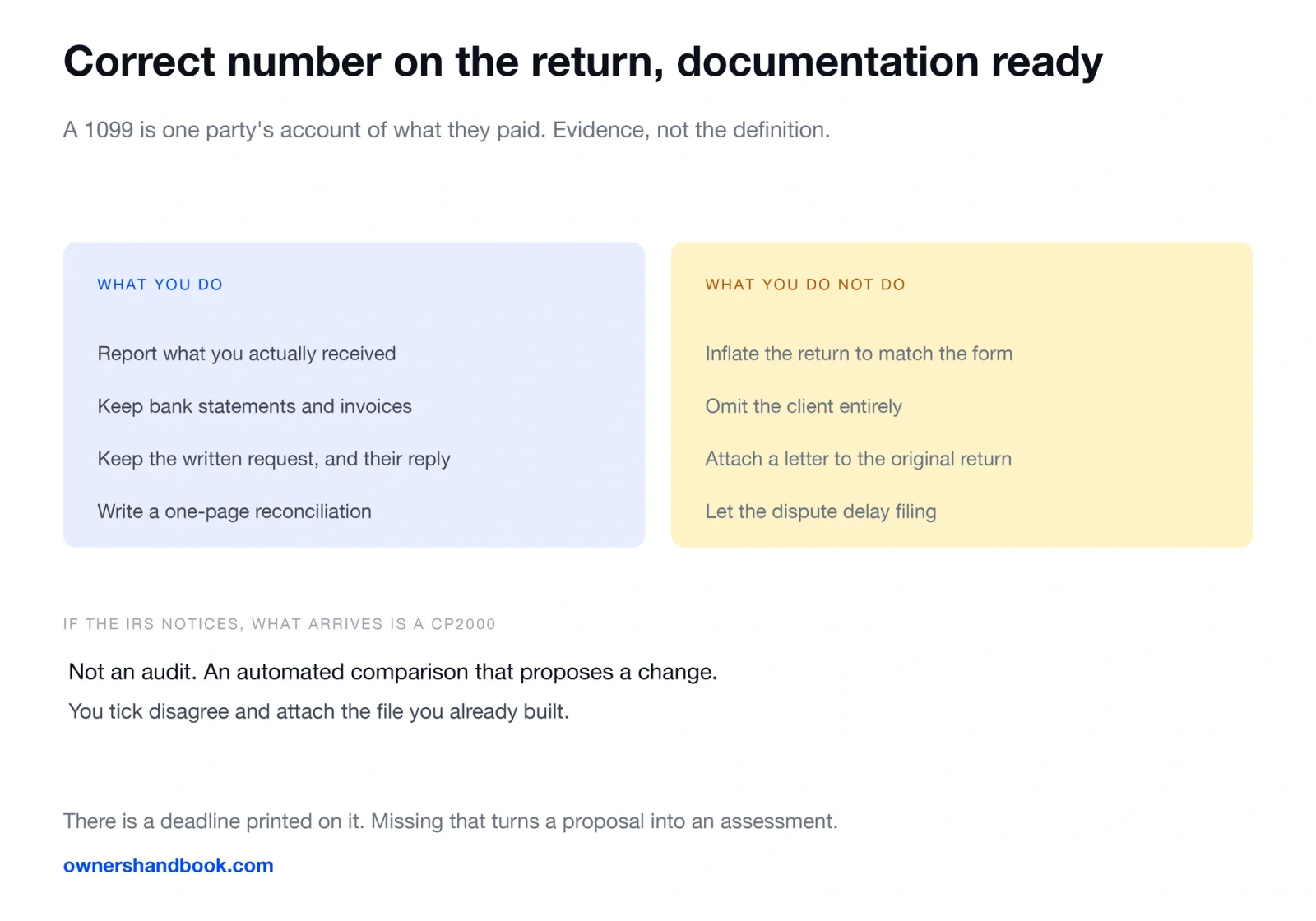
So the position you want is: correct number on the return, documentation ready.
Build the file before you file
The goal is that if a question arrives eighteen months from now, you can answer it in one reply instead of reconstructing a year.
| Keep | Why |
|---|---|
| Bank statements showing every deposit from that client | The primary evidence of what you received |
| Your invoices, with dates and amounts | Shows what you billed and when |
| The 1099 as issued | You are explaining a difference from it |
| Your written correction request | Shows you tried |
| Their reply, or a note that none came | Shows they refused or went silent |
| A one-page reconciliation | The arithmetic, ready to hand over |
The reconciliation is the item worth actually preparing. One page: the form’s total, your total, and the specific items that explain the gap, each with a date. Write it now, while you remember which invoices they are.
What arrives if the IRS notices: a CP2000
Not an audit. The IRS describes the notice this way:
The income or payment information we received from third parties, such as employers or financial institutions, doesn’t match what you reported on your tax return.
And on what it is:
This notice isn’t a bill and your response may be required.
It is an automated comparison between forms filed about you and the return you filed. It proposes a change. It does not assert one.
The response is the reconciliation you already built:
State whether you agree or disagree with the notice and include any supporting documentation.
You tick disagree, attach the bank statements and the reconciliation, and explain the difference in a paragraph. People who have the documents find this administrative. People who do not find it frightening — which is the entire argument for building the file in advance.
There is a deadline printed on the notice. Missing it lets the proposed change become an assessment, so the one thing you cannot do is set it aside.
If the form arrives after you already filed
Check your return before you panic.
If you reported your actual income and the form is the thing that is wrong, there is nothing to amend. You already filed correctly. Add the form to the file with a note and carry on.
Form 1040-X, the amended return, is for when the number you filed was wrong — not for when someone else’s form disagrees with a correct return.
If the client has disappeared
It happens: the company folded, the contact left, nobody answers.
Nothing changes about what you file. You report your actual income, you keep the evidence of what you received, and you note that the issuer could not be reached. A documented attempt to contact a defunct business is a reasonable position.
If they went out of business still owing you money, our guide on a client who will not pay covers the separate question of collection.
What not to do
Do not amend a correct return to match an incorrect form. You would be filing a return you know to be wrong.
Do not simply omit the client from your Schedule C. The gross receipts line is a total. It does not itemise clients, so there is nothing to omit — you report your correct total, which already differs from their form.
Do not attach a letter of explanation to the original return. There is no field for it, it is not read, and it does not prevent the automated matching. The documentation does its work when a notice arrives, not before.
Do not let it delay filing. A late return has its own penalty, charged from the due date, and it is unrelated to this dispute. File on time with the correct number.
Frequently asked questions
Will I be audited for reporting less than my 1099 shows?
A mismatch can trigger a CP2000, which is an automated notice rather than an audit. With bank statements and a reconciliation it is answered in one reply.
Can I report the wrong amount and then deduct the difference?
No. Inventing an expense to cancel income you never received is worse than the problem. Report the correct income.
What if the 1099 is too low?
Report your actual income, which is higher. Under-reporting is the risk you care about, and the form being low does not reduce what you owe.
Can I report the client to the IRS?
There is a process for reporting information-return problems, and the IRS can contact a payer about incorrect filings. It rarely changes your own filing position, which is to report your correct income either way.
Does this apply to a 1099-K too?
Yes, and 1099-K mismatches are more common because the form reports gross. Platform fees, refunds and chargebacks all come out after the reported figure. Those are deductible, which usually resolves the gap without any correction being needed.
How long should I keep the documentation?
At least as long as the return itself. Our guide to tax record keeping covers the periods.
Sources
IRS, Understanding your CP2000 series notice
https://www.irs.gov/individuals/understanding-your-cp2000-series-notice
IRS, Instructions for Forms 1099-MISC and 1099-NEC
https://www.irs.gov/instructions/i1099mec
IRS, General Instructions for Certain Information Returns
https://www.irs.gov/instructions/i1099gi
IRS, Topic no. 154, Form W-2 and Form 1099-R, what to do if incorrect or not received
https://www.irs.gov/taxtopics/tc154
IRS, About Form 1040-X, Amended U.S. Individual Income Tax Return