Schedule SE, Line by Line
Schedule SE is one page. Part I has thirteen numbered lines, and an ordinary freelancer with no farm and no church employment will touch seven of them. The rest of the page exists for somebody else.
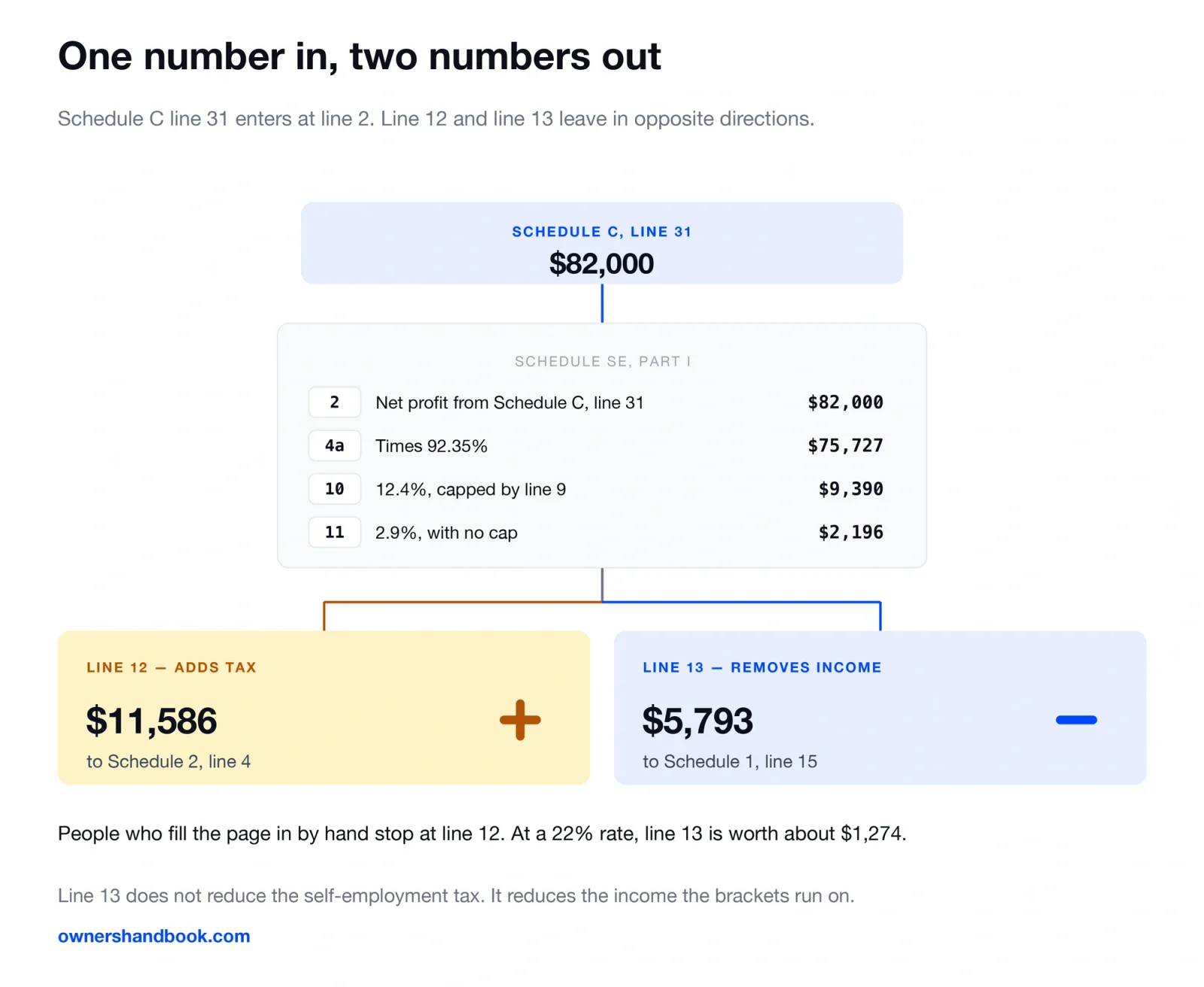
The form takes one number in — your profit from Schedule C line 31 — and sends two numbers out, in opposite directions. One is a tax you add. One is a deduction you subtract. People who fill this in by hand usually forget the second one.
What follows walks the 2025 form with one example carried all the way through. Why this tax exists and what it costs you overall is a separate question, covered in the main self-employment tax post. This is only the mechanics of the page.
What the form is actually doing
Lines 1 through 6 work out net earnings from self-employment. That is not your profit. It is your profit shrunk by a fixed multiplier.
Line 7 is a printed ceiling, and lines 8 and 9 decide how much of it you have left after any W-2 job.
Lines 10 and 11 apply two rates to two bases. Only one of them is capped. Lines 12 and 13 are the two exits.
Part I: lines 1 through 6
| Line | What the form says | What to enter |
|---|---|---|
| A | Minister or religious order member who filed Form 4361 | Leave unchecked unless that is you |
| 1a, 1b | Net farm profit, and Conservation Reserve Program payments | Blank unless you farm |
| 2 | Net profit or (loss) from Schedule C, line 31 | Your profit. This is the line that matters |
| 3 | Combine lines 1a, 1b, and 2 | Same as line 2 for a non-farmer |
| 4a | If line 3 is more than zero, multiply line 3 by 92.35% (0.9235) | The multiplier. See below |
| 4b | If you elect one or both of the optional methods | Blank. Part II is for farmers |
| 4c | Combine lines 4a and 4b | Your net earnings from self-employment |
| 5a, 5b | Church employee income from Form W-2, times 92.35% | Blank for almost everyone |
| 6 | Add lines 4c and 5b | The base that lines 10 and 11 run on |
Line 2 asks for net profit from Schedule C line 31 — after expenses, not before. Every legitimate deduction you took has already made this number smaller.
Line 4c carries a stop sign the form prints in plain language: “Combine lines 4a and 4b. If less than $400, stop; you don’t owe self-employment tax.” Work backwards through the multiplier and $400 of net earnings is about $433 of profit. That is a different and lower bar than the income tax filing threshold.
If you ran two businesses, you do not file two of these. The instructions are explicit: “If you had two or more businesses subject to SE tax, your net earnings from self-employment are the combined net earnings from all of your businesses. If you had a loss in one business, it reduces the income from another.” Spouses are the opposite — each files a separate Schedule SE.
Line 4a: the 92.35% multiplier
This is the line everyone asks about, and it is one multiplication.
If line 3 is more than zero, multiply line 3 by 92.35% (0.9235).
On $82,000 of profit that is $75,727. You are taxed on that, not on $82,000.
Two details decide whether you get it right. The multiplier applies only if line 3 is above zero — the form says “Otherwise, enter amount from line 3,” so a loss passes through untouched. And it runs on the combined figure at line 3, not on each business separately.
What the multiplier does not do is absorb your other adjustments. The health insurance deduction and your retirement contributions come off later, on Schedule 1, and neither touches line 2. The Form 7206 instructions say so directly: “You can’t subtract the self-employed health insurance deduction when figuring net earnings for your self-employment tax.”
Line 7: the number already printed on the form
The 2025 form fills line 7 in for you:
Maximum amount of combined wages and self-employment earnings subject to social security tax or the 6.2% portion of the 7.65% railroad retirement (tier 1) tax for 2025 — $176,100
That figure changes every year, which is the best single reason to use the current year’s form.
| Tax year | Line 7 | Source |
|---|---|---|
| 2025 | $176,100 | Printed on the 2025 Schedule SE |
| 2026 | $184,500 | SSA determination published November 3, 2025 |
The 2026 figure is already set: the contribution and benefit base “will be $184,500 for remuneration paid in 2026 and self-employment income earned in tax years beginning in 2026.” The 2026 draft Schedule SE prints it on line 7, and every other line number on that draft is unchanged.
Lines 8 through 11: the cap, and the rate that ignores it
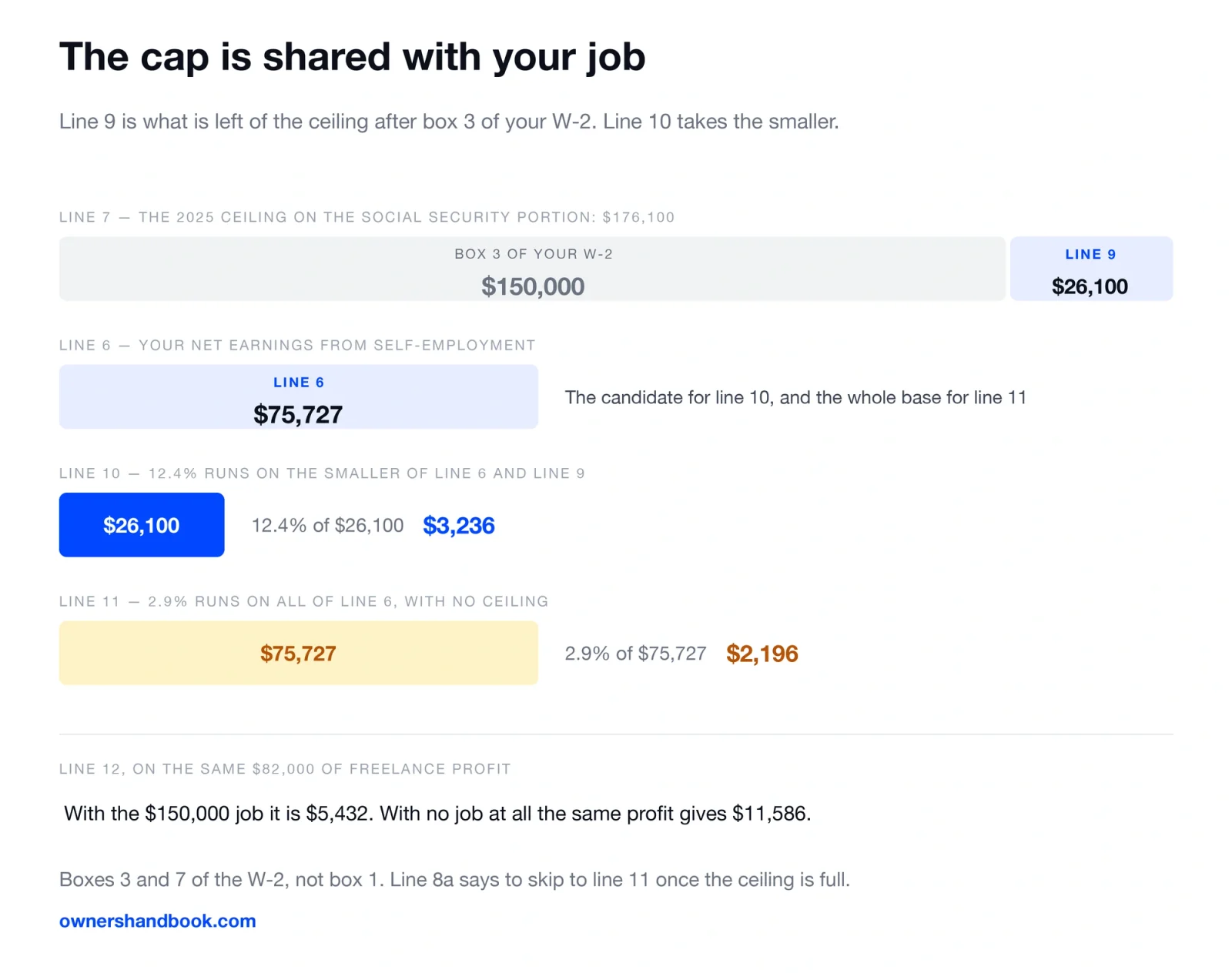
The ceiling at line 7 covers your wages and your self-employment earnings together, so a job eats into it before your freelancing gets a turn. Lines 8a through 8d total your W-2 social security wages — boxes 3 and 7, not box 1 — plus unreported tips from Form 4137 and wages from Form 8919. Line 9 subtracts that total from line 7.
Line 8a prints a shortcut that saves four lines of work: “If $176,100 or more, skip lines 8b through 10, and go to line 11.” A job that already hit the ceiling means your freelance profit owes no Social Security portion at all.
| Line | The arithmetic | The rate |
|---|---|---|
| 10 | Multiply the smaller of line 6 or line 9 by 12.4% | Social Security. Capped |
| 11 | Multiply line 6 by 2.9% | Medicare. Not capped |
| 12 | Add lines 10 and 11 | Your self-employment tax |
Line 10 is the whole cap mechanism in one instruction: the smaller of line 6 or line 9. Line 6 is what you earned, line 9 is what is left of the ceiling, and you pay 12.4% on whichever is less.
Line 11 makes no such comparison. It runs on all of line 6, every year, with no ceiling. An extra 0.9% applies above $200,000 single or $250,000 filing jointly, but not on this form — the instructions send you to Form 8959 for it.
A worked example, start to finish
A freelancer with $82,000 on Schedule C line 31 and no W-2 job.
| Line | Figure |
|---|---|
| 2. Net profit from Schedule C line 31 | $82,000 |
| 3. Combine lines 1a, 1b, and 2 | $82,000 |
| 4a. Line 3 times 92.35% | $75,727 |
| 4c and 6. Net earnings from self-employment | $75,727 |
| 7. Maximum subject to social security tax | $176,100 |
| 8d. Social security wages | $0 |
| 9. Line 7 minus line 8d | $176,100 |
| 10. Smaller of line 6 or line 9, times 12.4% | $9,390 |
| 11. Line 6 times 2.9% | $2,196 |
| 12. Self-employment tax | $11,586 |
| 13. Line 12 times 50% | $5,793 |
The cap never bound here, because line 6 came in well under line 9. And $11,586 is 15.3% of $75,727, not of $82,000. The difference is $963, which is what line 4a bought.
Now run it again for someone with the same $82,000 of profit who also held a W-2 job with $150,000 in box 3. Line 6 is unchanged at $75,727, but line 9 is now $176,100 − $150,000 = $26,100. Line 10 takes the smaller figure, so 12.4% applies to $26,100 and gives $3,236. Line 11 still charges 2.9% on the full $75,727. Line 12 comes to $5,432 — $6,154 less, on identical freelance profit. The job did it.
Lines 12 and 13: where the two numbers go
The form prints both destinations, and they are not the same place. Line 12 says “Enter here and on Schedule 2 (Form 1040), line 4,” where line 4 reads “Self-employment tax. Attach Schedule SE.” Line 13 says “Multiply line 12 by 50% (0.50). Enter here and on Schedule 1 (Form 1040), line 15,” where line 15 reads “Deductible part of self-employment tax.”
| Line | Destination | Effect |
|---|---|---|
| 12 | Schedule 2, line 4 | Adds $11,586 of tax |
| 13 | Schedule 1, line 15 | Removes $5,793 from taxable income |
Line 13 does not reduce the self-employment tax. It reduces the income the brackets run on. At a 22% marginal rate, $5,793 off your income is worth about $1,274, and that is what people leave behind by stopping at line 12. The figure also feeds forward: Form 7206 line 7 pulls it back in when limiting your health insurance deduction.
Line 12 matters outside April too. It is the half of your annual bill that no withholding covers, which is why quarterly estimated payments exist. There is a calculator for the whole Part I sequence if you want to check your arithmetic.
Part II, and why you will skip it
Page 2, lines 14 through 17, holds two optional methods — one farm, one nonfarm — and the conditions printed on the form rule out most people at the first line. The nonfarm method needs net nonfarm profits under $7,840 *and* under 72.189% of gross nonfarm income, plus net earnings of at least $400 in 2 of the prior 3 years. The form adds: “Caution: You may use this method no more than five times.”
Line 14 prints a maximum of $7,240 for 2025. The point of an optional method is to report *more* earnings than you actually had, to buy a Social Security credit in a bad year. A freelancer with a normal year skips the page.
What trips people up
Running 15.3% on revenue. Line 2 is profit from Schedule C line 31, already net of expenses.
Skipping line 13. The deduction is half your self-employment tax and sits on the same page as the tax. Stopping at line 12 is the most expensive mistake available here.
Subtracting health insurance or retirement on line 2. Both are Schedule 1 adjustments, one layer later, and the law does not let them shrink this base.
Filing two Schedules SE for two businesses. Combine them on line 3. A loss in one genuinely offsets profit in the other.
Using box 1 of the W-2 on line 8a. The form asks for boxes 3 and 7, which is a different number. If you had a W-2 job and 1099 work in the same year, this is where the interaction shows up.
Using last year’s form. Every line number held steady into the 2026 draft. The figure printed on line 7 did not.
Frequently asked questions
Do I file Schedule SE if my business lost money?
Usually no. Line 4c tells you to stop if net earnings are under $400, and a loss is under $400. The exception is electing an optional method in Part II to buy a Social Security credit, which requires filing.
My spouse and I both freelance. One form or two?
Two. The instructions require a separate Schedule SE for each spouse with self-employment income, even on a joint return. The tax is combined on Schedule 2, line 4.
I already hit the Social Security cap at my job. Do I still file?
Yes, for Medicare. Line 8a sends you straight past line 10 to line 11, where 2.9% applies with no ceiling. Lines 12 and 13 work normally.
Does the QBI deduction reduce the number on line 2?
No. The 20% deduction is figured much later, after your income is assembled, and never touches Schedule SE.
I never sent quarterly payments. Does that change this form?
No. The form is the same. What changes is that you owe interest rather than a penalty on what you should have paid during the year.
Is it worth doing this by hand if software will do it?
Once. Walking it shows which number the cap applies to and where the deductible half lands, and both are easy to miss when filing your own return.
Sources
IRS, Schedule SE (Form 1040), Self-Employment Tax, 2025
https://www.irs.gov/pub/irs-pdf/f1040sse.pdf
IRS, Instructions for Schedule SE (Form 1040), 2025
https://www.irs.gov/pub/irs-pdf/i1040sse.pdf
IRS, Schedule 1 (Form 1040), Additional Income and Adjustments to Income, 2025
https://www.irs.gov/pub/irs-pdf/f1040s1.pdf
IRS, Schedule 2 (Form 1040), Additional Taxes, 2025
https://www.irs.gov/pub/irs-pdf/f1040s2.pdf
Social Security Administration, Cost-of-Living Increase and Other Determinations for 2026, 90 Fed. Reg. (November 3, 2025)
https://www.govinfo.gov/content/pkg/FR-2025-11-03/pdf/2025-19763.pdf
IRS, Instructions for Form 7206, Self-Employed Health Insurance Deduction, 2025