W-2 Job and 1099 Income in the Same Year: How to File
You file one return, not two. The job and the freelance work both land on the same Form 1040 — but they arrive by different routes, and only one of them had tax taken out along the way.
That difference is why the refund you are used to can turn into a bill in the year you start freelancing.
The refund that disappears
Here is the pattern, and it catches almost everyone in their first mixed year.
A W-2 job withholds tax from every paycheck, and it usually withholds slightly too much. That is where a refund comes from — it is your own money coming back.
Freelance income has nothing withheld. Nobody takes anything out. And on top of income tax, it carries self-employment tax at 15.3%, which a salary does not.
| What | W-2 job | Freelance work |
|---|---|---|
| Tax withheld during the year | Yes, every paycheck | None |
| Social Security and Medicare | Split with your employer | All yours, 15.3% |
| What arrives in January | Form W-2 | Form 1099-NEC, sometimes |
| What you do at filing | Copy one number | Fill out Schedule C |
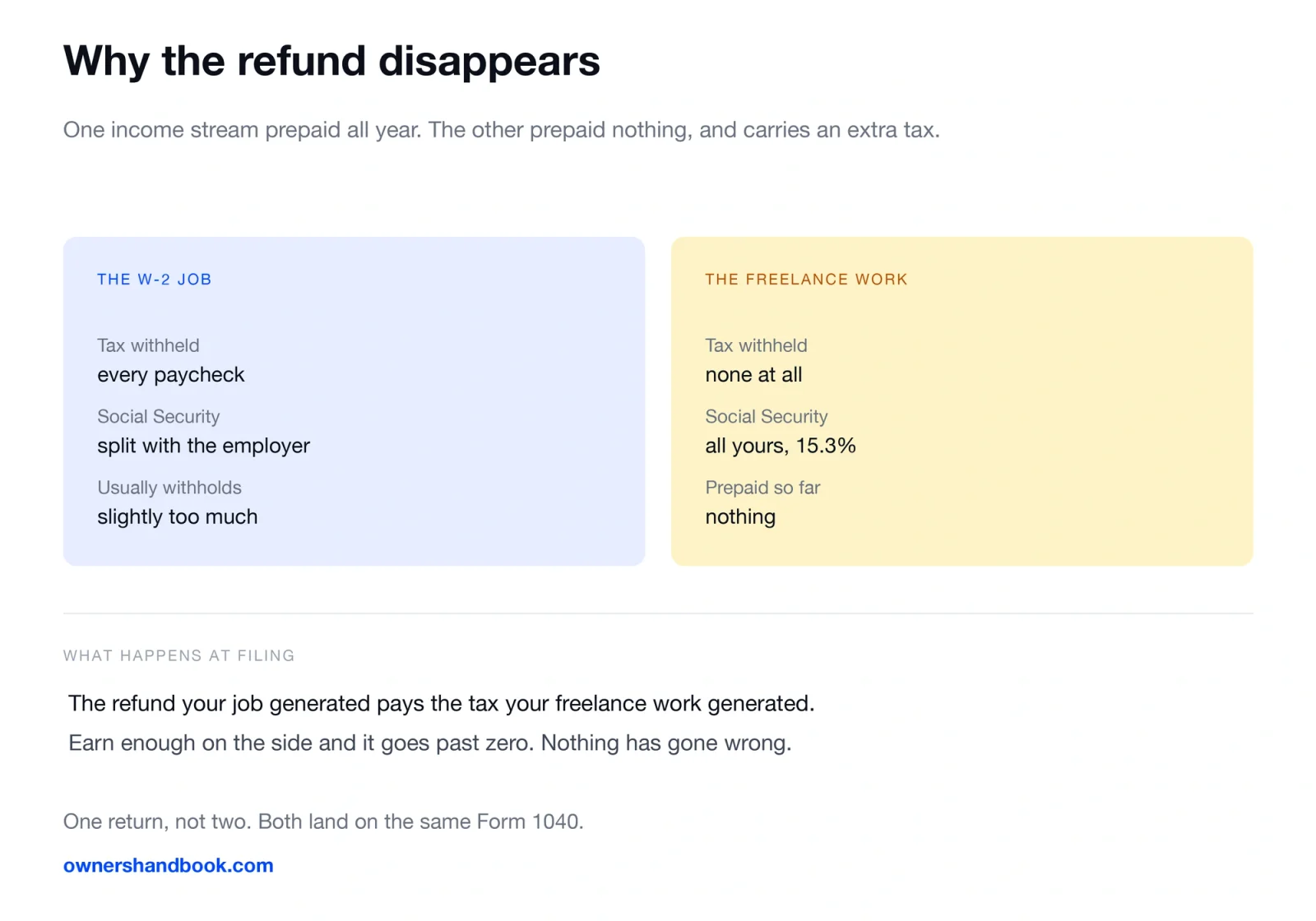
So the refund your job generated gets consumed by the tax your freelance work generated. Earn enough on the side and it goes past zero.
This is not a penalty and nothing has gone wrong. It is simply that one income stream prepaid and the other did not.
Where each one goes on the return
One return. Four places.
| What | Goes on | Then flows to |
|---|---|---|
| W-2 wages | Form 1040, line 1 | Your total income |
| Freelance income and expenses | Schedule C | Schedule 1, then Form 1040 |
| Self-employment tax | Schedule SE | Schedule 2, then Form 1040 |
| The deductible half of that tax | Schedule 1, line 15 | Reduces your income |
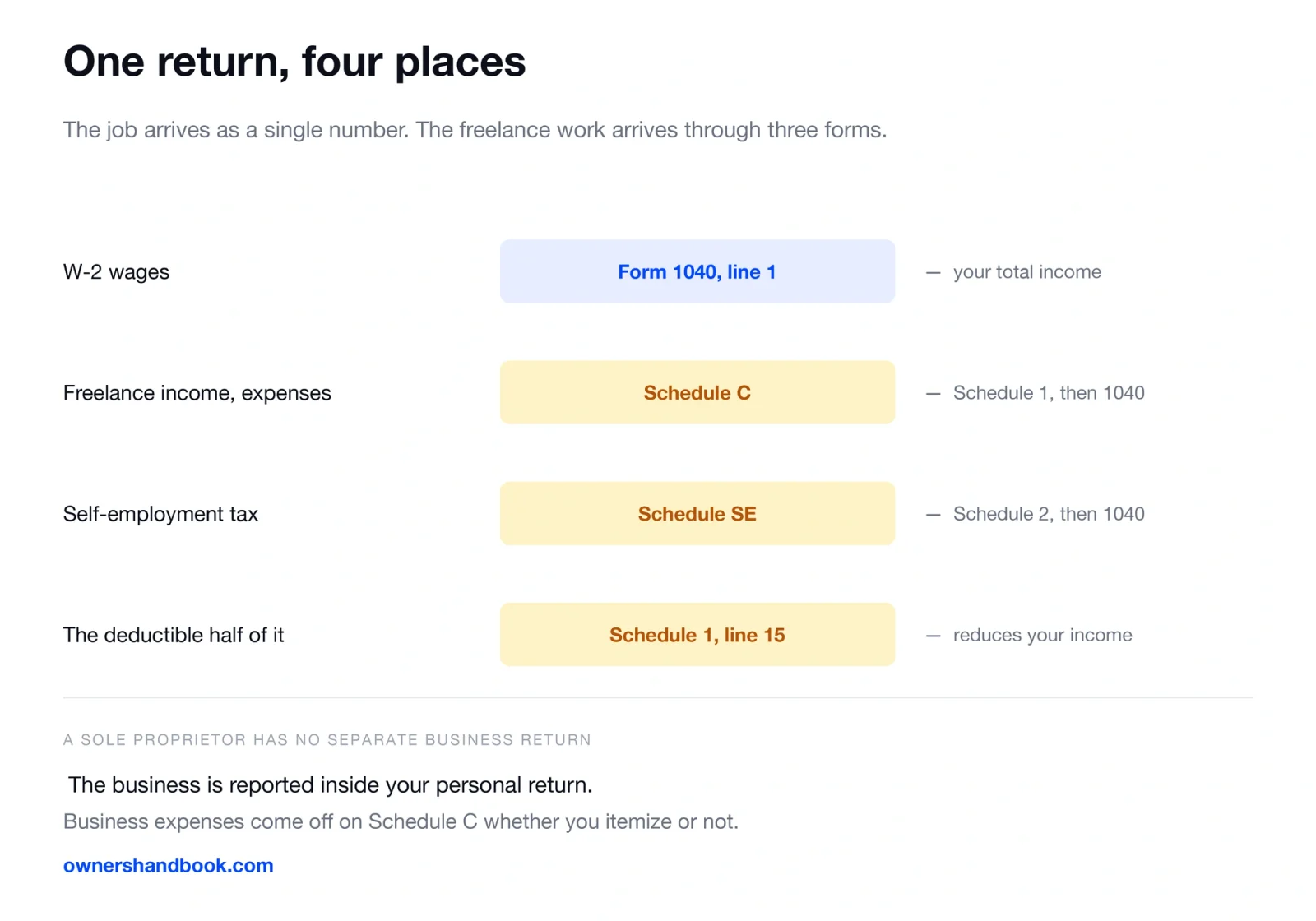
You do not file separately, you do not file twice, and you do not need a separate return for the business. A sole proprietor’s business is reported inside their personal return.
Our walkthrough of Schedule C covers the form line by line.
The job changes your self-employment tax, and most calculators miss it
This is the part worth understanding, because it can move the number by thousands.
Self-employment tax is 15.3% — 12.4% for Social Security and 2.9% for Medicare. The 12.4% stops at a ceiling. The 2.9% does not.
Your W-2 wages fill that ceiling first. Whatever room is left is what your freelance profit gets charged the 12.4% on.
| Your situation | A flat 15.3% says | Actually owed |
|---|---|---|
| $40,000 freelance, no job | $5,652 | $5,652 |
| $40,000 freelance, $60,000 job | $5,652 | $5,652 |
| $40,000 freelance, $180,000 job | $5,652 | $1,782 |
The third row is the one to notice. A large salary uses up nearly all of the Social Security ceiling, so only the remainder of your freelance profit pays the 12.4%. The rest pays Medicare only.
Our self-employment tax calculator asks for your W-2 wages for exactly this reason.
You still get your business expenses
A common and expensive misreading: people take the standard deduction, assume it covered everything, and leave Schedule C’s expense section empty.
Business expenses are not itemized deductions. They come off on Schedule C, before your adjusted gross income is calculated, and you get every one of them whether you itemize or not.
Two different lists, at two different stages. You get both. Our guide to Schedule C versus itemizing explains why this trips so many people.
You report the income whether or not a 1099 arrives
The threshold is a reporting rule for the client, not an earning threshold for you — and it moved.
A client who paid you $2,000 or more for services during 2026 is generally required to send you a Form 1099-NEC. Below that, they are not. Either way, the income is reportable.
That floor sat at $600 from 1954 through the end of 2025. The IRS instructions state that for tax years beginning after 2025 the minimum “increased to $2,000 and may be adjusted for inflation beginning in calendar year 2027.” A great deal of advice online still says $600, because it was written before the change.
| What happened | What you report |
|---|---|
| Client sent a 1099-NEC | The income |
| Client paid you $400 and sent nothing | The income |
| You were paid by card or a payment app | The income — it may appear on a 1099-K instead |
| A 1099 never arrived and you cannot get one | The income, from your own records |
Our comparison of 1099-NEC and 1099-K covers which form shows up when, and why some income can appear on both.
Do you have to pay quarterly now?
Not necessarily, and this is the advantage of keeping a job.
The rule has two conditions and you only owe estimated payments if both apply: you expect to owe at least $1,000 after withholding, and your withholding will be less than the smaller of 90% of this year’s tax or 100% of last year’s.
Your job’s withholding counts toward that second test. If it already covers 100% of what you owed last year, you are done — no estimated payments, regardless of how big this year gets.
And there is a lever most people do not know they have.
Raising the withholding on your job can fix quarters you have already missed. Withholding is treated as paid evenly across the year no matter when it actually came out. An estimated payment is credited on the day you send it. So cranking up your W-4 in November can retroactively cure a shortfall from April in a way that a November cheque cannot.
File a new Form W-4 with your employer and use the extra withholding line. Our guide to missed estimated payments goes through the timing, and the quarterly tax calculator works out the safe harbor if you decide to pay directly instead.
If this is your first year with freelance income, first-year quarterly taxes covers an exception that may mean you owe nothing quarterly at all.
What you need before you file
The job gives you one document. The freelance work does not give you anything — you assemble it.
| What | Where it comes from | If you do not have it |
|---|---|---|
| Your W-2 | The employer, by the end of January | Ask payroll. Do not guess |
| Every 1099-NEC | Each client who paid you $2,000 or more | File anyway, from your own records |
| Every 1099-K | The card processor or payment app | Same |
| Income with no form attached | Your own records | This is on you, and it is still reportable |
| Expense records by category | Receipts, statements, bookkeeping | An unsupported number is a weak number |
| A mileage log | Written as you drove | Reconstructing it in April is what auditors recognise |
| Home office measurements | Square footage of the space and of the home | Needed for either method |
| Last year’s tax return | Your own file | The safe harbor is built on its total tax line |
That last row is the one people skip. Line 24 of last year’s Form 1040 is the number the prior-year safe harbor runs on, and it is the cheapest way to make the penalty impossible.
Our guides to tax record keeping and receipt rules cover how long to keep what.
Six things that go wrong
1. Counting the same income twice. A client who paid you by card or through a payment app should not also send a 1099-NEC for those payments — the processor reports them on a 1099-K instead. Some clients send one anyway. If you add both to your Schedule C you have reported the money twice. Reconcile the forms against your own records before you use either.
2. Leaving out income because no form came. Under $2,000, a client is not required to send anything — and since the floor more than tripled for 2026, far fewer forms will arrive than you are used to. The income is still reportable. Your records are the source, not the forms.
3. Putting business expenses in the wrong place. They go on Schedule C, not Schedule A. Taking the standard deduction does not cost you a single business expense.
4. Forgetting the state. Your job’s withholding covers the state tax on your *salary*. It usually does not cover the state tax on your freelance profit, and most states want their own estimated payments. Our guide to state taxes for the self-employed covers which ones and when.
5. Assuming a refund means you were on time. The underpayment penalty is figured separately for each quarterly due date. You can be owed a refund in April and still owe a penalty for having been short in June.
6. Using your employer’s address on the business return. Your Schedule C address should be where your business operates — usually your home. Putting your day job’s address on it is a small thing that reads badly.
What to set aside
The usual advice is 25% to 30% of every freelance payment. With a W-2 job in the picture that range still works, but the reason changes.
Your job has already absorbed the lower tax brackets. Freelance profit stacks on top, so it is taxed at your marginal rate, not an average one — plus self-employment tax on top of that.
The practical version: open a separate account, move a fixed percentage the day each client payment lands, and do not treat it as available. Deciding in April how to find the money is the hard way.
Frequently asked questions
Do I file two returns?
No. One Form 1040 covers both. The freelance work is reported on Schedule C inside that same return.
Can my freelance losses reduce the tax on my salary?
Often yes — a Schedule C loss generally offsets other income on your return, including wages. There are limits, and a pattern of losses raises the question of whether the activity is a business at all. Our guide to hobby versus business covers that line.
My employer says I cannot freelance on the side. Is that a tax problem?
No, that is an employment question between you and your employer. The tax treatment is the same either way.
Do I need an LLC or an EIN for side income?
Neither is required. A sole proprietor reports on Schedule C under their own Social Security number. Our comparison of LLC and sole proprietor covers when forming one actually helps.
I only made a few hundred dollars. Do I still file?
You report the income. Self-employment tax kicks in once net earnings reach $400, and the filing rules are covered in the filing threshold.
Should I just raise my W-4 withholding instead of paying quarterly?
For most people with a steady job, yes — it is simpler, it is harder to forget, and it has the timing advantage described above. The one case where it fails is when your salary is too small to withhold enough to cover both.
Sources
IRS, Form 1040-ES, Estimated Tax for Individuals (2026)
https://www.irs.gov/pub/irs-pdf/f1040es.pdf
IRS, Instructions for Schedule C (Form 1040)
https://www.irs.gov/instructions/i1040sc
IRS, Instructions for Schedule SE (Form 1040)
https://www.irs.gov/pub/irs-pdf/i1040sse.pdf
IRS, Topic no. 306, Penalty for underpayment of estimated tax
https://www.irs.gov/taxtopics/tc306
IRS, Instructions for Forms 1099-MISC and 1099-NEC
https://www.irs.gov/instructions/i1099mec
IRS, Tax Withholding Estimator