Can a Schedule C Loss Offset Your W-2 Income?
Yes. A net loss on Schedule C lands on line 3 of Schedule 1, flows into your Form 1040 total income, and reduces the tax on everything else on the return — including your W-2 wages. There is no wall between the two.
That is the general rule, and for most freelancers with a day job it is the whole answer. What follows is the set of limits that can stop the loss landing, what happens to a loss that gets stopped, and the question everyone asks next: whether claiming one invites attention.
How the offset actually works
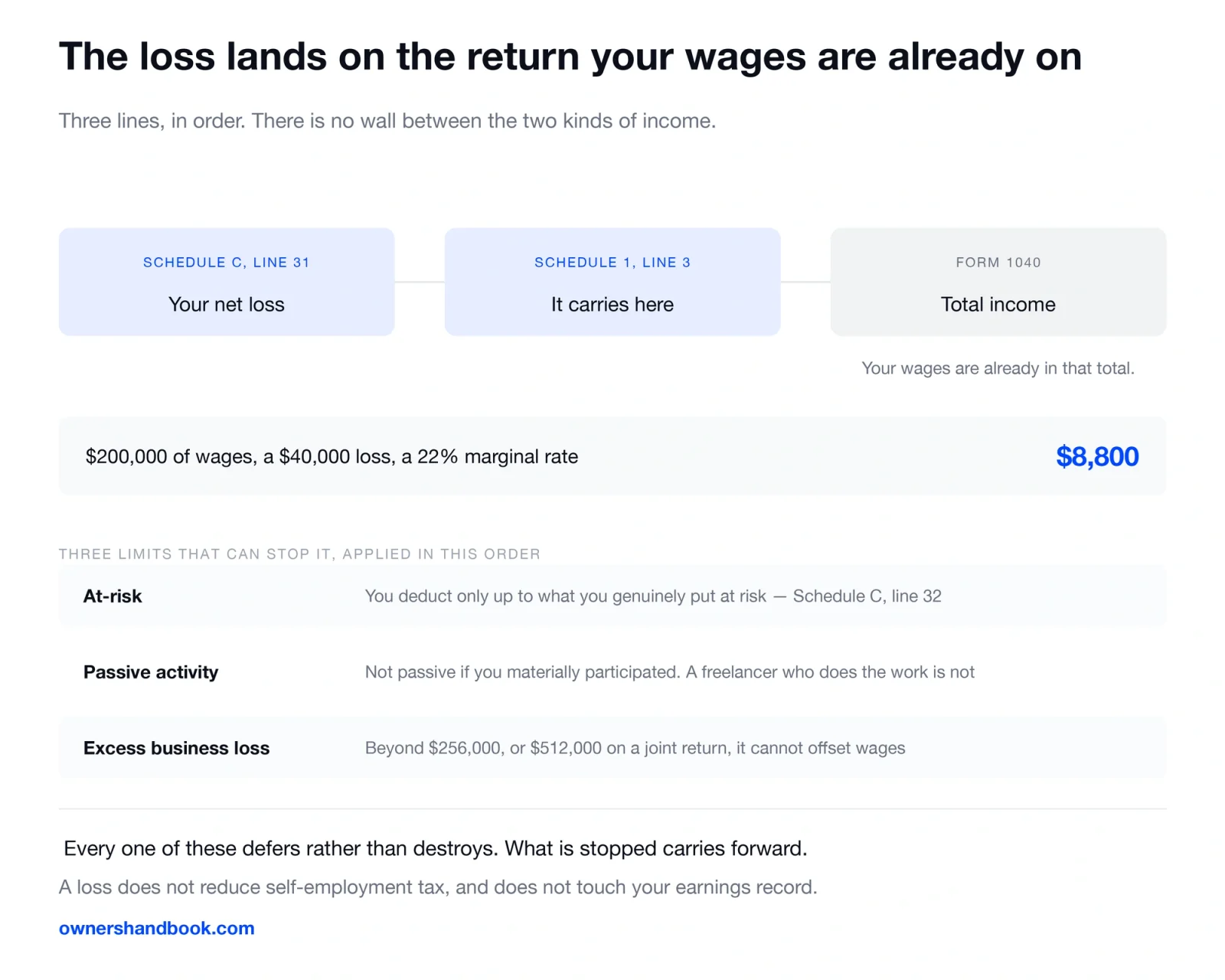
Three lines, in order.
| Where | What happens |
|---|---|
| Schedule C, line 31 | Your net profit or loss |
| Schedule 1, line 3 | The figure carries here — “Business income or (loss). Attach Schedule C” |
| Form 1040 | Schedule 1 feeds your total income, which your wages are already in |
A loss arrives at line 3 as a negative number and reduces total income, then adjusted gross income, then taxable income. Your wages are sitting in that same total. The loss does not care where the other income came from.
Take a married couple filing jointly with $200,000 of wages and a $40,000 Schedule C loss. With the 2026 standard deduction of $32,200, taxable income falls from $167,800 to $127,800. Both figures sit inside the band running from $100,800 to $211,400 for joint filers, where the marginal rate is 22%. The loss is worth $40,000 × 22% = $8,800.
Our walkthrough of Schedule C covers how the loss gets to line 31 in the first place.
What the offset does not do
Two things it will not reach — and one thing it does reach, which people miss.
It does not reduce self-employment tax. That tax is charged on self-employment income; a loss means there is none, so there is nothing to charge — but you get no credit against the Social Security and Medicare already withheld from your wages. Those were employment taxes on employment income and they stay put.
It does not touch your Social Security earnings record either. A loss year contributes nothing toward your eventual benefit, and subtracts nothing from what your wages contributed.
And it is not an itemised deduction — which cuts in your favour. Business expenses come off on Schedule C before adjusted gross income is figured, so you get all of them whether or not you itemise. Schedule C versus itemising covers this.
Three limits that can stop the loss
They apply in a fixed order.
At-risk rules. You can deduct losses only up to the amount you have genuinely put at risk — your own money, property you contributed, debt you are personally liable for. Schedule C makes you declare it at line 32: 32a if all your investment is at risk, 32b if some is not, with the limit worked on Form 6198. Most freelancers check 32a, correctly. Fund the business out of your own pocket and everything in it is at risk.
Passive activity rules. A loss from a passive activity can only offset passive income, not wages. The definition matters here:
A trade or business activity isn’t a passive activity if you materially participated in the activity.
Material participation has seven tests and you need to meet only one. The two that settle most cases are more than 500 hours in the year, or more than 100 hours and at least as much as anyone else. A freelancer who does the work is not passive. This limit is aimed at silent investors. Where it applies, Form 8582 runs the calculation.
The excess business loss limitation. This one is real, and it has a number, stated in the IRS’s own inflation guidance:
For taxable years beginning in 2026, in determining a taxpayer’s excess business loss, the amount under § 461(l)(3)(A)(ii)(II) is $256,000 ($512,000 for joint returns).
Business losses beyond that in a single year cannot offset non-business income such as wages. The excess is computed on Form 461 and added back on Schedule 1, line 8p. A couple with $900,000 of wages and a $700,000 business loss are limited to $512,000 of offset; the other $188,000 comes back on line 8p. If your loss is in the tens of thousands, none of this reaches you.
A loss you cannot use is not a loss you lose
Every one of these limits defers rather than destroys.
| Limit | What happens to the stopped amount |
|---|---|
| At-risk | Carried forward to a year when you are at risk |
| Passive activity | Carried forward and treated as a deduction from that activity next year |
| Excess business loss | Becomes a net operating loss carryover |
The Form 461 instructions are explicit on the last one — keep a record of the excess from each year, because it is treated as an NOL carryover for subsequent taxable years.
Net operating losses arising after 2020 generally cannot be carried back; they go forward, and indefinitely. The trade is a ceiling on how much you can use at once: an NOL deduction attributable to post-2017 losses cannot exceed 80% of taxable income figured without it.
The money is deferred, not forfeited. What you lose is the timing — which, in a high-wage year, was the part worth having.
Does a loss invite scrutiny
This is the second half of the question and it deserves a straight answer.
A single loss year is unremarkable. Businesses buy equipment before it earns anything.
What draws the question is a pattern — losses year after year, against substantial wage income, from an activity that resembles something people do for pleasure. The concern is not that you had a bad year. It is whether the activity is a business at all.
That matters because an activity not engaged in for profit is treated quite differently. Its income goes on Schedule 1, line 8j — “Activity not engaged in for profit income” — and the expenses do not come off against it. No Schedule C, no loss, no offset against wages.
The Schedule C instructions set the entry requirement plainly: your primary purpose must be income or profit, and you must be involved with continuity and regularity. A sporadic activity, a not-for-profit activity, or a hobby does not qualify as a business. Our guide to audit triggers covers what else moves the needle.
The three-of-five presumption, and what it does not say
Almost everything written about this rule states it backwards. Here is the actual text, from the form that exists to invoke it. An activity is presumed engaged in for profit if gross income exceeds deductions in:
each of 3 or more of the tax years in the period of 5 consecutive tax years
Read what that is. It is a presumption in your favour. Show profit in three of five years and the burden shifts: the IRS has to prove you are not in business, rather than you proving you are.
What it is not:
| What people think it says | What it says |
|---|---|
| You must profit in 3 of 5 years or it becomes a hobby | It is a safe harbour, not a requirement |
| Fail it and your deductions are disallowed | Failing it changes nothing automatically — you are simply back to the ordinary facts-and-circumstances test |
| It is a rule about losses | It is a rule about who bears the burden of proof |
Plenty of genuine businesses lose money for more than two years out of five and remain businesses. The presumption is a shortcut you can reach for, not a test you can fail.
Form 5213 elects to postpone the determination until after the fourth consecutive tax year following the one you started in, giving the presumption time to develop — at the cost of extending the period in which the IRS can assess tax on those years. Our comparison of hobby versus business goes through the classification in full.
What actually separates a bad year from a hobby
Not the loss. The conduct around it. The IRS publishes the questions it asks, and they are answerable:
| The question | What it looks for |
|---|---|
| Is the activity conducted like a business | Records, a separate account |
| Do you change methods to improve profitability | That you responded to the losses |
| What is your expertise, or your advisors’ | Preparation and accepted practice |
| Is it a main source of income, and how much time | Hours and commitment |
| Have you made a profit before | A history of turning ventures around |
| Is the activity profitable in some years | The pattern, not one year |
| Are losses beyond your control or normal at startup | Cause, and the stage you are at |
| Are there elements of personal pleasure or recreation | Whether profit is the actual appeal |
Notice what is doing the work. Records, changes in response to losses, expertise, hours. None of it is the size of the loss.
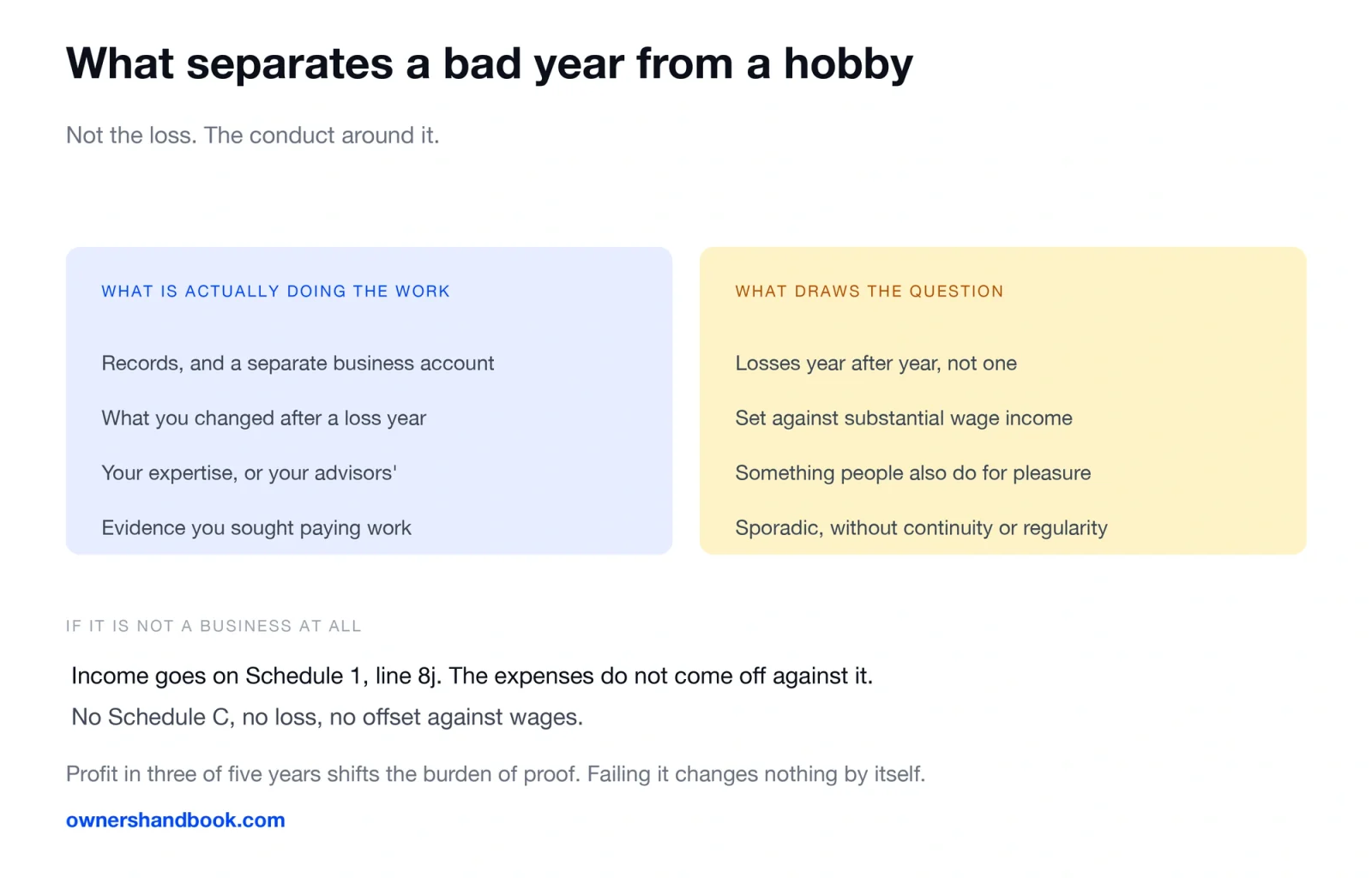
The practical version is short. Keep a separate business bank account and contemporaneous records — tax record keeping covers what and for how long. Write down what you changed after a loss year and why. Keep evidence that you sought paying work: pitches, proposals, rate cards, rejections. And claim the deductions you are entitled to, properly substantiated. A home office that meets the rules is not a red flag, and our list of freelance tax deductions covers what qualifies.
Frequently asked questions
Can a Schedule C loss offset my spouse’s W-2 wages on a joint return?
Yes. A joint return has one total income. The loss reduces it regardless of which spouse generated either figure.
Does a loss mean I get a refund of tax withheld from my paycheque?
It can. If withholding on your wages exceeded the tax on the reduced income, the difference comes back as a refund.
Is there a limit to how many loss years I can report?
No numerical limit exists in the rules. What changes with repetition is the evidence you need that the activity is a business. A first-year loss in particular is the expected shape — starting costs precede revenue in almost every business.
Should I skip deductions to avoid showing a loss?
No. Under-reporting deductions to engineer a profit is its own problem, and it costs you real money.
What if the loss is larger than my wages?
You can offset down to zero and the remainder generally becomes a net operating loss carried forward to future years, subject to the 80% limitation when you use it.
Sources
IRS, Instructions for Schedule C (Form 1040), Profit or Loss From Business
https://www.irs.gov/instructions/i1040sc
IRS, Schedule 1 (Form 1040), Additional Income and Adjustments to Income
https://www.irs.gov/pub/irs-pdf/f1040s1.pdf
IRS, Revenue Procedure 2025-32 (inflation adjustments for tax year 2026)
https://www.irs.gov/pub/irs-drop/rp-25-32.pdf
IRS, Instructions for Form 461, Limitation on Business Losses
https://www.irs.gov/instructions/i461
IRS, Publication 925, Passive Activity and At-Risk Rules
https://www.irs.gov/publications/p925
IRS, Instructions for Form 172, Net Operating Losses for Individuals, Estates, and Trusts
https://www.irs.gov/instructions/i172
IRS, Form 5213, Election To Postpone Determination as To Whether the Presumption Applies
https://www.irs.gov/pub/irs-pdf/f5213.pdf
IRS, Know the difference between a hobby and a business
https://www.irs.gov/newsroom/know-the-difference-between-a-hobby-and-a-business
IRS, Self-employment tax (Social Security and Medicare taxes)