The Underpayment Penalty, and the Two Safe Harbors
The charge for underpaying estimated tax is an interest rate applied to an amount for a period of days. That is not a figure of speech — it is the structure of the statute. Section 6654(a) says the addition to tax is determined by applying the underpayment rate, to the amount of the underpayment, for the period of the underpayment.
Which means there is no penalty amount to look up. There are three inputs, and if you can produce them you can produce the number yourself before the IRS does.
This page is the calculation and the two safe harbors that drive it to zero. For what to do once you are already behind — part payments, payment plans, the W-4 repair — see missed estimated taxes, which covers the recovery rather than the arithmetic.
The rate is set by statute and reset every quarter
Section 6654(a) points at the underpayment rate under section 6621. For anyone who is not a corporation, that rate is the federal short-term rate plus three percentage points.
The IRS resets it quarterly and compounds it daily. It has been remarkably steady.
| Quarter | Rate for individual underpayments |
|---|---|
| 2025, all four quarters | 7% |
| 2026 Q1, January to March | 7% |
| 2026 Q2, April to June | 6% |
| 2026 Q3, July to September | 7% |
| 2026 Q4, October to December | 7% |
| 2027 Q1 | Not announced as of October 2026 |
The Q4 2026 figure comes from Revenue Ruling 2026-15, computed from the federal short-term rate determined during July 2026. The first-quarter 2027 rate has not been published yet, so any 2026-year penalty running into next spring cannot be computed to the last dollar today.
The worked example below uses the 2025 tax year, because for that year the Form 2210 penalty worksheet prints the rate on the form itself: 0.07, in all four rate periods.
Step one: the required annual payment
The penalty is not measured against what you owe. It is measured against a number the law constructs, and that number is the lesser of two things.
Section 6654(d)(1)(B) defines the required annual payment as the lesser of:
90 percent of the tax shown on the return for the taxable year … or 100 percent of the tax shown on the return of the individual for the preceding taxable year.
One limit on the second route. Section 6654(d)(1)(C) raises it if last year was a good year:
subparagraph (B) shall be applied by substituting “110 percent” for “100 percent”
That substitution switches on when your adjusted gross income for the preceding year exceeded $150,000, or $75,000 if you are married filing separately for the current year. Form 1040-ES states the same rule for 2026 estimates in terms of 2025 adjusted gross income.
Two things about the $150,000 line catch people. It is prior-year AGI, so it was decided before the tax year even began, and on a joint return it is the household figure rather than a per-person one. Nothing tells you when you cross it; the first notice is a penalty on a return you believed was safe.
Form 2210 walks the same path in Part I. Line 4 is the current year’s tax, line 5 is 90% of it, line 8 is the prior-year ceiling, and line 9 takes the smaller of the two. Our quarterly tax calculator runs Part I on your own figures.
Step two: one quarter of it, on each of four dates
Section 6654(d)(1)(A) splits the required annual payment into four: each required installment is 25 percent of it.
Section 6654(c)(2) fixes the dates — April 15, June 15, September 15, and January 15 of the following taxable year. They are not quarters, and quarterly estimated taxes explains why the second period is two months long and the fourth is four.
Then the sentence that produces most of the surprise. The Form 2210 instructions:
The penalty is figured separately for each installment due date. Therefore, you may owe the penalty for an earlier due date even if you paid enough tax later to make up the underpayment. This is true even if you’re due a refund when you file your tax return.
A refund in April is not evidence you were on time. It is evidence you were short in June and generous in December.
Withholding is the exception. For federal income tax withheld, the instructions say you are considered to have paid one-fourth of the amount on each payment due date unless you can show otherwise — which is why W-4 withholding instead of quarterlies can repair a quarter you already missed and an estimated payment cannot.

Step three: the amount, and the days it stayed unpaid
Section 6654(b) defines both. The amount of the underpayment is the required installment minus whatever was paid on or before the due date for that installment. The period runs from the due date to the earlier of the date it is paid or the following April 15.
Payments are applied first to any underpayment on an earlier installment, even if you designate them for a later period. The instructions give the example: a $500 shortfall after April 15, then a $1,200 payment on June 10 — $500 of it clears April and only $700 reaches the June installment.
And there is no cap. Failure to file stops at 25% of the unpaid tax and failure to pay stops at the same ceiling. This one just runs on the days.
The worksheet counts those days in rate periods rather than one stretch, so a rate change mid-year is handled column by column. For the 2025 tax year, with no payments at all until the return was filed, the official day counts are these.
| Installment due | Days unpaid to April 15, 2026 |
|---|---|
| April 15, 2025 | 365 |
| June 15, 2025 | 304 |
| September 15, 2025 | 212 |
| January 15, 2026 | 90 |
The whole calculation on one freelancer
A single freelancer. 2025 total tax of $18,000, no W-2 job and therefore no withholding, and 2024 tax of $14,000 on 2024 adjusted gross income of $96,000. Nothing was sent all year; the full $18,000 went in with the return on April 15, 2026.
Part I first. Current year tax $18,000, so 90% of it is $16,200. The prior-year ceiling is $14,000, and because 2024 AGI was under $150,000 it stays at 100% rather than 110%. The required annual payment is the smaller: $14,000. Each installment is $3,500.
Column (a) shows the rate-period structure. The April 15 installment was unpaid for all four periods.
| Rate period | Days | 7% on $3,500 |
|---|---|---|
| April 16 – June 30, 2025 | 76 | $51.01 |
| July 1 – September 30, 2025 | 92 | $61.75 |
| October 1 – December 31, 2025 | 92 | $61.75 |
| January 1 – April 15, 2026 | 105 | $70.48 |
| Column (a) total | 365 | $245.00 |
The other three columns are the same arithmetic over fewer days.
| Installment | Days | Interest at 7% |
|---|---|---|
| $3,500 due April 15 | 365 | $245.00 |
| $3,500 due June 15 | 304 | $204.05 |
| $3,500 due September 15 | 212 | $142.30 |
| $3,500 due January 15 | 90 | $60.41 |
| $14,000 never sent on time | About $652 |
Six hundred fifty-two dollars. On the $14,000 of required installments that is 4.7% — which is what a year of interest at 7% looks like when the average dollar was only late for part of the year.
Now change one input. Suppose 2024 adjusted gross income had been $160,000 instead of $96,000, with the same $14,000 of 2024 tax. Line 8 becomes 110% of $14,000, or $15,400. That is still smaller than $16,200, so it still governs, and the installments rise to $3,850 each.
The penalty rises with them, to about $717. The $150,000 line does not only change what you should have paid. It changes what you are charged for not paying it.
Safe harbor one: 90% of this year
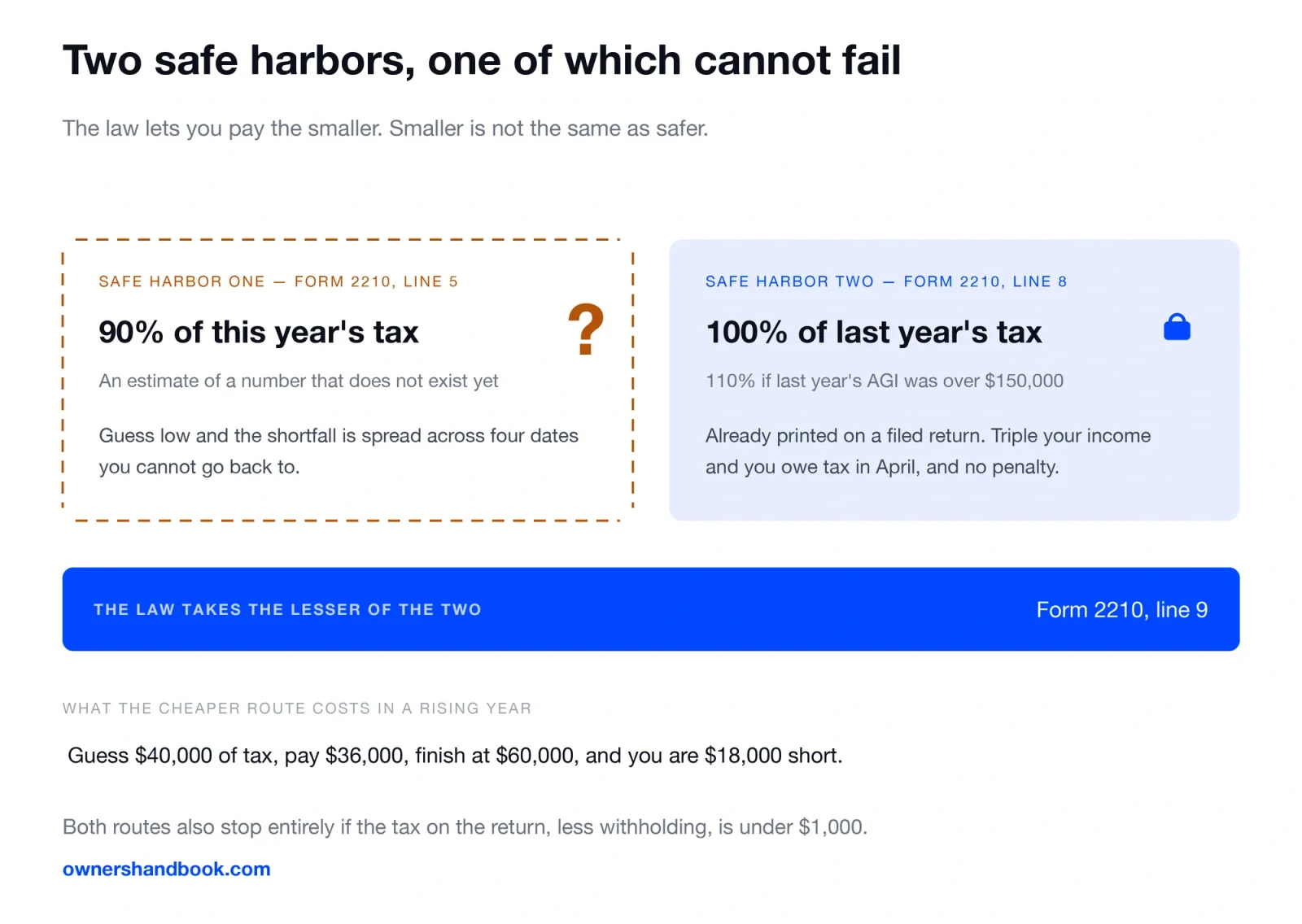
Pay in 90% of the tax that ends up on this year’s return and no penalty can arise, because line 9 can never exceed line 5.
The catch is in the tense. You are being asked to hit a percentage of a number that does not exist yet.
Guess $40,000 of tax and pay 90% of it, which is $36,000. If the year finishes at $60,000 of tax, the rule wanted $54,000 and you are $18,000 short across four dates.
So this route is the cheaper one when your income is falling and the dangerous one when it is rising. Our self-employment tax calculator is the right tool for sizing the current-year number if you are going to use it, and how much to set aside builds the underlying rate from its parts.
Safe harbor two: 100% of last year, or 110%
This is the one that cannot fail, because it references a number already printed on a return you have filed.
Pay 100% of last year’s total tax — 110% if last year’s AGI was over $150,000 — split across the four dates, and the penalty is unreachable no matter what this year turns out to be. Triple your income and you will owe a great deal of tax in April. You will owe no penalty.
The figure you need is the line labelled total tax, near the bottom of page two of last year’s Form 1040. It is not the amount you owed in April, which is what was left after withholding and estimates, and people grab that one constantly.
Two conditions: the prior year must have been a 12-month year, and you must have filed a return for it. A first-year freelancer has neither, which is what first-year quarterly taxes is for.
Two exits that are not safe harbors
Neither of these asks you to pay anything, and both are easy to miss because they sit in a different subsection.
Under $1,000. Section 6654(e)(1) imposes no addition to tax at all if the tax shown on the return, reduced by tax withheld, is less than $1,000. Form 2210 implements it twice, at line 4 and again at line 7, and both say stop.
No tax last year. Section 6654(e)(2) imposes no addition to tax if the preceding taxable year was a 12-month year, you had no liability for tax in it, and you were a citizen or resident of the United States throughout it. Three conditions, all of them factual, none of them discretionary. A freelancer whose first profitable year follows a year with no tax owes no estimated payments at all for it, though the tax still arrives in April.
Separately, the penalty can be waived rather than avoided. Retirement after age 62 or disability in the current or prior year, or a casualty or disaster making the charge inequitable, are grounds under section 6654(e)(3), and a federally declared disaster triggers relief automatically while your return is processed. Those are claimed in Part II of Form 2210.
One relief that does not reach here. First Time Abate, the waiver for a clean compliance record, covers failure to file and failure to pay and explicitly excludes the estimated tax penalty.
What you do not have to do
Compute any of this. The IRS states it plainly in the Form 2210 instructions: the IRS will generally figure your penalty for you and you should not file Form 2210.
Leave it alone and a bill arrives. You file the form only to claim a waiver, to run the annualized income installment method, or to treat withholding as paid on the dates it actually came out.
The annualized method is the one worth knowing about, because it is the only route that reduces an already-earned penalty rather than preventing a future one. If your income arrived late in the year, Form 2210 Schedule AI recomputes each required installment against income you had actually received by that date, and it frequently cuts the number by more than half.
If the problem is the balance rather than the penalty, an extension on Form 4868 moves the filing deadline and nothing else. The tax is still due in April.
Frequently asked questions
Is the underpayment penalty deductible?
No. It is an addition to tax on your personal return, and personal tax penalties and interest are not deductible.
Can I avoid it by paying everything in April?
No. The period of underpayment for each installment runs from its own due date, so a single April payment leaves three clocks that already ran. This is the most common misunderstanding about the charge.
Does the rate change mid-year change what I owe?
Only for the days inside the changed quarter. The worksheet splits the days into rate periods and applies each quarter’s rate separately, which is why 2026’s drop to 6% in the second quarter only touches April through June.
I had a refund. Can I still owe this?
Yes, and the instructions say so directly. A refund means your total payments exceeded your total tax, not that each installment was covered when it was due.
Do states charge this too?
Most states with an income tax run their own version, with their own rate and sometimes their own installment percentages. California, for one, splits the year 30-40-0-30. Our guide to state taxes for the self-employed covers which states have their own schedule.
Sources
IRS, Instructions for Form 2210, Underpayment of Estimated Tax by Individuals, Estates, and Trusts (2025)
https://www.irs.gov/pub/irs-pdf/i2210.pdf
IRS, Form 2210 (2025)
https://www.irs.gov/pub/irs-pdf/f2210.pdf
IRS, Form 1040-ES, Estimated Tax for Individuals (2026)
https://www.irs.gov/pub/irs-pdf/f1040es.pdf
IRS, Quarterly Interest Rates
https://www.irs.gov/payments/quarterly-interest-rates
IRS, Interest rates remain the same for the fourth quarter of 2026
https://www.irs.gov/newsroom/interest-rates-remain-the-same-for-the-fourth-quarter-of-2026
IRS, Topic 306: Penalty for Underpayment of Estimated Tax
https://www.irs.gov/taxtopics/tc306
26 U.S.C. § 6654, Failure by individual to pay estimated income tax
https://www.law.cornell.edu/uscode/text/26/6654
IRS, Publication 505, Tax Withholding and Estimated Tax (2026)