What Changed for the 2026 Tax Return
Ten things changed on the return you will file in early 2027. One cuts your mileage log in half on June 30. One removes a dollar ceiling that has been protecting people from a four-figure health insurance bill. And the list of things expiring on December 31, 2026 is empty — which is not what the rest of the internet is telling you this autumn.
This page is the index. Each change gets the statute or notice behind it, the figure, and a link to the full treatment where we have written one. Everything below is tax year 2026. The 2027 inflation numbers are not out yet.
Where the changes land
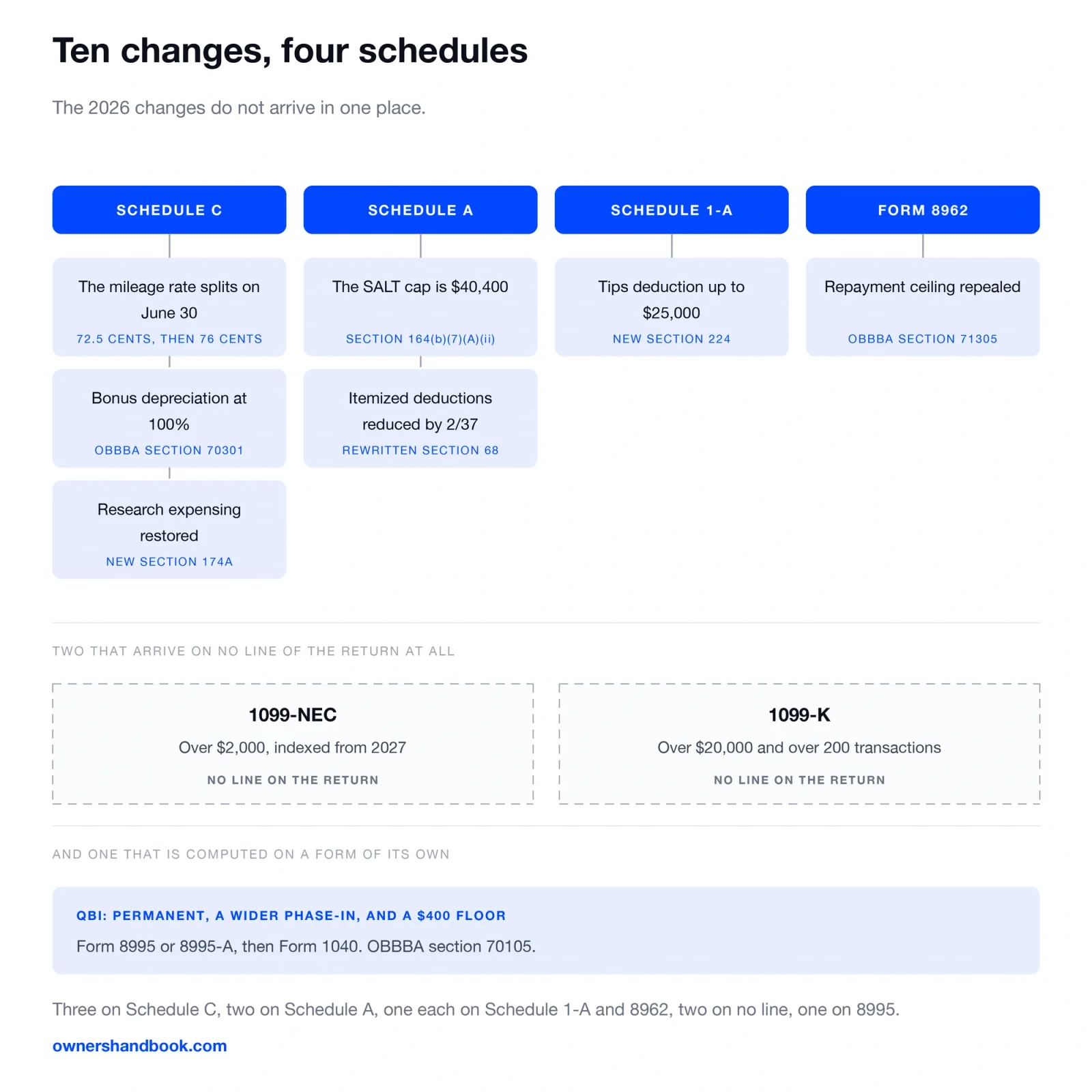
Four schedules, and two items that touch no line at all. The 1099 thresholds change what arrives in your mailbox, not what you owe.
The mileage rate split in the middle of the year
The business standard mileage rate for 2026 is 72.5 cents for miles driven January 1 through June 30, and 76 cents from July 1 through December 31.
Notice 2026-10 set the original 72.5. Announcement 2026-11, in Internal Revenue Bulletin 2026-29, revised it:
This modification results from recent increases in the price of fuel.
One sourcing note, because this is a trap. The IRS rate table lists the source for the July–December figure as “IR-2026-29,” a news-release number. The document that sets the rate is Announcement 2026-11, and 2026-29 is the number of the Bulletin it appears in, not of a news release. If you are checking a citation on this rate, that is the mismatch to look for.
A single annual mileage total is now useless. You need two subtotals, split at June 30. Our 2026 mileage rate guide works through it, the mileage deduction calculator does both halves, and if your log is not date-stamped, what the IRS requires of a mileage record comes before any attempt to reconstruct it.
Both 1099 thresholds moved, in opposite directions
1099-NEC. OBBBA section 70433 struck “$600” from section 6041(a) and inserted “$2,000”. It applies to payments made after December 31, 2025, and is indexed for calendar years after 2026.
1099-K. OBBBA section 70432 rewrote section 6050W(e): a platform reports only if the amount exceeds $20,000 and the number of transactions exceeds 200. Both conditions, not either. Nothing in the provision indexes it.
| Form | 2026 threshold | Indexed? |
|---|---|---|
| 1099-NEC | Over $2,000 | Yes, from 2027 |
| 1099-K | Over $20,000 and over 200 transactions | No |
| 1099-MISC box 10, gross proceeds to an attorney | $600 or more | No |
That last row is where people go wrong. Section 70433 amended section 6041. Gross proceeds paid to an attorney are reported under section 6045(f), which was not touched, and the instructions still say “Enter gross proceeds of $600 or more paid to an attorney.”
Neither threshold changes what you owe. What changes is how much of your income now has no paper trail behind it — covered in 1099-NEC vs 1099-K and, from the other side of the desk, in when you are the one issuing 1099s. If you sell through platforms, taxes by platform and creator income both turn on the new 1099-K numbers.
The repayment ceiling on health insurance subsidies is gone
This is the expensive one, and almost nobody is writing about it.
Take an advance premium tax credit, earn more than you estimated, and you repay the excess on Form 8962. Until now there was a ceiling on how much you could be made to repay:
| Household income, % of federal poverty line | Single | Any other filing status |
|---|---|---|
| Under 200% | $375 | $750 |
| 200% to 300% | $975 | $1,950 |
| 300% to 400% | $1,625 | $3,250 |
| 400% or more | No limit | No limit |
OBBBA section 71305 struck section 36B(f)(2)(B) — the subparagraph that created that table. For tax years beginning after December 31, 2025 there is no cap at any income level. The 2026 Form 1040-ES says it in one line: “There is no longer a limit on the amount you will have to” repay.
A single freelancer who estimated $38,000, landed at $55,000, and had $7,200 of advance credit paid on their behalf repaid $975 in 2025. In 2026 they repay the full excess.
Add the separate loss of eligibility above 400% of the poverty line and your income estimate becomes the highest-stakes number on a marketplace application. Health insurance in 2026 covers the cliff; the health insurance deduction calculator handles the circular interaction between the credit and the deduction.
A new reduction to itemized deductions
OBBBA section 70111 rewrote section 68 as a formula rather than a phase-out. Itemized deductions are reduced by:
2/37 of the lesser of — (1) such amount of itemized deductions, or (2) so much of the taxable income of the taxpayer for the taxable year … as exceeds the dollar amount at which the 37 percent rate bracket under section 1 begins
For 2026 the 37% bracket starts at $768,700 joint, $640,600 single or head of household, $384,350 married filing separately. Worked, for a single filer with $74,000 of itemized deductions and $700,000 of taxable income:
| Step | Amount |
|---|---|
| Taxable income, increased by itemized deductions | $774,000 |
| Less the 37% bracket threshold | $640,600 |
| Excess | $133,400 |
| Lesser of $74,000 and $133,400 | $74,000 |
| Reduction, 2/37 of that | $4,000 |
| Itemized deductions allowed | $70,000 |
The fraction is chosen so a dollar of itemized deduction saves at most 35 cents instead of 37. Below the 37% bracket it does nothing. And it is ignored when figuring QBI: section 70111(b) inserted “without regard to section 68” into section 199A(e)(1).
Two giving changes land the same year. Section 70425 added a 0.5% of contribution base floor for itemizers — the first half percent of AGI in gifts is not deductible at all. Section 70424 gave non-itemizers up to $1,000 ($2,000 joint).
None of this touches a Schedule C expense, and assuming it does is the standard mistake. Business expenses are not itemized deductions is the one to read first.
The tips deduction, and why overtime cannot reach you
Section 224, added by OBBBA section 70201, allows a deduction of up to $25,000 of qualified tips, reduced by $100 for each $1,000 of modified AGI over $150,000 ($300,000 joint). Non-itemizers get it. It terminates after 2028.
It does reach the self-employed, with two conditions that cut hard. Section 224(c) counts tips from a trade or business only to the extent that business’s gross income exceeds its allocable deductions — Schedule 1-A puts it as “do not enter more than the net profit from the trade or business.” And section 224(d)(2)(B) excludes a specified service trade or business as defined in section 199A(d)(2), which rules out a long list of professional freelancers. The occupation also has to appear on the IRS list at IRS.gov/TippedOccupations.
Overtime is a different story, worth clearing up because the two sit on the same schedule. Section 225 defines qualified overtime compensation as overtime:
required under section 7 of the Fair Labor Standards Act of 1938 that is in excess of the regular rate (as used in such section) at which such individual is employed
Fair Labor Standards Act section 7 creates an obligation an employer owes an employee. Your own business owes you nothing under it, so seventy-hour weeks for yourself produce no qualified overtime compensation. Schedule 1-A does carry a line for overtime reported on a 1099-NEC, so it is not strictly W-2-only — but the amount still has to be FLSA overtime, and your own client work is not.
If you are in a tipped trade and running it yourself, booth renter taxes covers the self-employment side.
QBI is permanent, wider, and now has a floor
Three changes from OBBBA section 70105, all for tax years beginning after December 31, 2025.
Permanent. Section 199A(i) used to say the deduction did not apply after December 31, 2025. Section 70105(b) replaced that subsection outright. The sunset is gone.
Wider phase-in. For a specified service trade or business the deduction phases out above the threshold over a range that was $50,000 ($100,000 joint) and is now $75,000 ($150,000 joint). For 2026, from Rev. Proc. 2025-32, the threshold is $403,500 joint and $201,750 for other returns, topping out at $553,500 and $276,750.
A floor. New section 199A(i) gives a minimum deduction of $400 to any taxpayer with at least $1,000 of aggregate qualified business income from active qualified trades or businesses — active meaning material participation under section 469(h). Both amounts are indexed after 2026.
The floor is aimed squarely at the smallest Schedule C filers. On $1,400 of profit the ordinary 20% calculation gives $280; the floor gives $400. The 20% deduction for being self-employed walks through which you end up with, and when an S corp election starts paying for itself now has a permanent deduction on one side of that arithmetic instead of an expiring one.
Equipment and research: 100% expensing, one closed window
Bonus depreciation. OBBBA section 70301 struck the clause phasing section 168(k) down and replaced “the applicable percentage” with “100 percent”. It applies to property acquired after January 19, 2025 — and property is not treated as acquired after the date a written binding contract for it was entered into, so the contract date is the test. Writing off equipment covers the choice between this and section 179, which are not the same election. If your largest asset is a vehicle, owner-operator truck driver taxes has the limits sitting on top.
Section 174A. OBBBA section 70302 created section 174A, restoring an immediate deduction for domestic research or experimental expenditures from tax years beginning after December 31, 2024. For a solo developer building their own product, that ends the five-year amortization rule.
The retroactive election for small businesses — reaching back to tax years beginning after December 31, 2021 — had to be made within one year of enactment. Rev. Proc. 2025-28 fixed the date, and because July 4, 2026 was a Saturday it landed on Monday, July 6, 2026. That window is closed. Section 174A for freelance developers covers what is left for the earlier years; app and SaaS revenue covers the income side.
The SALT cap is $40,400
OBBBA section 70120 replaced the flat $10,000 limit with an “applicable limitation amount” written out year by year in section 164(b)(7)(A): $40,000 for 2025, $40,400 for 2026, then 101% of the prior year through 2029, then back to $10,000 after calendar year 2029. It is reduced by 30% of modified AGI above $505,000 for 2026, but never below $10,000.
The cap sits on Schedule A and most freelancers never get there. State income tax on business profit is an itemized deduction, not a business expense. What you owe your state is worked out in you owe state tax too.
What did not change, and what is not expiring
Nothing in the OBBBA that matters to a Schedule C filer expires on December 31, 2026. The business-side provisions were made permanent, not extended: bonus depreciation, section 174A, QBI, the excess business loss limitation. An article telling you to buy equipment before December 31 to beat a deadline is describing a deadline that does not exist. Here is where the real dates are.
| Provision | When it ends |
|---|---|
| Bonus depreciation, section 174A, QBI, excess business loss | Permanent |
| Tips deduction, section 224(h) | Tax years beginning after December 31, 2028 |
| Overtime deduction, section 225(g) | Tax years beginning after December 31, 2028 |
| Car loan interest, section 163(h)(4) | Tax years 2025 through 2028 |
| Senior deduction, section 151(d)(5)(C) | Tax years beginning before January 1, 2029 |
| SALT cap reverts to $10,000 | Tax years beginning after calendar year 2029 |
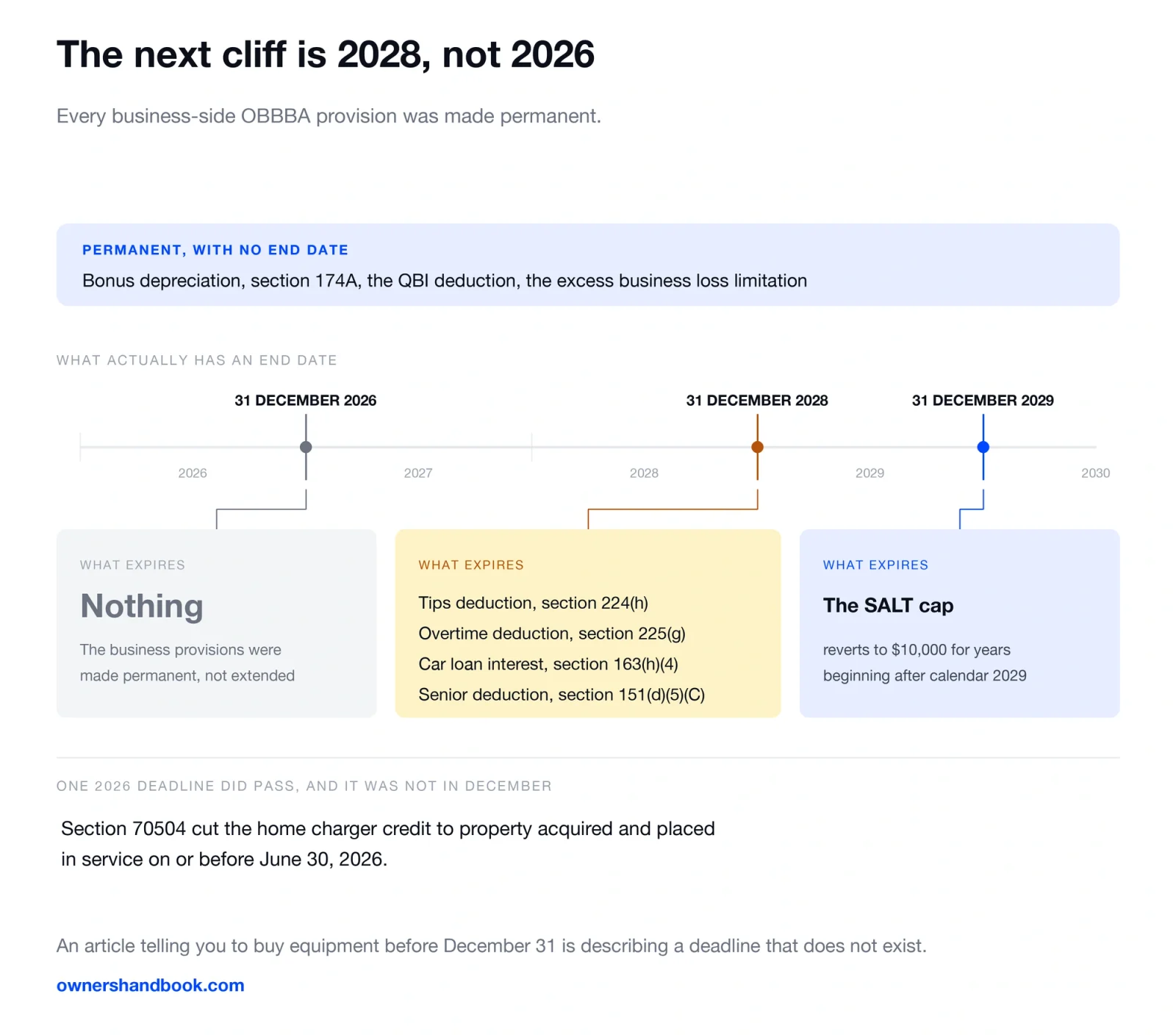
One 2026 deadline did pass, and it was not in December. Section 70504 cut the section 30C credit for alternative fuel vehicle refueling property — the home charger credit — to property acquired and placed in service on or before June 30, 2026.
What genuinely turns over at midnight on December 31 is mostly not OBBBA at all: the solo 401(k) deferral election, the age setting your long-term care premium cap, and whether equipment was placed in service. Those are in what actually expires on December 31.
Also unchanged: the self-employment tax rate, the 92.35% multiplier, and the four payment dates. Self-employment tax and quarterly estimated taxes read the same as last year. The one number that moved there is the social security wage base, $184,500 for 2026.
What to do with this list
Check your marketplace income estimate. The repayment cap is gone and nothing now sits between a bad estimate and the full bill.
Split your mileage log at June 30. One annual total cannot be turned into the right deduction after the fact.
Do not restructure anything for a December deadline. There isn’t one. If you were buying equipment anyway, the deduction list and Schedule C, line by line are where to check it belongs on the return at all.
Decide whether this is the year you stop filing it yourself. Section 68, the QBI floor, and the premium tax credit interaction are three places where software has to get a brand-new calculation right. Tax software or a CPA gives the threshold, and how to pay estimated taxes covers the part that has not changed.
Frequently asked questions
Do I have to report income if no 1099 arrives?
Yes. The thresholds govern the payor’s filing obligation, not your reporting obligation. A client who paid you $1,800 in 2026 files nothing, and you still report $1,800.
I drove 12,000 miles in 2026 and never recorded the dates. What now?
You need the split. Calendar entries, invoices, project dates, and odometer readings around June 30 are all evidence of which miles fell where. Assuming half in each period is not a record.
Does the new section 68 limit affect my business expenses?
No. Section 68 applies to itemized deductions on Schedule A. Business expenses come off on Schedule C, before adjusted gross income, and are untouched.
Can I still make the retroactive section 174A election for 2022 through 2024?
No. The deadline was July 6, 2026. What remains for those years depends on the ordinary refund limitation period under section 6511 and is not an election you can make unilaterally.
Should I buy equipment before December 31, 2026?
Only if you need it. Bonus depreciation at 100% is permanent, so waiting until January costs a year of timing, not the deduction. The one real December test is whether the item was placed in service, not whether it was paid for.
Is there a 2027 version of any of these numbers yet?
Not for the brackets, the standard deduction, the QBI thresholds, or the section 179 limits — as of mid-October 2026 the IRS has not published the 2027 inflation adjustments. The 2027 HSA limits, the ACA applicable percentage table, and the SALT cap figure do exist.
Sources
Public Law 119-21, One Big Beautiful Bill Act
https://www.govinfo.gov/content/pkg/PLAW-119publ21/pdf/PLAW-119publ21.pdf
IRS, Notice 2026-10, 2026 Standard Mileage Rates
https://www.irs.gov/pub/irs-drop/n-26-10.pdf
IRS, Internal Revenue Bulletin 2026-29 (Announcement 2026-11, page 49)
https://www.irs.gov/pub/irs-irbs/irb26-29.pdf
IRS, Revenue Procedure 2025-32, 2026 inflation adjusted items
https://www.irs.gov/pub/irs-drop/rp-25-32.pdf
IRS, Instructions for Forms 1099-MISC and 1099-NEC (Rev. December 2026)
https://www.irs.gov/pub/irs-pdf/i1099mec.pdf
IRS, 2025 Instructions for Form 8962, Premium Tax Credit
https://www.irs.gov/pub/irs-prior/i8962–2025.pdf
IRS, Form 1040-ES, Estimated Tax for Individuals (2026)
https://www.irs.gov/pub/irs-pdf/f1040es.pdf
IRS, Revenue Procedure 2025-28