Florida Has No Income Tax. Here Is What a Freelancer Actually Owes.
Florida does not tax personal income, and the state constitution is what keeps it that way. A freelancer with $95,000 of profit owes Florida nothing on it.
What Florida does want is a filing. An LLC annual report, due May 1, carrying a $400 late charge the day after.
This is a state layer on top of US federal tax
Nothing on this page reduces what you send the IRS. Self-employment tax is a United States federal tax, and it does not care which state you sleep in.
On $95,000 of profit, self-employment tax is $13,423. Multiply profit by 92.35%, then by 15.3%. That number is identical in Miami, Philadelphia, and Los Angeles.
Federal income tax sits on top of it, also unchanged. What Florida removes is the third layer, the state income tax return that most other states require.
The ban is in the constitution, not in a budget
Most states could add an income tax by passing a bill. Florida would have to amend its constitution first.
Article VII, Section 5 says no tax upon the income of natural persons who are residents or citizens of the state shall be levied by the state, or under its authority.
The sentence carries one narrow exception, tied to a credit against a federal tax that no longer exists. In practice the ban is total.
You can see it in what the Department of Revenue actually administers. Sales tax, corporate income tax, reemployment tax, fuel tax, documentary stamp tax. There is no individual return on the list.
What no income tax is worth in dollars
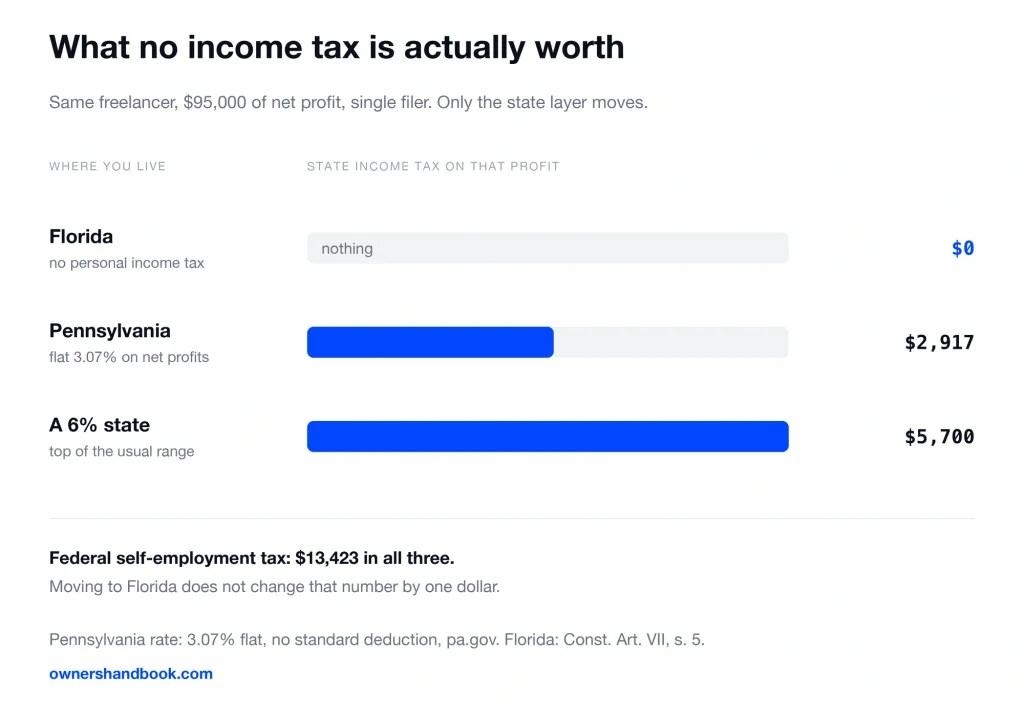
Take the same freelancer, $95,000 of net profit, single, running a one-member LLC. Now move them to Pennsylvania.
Pennsylvania makes the arithmetic easy. It charges a flat 3.07% on net profits from a business, profession, or farm, and it allows no standard deduction and no personal exemption.
| On $95,000 of profit | Florida | Pennsylvania |
|---|---|---|
| State income tax | $0 | $2,917 |
| Federal self-employment tax | $13,423 | $13,423 |
| Federal income tax | unchanged | unchanged |
| Ten years of state income tax | $0 | $29,170 |
Most states that tax income land between 3% and 6% on a freelance-sized Schedule C. On $95,000 that is roughly $2,900 to $5,700 a year, every year, forever.
So the savings are real and they compound. They are also smaller than the federal bill sitting above them, which is the part people forget when they load the truck.
The one filing a Florida LLC actually has
Here is where the free lunch ends. Every Florida LLC delivers an annual report to the Division of Corporations between January 1 and May 1.
The report is not a tax return. It confirms your principal address, your registered agent, your federal EIN, and at least one person with authority to manage the company. No revenue figure appears anywhere on it.
The price is two statutes added together. Fifty dollars for filing the annual report, plus an $88.75 annual supplemental corporate fee. $138.75 in total.
A sole proprietor who never formed an entity files none of this. No report, no fee, no May 1. In Florida that is the honest paperwork difference between a sole proprietor and an LLC.
Forming the LLC in the first place runs $100 for the articles of organization plus $25 to designate a registered agent.
Miss May 1 and it costs $400
The statute adds a late charge of $400 if the supplemental corporate fee is remitted after May 1. Read that against the $138.75 the report costs on time.
The wording is shall be imposed. There is exactly one carve-out in the text, and it is not a hardship waiver.
It applies only where the entity was already administratively dissolved for failing to file and then reinstated after paying the reinstatement fee. Nobody wants to qualify that way.
The date that actually ends your LLC comes later. Florida may administratively dissolve a company that has not delivered its annual report by 5:00 p.m. Eastern on the third Friday in September.
Dissolution for a missed report happens on the fourth Friday in September. From then the company exists only to wind itself up.
It also cannot maintain or defend an action in a Florida court until the report is filed and every fee and penalty is paid. A client who stops paying becomes very hard to chase.
Reinstatement is $100 in filing fee, on top of the report and the $400 you were trying not to spend.
Sales tax, if you sell the right things
Florida’s state sales tax rate is 6%. Counties add a discretionary sales surtax, a local add-on that currently ranges from 0.5% to 2%, and some counties impose none at all.
Most freelance services are not taxable here. The Department of Revenue’s list of taxable services is short: investigative and crime protection services, interior nonresidential cleaning, and nonresidential pest control.
Design, writing, code, consulting, photography sold as a service. None of those appear. Sell a physical print, resell hardware, or repair tangible property, and you are in the sales tax system.
Once you are registered, returns are due on the 1st and late after the 20th of the month following each reporting period. Most new businesses start out filing quarterly.
A return is due for every period even when you collected nothing, and the late filing penalty is 10% of the tax owed with a $50 minimum.
Reemployment tax starts the day you hire
Reemployment tax is Florida’s name for state unemployment insurance tax. The employer pays it. Nothing comes out of the worker’s check.
You become liable once you have one quarterly payroll of $1,500 or more in a calendar year, or one or more employees for a day or part of a day during any 20 weeks in a calendar year.
The initial rate for a new employer is 2.7%, charged on the first $7,000 of wages paid to each employee per year. That is a ceiling of $189 per employee.
Paying a contractor triggers none of this. Hiring a W-2 employee does, and it arrives with quarterly payroll returns attached.
The county tax on your equipment
This is the Florida obligation freelancers have never heard of, and it is billed by the county, not the state.
Tangible personal property tax is an annual county tax on the equipment, furniture, and fixtures a business owns. Inventory and household goods are excluded from it.
Anyone with a proprietorship, partnership, or corporation, and self-employed agents and contractors, files Form DR-405 with the county property appraiser by April 1.
File on time and up to $25,000 of assessed value is exempt per return. A one-person business with a laptop, a camera, and a desk is nowhere near that, and the tax comes out at zero.
The waiver is the useful part. File once and claim the exemption, and while your listed value stays under $25,000 the annual return requirement is waived. You have to file that first one to switch it off.
Skip it and the penalty is 5% per month up to 25%, or a flat 25% of the total tax if you never file at all.
Your Florida calendar
Sole proprietor, no taxable sales, no employees, no equipment worth $25,000. Your state calendar is genuinely empty, and your only deadlines are the four federal quarterly dates.
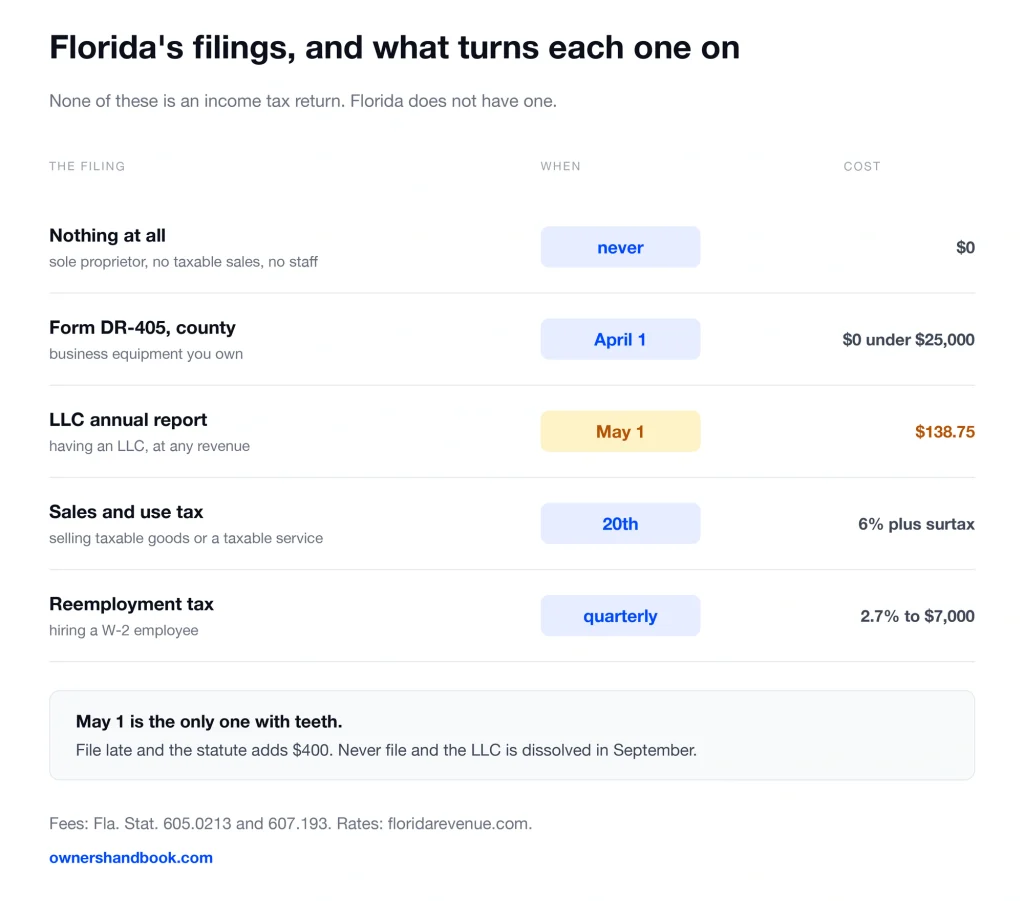
Every line below is triggered by something you did, not by living here.
| Filing | What triggers it | When | Cost |
|---|---|---|---|
| Nothing at all | Sole proprietor, no taxable sales, no employees | — | $0 |
| Form DR-405, county | Business equipment in the county | April 1 | $0 under $25,000 of value |
| LLC annual report | Having an LLC, any revenue | May 1 | $138.75, then $400 late |
| Sales and use tax return | Selling taxable goods or a taxable service | 20th of the month | 6% plus county surtax |
| Reemployment tax return | Hiring a W-2 employee | Quarterly | 2.7% of first $7,000 per employee |
Set the LLC reminder for April 1, not April 30. The filing takes ten minutes and the downside of forgetting is three times the fee.
Whether to be an LLC or a sole proprietor is a liability question before it is a tax question. In Florida the tax side of that choice is a wash, and the cost side is $138.75 a year.
Frequently asked questions
Does living in Florida lower my self-employment tax?
No. Self-employment tax is federal, 15.3% of 92.35% of net profit, and it is the same in all fifty states. On $95,000 of profit it is $13,423 in Tampa and $13,423 in Pittsburgh.
I am a sole proprietor in Florida. Do I file anything with the state?
Not unless something triggers it. No income tax return, no annual report. Sales tax only if you sell taxable items, and a DR-405 with your county if you own business equipment.
My LLC made nothing this year. Do I still file the annual report?
Yes. The report is due between January 1 and May 1 regardless of revenue, including zero revenue, and the $400 late charge does not care either.
Can the $400 late fee be waived?
The statute says it shall be imposed, with a single exception for an entity that was administratively dissolved for a missed report and later reinstated after paying the reinstatement fee. There is no general hardship waiver.
Do I charge Florida sales tax on freelance design or consulting?
Generally no. Florida taxes goods and a short list of named services that does not include design, writing, code, or consulting. Selling physical products alongside the service is what changes the answer.
Could Florida corporate income tax reach my LLC?
Yes, if you elect corporate treatment. Florida’s corporate income tax rate is 5.5% and applies to an LLC classified as a corporation. A single-member LLC that is disregarded files no separate Florida corporate return.
Sources
Florida Constitution, Article VII, Section 5
http://www.leg.state.fl.us/Statutes/index.cfm?Mode=Constitution&Submenu=3&Tab=statutes
Florida Statutes 605.0212, Annual report for department
Florida Statutes 605.0213, Fees of the department
Florida Statutes 607.193, Supplemental corporate fee
Florida Statutes 605.0714, Administrative dissolution
Florida Division of Corporations, Annual Report filing
https://services.sunbiz.org/Filings/AnnualReport/FilingStart
Florida Department of Revenue, Florida Sales and Use Tax
https://floridarevenue.com/taxes/taxesfees/Pages/sales_tax.aspx
Florida Department of Revenue, Discretionary Sales Surtax
https://floridarevenue.com/taxes/taxesfees/Pages/discretionary.aspx
Florida Department of Revenue, Reemployment Tax
https://floridarevenue.com/taxes/taxesfees/Pages/reemployment.aspx
Florida Department of Revenue, Corporate Income Tax
https://floridarevenue.com/taxes/taxesfees/Pages/corporate.aspx
Florida Department of Revenue, Tangible Personal Property
https://floridarevenue.com/property/Pages/Taxpayers_TangiblePersonalProperty.aspx
Florida Statutes 196.183, Exemption for tangible personal property
Florida Statutes 193.062, Dates for filing returns
Pennsylvania Department of Revenue, Personal Income Tax
https://www.pa.gov/agencies/revenue/resources/tax-types-and-information/personal-income-tax.html
IRS, Self-Employment Tax