Solo 401(k) vs SEP IRA: Which Fits Your Income
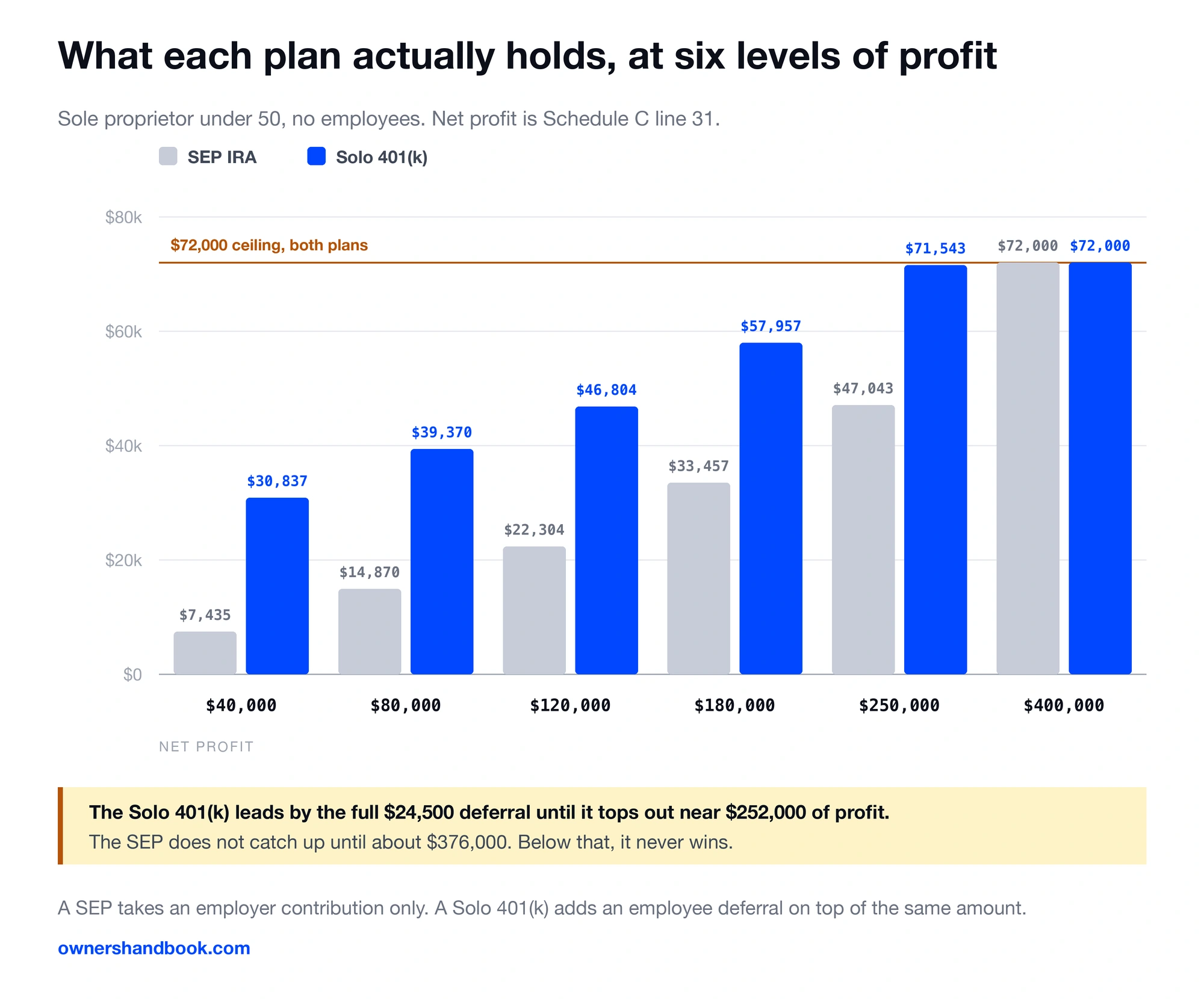
Both plans stop at the same number in 2026: $72,000. They get there very differently. A SEP IRA takes only an employer contribution, capped at 20% of your net self-employment earnings. A Solo 401(k) takes that same employer contribution and lets you stack an employee deferral of up to $24,500 on top of it. On $80,000 of net profit that is $14,870 in a SEP against $39,370 in a Solo 401(k).
Two pockets versus one
When you work for yourself you are both the employer and the employee. A Solo 401(k) lets you contribute in both roles. A SEP IRA lets you contribute in one.
The employee side is an elective deferral — money you elect to divert out of your own pay and into the plan instead of taking it home. For 2026 you can defer up to $24,500.
The employer side is a nonelective contribution — money the business puts in for you, with no election involved. It is capped at 25% of compensation.
For a sole proprietor that 25% is not 25% of your Schedule C profit. It is 25% of compensation as the plan measures it, and because the contribution itself reduces compensation, the math folds back on itself.
Publication 560 solves that circle for you with a rate table. A 25% plan rate comes out to a flat 20% for a self-employed owner.
20% of what, exactly. Of net self-employment earnings — your Schedule C net profit minus the deduction for one half of your self-employment tax.
On $80,000 of profit that half is about $5,652, so your net earnings are $74,348, and 20% of that is $14,870.
That $14,870 is the entire SEP. It is also only the employer half of the Solo 401(k).
The same numbers, run through both plans
| Net profit on Schedule C | SEP IRA | Solo 401(k) | Which one wins |
|---|---|---|---|
| $40,000 | $7,435 | $30,837 | Solo, by $23,402 |
| $80,000 | $14,870 | $39,370 | Solo, by $24,500 |
| $180,000 | $33,457 | $57,957 | Solo, by $24,500 |
| About $376,000 and up | $72,000 | $72,000 | Tie |
Read the first row twice. At $40,000 of profit the SEP shelters $7,435 and the Solo 401(k) shelters $30,837. Four times as much, out of the same income.
The Solo 401(k) is held down there by a different rule. Your total contribution cannot exceed what the business paid you, and once the employer share comes out of that, $30,837 is all that fits.
At $80,000 and again at $180,000 the gap settles at exactly $24,500. That is the deferral, and the deferral is the entire difference.
There is no income level at which a SEP beats a Solo 401(k). The SEP can only catch up and tie.
Where the two meet, and what turning 50 changes
The Solo 401(k) hits the $72,000 ceiling first, at roughly $252,000 of net profit. From there it stops growing.
The SEP keeps climbing at 20% and does not reach $72,000 until about $376,000 of net profit.
Between those two figures the gap narrows from $24,500 down to nothing. Above about $376,000 the two plans hold the same amount.
So the short version. Under roughly $250,000 of profit, the Solo 401(k) shelters more, and at low income it shelters dramatically more. Above that, what separates them is age, deadlines, and paperwork.
If you are 50 or older at the end of 2026, a Solo 401(k) lets you defer an extra $8,000 on top of the $24,500. Your personal ceiling becomes $80,000.
If you turn 60, 61, 62, or 63 during 2026, the catch-up is $11,250 instead. Ceiling $83,250.
A SEP has none of this. A catch-up is an extra employee deferral, and a SEP has no employee deferrals to add to.
For anyone over 50 who is not already at the ceiling, that widens the gap by another $8,000 to $11,250.
The deadlines, and the one thing a SEP does better
| Plan | Deadline to open it | Deadline to fund it |
|---|---|---|
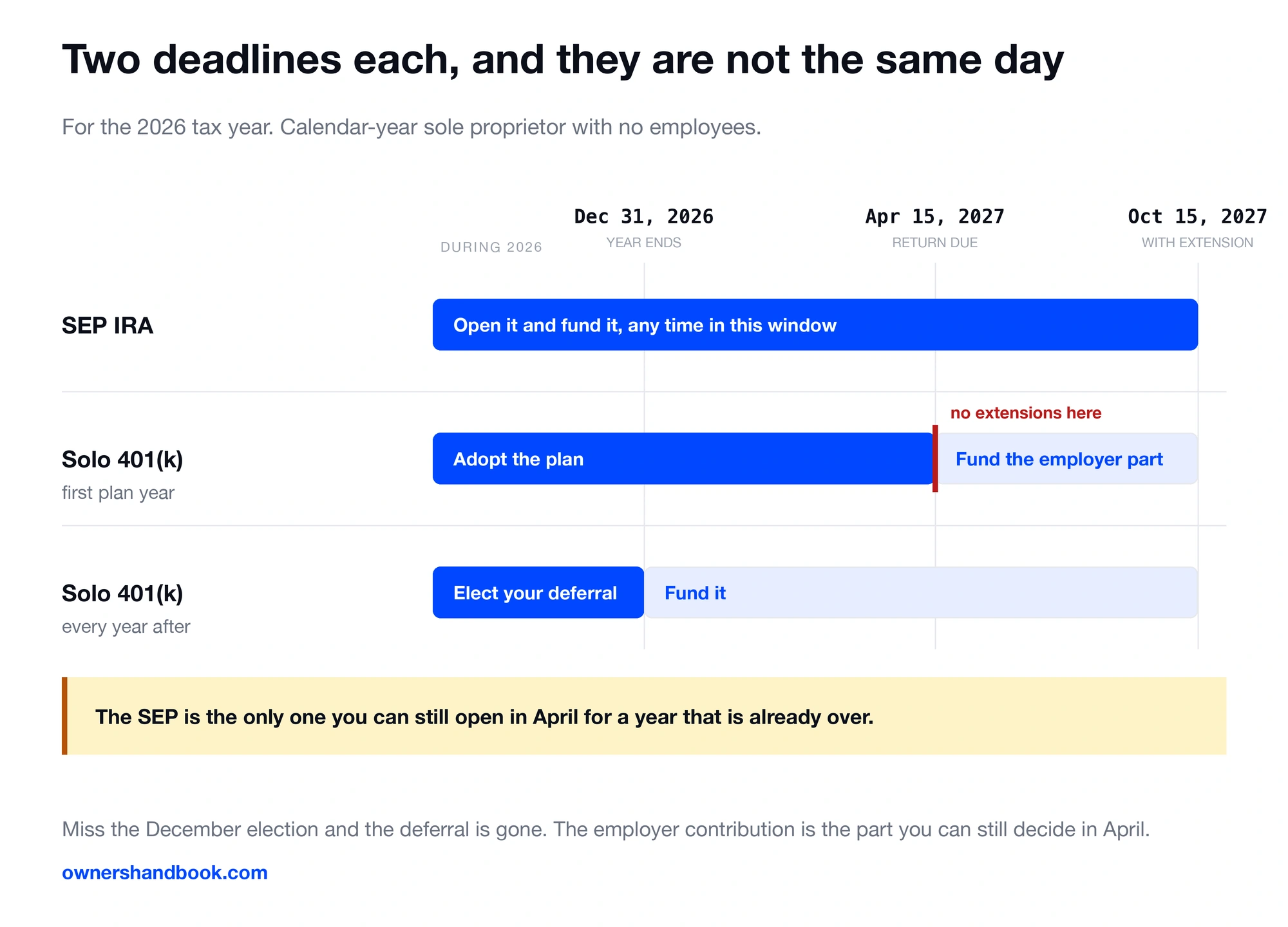
| SEP IRA | Return due date, extensions included | Return due date, extensions included |
| Solo 401(k), first year | Return due date, no extensions | Employer part: return due date with extensions |
| Solo 401(k), later years | Must already exist | Elect the deferral by Dec 31, fund by the return due date |
This is the SEP’s real advantage, and it is not a small one. You can open a SEP IRA in April, fund it for last year, and claim the deduction on the return you are filing that week.
A Solo 401(k) used to be strictly a December 31 decision. Since 2023 a sole proprietor with no employees can adopt one after the year ends, provided the plan is adopted by the tax filing deadline without regard to extensions.
The deferral is where that flexibility runs out. In any year after the first, the election to defer generally has to be in place before the year closes, even though the cash can land later.
So the SEP is the plan you can still open in April. The Solo 401(k) is the plan you decide on in advance.
It lowers your income tax, not your self-employment tax
This is the part that disappoints people, and it is better to know it before you plan around it.
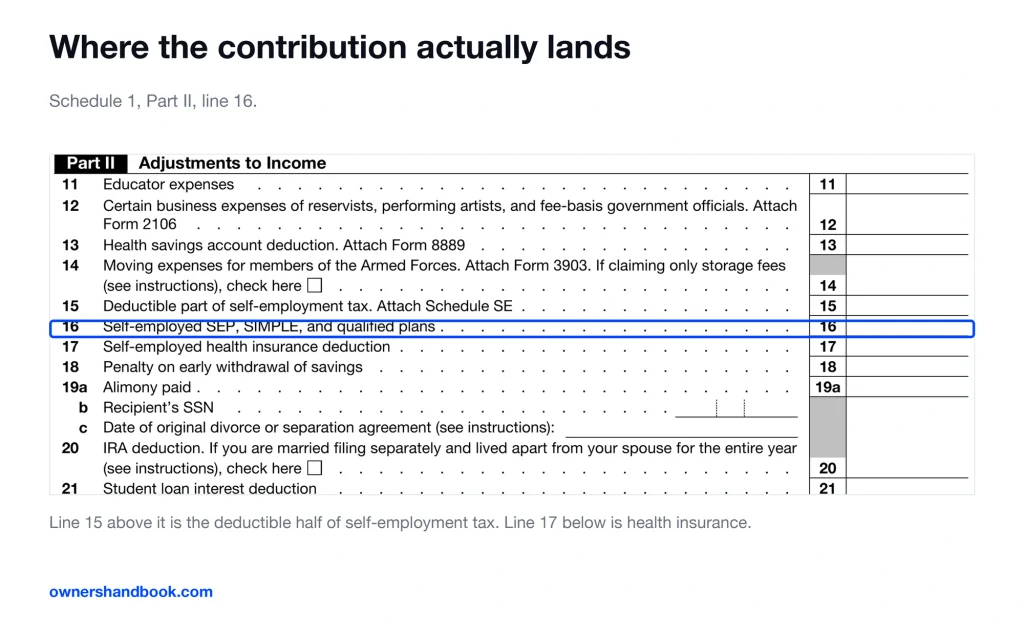
Your contribution for yourself comes off on Schedule 1, line 16. That sits below the point where self-employment tax has already been figured.
Self-employment tax is 15.3% on 92.35% of your Schedule C profit, and it runs off the profit itself. Nothing you move into a retirement account changes that number.
On $80,000 of profit, a $39,370 Solo 401(k) contribution cuts your income tax meaningfully and leaves $11,304 of self-employment tax exactly where it was.
The second honest caveat is liquidity. This money is locked. Take it out before age 59½ and you generally owe a 10% additional tax on top of the ordinary income tax.
A retirement plan is not an emergency fund. If you are choosing between three months of expenses in cash and a large contribution, fund the three months first.
Lowering your AGI does more than cut tax
Your contribution reduces adjusted gross income, the number near the bottom of the first page of your 1040, and that number feeds calculations that have nothing to do with your tax bracket.
The one that matters most to freelancers is the premium tax credit. Marketplace subsidies are built on household income, which starts from modified adjusted gross income.
A contribution that pulls your MAGI back under a threshold can be worth more than the deduction itself, because for 2026 the credit stops at the eligibility threshold rather than tapering off.
If you buy your own health insurance, run that math before December 31. It is the one place where the size of the contribution changes something other than tax.
Roth options, and the form that appears at $250,000
Both plans can be Roth now. You give up the deduction today and take tax-free growth instead.
A Solo 401(k) can accept designated Roth deferrals, and since the SECURE 2.0 Act it can also take employer contributions as Roth. A SEP can be set up so contributions go into a Roth SEP IRA.
Roth does not raise your ceiling. The $72,000 is the same either way. It only changes when the tax gets paid.
The paperwork difference comes down to one form. A SEP IRA has no annual filing at all. A Solo 401(k) picks one up once it grows.
If your one-participant plan holds more than $250,000 at the end of the plan year, you file Form 5500-EZ. At $250,000 or less, you do not.
You also file a final Form 5500-EZ for the year you close the plan and distribute everything, whatever the balance was.
Frequently asked questions
Can I have both a SEP IRA and a Solo 401(k)?
You can, but the $72,000 annual additions limit applies across both when the same business sponsors them. Two plans do not buy you two limits.
I already max out a 401(k) at a day job. What is left for my freelance income?
The $24,500 deferral limit belongs to you, not to each plan, so that part is spent. The employer contribution from your self-employment is still available, up to 20% of net earnings.
Does a SEP contribution reduce what I can put in a regular IRA?
No. An employer SEP contribution does not affect the amount you can contribute to a traditional or Roth IRA, which is $7,500 for 2026.
What happens if I hire an employee later?
A SEP generally requires you to contribute for eligible employees at the same rate you use for yourself. A Solo 401(k) stops being a one-participant plan and takes on testing and a fuller annual filing.
I already funded a SEP for last year. Can I switch to a Solo 401(k)?
Going forward, yes. You cannot retroactively turn a SEP contribution already made for a closed year into a 401(k) contribution.
I only have $5,000 to set aside. Does the choice matter?
Not much. At that size neither limit binds and the SEP is simpler to run. Choose the Solo 401(k) if you expect your profit to climb.
Sources
IRS, 401(k) limit increases to $24,500 for 2026, IRA limit increases to $7,500
https://www.irs.gov/newsroom/401k-limit-increases-to-24500-for-2026-ira-limit-increases-to-7500
IRS, COLA increases for dollar limitations on benefits and contributions
IRS, Publication 560, Retirement Plans for Small Business
https://www.irs.gov/publications/p560
IRS, One-participant 401(k) plans
https://www.irs.gov/retirement-plans/one-participant-401k-plans
IRS, Retirement plans FAQs regarding SEPs
https://www.irs.gov/retirement-plans/retirement-plans-faqs-regarding-seps
IRS, Retirement plans for self-employed people
https://www.irs.gov/retirement-plans/retirement-plans-for-self-employed-people
IRS, Topic no. 558, Additional tax on early distributions
https://www.irs.gov/taxtopics/tc558
IRS, Eligibility for the Premium Tax Credit
IRS, About Form 5500-EZ