When You Are the One Issuing 1099s
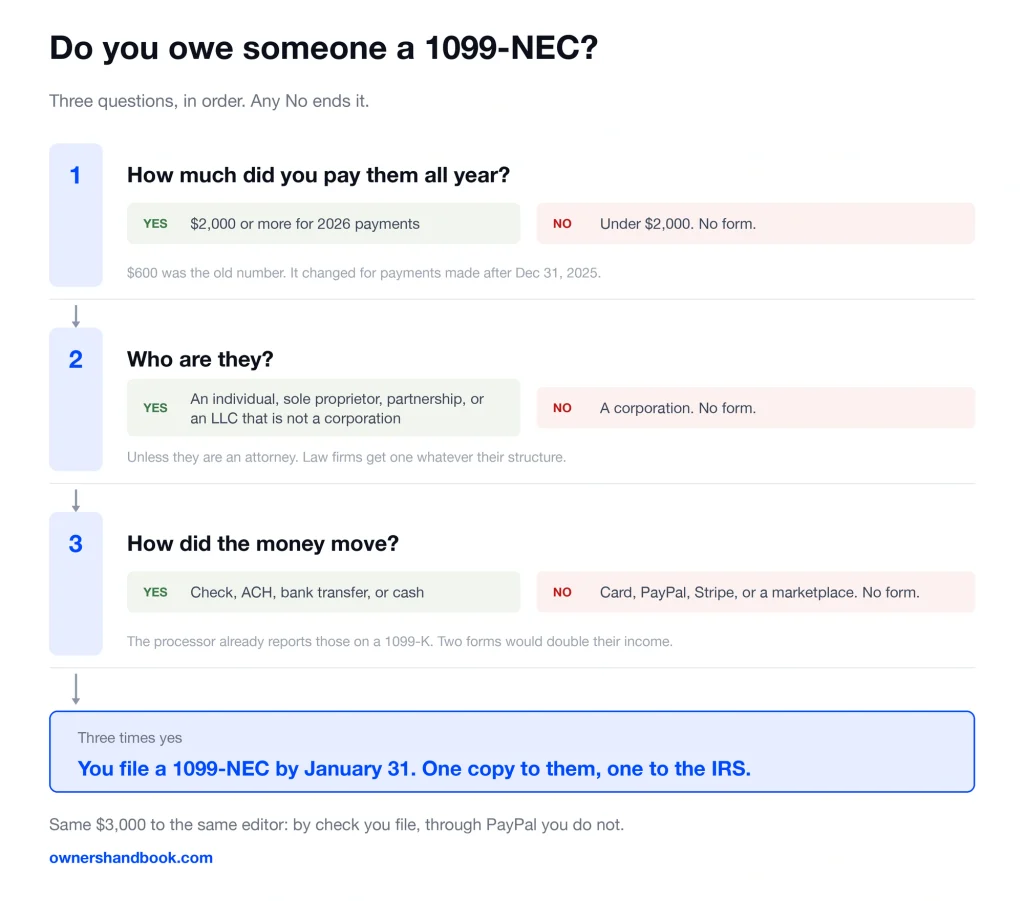
If you paid another freelancer $2,000 or more for work during 2026, and you paid by check, bank transfer, or cash, you owe that person a Form 1099-NEC by January 31. Pay the exact same person the exact same money through PayPal or a credit card and you owe nothing. The payment method decides it. And the threshold just moved.
The threshold moved to $2,000
For seventy years the number was $600. It was set in 1954 and never adjusted.
The One Big Beautiful Bill, the tax law passed in July 2025, raised it to $2,000 for payments made after December 31, 2025.
So two rules are sitting next to each other right now.
Payments you made during 2025 use $600. Those forms went out last January.
Payments you made during 2026 use $2,000. Those forms go out in January 2027.
The $2,000 is indexed for inflation after 2026, so it will drift upward each year rather than freezing for another seventy.
One thing the change does not touch. The money is still taxable income to whoever you paid, and it is still a deduction for you. A form that never gets filed does not erase either side.
How you paid matters more than how much
This is the part almost nobody knows, and it decides a large share of real cases.
Payments made with a credit card, a debit card, or a third party settlement network are not reported on Form 1099-NEC. The processor reports them instead, on Form 1099-K.
The IRS instructions say it directly. Those payments “must be reported on Form 1099-K by the payment settlement entity” and “are not subject to reporting on Form 1099-MISC or Form 1099-NEC.”
The reasoning is anti-duplication. Someone is already telling the IRS about that money. Two forms describing one payment would double your contractor’s income on paper.
| How you paid | Do you file a 1099-NEC? | Who tells the IRS |
|---|---|---|
| Business check | Yes | You |
| ACH or bank transfer | Yes | You |
| Cash | Yes | You |
| Credit or debit card | No | The card processor, on a 1099-K |
| PayPal, Stripe, Venmo for business | No | The platform, on a 1099-K |
| Upwork, Fiverr, a marketplace | No | The platform, on a 1099-K |
Run it with numbers. You hire an editor and pay $3,000 across the year.
Paid by check from your business account, you file a 1099-NEC. Paid through PayPal as a business payment, you file nothing at all.
Same person, same work, same $3,000. Opposite obligations.
One caution on that. Sending a business payment as friends and family takes it out of the platform’s reporting, which puts it back in yours. Pay contractors as a business payment and let the platform do its job.
Who is exempt, and the one exception
Payments to a corporation generally do not get a 1099-NEC. If the contractor’s W-9 says C corporation or S corporation, you are finished.
LLCs are where people slip. An LLC can be taxed as a sole proprietor, a partnership, or a corporation, and only the corporate versions are exempt.
That is precisely what line 3 of the W-9 asks. A single-member LLC that checks the individual box gets a form. One that writes S in the LLC box does not.
The exception is lawyers. The corporate exemption does not apply to legal services. If you paid an attorney $2,000 or more for work on your business, you file, even if the firm is a corporation.
Personal spending is also out. Paying a plumber to fix your own kitchen is not in the course of a trade or business. Paying one to fix the studio you rent for work is.
So is merchandise. A 1099-NEC covers services. Buying $5,000 of paper stock from a printer is not a payment for services.
| Who you paid | 1099-NEC? |
|---|---|
| Individual freelancer or sole proprietor | Yes |
| Single-member LLC taxed as a sole proprietor | Yes |
| Partnership | Yes |
| LLC taxed as an S corp or C corp | No |
| Any other corporation | No |
| Attorney or law firm, whatever its structure | Yes |
| Someone selling you goods rather than services | No |
Get the W-9 before the money leaves
You cannot file a 1099-NEC without the recipient’s legal name, address, and taxpayer identification number. Form W-9 collects all three on one page.
Ask for it before the first payment, not in January. A contractor who already has your money has very little reason to answer email about paperwork.
If a contractor will not give you a TIN, the rules say to hold back 24 percent of the payment as backup withholding and send it to the IRS on their behalf.
The practical version is simpler. Do not pay until the W-9 arrives.
The W-9 goes nowhere. You keep it in your own records and use it in January.
January 31, and how to file
Two copies, one date. The recipient copy and the IRS copy are both due January 31.
That is earlier than nearly every other tax deadline, and there is no automatic extension for a 1099-NEC. If January 31 falls on a weekend, it moves to the next business day.
If you are filing 10 or more information returns of all types combined, you have to file electronically. The count is not per form type. Six 1099-NECs plus four 1098s is ten.
Under ten forms, paper is still allowed, with a Form 1096 summary sheet on top.
How you file changed this year. The old FIRE system is being retired. Beginning with tax year 2026, filed in early 2027, the Information Returns Intake System is the only intake channel the IRS runs.
IRIS has a free web portal. You type in the contractor’s details, it files with the IRS, and you send the recipient their copy. Most bookkeeping and payroll tools will also do it, usually for a few dollars a form.
What skipping it costs
The penalty comes twice for one mistake. There are two separate failures in the law: not filing with the IRS, and not giving the contractor their copy.
Both carry identical amounts, and both apply. For forms due in January 2027:
| When you fix it | IRS copy | Recipient copy | Per contractor |
|---|---|---|---|
| Within 30 days | $60 | $60 | $120 |
| Day 31 through August 1 | $130 | $130 | $260 |
| After August 1, or never | $340 | $340 | $680 |
| Intentional disregard | $690 or 10% | $690 or 10% | $1,380 and up |
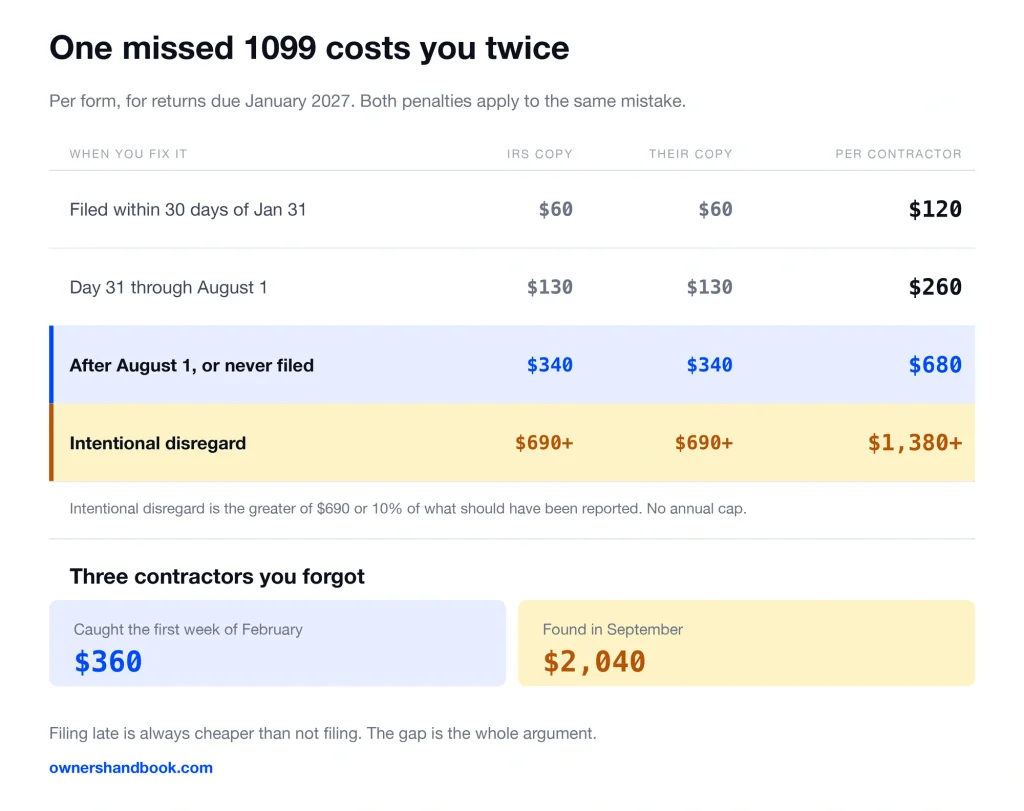
Three contractors you forgot about, discovered in September, is $2,040. The same three caught in the first week of February is $360.
That gap is the whole argument for filing late rather than not filing.
Intentional disregard means you knew and chose not to. It is the greater of $690 per form or 10 percent of what should have been reported, and it has no annual ceiling.
On $30,000 of unreported contractor payments, the 10 percent branch is $3,000 per side. Six thousand dollars for three missing pieces of paper.
If something real went wrong, say so. The IRS can reduce or remove the penalty for reasonable cause when you acted responsibly before and after the failure.
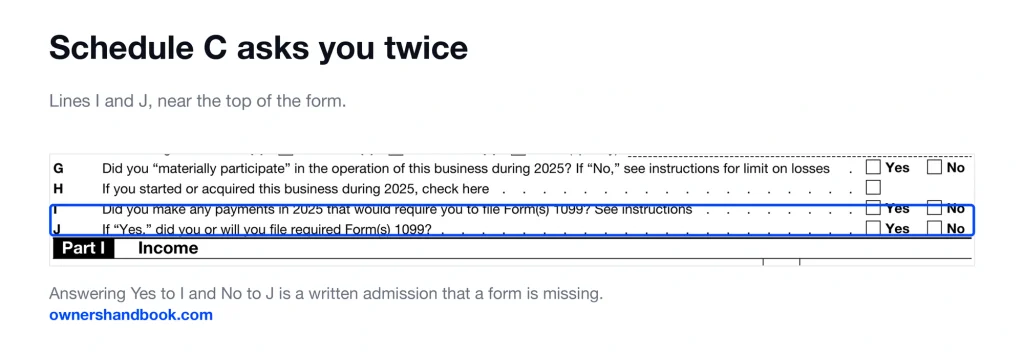
Schedule C asks you twice
Near the top of Schedule C, just under the accounting method questions, are two boxes most people check without reading.
Line I asks whether you made any payments during the year that would require you to file Forms 1099.
Line J asks, if you answered yes, whether you did or will file them.
You are answering both under penalty of perjury. Checking yes on I and no on J is a signed statement that you know about an obligation you did not meet.
Checking no on line I when you paid a subcontractor $2,500 by check is worse. That one is not a gray area.
The payment itself belongs on line 11, contract labor, either way. Your deduction never depended on whether the form got filed.
Frequently asked questions
I paid a contractor $1,900 in 2026. Do I file?
No. That is under the $2,000 threshold for 2026 payments. You still deduct the $1,900 on line 11 of your Schedule C, because the deduction does not depend on the form.
I paid someone $3,000 through PayPal. Really no form?
Really. Card and third party network payments are reported by the processor on Form 1099-K, and the instructions say they are not reportable on a 1099-NEC. Keep the record showing how you paid.
What if the contractor will not send me a W-9?
Ask in writing and keep the request. The rules then call for 24 percent backup withholding on what you pay them. The cleaner answer is to hold the payment until the form arrives.
Does Zelle count as a platform payment?
Zelle moves money directly between bank accounts and does not generate 1099-Ks, so the safe treatment is to file as if you had written a check.
I missed January 31. What now?
File immediately. Inside 30 days the cost is $60 per copy instead of $340, and the difference on even a few forms is real money.
Do I send a 1099 to someone who worked for me for one afternoon?
If the payments to that person totaled $2,000 or more for the year, in the course of your business, and you did not pay by card or platform, yes. Length of the job is not a factor.
Sources
IRS, Instructions for Forms 1099-MISC and 1099-NEC
https://www.irs.gov/instructions/i1099mec
IRS, Reporting Payments to Independent Contractors
IRS, Publication 1099, General Instructions for Certain Information Returns
https://www.irs.gov/publications/p1099
IRS, Information Return Penalties
https://www.irs.gov/payments/information-return-penalties
IRS, About Form W-9
https://www.irs.gov/forms-pubs/about-form-w-9
IRS, Backup Withholding
https://www.irs.gov/businesses/small-businesses-self-employed/backup-withholding
IRS, E-file Forms 1099 with IRIS
https://www.irs.gov/filing/e-file-forms-1099-with-iris
IRS, Instructions for Schedule C