The 20% Deduction for Being Self-Employed
If you turn a profit freelancing, roughly 20% of that profit comes off your income before tax is figured. You do not have to spend a dollar or file anything unusual to get it. On $80,000 of profit as a single filer it is worth about $2,183, and as of 2026 it is permanent.
The name is doing all the damage
This is called the qualified business income deduction, or Section 199A. Both names hide something simple.
Qualified business income means your profit from a business you own. For a freelancer that is line 31 of your Schedule C, with a couple of adjustments.
Section 199A is just where it sits in the tax code. It tells you nothing.
So read it as twenty percent off your profit. That is the whole idea. Everything below is fine print.
It exists because corporations got a permanent rate cut in 2018 and sole proprietors did not. This was the consolation prize, and it was set to expire after 2025.
The One Big Beautiful Bill Act made it permanent instead, starting with the 2026 tax year. It also widened the income ranges and added a small floor. More on both further down.
Where it lands on your return
It is the last subtraction before your tax is calculated, and it comes after the standard deduction rather than instead of it.
On Form 1040, line 12 is your standard deduction. Line 13 is this one. Line 15 takes both off and gives you taxable income.
You get both. You do not have to itemize to claim it.
One catch. It does not reduce your adjusted gross income, so it will not help you qualify for anything that keys off AGI.
That is the difference between this and a Schedule C expense. An expense comes off higher up and moves more things.
$80,000 of profit, all the way down
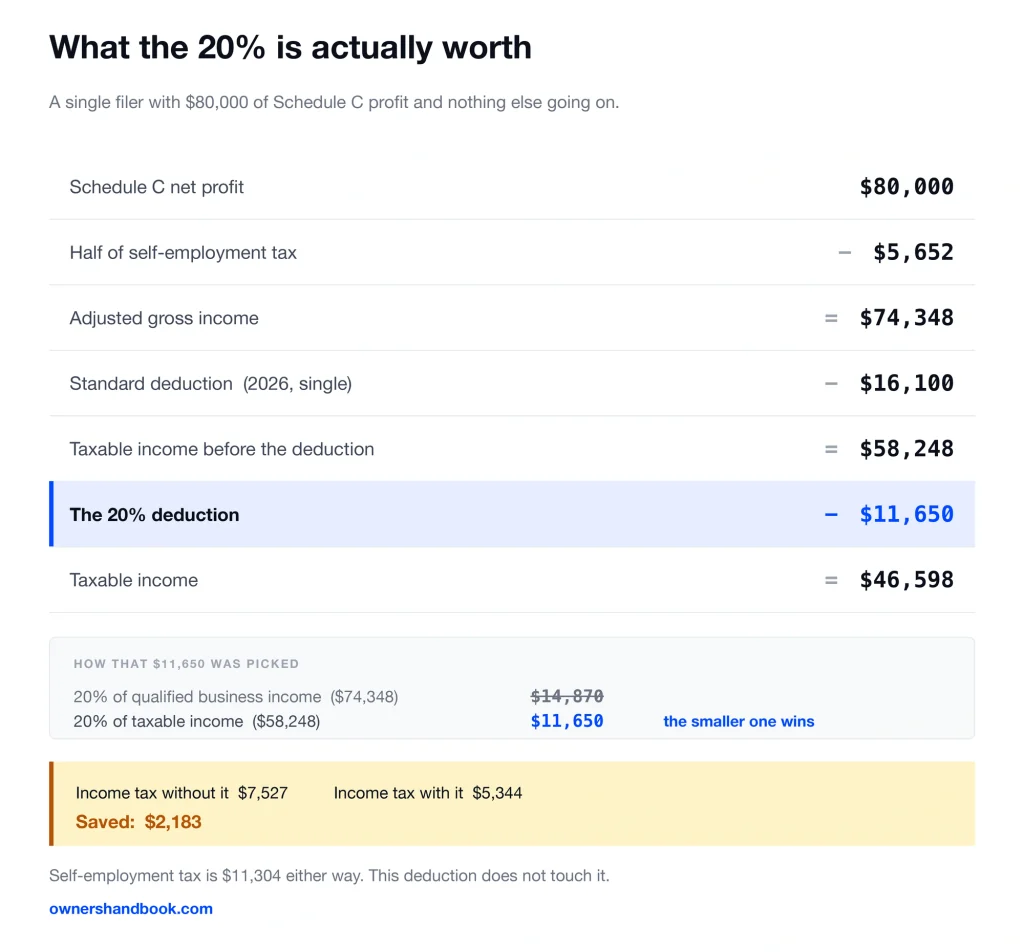
Take a single filer with no other income, no employees, and no large equipment purchases. Schedule C line 31 says $80,000.
Self-employment tax comes first. It runs at 15.3% on 92.35% of the profit, which is $11,304. Half of that, $5,652, comes off your income as an adjustment.
Adjusted gross income: $74,348.
Then the standard deduction, which for 2026 is $16,100 for a single filer. Taxable income before this deduction: $58,248.
Here is the part that surprises people. You work out two numbers and take the smaller one.
The first is 20% of your qualified business income. That is $74,348 here, not $80,000, because QBI is reduced by the deductible half of self-employment tax. Twenty percent of it is $14,870.
The second is 20% of your taxable income before this deduction. Twenty percent of $58,248 is $11,650.
The smaller one wins. Your deduction is $11,650.
| Step | Amount |
|---|---|
| Schedule C net profit | $80,000 |
| Deductible half of self-employment tax | −$5,652 |
| Adjusted gross income | $74,348 |
| 2026 standard deduction, single | −$16,100 |
| Taxable income before this deduction | $58,248 |
| 20% of QBI, which is $74,348 | $14,870 |
| 20% of taxable income, which is $58,248 | $11,650 |
| Your deduction, the smaller of the two | $11,650 |
| Taxable income | $46,598 |
Now the money. At 2026 single rates, $58,248 of taxable income owes $7,527 in income tax. $46,598 owes $5,344.
The deduction saved $2,183.
It saved more than a flat 12% of $11,650 because it dropped you out of the 22% bracket. The top slice came off at 22% and the rest at 12%.
Two other things shrink QBI the same way self-employment tax did: your self-employed health insurance deduction, and what you put into a SEP, SIMPLE, or solo 401(k). Fund a retirement account and this deduction gets a little smaller.
It does not cut your self-employment tax
A lot of writing about this deduction implies otherwise. It does not.
Self-employment tax is figured on Schedule SE, straight from your Schedule C profit, before this deduction exists anywhere on the return.
The IRS says it in one line: the deduction does not reduce net earnings from self-employment.
In the example above, the $11,304 of self-employment tax is identical with or without it. Only the income tax moved.
So a dollar of legitimate business expense is still worth more to you than a dollar of this. The expense cuts both taxes. This cuts one.
The income limits, and the new floor of $400
Below a certain taxable income, none of the complicated rules apply. You take 20% and move on.
For 2026 that line is $201,750 for single filers and $403,500 for joint filers. Under it, your line of work does not matter, and neither do your payroll or your equipment.
Above it, limits phase in over a range. For 2026 that range is $75,000 wide single and $150,000 joint, up from $50,000 and $100,000 last year.
That puts the top of the range at $276,750 single and $553,500 joint. Past those points the limits apply in full.
Inside the range, two things start to bite. If your work is a specified service business, the deduction shrinks toward zero. If it is not, it gets capped by your W-2 wages and your equipment instead.
There is also a floor, new for 2026. Have at least $1,000 of qualified business income from a business you actively work in, and your deduction is at least $400 even when 20% comes to less.
Both of those figures get adjusted for inflation after 2026.
Which freelancers are specified service businesses
A specified service trade or business, SSTB for short, is one the law singled out to lose this deduction at high income. The list is closed and specific.
Health, law, accounting, actuarial science, performing arts, consulting, athletics, financial services, brokerage, and investing or trading. Plus any business whose principal asset is the reputation or skill of the people in it.
That last clause sounds like it swallows everyone who sells their own work. It does not. The IRS reads it narrowly: endorsement income, licensing your name or likeness, and appearance fees.
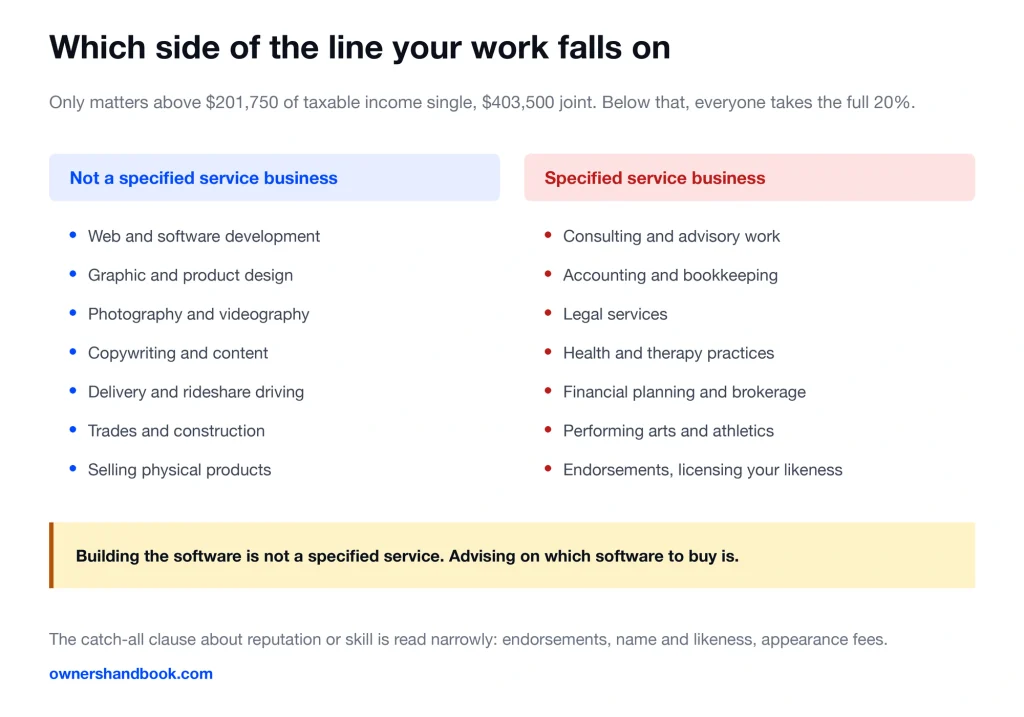
Most technical and creative freelancers sit outside the list. Web developers, designers, photographers, videographers, copywriters, delivery drivers. None of them are named.
Consulting is named, and that makes the label on your invoice worth thinking about. Building the software is not an SSTB. Advising on which software to buy is.
And if your taxable income is under the threshold, none of this touches you. The SSTB question only opens once you cross $201,750 single or $403,500 joint.
| Usually not an SSTB | Usually an SSTB |
|---|---|
| Web and software development | Consulting and advisory work |
| Graphic and product design | Accounting and bookkeeping |
| Photography and videography | Legal services |
| Copywriting and content | Health and therapy practices |
| Delivery and rideshare driving | Financial planning and brokerage |
| Trades and construction | Performing arts and athletics |
| Selling physical products | Endorsements, licensing your likeness |
Form 8995 or Form 8995-A
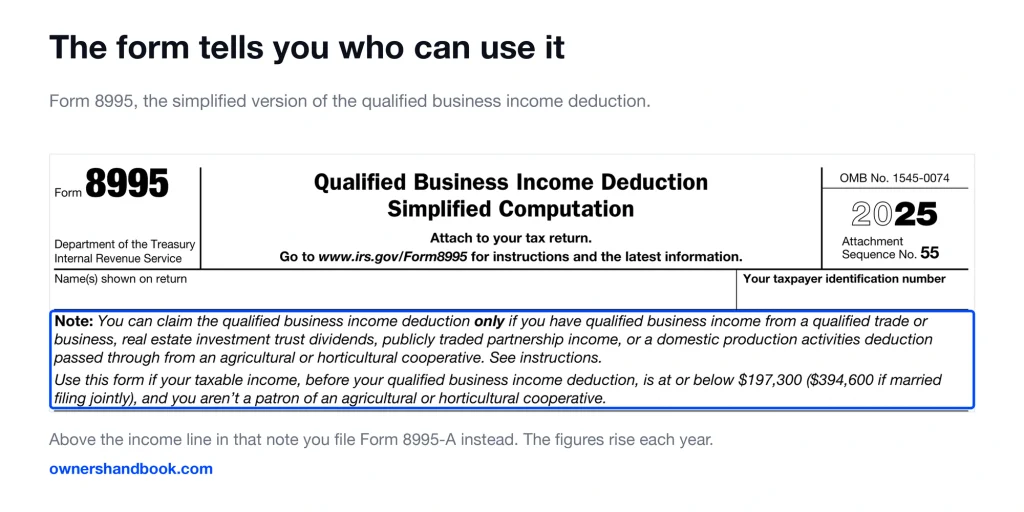
If your taxable income is under the threshold, you file Form 8995. One page, and mostly a single multiplication.
If you are over it, you file Form 8995-A. Four pages, and that is where the wage cap, the equipment cap, and the SSTB phase-out get worked out.
Either way the answer lands on line 13 of your Form 1040. Most tax software fills it in without asking, which is why a lot of people never learn they got it.
Frequently asked questions
Do I still get this if I take the standard deduction?
Yes. It is not an itemized deduction and it does not compete with the standard deduction. Both come off, on lines 12 and 13 of your Form 1040.
Does it reduce my self-employment tax?
No. Self-employment tax is figured on Schedule SE from your profit, before this deduction exists. The IRS states directly that it does not reduce net earnings from self-employment.
My business lost money this year. What happens?
There is nothing to deduct in a loss year. The loss carries forward as negative qualified business income and reduces the deduction you would otherwise get next year.
Do I need an LLC or an S corp to claim it?
No. A sole proprietor filing Schedule C qualifies. So does a single-member LLC, a partnership, and an S corp, though an S corp owner’s own W-2 wages are not qualified business income.
I am a consultant. Do I lose it?
Only if your 2026 taxable income is above $201,750 single or $403,500 joint. Under that, consultants take the same 20% as everyone else.
What is the $400 minimum for?
It gives a small active business a deduction of at least $400 when 20% of its income would come to less. You need $1,000 of qualified business income and you have to actually work in the business.
Sources
IRS, Qualified Business Income Deduction
https://www.irs.gov/newsroom/qualified-business-income-deduction
IRS, Section 199A Deduction for Qualified Business Income FAQs
IRS, Revenue Procedure 2025-32, inflation adjustments for 2026
https://www.irs.gov/pub/irs-drop/rp-25-32.pdf
IRS, Tax inflation adjustments for tax year 2026
IRS, Instructions for Form 8995
https://www.irs.gov/instructions/i8995
IRS, About Form 8995-A