What Freelancers Charge in 2026, by Field
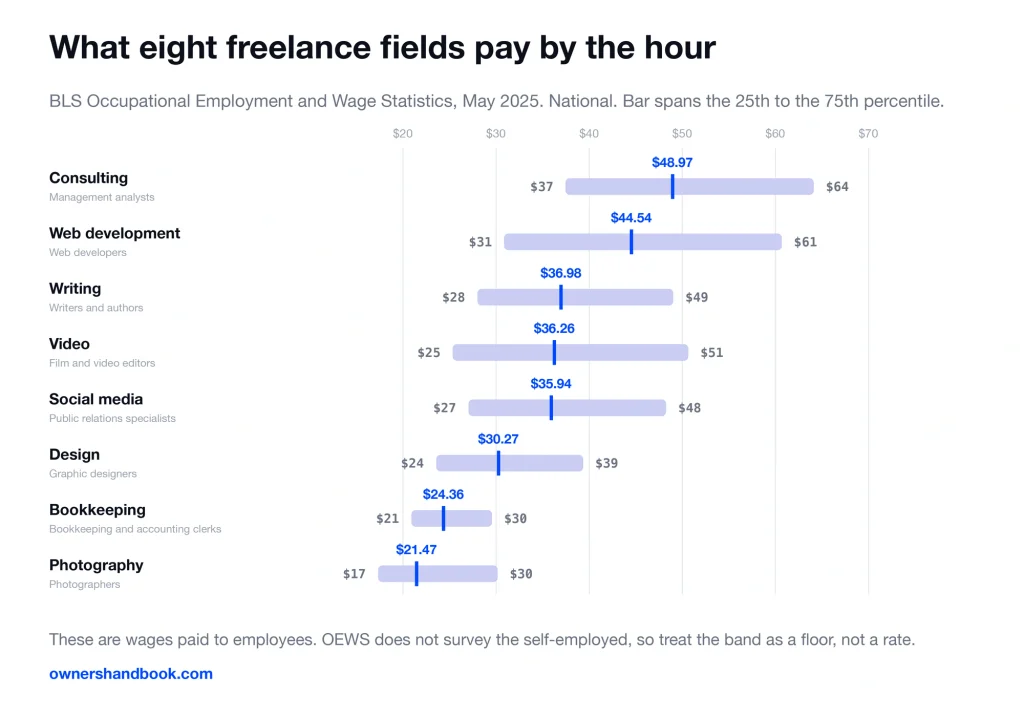
In May 2025 the middle half of US graphic designers earned $23.58 to $39.34 an hour, web developers $30.88 to $60.69, and management consultants $37.48 to $64.12. Those are Bureau of Labor Statistics figures, and they are wages paid to employees.
As a freelancer you have to charge close to double the median to land in the same place. You bill roughly 60% of the hours you work, and 15.3% comes off your profit before income tax touches it.
What these numbers actually measure
The bands below come from the Occupational Employment and Wage Statistics program, or OEWS. It is the BLS survey that pulls wage data for around 830 occupations straight from employer payroll records.
The most recent set is May 2025, published in 2026. It is the largest and most consistent wage dataset anyone publishes for these fields.
Start there rather than with a blog post that surveyed forty people on social media.
It has one limitation you have to hold onto. OEWS surveys employers, so the self-employed are excluded by design. Not one freelance invoice is in it.
That does not make it useless. It tells you what an employer pays for the same skill, and that is the number your client is comparing you to whether they say so or not.
One substitution to flag. BLS has no occupation called social media manager. The closest match is public relations specialists, so that is what the social media row shows.
The bands, field by field
Low is the 25th percentile and high is the 75th. Half of everyone in the occupation falls inside the band.
| Field | Low | Median | High |
|---|---|---|---|
| Consulting | $37.48 | $48.97 | $64.12 |
| Web development | $30.88 | $44.54 | $60.69 |
| Writing | $28.00 | $36.98 | $49.01 |
| Video | $25.35 | $36.26 | $50.63 |
| Social media | $27.05 | $35.94 | $48.25 |
| Design | $23.58 | $30.27 | $39.34 |
| Bookkeeping | $20.92 | $24.36 | $29.55 |
| Photography | $17.33 | $21.47 | $30.16 |
Photography has the widest spread between the middle and the top. The 90th percentile photographer earns $44.14 an hour, more than double the $21.47 median.
Bookkeeping is the tightest. Its 90th percentile is $35.84 against a $24.36 median. Experience buys you less there than it does in video, where the 90th percentile reaches $71.42.
That spread is worth more attention than the median. It tells you how much room there is above the middle in your field.
The median is a wage, not a rate
A wage comes with an employer attached. Take the employer away and the same hour has to pay for a great deal more.
BLS measures exactly how much more. In March 2026 total compensation for private industry workers averaged $46.60 an hour. Wages were $32.60 of that. Benefits were the other $14.01, or 30.1% of the bill.
That $14.01 bought health insurance, retirement contributions, paid leave, and the employer half of payroll tax. It never showed up on anyone’s paycheck, and nobody is buying it for you now.
So the median is not a target. It is the visible fraction of a number your old employer only ever showed you part of.
You bill about six hours in ten
Nobody pays you to write a proposal. Nobody pays you to chase an invoice, rebuild your portfolio, or sit through a call that goes nowhere.
Say you work 2,000 hours in a year, which is 40 a week with two weeks off. A utilization rate of 60% — the share of worked hours you can actually invoice — leaves 1,200 billable hours.
60% is optimistic in a first year and reasonable after that. Track it honestly for one month and you will have your own number, which is usually lower than the one you guessed.
Now run the writing median through it. At $36.98 an hour, 1,200 billable hours produces $44,376 of revenue for a full year of work.
An employed writer at that same $36.98 is paid for 2,080 hours, which is $76,918. The $32,000 gap is not a skill gap. It is 880 hours that nobody invoices.
Then 15.3% comes off the top
Self-employment tax is 15.3% — 12.4% for Social Security and 2.9% for Medicare. Both halves, because you are now both halves.
It is charged on 92.35% of your net profit rather than all of it, which pulls the real bite down to roughly 14.1%. Federal income tax sits on top of that, and state income tax on top of that.
For profit between $40,000 and $120,000 most people land somewhere between 25% and 30% all in. Use 28% for planning and check it against your own return.
The direction of that arithmetic is where people go wrong. Tax comes out of what you earn, so you divide by what is left, you do not add a percentage on.
Want to keep $70,000? Adding 28% gives you $89,600. Dividing by 0.72 gives you $97,222. The $7,600 between them is a shortfall you would not discover until April.
Turn a take-home number into a rate
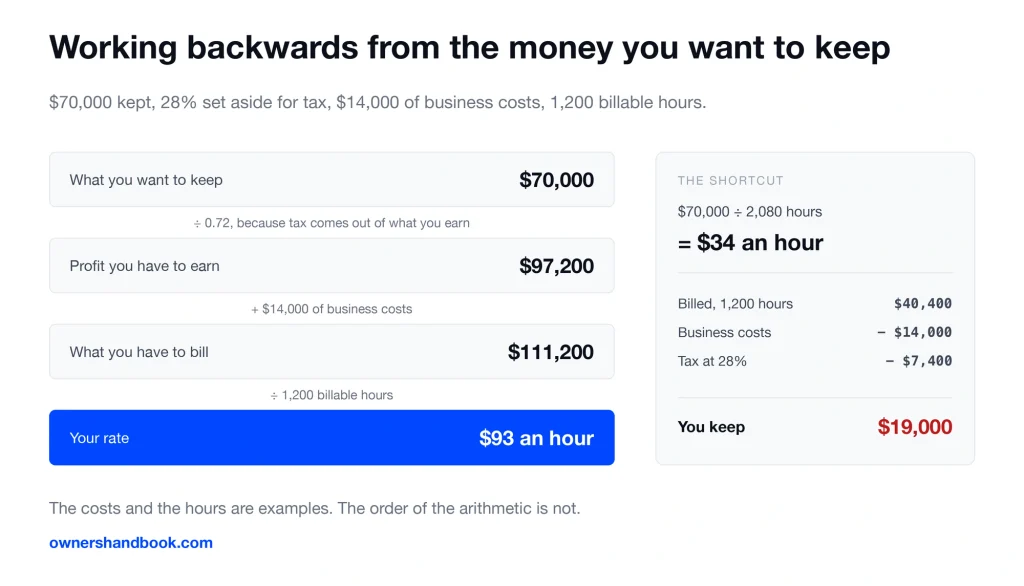
Start from what you want sitting in your account after everything. Divide by 0.72 to cover tax. Add what the business costs you to run for the year. Divide by your billable hours.
Call the business costs $14,000 — health insurance, software, an accountant, equipment, liability coverage, and the business share of phone and internet. Yours may be double that.
| Take-home you want | Profit to earn | Bill for the year | Rate at 1,200 hours |
|---|---|---|---|
| $50,000 | $69,400 | $83,400 | $70 |
| $70,000 | $97,200 | $111,200 | $93 |
| $100,000 | $138,900 | $152,900 | $127 |
$93 an hour against a $36.98 median is 2.5 times the wage. That is the honest ratio for a writer who wants an employed writer’s salary as take-home.
The shortcut version divides $70,000 by 2,080 and lands on $34. Bill 1,200 hours at $34, subtract $14,000 of costs and 28% for tax, and you keep about $19,000.
That is the whole point of the rate formula. Your rate is not a number you pick off a list. It is a number you solve for, and the list only tells you whether the answer is sellable.
What freelancers in one field actually bill
Editorial work has the one published freelance rate survey specific enough to check yourself against.
The Editorial Freelancers Association surveyed more than 1,100 members between November 2025 and mid-January 2026. Copyediting came back at $33 to $75 an hour. Developmental editing ran $50 to $95.
Ghostwriting and writing spanned $70 to $188, with technical writing in the $75 to $126 range.
Set that against the BLS writing median of $36.98. Working freelancers charge two to four times the employee wage for the same craft, and everything above is why.
If your field has a professional association, find out whether it publishes something similar. A survey of a thousand working freelancers beats any rate calculator.
Hourly rate or flat fee
Most experienced freelancers quote a flat project fee and never say an hourly number out loud.
Your rate does not disappear when you do that. It becomes the check. Estimate the hours, multiply by the rate, and that is the floor the fee has to clear.
Hourly billing quietly punishes you for getting faster, and that is the strongest argument for project pricing over an hourly rate.
The catch is scope. A flat fee on a vaguely defined project is how you end up working at $22 an hour and only finding out afterwards. Write down what is included before you name a price.
When the number should move
Once a year at minimum. Health insurance renewals move it more than anything else on the cost list.
Raising your rate works best on the next new client rather than on everyone at once. You get a real answer about what the market will pay before you risk the clients you already have.
And if your calculated floor sits above what your field pays, the floor is not the thing that is wrong. Too few billable hours, costs that are too high, or clients who cannot afford the work — one of those three is.
Frequently asked questions
Are these numbers before or after tax?
Before. Everything on this page is what you bill. Subtract your business costs, then set aside 25% to 30% of the profit for self-employment and income tax.
Why is the photography band so low?
OEWS counts employed photographers, which includes retail studio and school portrait work. Event and commercial freelancers price well above the band, and that is part of why the 90th percentile is more than double the median.
Do these rates vary by state?
Substantially. OEWS publishes the same percentiles for every state and metro area. A San Francisco web developer and a rural one are not selling into the same market.
Should I charge less while I am starting out?
Charge below your target, never below your floor. A rate under your floor means the work is being funded out of your savings, and volume does not fix that.
A client asked for my hourly rate and I quote flat fees. What do I say?
Give them the number. Refusing reads as evasion. Then say you normally quote the whole project, so they are not paying by the hour for your learning curve.
Is 1,200 billable hours realistic?
It is a reasonable steady state. First years often come in nearer 700. Established freelancers with repeat clients and no sales cycle can clear 1,400.
Sources
Bureau of Labor Statistics, Occupational Employment and Wage Statistics tables
https://www.bls.gov/oes/current/oes_nat.htm
Bureau of Labor Statistics, OEWS national estimates, May 2025
https://data.bls.gov/oes/#/area/0000000/2025
Bureau of Labor Statistics, Public Data API
https://www.bls.gov/developers
Bureau of Labor Statistics, Employer Costs for Employee Compensation, March 2026
https://www.bls.gov/news.release/ecec.nr0.htm
Editorial Freelancers Association, Editorial Rates
IRS, Self-Employment Tax
IRS, About Schedule SE (Form 1040)