Pennsylvania’s 3.07% Is Not the Whole Bill
Pennsylvania charges a flat 3.07% on your net profit. A freelancer in a typical township owes a local earned income tax on top of it, usually 1%. The real state and local rate is 4.07%, not 3.07%.
On $75,000 of profit that is $3,052.50. In Philadelphia the same freelancer pays two city taxes instead, and the bill runs roughly three times larger. All of this sits on top of United States federal tax.
What the 3.07% actually covers
Pennsylvania taxes eight separate classes of income at one flat rate. Net profits from a business or profession is one of the eight, and that is where your Schedule C lands.
There are no brackets. There is no state standard deduction. The 3.07% applies from your first dollar of profit.
You file a PA-40 return and pay through myPATH, the Department of Revenue’s online portal.
If you reasonably expect more than $9,500 of Pennsylvania taxable income that nobody is withholding on, the state wants quarterly estimated payments. The first one goes in with Form PA-40ESR (I).
A loss in one class cannot offset income in another, and losses do not carry forward year to year. That rule bites freelancers with a bad year followed by a good one.
The second tax, and how people find out about it
Almost everyone in Pennsylvania outside Philadelphia lives somewhere that levies an earned income tax — a local tax your municipality and school district charge, collected by a private agency under county contract, not by Harrisburg.
When you had a W-2, your employer withheld it and you never noticed. Freelance profit has no employer.
The tax still applies. Nobody is collecting it for you.
Act 32 is the 2008 law that consolidated hundreds of local collectors into one per county. Line 1 of the form your collector wants reads “Earned income and/or net profits.”
That second phrase is you.
Most self-employed people meet this tax by letter, a year or two late, with penalty and interest already added to the balance.
The statutory ceiling is 1% combined for a municipality and its school district, shared 50/50 unless the two agree otherwise. Home rule municipalities and a handful of voter-approved cases go above it.
Two quarterly schedules, not one
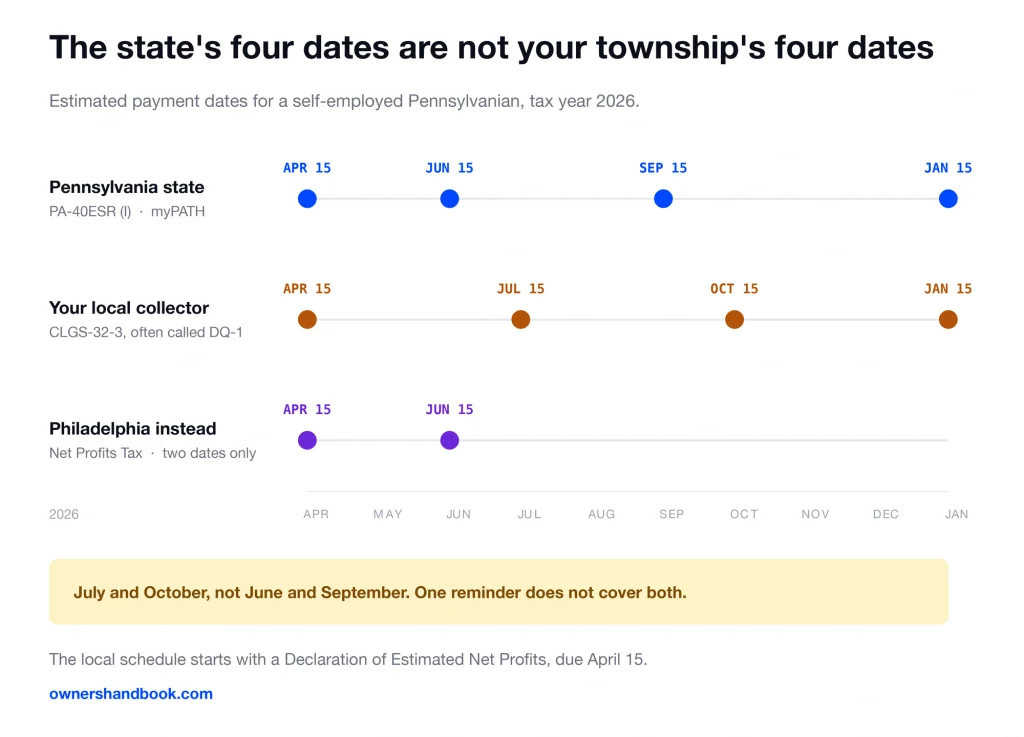
Pennsylvania’s state estimated dates copy the federal ones exactly: April 15, June 15, September 15, January 15.
The local ones do not. If you reasonably expect more than $12,000 in net profits with no withholding against them, you file a Declaration of Estimated Net Profits by April 15.
Then you pay in four equal installments: April 15, July 15, October 15, and January 15 of the following year.
July and October. Not June and September. It is a one-month drift, and it catches everyone who sets a single calendar reminder for all their tax dates.
| Due date | Pennsylvania state | Your local collector |
|---|---|---|
| April 15, 2026 | Yes | Yes, with the declaration |
| June 15, 2026 | Yes | — |
| July 15, 2026 | — | Yes |
| September 15, 2026 | Yes | — |
| October 15, 2026 | — | Yes |
| January 15, 2027 | Yes | Yes |
The state form is PA-40ESR (I). The local form DCED publishes is CLGS-32-3. Most collectors print their own version of it and call it a DQ-1, which is why the two names show up interchangeably.
$75,000 in a township, in dollars
Take a freelancer outside Philadelphia, in a township with a 1% earned income tax. Clients paid $90,000 during the year. After expenses, net profit is $75,000.
Pennsylvania takes 3.07% of the $75,000. That is $2,302.50, or $575.63 a quarter.
The township and the school district split 1% of the same $75,000. That is $750, or $187.50 a quarter.
Combined, $3,052.50. An all-in state and local rate of 4.07%.
That is genuinely low by national standards. The federal self-employment tax and federal income tax on the same profit come to several times more.
Philadelphia is not part of that system
Philadelphia is excluded from Act 32 by name, and Philadelphia County has no tax collection district. There is no local collector to send a DQ-1 to.
The city runs two taxes of its own instead, and a freelancer working there can owe both.
The Net Profits Tax is the closer cousin to the earned income tax. Residents pay 3.74% of net profit. Nonresidents pay 3.43% on the portion earned inside the city.
The Business Income and Receipts Tax is the other one, and it is the expensive surprise. It has two halves: a tax on gross receipts and a separate tax on net income.
For years, a business under $100,000 in gross receipts owed no BIRT. That exemption was eliminated starting with tax year 2025. Everyone doing business in the city now files.
| Philadelphia tax | Tax year 2025 rate | Applied to |
|---|---|---|
| Net Profits Tax, resident | 3.74% | Net profit, earned anywhere |
| Net Profits Tax, nonresident | 3.43% | Net profit earned in the city |
| BIRT, gross receipts | 1.410 mills, or $1.41 per $1,000 | Everything clients paid you |
| BIRT, net income | 5.71% | Net profit |
| Commercial Activity License | Required, no fee | Any for-profit activity in the city |
Tax year 2025 is the most recent year the city has published rates for. Philadelphia normally sets the following year’s rates by June, so check before you calculate.
The all-in rate, side by side
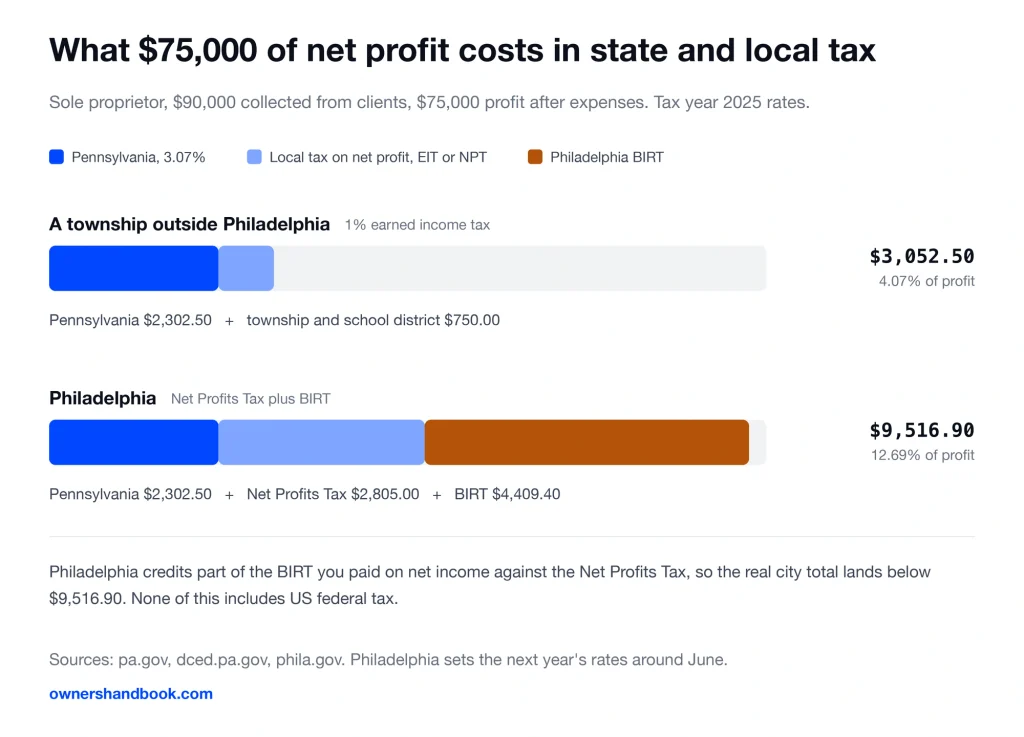
Same freelancer, same $90,000 in receipts and $75,000 in profit, now living in Philadelphia.
Pennsylvania still takes its $2,302.50. The Net Profits Tax takes 3.74% of the profit, another $2,805.
BIRT takes $126.90 on the $90,000 of receipts, plus $4,282.50 on the $75,000 of net income. That is $4,409.40 on top.
Add all of it and you are at $9,516.90 on $75,000 of profit, against $3,052.50 in the township.
One caveat, and it is a real one. Philadelphia lets you credit part of the BIRT you paid on net income against your Net Profits Tax, so the true combined number lands below $9,516.90.
The city publishes the current credit percentage on its Net Profits Tax page. That is the one figure here I am not going to estimate for you.
Philadelphia also asks for its Net Profits Tax estimates on two dates, not four: April 15 and June 15, each 25% of last year’s tax.
There is a third tax, and it is $52
The Local Services Tax is a flat annual charge levied where you work, capped at $52 a year across every municipality combined.
Self-employed people remit it themselves. Where the combined rate exceeds $10, you pay a quarter of it within 30 days of the end of each calendar quarter.
If your total earned income and net profits inside that municipality come to less than $12,000, you can claim the low-income exemption.
Fifty-two dollars is not the problem. Being unregistered for three years and hearing about it all at once is.
How to find your own collector
DCED runs an address lookup. Type in your street address and it returns your PSD code — a six-digit political subdivision code naming your exact municipality and school district — plus your earned income tax rate and your collector.
Write down three things: the rate, the collector’s name, and the collector’s website.
Then email them and say you are self-employed with net profits and want to start quarterly estimates. They will open an account for you.
Doing this in your first year costs an afternoon. Doing it after the letter arrives costs the penalty and the interest as well.
What Pennsylvania does not charge you
There is no state self-employment tax, in Pennsylvania or anywhere else. Social Security and Medicare are federal programs, and Schedule SE goes to the IRS alone.
Pennsylvania also ignores the federal standard deduction and most itemized deductions. Ordinary business expenses do reduce your PA net profits, under the state’s own rules rather than the federal ones.
The quarterly estimated taxes guide covers the federal half of this, and the general state tax guide covers what other states do. Pennsylvania’s twist is the second collector, not the rate.
Frequently asked questions
I live in a township but all my clients are in Philadelphia. Do I owe the city?
Possibly. The Net Profits Tax reaches nonresidents at 3.43% on profit earned from work performed inside the city. Where you physically sat while working generally decides it, not where the client’s office is.
Do I still file locally if I barely made anything?
The declaration requirement starts above $12,000 in net profits not subject to withholding. Below that, ask your collector, because the annual local return is usually still expected of every resident.
My collector says I owe for years I never knew about. Can they do that?
Yes. The obligation existed whether or not anyone told you. Contact them directly, because collectors handle back filings routinely and interest stops accruing once you pay.
Does paying Pennsylvania cover the local tax?
No. Two separate systems, two separate forms, two separate recipients. myPATH sends nothing to your township, and your collector sends nothing to Harrisburg.
Is Pittsburgh like Philadelphia?
No. Pittsburgh is inside the Act 32 system, so its earned income tax runs through a county collector. The Pittsburgh school district portion is capped at 2% rather than the usual 1% combined limit.
What do I actually send the local collector each quarter?
A quarterly estimate form with your net profit for the period, your rate, and the tax due. DCED’s version is CLGS-32-3; your collector’s version may be labeled DQ-1 and may be payable online.
Sources
Pennsylvania Department of Revenue, Personal Income Tax
https://www.pa.gov/en/agencies/revenue/resources/tax-types-and-information/personal-income-tax.html
Pennsylvania Department of Revenue, PA Personal Income Tax Guide, Estimated Payments
Pennsylvania DCED, Act 32 Local Income Tax Information
Pennsylvania DCED, Taxpayer Quarterly Estimated Earned Income Tax, Form CLGS-32-3
Pennsylvania DCED, Act 32 of 2008 Procedure Manual
https://dced.pa.gov/download/act-32-of-2008-procedure-manual/?wpdmdl=56767
Pennsylvania DCED, Local Earned Income Tax Regulations
https://dced.pa.gov/download/local-earned-income-tax-regulations-9-1-2018/?wpdmdl=56769
Pennsylvania DCED, Local Services Tax
Pennsylvania DCED, Find Your Local Tax Rate by Address
https://apps.dced.pa.gov/Munstats-Public/FindLocalTax.aspx
City of Philadelphia, Net Profits Tax
City of Philadelphia, Business Income and Receipts Tax
City of Philadelphia, Five Things to Know as an Independent Contractor Working in Philadelphia