Deducting What You Spent Before the Business Existed
The money you spent getting ready to freelance is deductible. It is just not deductible the way you are expecting. Most of it does not go on your first Schedule C as an ordinary expense at all — it goes through a separate mechanism with a cap, a threshold that removes the cap, and a fifteen-year tail.
That mechanism is section 195. Here is what it actually does, with the arithmetic worked through.
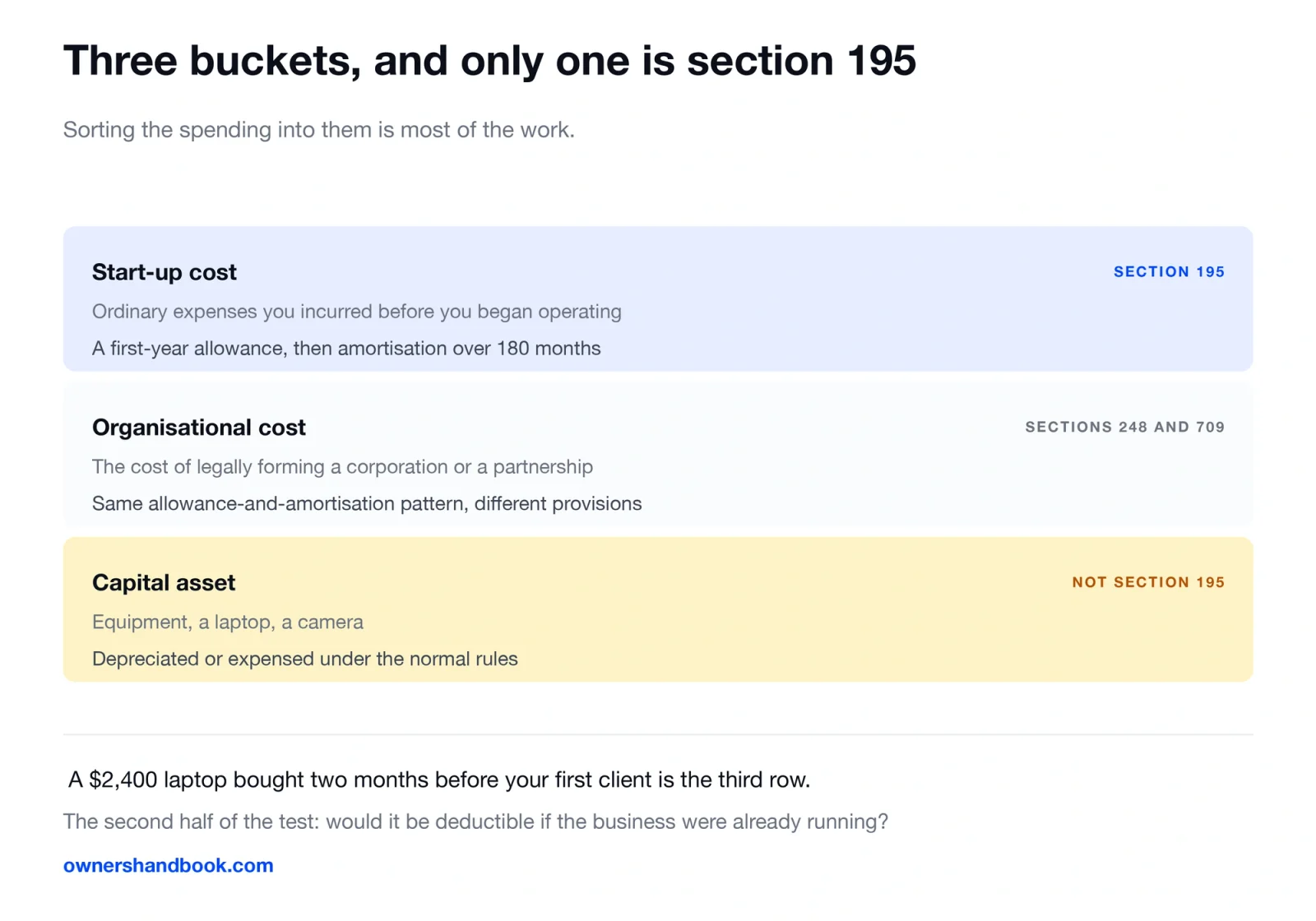
Three categories, and only one of them is section 195
Everything you paid before you were open falls into one of three buckets, and they are treated differently. Sorting your spending into them is most of the work.
| Category | What it is | How it is treated |
|---|---|---|
| Start-up cost | Ordinary expenses you incurred before you began operating | Section 195: a first-year allowance, then amortisation |
| Organisational cost | The cost of legally forming a corporation or a partnership | Sections 248 and 709, on the same allowance-and-amortisation pattern |
| Capital asset | Equipment, a laptop, a camera | Depreciated or expensed under the normal rules, not section 195 |
The third one catches people out. A $2,400 laptop bought two months before your first client is not a start-up cost. It is an asset, recovered through depreciation or section 179 like any other — our guide to writing off equipment covers that path. Only the first row is what follows.
The date that splits everything
This is the definition nobody states, and everything else depends on it. The IRS puts it plainly:
Business start-up costs are the expenses you incur before you actually begin business operations.
Note what that sentence does not say. It does not say before you registered. It does not say before you formed an LLC, opened a business bank account, or got an EIN. It says before you began business operations.
The statute declines to fix the moment precisely, leaving it to regulations, and gives one bright line: an acquired trade or business “shall be treated as beginning when the taxpayer acquires it.” For anyone building from nothing the test is functional — you are carrying on the activity the business exists to do. For a freelancer that means open, able to take work, and holding yourself out for it. Not the day the state accepted your filing.
So the sequence you may have assumed — form the LLC, then start — has no tax significance either way. You can begin operating months before you register and form an LLC long afterwards; the section 195 line sits where the operations started.
What actually qualifies as a start-up cost
The statute sets a two-part test. An amount is a start-up expenditure if it was paid in connection with investigating the creation or acquisition of an active trade or business, or creating one, and it would have been deductible if you had already been operating.
That second half is the useful filter. Ask: if I spent this next year, with the business running, would it be an ordinary deductible expense? If yes, and you spent it before opening, it is a start-up cost.
| Spending | Start-up cost |
|---|---|
| Market research, surveys, competitor analysis | Yes |
| Training before you open | Yes — the IRS names training in its own examples |
| Travel to meet potential clients before opening | Yes |
| Advertising placed before your first client | Yes |
| A laptop | No — it is an asset |
| Interest, taxes, research and experimental costs | No — the statute excludes amounts deductible under sections 163(a), 164, 174 and 174A |
That last exclusion is easy to miss, and it is written into the definition itself.
The allowance, the threshold, and the 180 months
From the statute, you may deduct in the year the business begins the lesser of your total start-up costs or:
$5,000, reduced (but not below zero) by the amount by which such start-up expenditures exceed $50,000
and the remainder is deducted:
ratably over the 180-month period beginning with the month in which the active trade or business begins
Three numbers: $5,000, $50,000, 180 months — fifteen years.
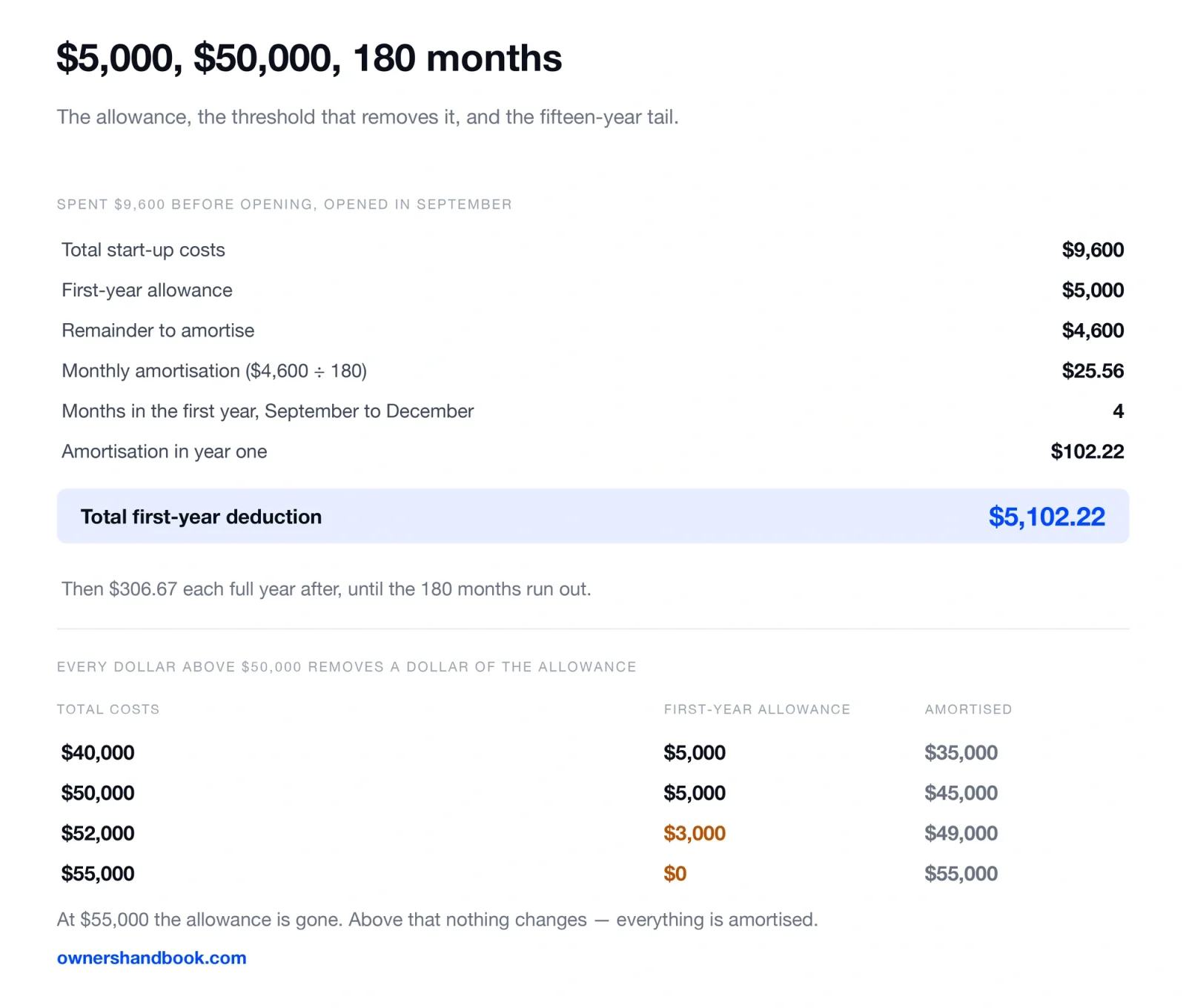
Say you spent $9,600 before opening, and you opened in September.
| Step | Amount |
|---|---|
| Total start-up costs | $9,600 |
| First-year allowance | $5,000 |
| Remainder to amortise | $4,600 |
| Monthly amortisation ($4,600 ÷ 180) | $25.56 |
| Months in the first year (September to December) | 4 |
| Amortisation in year one | $102.22 |
| Total first-year deduction | $5,102.22 |
You deduct $5,102.22 in the first year and $306.67 each full year after, until the 180 months run out.
Now the phase-out, the part explained badly everywhere. It is not a cliff and not a percentage: every dollar above $50,000 removes a dollar of the $5,000 allowance.
| Total start-up costs | First-year allowance | Amount amortised over 180 months |
|---|---|---|
| $40,000 | $5,000 | $35,000 |
| $50,000 | $5,000 | $45,000 |
| $52,000 | $3,000 | $49,000 |
| $55,000 | $0 | $55,000 |
At $55,000 the allowance is gone entirely, and above that nothing changes — everything is amortised. Very few freelancers are near this, which is the honest reason the phase-out feels theoretical. For most people the answer is simply: deduct $5,000, amortise the rest.
Organisational costs, and why you may not have any
Organisational costs run on an identical $5,000 and $50,000 pattern, over the same 180 months. But they exist under two specific provisions: section 248, for corporations, and section 709, for partnerships.
If you file Schedule C — including as a single-member LLC — you have neither. There is no corporation and no partnership to organise, so the state filing fee is not an organisational cost in that sense, and treating it as a second $5,000 bucket is a mistake. Our comparison of LLC and sole proprietor covers what the filing does and does not change.
If the business never starts
The case the articles skip, and the answer follows from the statute’s own wording.
The deduction is allowed “for the taxable year in which the active trade or business begins.” The amortisation period begins “with the month in which the active trade or business begins.” If no such year and no such month ever arrive, section 195 gives you nothing — the default rule in the same section is that no deduction is allowed for start-up expenditures.
One adjacent provision is worth knowing. If you do start and then dispose of the business completely before the 180 months are up, the statute says the deferred expenses not yet deducted “may be deducted to the extent allowable under section 165” — the loss provision. That is relief for a business that ended, not for one that never began.
Whether a venture abandoned before opening produces any deductible loss is a facts question, turning on how far you got and what you were acquiring. Anyone who answers it with a confident number is guessing. If what you have is a sustained unprofitable activity rather than an abandoned plan, hobby versus business is the more relevant test.
The election, and the deadline attached to it
You make the election by claiming the deduction. No statement is required:
You are not required to attach a statement to make this election. Once made, the election is irrevocable.
The amortisation goes on Form 4562, and the deducted portion lands in Part V of Schedule C as an other expense. Our walkthrough of Schedule C covers where each line goes.
The timing matters. The election must be made by the due date, including extensions, of the return for the year the business begins. If you filed that return on time without making it, you can still make the election on an amended return filed within six months of the original due date, excluding extensions, writing “Filed pursuant to section 301.9100-2” on it.
Miss all of that, and you have capitalised costs with no recovery mechanism.
Receipts from before you had a business account
The practical objection: these were personal card charges, months before the business existed, with no business account behind them.
None of that matters. The rule is about the nature of the expense, not the account it came from. A domain registration on your personal card in March is a start-up cost whether or not a business bank account existed yet.
What you do need is substantiation, which is harder retrospectively because the charges are scattered through personal statements. Pull the statements for the relevant months, highlight every business-related charge, and write a one-line note beside each explaining the purpose. That note is worth far more written now than reconstructed in three years. Our receipt rules post covers what each type of expense needs.
Total it and keep the working. The $5,000 figure is a cap, not a safe harbour — you still have to show what you spent. And keep the schedule for the whole amortisation period: you are claiming a deduction from it for fifteen years. Tax record keeping sets out the retention periods.
Frequently asked questions
Can I deduct start-up costs from a year before the business began?
No. They are deducted in the year the business begins, not the year you paid them. Costs from three years earlier still go into the first-year calculation.
Does the $5,000 apply per year?
No. It is a one-time allowance for the year the business begins. There is no second $5,000 in year two.
Is the $50,000 threshold about the allowance or the amortisation?
The allowance. Costs above $50,000 reduce the $5,000 dollar for dollar, and the allowance reaches zero at $55,000. The remainder is amortised either way.
What if I already filed and forgot the election?
You can make it on an amended return filed within six months of the original due date, excluding extensions, marked “Filed pursuant to section 301.9100-2.”
Where does this go on the return?
Amortisation on Form 4562; the deducted amount in Part V of Schedule C, which feeds into the same net profit line as everything else.
Sources
26 U.S. Code § 195, Start-up expenditures
IRS, Publication 583, Starting a Business and Keeping Records
https://www.irs.gov/publications/p583
IRS, Instructions for Form 4562, Depreciation and Amortization
https://www.irs.gov/instructions/i4562
IRS, Instructions for Schedule C (Form 1040)
https://www.irs.gov/instructions/i1040sc
IRS, Publication 334, Tax Guide for Small Business