Home Office Deduction: Simplified vs Actual
The simplified method is $5 per square foot of office, capped at 300 square feet, so $1,500 is the most it will ever give you. The actual method takes what your home costs to run for the year and hands you the business percentage of it, and if you use a whole room for work it is usually the bigger number by far. Both land on the same line of your Schedule C, and you get to choose again next year.
The simplified method takes a minute
Measure the room. Multiply the square feet by five. That is your deduction.
A 150 square foot room gives you $750. A 300 square foot room gives you $1,500. A 400 square foot room also gives you $1,500, because 300 square feet is the cap.
No receipts. No rent statements. No utility bills. The IRS built this option to cut the paperwork, and the paperwork is genuinely gone.
You give up two things for that.
The first is depreciation — the slow write-off of the value of the part of your home you use for work.
You also never have to pay that back when you sell, which for some people is the better end of the trade.
The second is the carryover, and it needs its own section further down.
The actual method takes an afternoon
| How they differ | Simplified method | Actual method |
|---|---|---|
| The math | Square feet x $5 | What the home cost to run, times your business share |
| The most it can ever give you | $1,500 | No limit |
| Extra form to file | None. One line on Schedule C. | Form 8829 |
| What you have to dig up | The square footage, once | Rent or mortgage, utilities, insurance, repairs |
| If a low-profit year caps it | The unused part is gone | The unused part waits for next year |
| Usually better when | The office is small, or you want this done in a minute | You rent, or the office is a whole room |
You total what the home cost for the year, then take the business percentage of it.
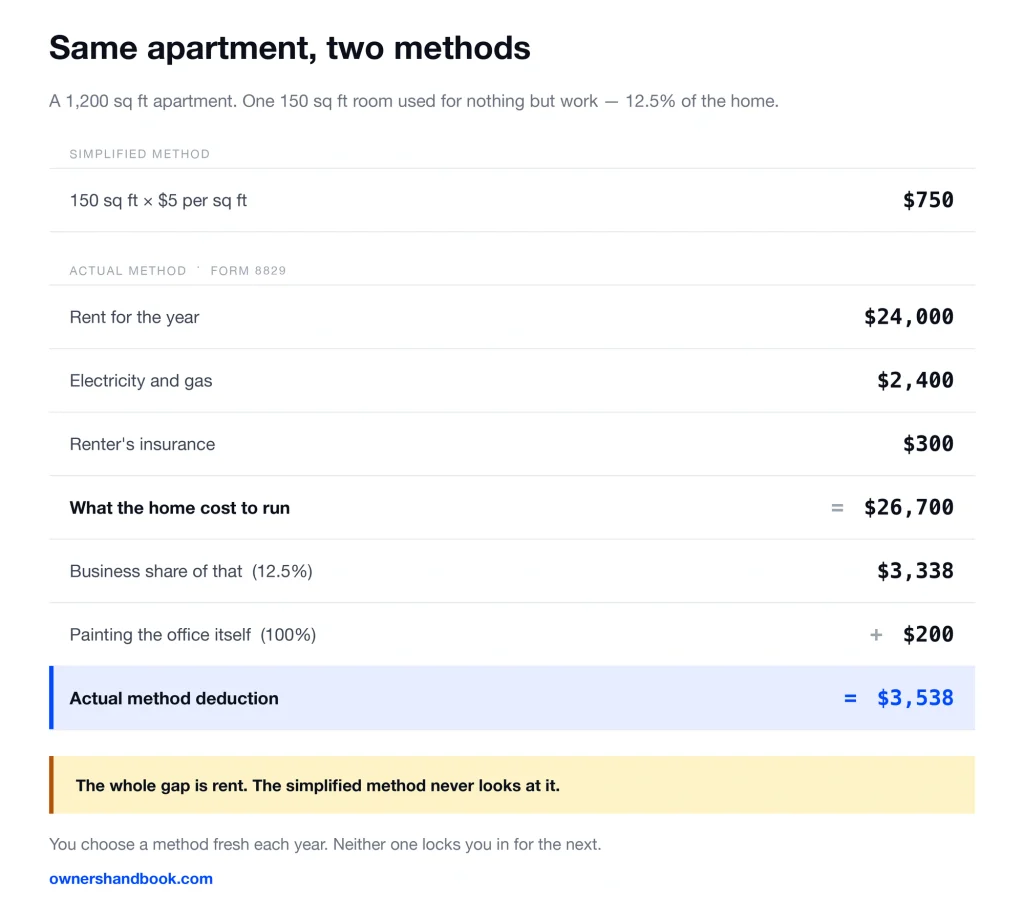
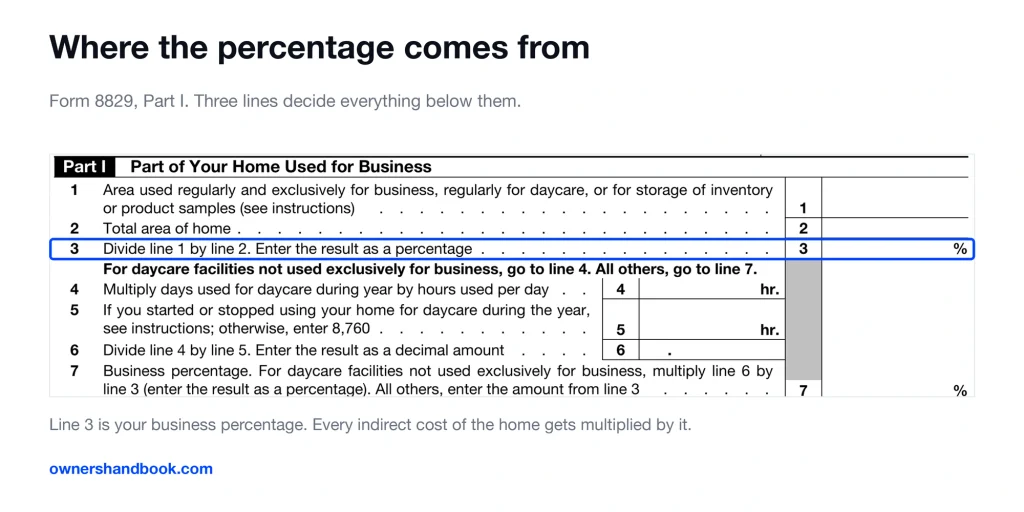
The percentage is your office square footage divided by the total square footage of the home. A 150 square foot room in a 1,200 square foot apartment is 12.5%.
Then you sort the costs into two kinds.
Indirect expenses cover the whole home: rent or mortgage interest, property tax, homeowner’s or renter’s insurance, electricity, gas, water, trash. You deduct the business percentage of each one.
Direct expenses touch the office only: painting that room, a light fixture in it, a repair to that one wall. You deduct all of it.
The figure above runs both methods on the same apartment. $750 against $3,538.
The whole gap is rent. It is the largest number in the pile, and the simplified method does not look at it at all. That is why renters with a dedicated room tend to gain the most from switching.
The price of the bigger number is Form 8829, Expenses for Business Use of Your Home. It is one page, and it wants real amounts, which means you need the bills.
You pick a method each year on that year’s original return. Simplified this year, actual next year, back again after that. What you cannot do is change the method for a year you already filed.
Simplified vs actual: which one gives you more
Three situations cover most people, and the answer flips between them.
**You rent, and a whole room is the office.** Actual, usually by a wide margin. Rent is the biggest number in the pile and the simplified method ignores it entirely. A 150 square foot room in a 1,200 square foot apartment is 12.5% of everything — rent, renters insurance, electricity, internet.
**You own, and the office is a corner of a room you also live in.** Simplified. A corner rarely passes exclusive use in the first place, and where a small partitioned area does, the paperwork of the actual method costs more than the difference.
**Your office is larger than 300 square feet.** Actual, or you leave money behind. The simplified method stops paying at 300 square feet no matter how big the room is, so a 450 square foot studio gets the same $1,500 as a 300 square foot one.
The tiebreaker is whether you have the bills. The actual method wants real amounts for rent or mortgage interest, utilities, insurance and repairs. If digging those out costs you an afternoon and the gap is a few hundred dollars, take the minute instead.
How to measure your home office square footage
Two numbers decide everything: the office, and the whole home.
Measure the office as the area you use regularly and exclusively for work. Length times width. A 10 by 12 room is 120 square feet. If the space is an irregular shape, break it into rectangles and add them.
For total home square footage, use the finished living area. That is the figure on your lease, your property tax assessment, or the listing you bought from — you do not need to measure the whole place yourself.
| Office | Home | Business percentage | Simplified at $5 |
|---|---|---|---|
| 80 sq ft | 800 sq ft | 10% | $400 |
| 120 sq ft | 1,000 sq ft | 12% | $600 |
| 150 sq ft | 1,200 sq ft | 12.5% | $750 |
| 200 sq ft | 1,500 sq ft | 13.3% | $1,000 |
| 300 sq ft | 1,800 sq ft | 16.7% | $1,500, the cap |
| 450 sq ft | 2,000 sq ft | 22.5% | Still $1,500 |
The percentage column only matters for the actual method. The simplified method never asks what share of your home the office is — it multiplies square feet by $5 and stops at 300.
That last row is the one to notice. A 450 square foot office gets the same $1,500 as a 300 square foot one, while the actual method would give it 22.5% of everything the home costs to run.
The three tests you have to pass
| Test | It passes when | It fails when |
|---|---|---|
| Exclusive use | The space is used for work and nothing else | The dining table you also eat at |
| Regular use | You work there steadily, not once in a while | A room you used twice last year |
| Principal place of business | It is where the work or the admin happens | You rent a studio and do the same admin there |
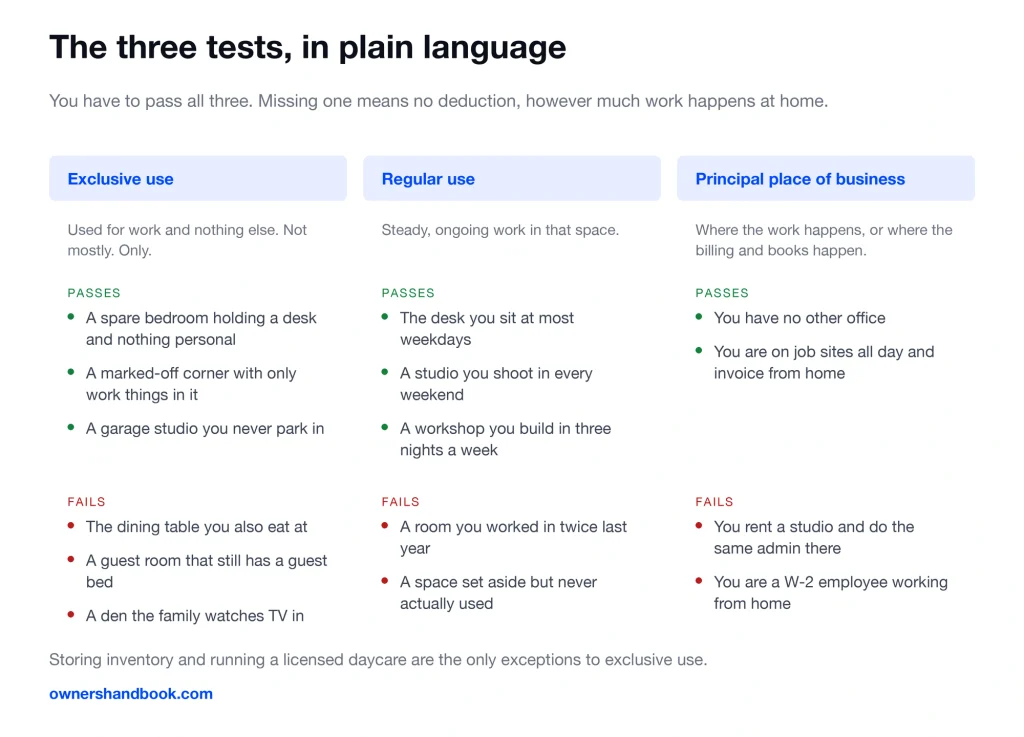
Exclusive use comes first. The space is used for work and nothing else. Not mostly work. Only work.
The IRS uses an attorney as its own example. He works in the den, and his family watches television in the same den. That den fails, however many billable hours happen in it.
The space does not need walls or a door. A marked-off corner of a room qualifies. What it cannot do is double as anything personal.
There are two exceptions to exclusive use: storing inventory or product samples, and running a licensed daycare.
Regular use comes second. You work there on a steady basis. Occasional or incidental use is not regular use.
Principal place of business comes third. Either your home is where the work itself happens, or you work elsewhere all day and your home is where you do the administrative side.
That second route matters more than people realize. Billing clients, keeping the books, ordering supplies, scheduling — if you do those at home and have no other fixed location for them, you qualify.
A contractor on job sites all week who invoices from a desk at home, a desk used for nothing else, meets the test.
No, it does not trigger an audit
There is no such rule. The IRS publishes no flag for this deduction, and no line on any form behaves differently because you filled it in.
The belief is a leftover from the 1990s, when the rules were narrower and the deduction was fought over more often. That was thirty years ago.
The agency has since moved the other way. It created the simplified method specifically to reduce the recordkeeping burden on people claiming it.
What does create trouble is a claim you cannot support. A 400 square foot office inside a 900 square foot apartment. A dining table described as a workspace.
The defense is not skipping the deduction. It is a tape measure, one photo of the room, and the square footage written down in the same file as your receipts.
It cannot create a loss
Your home office deduction is capped by what the business earned after its other expenses. It can take your profit to zero. It cannot push it below zero.
Say your business income after every other expense is $2,000, and the home office works out to $3,500. You deduct $2,000 this year.
Under the actual method the unused $1,500 carries forward to a future year when you use actual expenses again and have the income to absorb it.
Under the simplified method that $1,500 is gone for good. No carryover exists. That is the second thing you trade away for the short worksheet.
Line 30, and nowhere else
Schedule C states it on the form itself: enter expenses for business use of your home only on line 30.
This matters because the same costs have their own lines elsewhere. Line 20 is rent. Line 25 is utilities. Line 15 is insurance.
Those lines are for a separate business space — a studio you rent, an office you keep across town. Your apartment rent does not belong on line 20.
Line 29 is your profit before the home office. Line 30 is the home office. Line 31 is what survives, and line 31 is what income tax and self-employment tax are both charged on.
If you use the simplified method, line 30 also asks you to write in two numbers: the total square footage of your home, and the part used for business.
Homeowners on the actual method split their mortgage interest and property tax. The business share goes on Form 8829. The rest goes on Schedule A if you itemize. On the simplified method you claim all of it on Schedule A.
Like every business deduction, this one still has to be ordinary and necessary. The home office rules sit on top of that test, not instead of it.
What trips people up
Claiming a room that is only half a workspace. If the guest bed is still in there, the room is not exclusive, and the honest move is to claim the desk area instead.
Deducting the whole internet bill. It is a household service you also use personally. Deduct the business share.
Never measuring. “About a third of the place” is not a number you can defend. Measure once, write it down, reuse it every year.
Running the actual method without the bills. That method needs real amounts, and guessing at a year of utilities is exactly the kind of claim people are afraid of.
Claiming a home office in a year with no self-employment income. No business, no deduction.
Assuming a job that lets you work from home qualifies you. It does not. Employees are not eligible, even when the employer requires the arrangement.
Frequently asked questions
I work from home for my employer. Can I deduct my office?
No. Employees are not eligible to claim the home office deduction, no matter who decided you would work from home. If you also run something on the side, the deduction can apply to that business only.
Do I need a separate room with a door?
No. A defined area inside a larger room qualifies, as long as nothing personal happens in that area. A door helps you prove it, not qualify for it.
Can I switch between the two methods?
Yes, year by year. You choose by using that method on your timely filed original return for the year. You cannot go back and change the method for a year already filed.
Does renting instead of owning change the math?
Usually in your favor. Rent is a home cost like any other, and the actual method gives you the business percentage of it, which is often the single biggest line in the calculation.
What if I moved, or the office changed size mid-year?
Both methods handle it. Under the simplified method you use the average monthly allowable square footage, adding up the allowable square feet for each month and dividing by twelve, with 300 square feet as the ceiling for any one month.
Will this cost me when I sell my house?
Only under the actual method, and only on the depreciation you actually claimed. Years you used the simplified method carry no depreciation deduction and no later recapture.
Sources
IRS, Home office deduction
https://www.irs.gov/businesses/small-businesses-self-employed/home-office-deduction
IRS, Simplified option for home office deduction
IRS, Topic no. 509, Business use of home
https://www.irs.gov/taxtopics/tc509
IRS, Publication 587, Business Use of Your Home
https://www.irs.gov/publications/p587
IRS, About Form 8829, Expenses for Business Use of Your Home
https://www.irs.gov/forms-pubs/about-form-8829
IRS, Instructions for Schedule C
https://www.irs.gov/instructions/i1040sc
IRS, Home office deduction benefits eligible small business owners
https://www.irs.gov/newsroom/home-office-deduction-benefits-eligible-small-business-owners