Schedule C Business Codes for Freelancers: Box B, Decoded
Box B on Schedule C wants a six-digit number, and the form tells you almost nothing about how to pick it. The instruction reads: enter the six-digit code from the Principal Business or Professional Activity Codes chart at the end of these instructions.
That chart is four pages of dense columns organised by industry, not by what you would call yourself. A graphic designer looking for “graphic designer” will not find it. The code exists, but it is filed under specialized design services.
Here is the lookup, by what you actually do.
Codes for common freelance work
| What you do | Code | What the IRS calls it |
|---|---|---|
| Graphic design, interior design, industrial or fashion design | 541400 | Specialized design services |
| Web development, software development, IT consulting | 541510 | Computer systems design and related services |
| Writing, illustration, performing, fine art | 711510 | Independent artists, writers, and performers |
| Photography | 541920 | Photographic services |
| Advertising, PR, social media marketing | 541800 | Advertising, public relations, and related services |
| Business, management or strategy consulting | 541600 | Management, scientific, and technical consulting services |
| Market research, survey work | 541910 | Market research and public opinion polling |
| Translation, interpretation | 541930 | Translation and interpretation services |
| Tutoring, teaching, course creation, coaching | 611000 | Educational services |
| Video production, film, editing | 512100 | Motion picture and video industries |
| Audio production, podcast editing, music recording | 512200 | Sound recording industries |
| Delivery driving, courier work | 492000 | Couriers and messengers |
| Landscape design | 541320 | Landscape architecture services |
| Cleaning services | 561720 | Janitorial services |
| Personal training, coaching, other personal services | 812990 | All other personal services |
| Nothing above fits at all | 999000 | Unclassified establishments |
Codes are from the Principal Business or Professional Activity Codes chart in the Schedule C instructions for tax year 2025. The chart is revised occasionally, so check yours against the current instructions.
The ones that cause the most confusion
**Designers go in 541400, not 711510.** Specialized design services covers “interior, industrial, graphic, and fashion design” — the IRS names graphic design inside that parenthetical. Independent artists is for fine art and performance, not client design work.
**Developers and IT consultants share one code.** 541510 covers computer systems design and related services. There is no separate code for front-end work, back-end work, or app development.
**Writers have a choice to make.** 711510 covers independent writers. But a copywriter whose work is advertising may fit 541800 better, and a technical writer embedded in software work may fit 541510. Pick the one that describes the majority of your revenue.
**Coaching splits by subject.** Business coaching is consulting, 541600. Life or fitness coaching is closer to 812990, other personal services. Teaching a subject is 611000.
**Two businesses means two codes.** If you shoot weddings and also drive for a delivery app, that is two Schedule Cs, each with its own code. One form cannot carry two codes.
What the code actually does
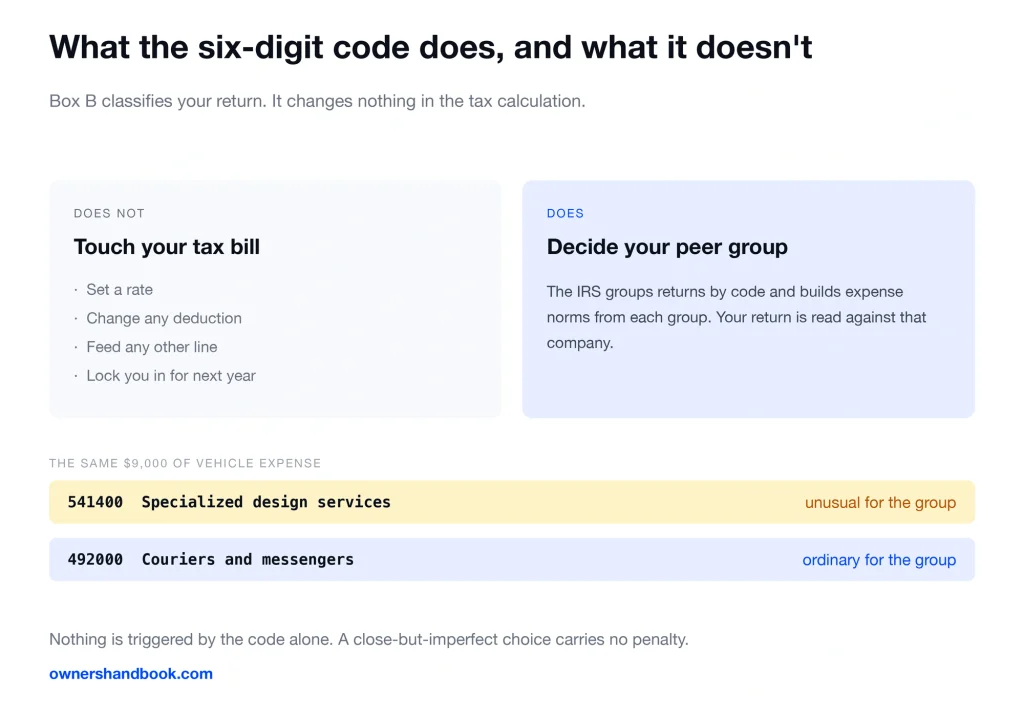
It is not a tax rate and it does not change what you owe. Nothing on the rest of the form keys off it.
What it does is classify your return. The IRS groups returns by activity code, which is how it produces statistics on what businesses in each category typically report — and how it develops the expense norms that a return gets measured against.
That is the practical consequence. A return reporting heavy vehicle expenses under a code for desk-based design work is unusual for its group. A return reporting the same expenses under a code for courier work is not. The code does not trigger anything on its own, but it sets the company your return keeps.
What if I picked the wrong one
A close-but-imperfect code is not a problem worth losing sleep over. There is no penalty for it, the IRS does not reject returns over it, and you are not locked in — you enter a code each year and can enter a different one next year.
What is worth avoiding is a code that describes something genuinely different from what you do. A consultant filing under a retail code will have expenses that look nothing like the group they have been placed in.
If you have used one code for years and your work has shifted, change it. No form, no explanation, no amendment. Just enter the right one on this year’s return.
And if nothing fits, 999000 exists for exactly that. It is a real option, not a failure.
Where to find the full chart
The complete list runs to several pages at the end of the Schedule C instructions, organised by sector. If your work is not in the table above, that is where to look.
The chart is arranged by what the business does, not by job title, so search for the activity rather than the profession. “Consulting” appears; “consultant” does not. “Design services” appears; “designer” does not.
Frequently asked questions
Does my business code affect how much tax I pay?
No. It classifies the return. Nothing in the tax calculation depends on it.
Can I change my code from last year?
Yes. You enter a code on each year’s return and nothing carries over. If your work changed, enter the new code and file normally.
I have two businesses. Do they share a code?
No, and they do not share a Schedule C either. Two genuinely different businesses means two forms, each with its own code.
What if my work spans two codes?
Pick the one covering the larger share of your revenue. There is no mechanism for splitting a single Schedule C between codes.
Is there a code for freelancer?
No. The chart is organised by the activity, so a freelancer is classified by what the work is — design, development, writing, photography — not by the employment arrangement.
Where does the code go on the form?
Box B, on the top line of Schedule C, immediately to the right of box A where you describe the business in words.
Sources
IRS, Instructions for Schedule C
https://www.irs.gov/instructions/i1040sc
IRS, Schedule C (Form 1040)
https://www.irs.gov/pub/irs-pdf/f1040sc.pdf
IRS, About Schedule C (Form 1040)
https://www.irs.gov/forms-pubs/about-schedule-c-form-1040
Census Bureau, North American Industry Classification System