Real Estate Agent Taxes: A Statutory Nonemployee
Two provisions in the tax code single out real estate agents by name. One decides you are not an employee — not as a matter of judgement but as a matter of statute, whatever your brokerage tells you to wear or when to be at the office. The other quietly leaves you off the list of professions that lose the 20% qualified business income deduction at higher incomes. Both are worth more than most of the deductions people ask about.
You are a nonemployee by statute, not by the usual test
Most workers who argue about classification are arguing about control — who sets the hours, who supplies the tools, who can fire whom. Agents do not have that argument, because Congress removed them from it in 1982. Section 3508 of the Internal Revenue Code:
(a) General rule For purposes of this title, in the case of services performed as a qualified real estate agent or as a direct seller— (1) the individual performing such services shall not be treated as an employee, and (2) the person for whom such services are performed shall not be treated as an employer.
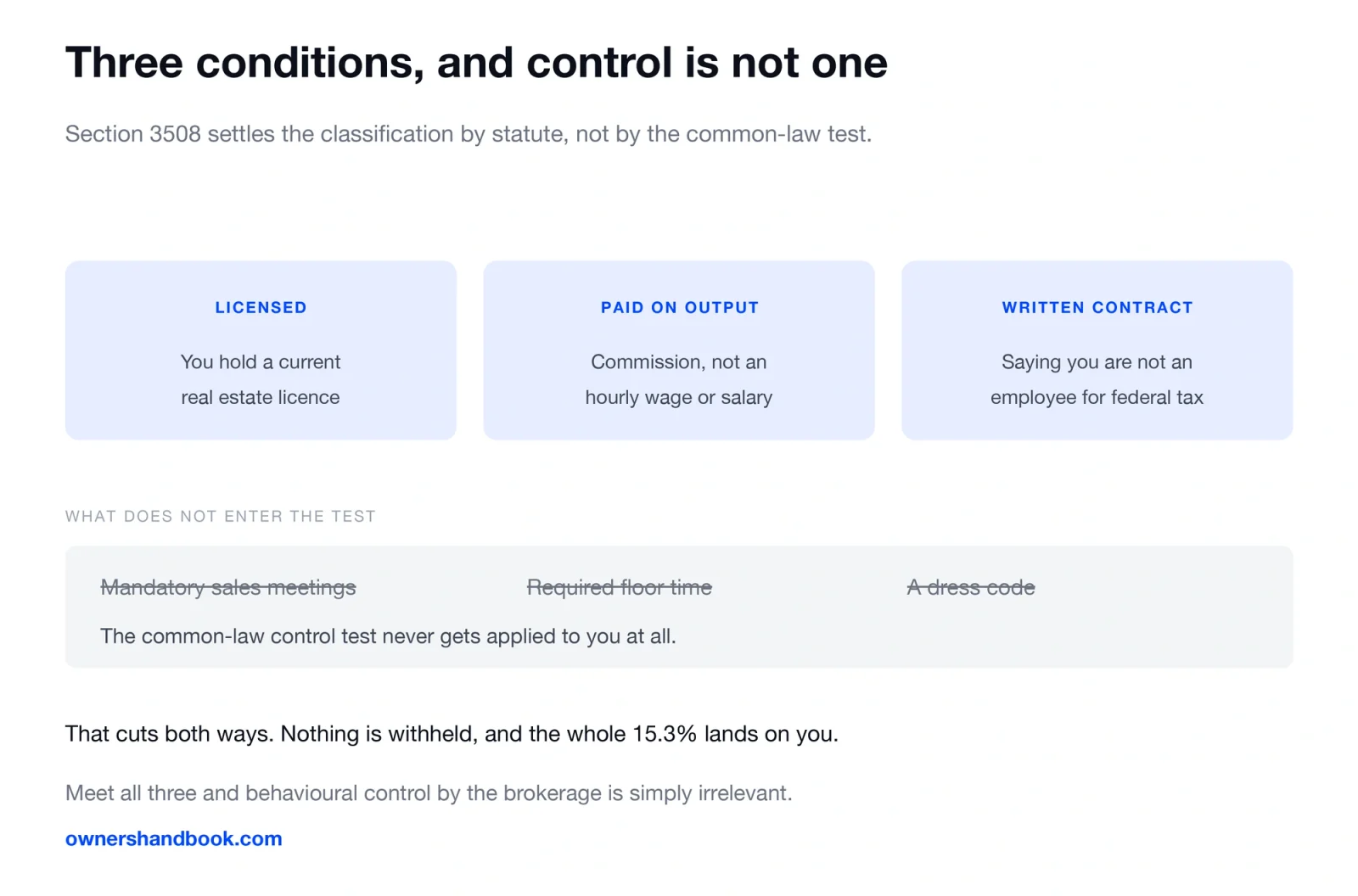
A “qualified real estate agent” is defined in the next subsection, in three parts:
(A) such individual is a licensed real estate agent, (B) substantially all of the remuneration (whether or not paid in cash) for the services performed by such individual as a real estate agent is directly related to sales or other output (including the performance of services) rather than to the number of hours worked, and (C) the services performed by the individual are performed pursuant to a written contract between such individual and the person for whom the services are performed and such contract provides that the individual will not be treated as an employee with respect to such services for Federal tax purposes.
| Condition | What it means in practice |
|---|---|
| Licensed | You hold a current real estate licence |
| Paid on output | Commission, not an hourly wage or salary |
| Written contract | The independent contractor agreement your brokerage had you sign |
Meet all three and the classification is settled. Behavioural control by the brokerage is irrelevant. Mandatory sales meetings, required floor time, a dress code — none of it makes you an employee, because the common-law control test never gets applied to you at all.
That cuts both ways. Nobody withholds anything from your commission, and the full weight of Social Security and Medicare lands on you.
What that costs: the self-employment tax
Nothing is taken out of a commission cheque, so the tax an employer would normally split with you is entirely yours.
The rate is 15.3% — 12.4% for Social Security and 2.9% for Medicare. It applies to 92.35% of your net profit, not to gross commissions. The Social Security half applies only to the first $184,500 of combined wages and net earnings in 2026; the Medicare half has no ceiling.
Work an example. An agent nets $95,000 after the split, desk fees and every other expense:
| Step | Amount |
|---|---|
| Net profit on Schedule C | $95,000 |
| Multiply by 92.35% | $87,733 |
| Self-employment tax at 15.3% | $13,423 |
| Deductible half, against income tax | $6,711 |
That $13,423 sits on top of income tax, and it is the number that makes a first good year feel worse than it looked. Our guide to self-employment tax works through the mechanics, and the self-employment tax calculator will run your own figures. Because nothing is withheld, it is paid in four instalments — see quarterly estimated taxes.
The deduction a consultant loses and you keep
Here is the second provision, and it is the one almost nobody mentions.
The qualified business income deduction is worth up to 20% of business profit. Above certain income levels it is withdrawn from a list of “specified service trades or businesses” — consultants, lawyers, accountants, therapists, financial advisers, and people in “brokerage services”.
You would assume a real estate broker is in brokerage services. The regulation says otherwise, in terms:
the performance of services in the field of brokerage services includes services in which a person arranges transactions between a buyer and a seller with respect to securities (as defined in section 475(c)(2)) for a commission or fee. This includes services provided by stock brokers and other similar professionals, but does not include services provided by real estate agents and brokers, or insurance agents and brokers.
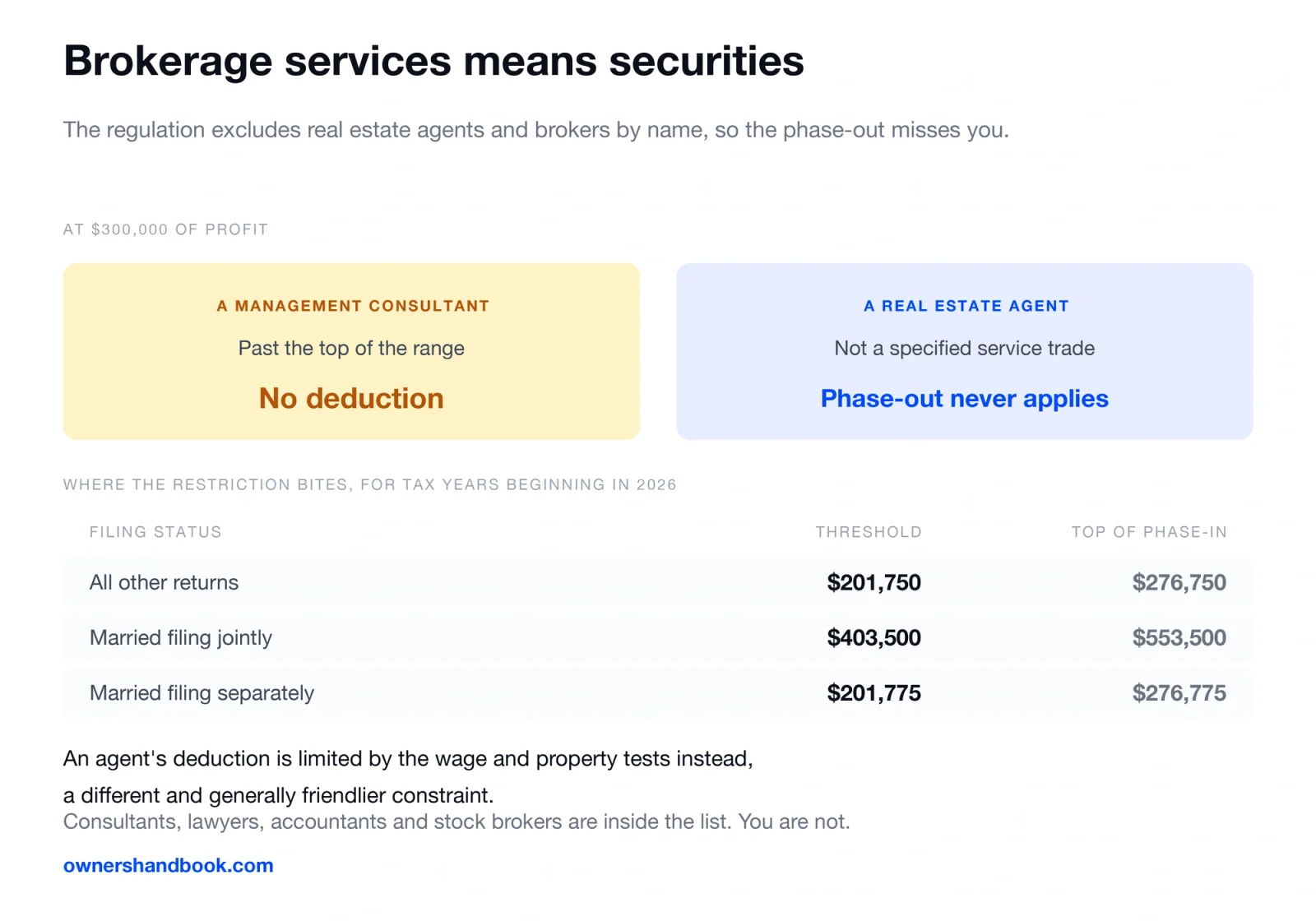
“Brokerage services” means securities. Real estate agents and brokers are excluded by name.
The effect shows at the thresholds where the restriction bites. For tax years beginning in 2026:
| Filing status | Threshold | Top of phase-in range |
|---|---|---|
| All other returns | $201,750 | $276,750 |
| Married filing jointly | $403,500 | $553,500 |
| Married filing separately | $201,775 | $276,775 |
A single management consultant with $300,000 of profit is past the top of that range and gets nothing. An agent with the same $300,000 is not in a specified service business at all, so that phase-out never applies — their deduction is limited instead by the wage and property tests, a different and generally friendlier constraint. Our QBI deduction guide covers how those work.
What arrives in January, and what to check on it
Your brokerage reports commissions on Form 1099-NEC. The threshold rose for tax years beginning after 2025 — it is now $2,000, not the $600 most articles still print.
Is it your share or the gross? Brokerages differ. Some report only what they paid after the split; some report a larger number and expect you to deduct the split yourself. If the 1099 exceeds what reached your bank account, do not quietly reduce it — report the figure as income and take the difference as an expense, so your return matches what the IRS received.
Is anything missing? Referral fees from other agents, bonuses and rebates may or may not appear, and income routed through a payment platform arrives on a 1099-K instead. Your own records are the control total.
The costs that are specific to this business
Everything below is an ordinary and necessary cost of a real estate practice and goes on Schedule C, under business code 531210, Offices of real estate agents and brokers — see Schedule C business codes.
| Cost | Notes |
|---|---|
| Brokerage split | Deductible if the 1099 reported gross |
| Desk, technology and franchise fees | Whatever the brokerage bills monthly |
| MLS dues, lockbox and key fees | Recurring, easy to forget |
| Board and association dues | Any lobbying portion is not deductible |
| Licence renewal and continuing education | Renewal only, not qualifying initially |
| Errors and omissions insurance | Often billed per transaction |
| Advertising, portals, lead generation | Zillow, postcards, sponsored posts |
| CRM, e-signature, transaction software | Monthly subscriptions |
Your car is usually the largest single line
For most agents it is not close. Showings, previews, inspections, closings, sign installs. The 2026 standard mileage rate changed mid-year, so a single annual figure will be wrong:
| Period | Rate per business mile |
|---|---|
| January 1 – June 30, 2026 | $0.725 |
| July 1 – December 31, 2026 | $0.76 |
Keep the two halves of the year separate. The 2026 mileage rate post explains the split and how to handle a car bought mid-year.
The trap is commuting. Driving from home to your regular office is personal and never deductible. If your home is your principal place of business, the rule changes:
daily transportation expenses can be deducted if (1) you have one or more regular work locations away from your residence; or (2) your residence is your principal place of business and you incur expenses going between the residence and another work location in the same trade or business, regardless of whether the work is temporary or permanent and regardless of the distance.
For an agent who genuinely works from a home office and uses the brokerage desk occasionally, that turns nearly every drive of the day into business mileage. It is worth getting the home office deduction right for that reason alone.
Whichever method you use, the log is what defends it — date, destination, purpose, miles. An app that records it automatically beats a reconstruction in March.
Staging, closing gifts, and the $25 ceiling
Staging, professional photography and virtual tours are advertising for a specific listing. Deduct them in full. Closing gifts are different, and run into a limit that has not moved in decades:
You can deduct no more than $25 for business gifts you give directly or indirectly to each person during your tax year.
A $200 bottle of champagne at a closing produces a $25 deduction. Branded items of minimal value that you hand out widely — pens, notepads, keychains — fall outside the gift rules and count as advertising instead. Buy the substantial gift if you want to; just buy it knowing most of the cost is not deductible.
Frequently asked questions
My brokerage requires me at the office every Tuesday. Does that make me an employee?
Not for federal tax purposes. Section 3508 turns on your licence, output-based pay and a written contract. How much the brokerage directs your day does not enter the test.
Does section 3508 apply to state law too?
It is written “for purposes of this title”, meaning the Internal Revenue Code. State employment, workers’ compensation and unemployment rules are separate, and some states classify agents differently. Check your own state rather than assuming the federal answer carries over.
Should I form an LLC or elect S corporation status?
An LLC by itself changes nothing about the tax above. An S corporation election can reduce self-employment tax once profit is consistently high, at the cost of payroll and a second return. See is the S corp election worth it.
My brokerage did not send a 1099. Do I still report the commissions?
Yes. Income is reportable whether or not a form arrives, and the $2,000 threshold governs the brokerage’s filing duty, not your reporting duty.
Can I deduct the cost of getting my licence in the first place?
No. Education that qualifies you for a new trade or business is not deductible. Renewals and continuing education for a licence you already hold are.
Sources
26 U.S. Code § 3508, Treatment of real estate agents and direct sellers
https://www.law.cornell.edu/uscode/text/26/3508
26 CFR § 1.199A-5, Specified service trades or businesses and the trade or business of performing services as an employee
https://www.law.cornell.edu/cfr/text/26/1.199A-5
IRS, Revenue Procedure 2025-32 (2026 inflation-adjusted amounts)
https://www.irs.gov/pub/irs-drop/rp-25-32.pdf
IRS, Self-employment tax (Social Security and Medicare taxes)
Social Security Administration, Contribution and benefit base
https://www.ssa.gov/oact/cola/cbb.html
IRS, Standard mileage rates
https://www.irs.gov/tax-professionals/standard-mileage-rates
IRS, Publication 463, Travel, Gift, and Car Expenses
https://www.irs.gov/publications/p463
IRS, Instructions for Forms 1099-MISC and 1099-NEC
https://www.irs.gov/instructions/i1099mec
IRS, Instructions for Schedule C (Form 1040)