The 2026 Mileage Rate Changed Mid-Year
The 2026 business mileage rate is 72.5 cents a mile for miles driven January 1 through June 30, and 76 cents a mile from July 1 through December 31. The IRS raised it in the middle of the year, which is rare enough that most rate tables online still show a single number. If you have been logging miles all year against one rate, you have to cut the log at June 30 and multiply each half on its own.
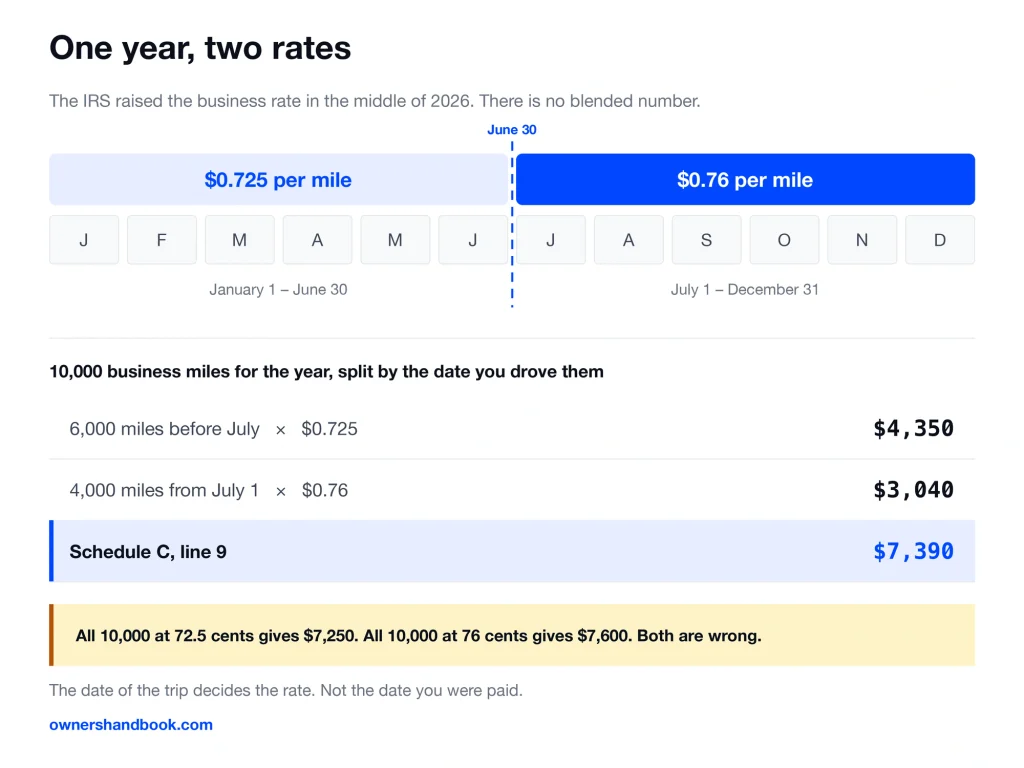
The two rates, and the day that splits them
| When you drove | Rate per mile | 1,000 miles is worth |
|---|---|---|
| January 1 to June 30, 2026 | $0.725 | $725 |
| July 1 to December 31, 2026 | $0.76 | $760 |
There is no blended rate. The IRS did not average the two, and you should not either.
A mile you drove on June 30 is worth 72.5 cents. A mile you drove on July 1 is worth 76 cents.
What decides is the date of the trip. Not the date the client paid you, and not the date you filled the tank.
Say you drove 10,000 business miles in 2026. Six thousand of them before July, four thousand after.
First half: 6,000 miles × $0.725 = $4,350.
Second half: 4,000 miles × $0.76 = $3,040.
Your deduction is $7,390.
Run all 10,000 miles at 72.5 cents and you get $7,250. That is $140 you handed back for no reason.
Run all 10,000 at 76 cents and you get $7,600, which overstates the deduction by $210. That one is not a rounding error. It is a wrong number on a filed return.
Splitting a log that crosses June 30
Every mileage app can export by date range. Export twice, January 1 to June 30 and July 1 to December 31, and keep both files.
If you kept a spreadsheet, sort by date and put a subtotal row after the last June trip. Two sums, two rates, one total.
If your records are monthly totals rather than individual trips, that is still enough. January through June go in the first bucket and July through December in the second.
The bad case is a single odometer reading for the whole year and nothing else.
There is no honest way to split one annual number across two rates. Any ratio you invent is a guess, and a guess is what the substantiation rules exist to prevent.
If that is where you are, rebuild what you can from calendar entries, invoices, and map history, and start a real log tomorrow.
Why it moved, and whether it moves again
Mid-year changes are unusual. The last one was in 2022.
The cause both times was fuel. Regular gas averaged about $2.89 a gallon in December 2025, when the original 2026 rate was set. By mid-July 2026 the national average was around $3.87.
The IRS made the change in Announcement 2026-11, which modified the original Notice 2026-10.
The medical and moving rate moved with it, from 20.5 cents to 23.5 cents. The charitable rate stayed at 14 cents, because that one is fixed in the statute and only Congress can change it.
Do not assume 76 cents carries into 2027. The IRS sets a new rate each December, and it is announced fresh every year.
Which miles actually count
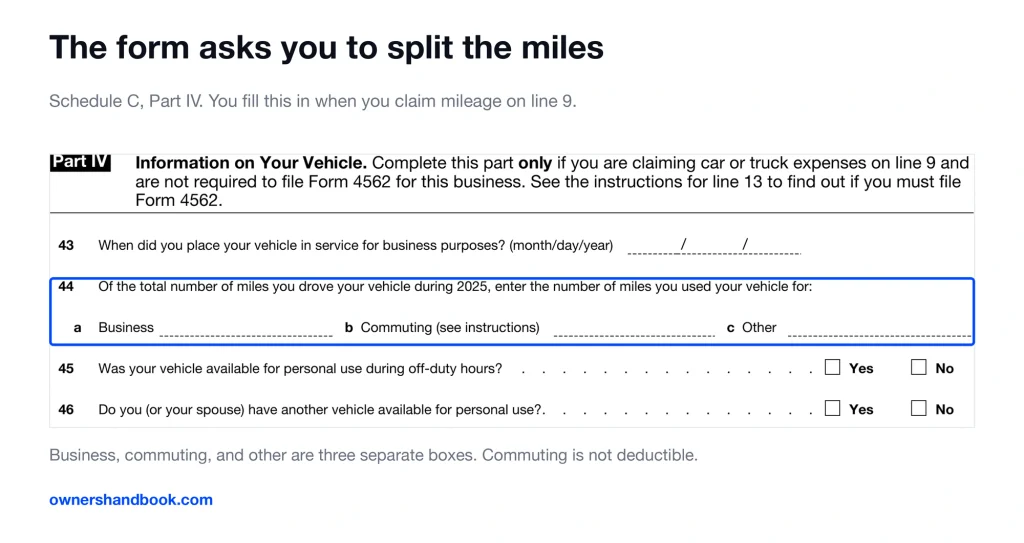
Commuting is not deductible. Driving from your home to a place you regularly work is personal driving, no matter who you work for.
There is an exception that covers a lot of freelancers, and it turns on the home office.
If part of your home qualifies as your principal place of business, the trip from that home office to a client is business transportation from the moment you pull out.
Qualifying means exclusive and regular use of that space, and no other fixed location where you do the administrative work of the business.
Without a qualifying home office, the drive to your first work location of the day is usually commuting, and the drives between locations after that are business.
Miles that count once you are working: client to client, to a job site, to the post office to ship an order, to a supplier, to the bank for a business deposit, to a conference in your field.
If you stop for groceries on the way back from a client, that detour is personal. Log the business portion only.
Standard mileage or actual expenses
| How they differ | Standard mileage | Actual expenses |
|---|---|---|
| What the one number covers | Gas, insurance, repairs, depreciation. All of it. | Nothing. You add up every cost yourself. |
| What you have to keep | A log of miles and dates | Every receipt, plus the same mileage log to work out the business share |
| Parking and tolls | Deducted on top of the rate | Deducted like any other cost |
| Can you switch later | Yes, either direction | Only if you used standard mileage the first year you owned the car |
Two methods exist for the same car. You pick one for the year and you never use both.
Actual expenses means adding up gas, oil, insurance, repairs, tires, registration, lease payments, and depreciation, then multiplying the total by the share of miles that were business.
There is one rule that catches people permanently, so read it twice.
If you own the car, you must use the standard mileage rate in the first year that car is available for business use in order to have the option at all.
Take actual expenses that first year and the standard rate is closed to that vehicle for as long as you own it. There is no going back.
Standard mileage in year one keeps both doors open. You can switch to actual in a later year if the car gets expensive.
Leases run the other way. Choose the standard rate on a leased car and you are committed to it for the whole lease, renewals included.
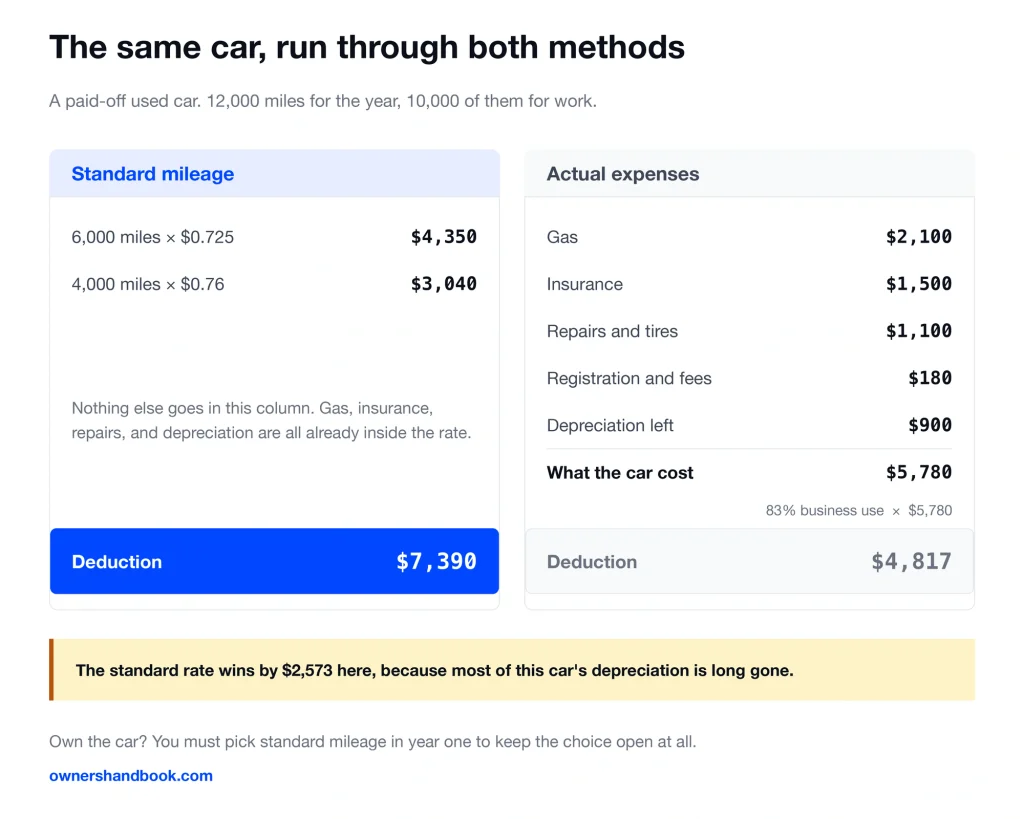
For a paid-off used car, the standard rate usually wins by a wide margin, because most of the actual cost is depreciation you already took years ago.
For a new car in its first two years, or an expensive one, actual expenses often win. Run both before you commit in year one.
The log has to be written as you drive
The records have to be kept at or near the time of the trip. A log you fill in weekly counts as timely. A number reconstructed from memory in April does not.
Each entry needs four things: the date, where you went, the business reason, and the miles.
“Client meeting, Nguyen project” is a business reason. “Work” is not.
Read your odometer on January 1 and again on December 31. That gives you total miles for the year, which is what your business percentage is measured against.
Keep the log for at least three years after you file. It is the only thing standing between the deduction and a disallowance.
Mileage is one deduction among many, and it answers to the same ordinary and necessary test as the rest of them.
Where it goes on your return
Everything lands on line 9 of Schedule C, car and truck expenses.
Line 9 takes one number: your two half-year subtotals added together, plus business parking and tolls.
Parking and tolls are not built into the mileage rate. Add them on top, and add them under the actual expense method too.
What the rate does cover is gas, maintenance, repairs, insurance, and depreciation. You do not deduct those separately when you take the standard rate.
Then there is Part IV of Schedule C, the vehicle questions. You fill it in when you claim the standard rate and are not otherwise required to file Form 4562.
It asks when you placed the car in service, how the miles split between business, commuting, and personal, whether another vehicle was available, and whether you have written evidence.
That last question is the one to take seriously. Answering yes without a log is where an ordinary deduction becomes an expensive problem.
One more thing worth knowing. If you also hold a W-2 job, you cannot deduct unreimbursed mileage as an employee.
The 2017 tax law suspended that deduction and the 2025 budget law made the repeal permanent, with narrow carve-outs for reservists, performing artists, fee-basis officials, and impairment-related expenses.
Mileage is now a self-employment deduction. If your employer does not reimburse you, ask them to.
Frequently asked questions
Do I really have to use two different rates for 2026?
Yes. Miles through June 30 are deducted at 72.5 cents and miles from July 1 at 76 cents, with no blending.
I have been paying quarterly estimates using 72.5 cents. Do I need to fix anything now?
No. Estimated payments are just deposits. Use the correct split when you file, and the difference settles in April.
Can I switch to standard mileage on a car I have been claiming actual expenses on?
Not if you own it. The choice in the first year the car was available for business is permanent for that vehicle.
I work from home. Does the drive to my client’s office count?
If your home office qualifies as your principal place of business, yes, that trip is deductible. Without a qualifying home office it is usually commuting.
Do parking and tolls come on top of the mileage rate?
Yes. Business parking and tolls are deducted separately under either method, and they go on line 9 with the mileage total.
My app only shows one total for the year. What now?
Export by date range if the app allows it. If it does not, rebuild the split from monthly summaries, calendar entries, and invoices rather than picking a ratio.
Sources
IRS, Standard Mileage Rates
https://www.irs.gov/tax-professionals/standard-mileage-rates
IRS, Internal Revenue Bulletin 2026-29 (Announcement 2026-11)
https://www.irs.gov/irb/2026-29_irb
IRS, Topic no. 510, Business Use of Car
https://www.irs.gov/taxtopics/tc510
IRS, Publication 463, Travel, Gift, and Car Expenses
https://www.irs.gov/publications/p463
IRS, Publication 587, Business Use of Your Home
https://www.irs.gov/publications/p587
IRS, Instructions for Schedule C