Net 30, Net 15, or Due on Receipt
Net 30 means the balance is due 30 days after the invoice date. Net 15 means fifteen. Due on receipt means now. Pick whichever you like — but the number is not where your money leaks out. The send date is. A Net 30 you send a week after you finish the work is a Net 37, and nobody agreed to that except you.
What the three terms actually mean
Net is an accounting word, not a legal one. It means the whole amount, with nothing taken off.
So Net 30 reads as: the full invoice, due thirty days out. Net 15 is the same sentence with a smaller number.
Due on receipt means the balance is payable the moment the invoice arrives. It is a real term.
It is also the one most likely to be ignored, because a lot of companies cannot move that fast even when they want to.
Net 30 became the business-to-business default because it is a form of short-term credit. The Small Business Administration describes a net 30 account as a way to “defer the payment on those purchases for 30 days, thereby conserving cash flow.”
Read that from your side of the table. Net 30 exists to protect the buyer’s cash flow. Not yours.
That does not make it wrong. It makes it a choice — and Net 15 is not a rude thing to ask for.
The clock starts on the invoice date
This is the part that decides everything else.
Thirty days is counted from the date printed on the invoice. Not from the day you finished the work. Not from the day the client said they liked it.
Nolo’s guidance to small businesses uses exactly that framing. Set a due date “such as 30 days from the invoice date.”
Then put the matching phrase on the invoice itself — accounts not paid within so many days “of the date of the invoice.”
The federal government makes the same point in a way you can go read. Under the Prompt Payment rule, an agency’s payment clock “shall begin on the date of receipt of a proper invoice.”
Thirty days after that is the default due date when the contract is silent.
Receipt. Not completion. The work being finished starts nothing.
Meanwhile the early-payment discount window in that same rule runs from “the date placed on the proper invoice by the vendor.”
The vendor is you. Your date starts the count.
So every day between finishing the work and sending the invoice is a day you gave away for free.
Where the week actually goes
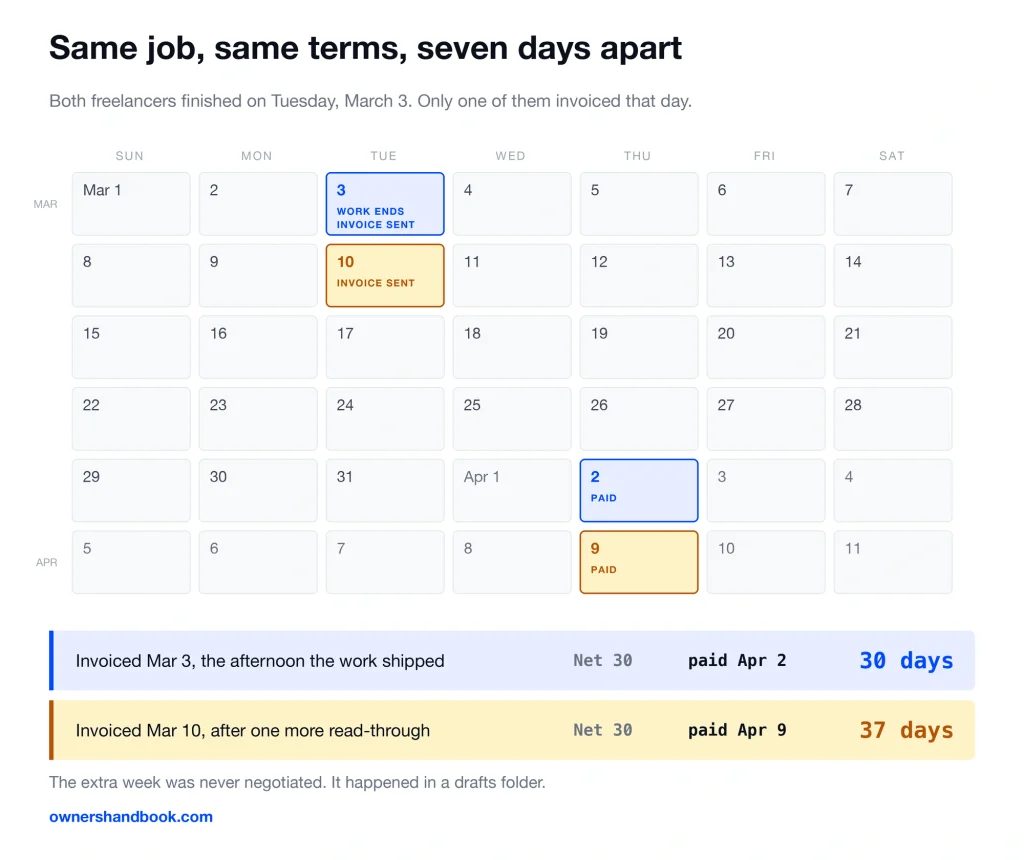
Say you finish a project on Tuesday, March 3. Net 30, agreed up front, in writing.
Send it that afternoon and the money is due April 2.
Send it the following Tuesday because you wanted to reread it first, and the money is due April 9.
| Same job, same client, same terms | Invoice date | Terms | Payment due | Days after you finished |
|---|---|---|---|---|
| You invoice the day you finish | Mar 3 | Net 30 | Apr 2 | 30 |
| You invoice one week later | Mar 10 | Net 30 | Apr 9 | 37 |
| You invoice the day you finish, at Net 15 | Mar 3 | Net 15 | Mar 18 | 15 |
Nobody negotiated that extra week. It happened in your drafts folder.
Look at the third row. Going from Net 30 to Net 15 buys you fifteen days, and you have to ask for it.
Sending on the day you finish buys you seven, costs nothing, and requires permission from nobody.
So invoice the day the work ships. For ongoing work, invoice on a fixed day every month.
A retainer billed on the 1st gets processed on a cycle. One billed whenever you remember has to be handled by a person, every time.
A late fee only counts if it existed first
Here is what most freelancers have backwards. No federal law makes a private client owe you interest for paying late. Your right to charge a late fee comes from your contract and nowhere else.
Nolo states the standard plainly: “You should assess a late charge only if the client was on notice, at the outset, that you reserved the right to do so.”
And the consequence: “If your written agreement and invoice did not include provisions regarding late fees, you likely cannot impose finance charges.”
So a 1.5% line you add to an invoice after the client went quiet is not a fee. It is a request.
Three details worth getting right.
The fee has to be a reasonable estimate of what the delay actually cost you — lost interest, the hours spent chasing it, the reissued invoice. It is not a profit center.
There is a ceiling. States have usury laws — caps on how much interest anyone can charge — and Nolo’s rule of thumb is that at no more than 10% a year, “you probably won’t run afoul of your state’s statutes.”
Never call it a penalty. Nolo is blunt about why: the word tells a judge you meant to punish rather than to be made whole, “which can result in the court refusing to enforce your provision.”
Put the clause in the contract before work starts. Then repeat it word for word on every invoice.
The discount is the other lever
If a late fee is the stick, an early-payment discount is the carrot, and it is a standard mechanism, not something you invented.
It is written like this: 2/10 net 30. Take 2% off if you pay within 10 days, otherwise the full amount is due in 30.
Federal agencies are built to take these, and so are most corporate accounts payable systems, because 2% for paying twenty days early is a real return on idle cash.
One caution, from the same Nolo article. If the discount is large, a judge can read it as a late fee in disguise and refuse to enforce the agreement. Keep it small.
How they pay decides when you have it
Your terms say the due date. Your bank decides the deposit date, and the two are not the same day.
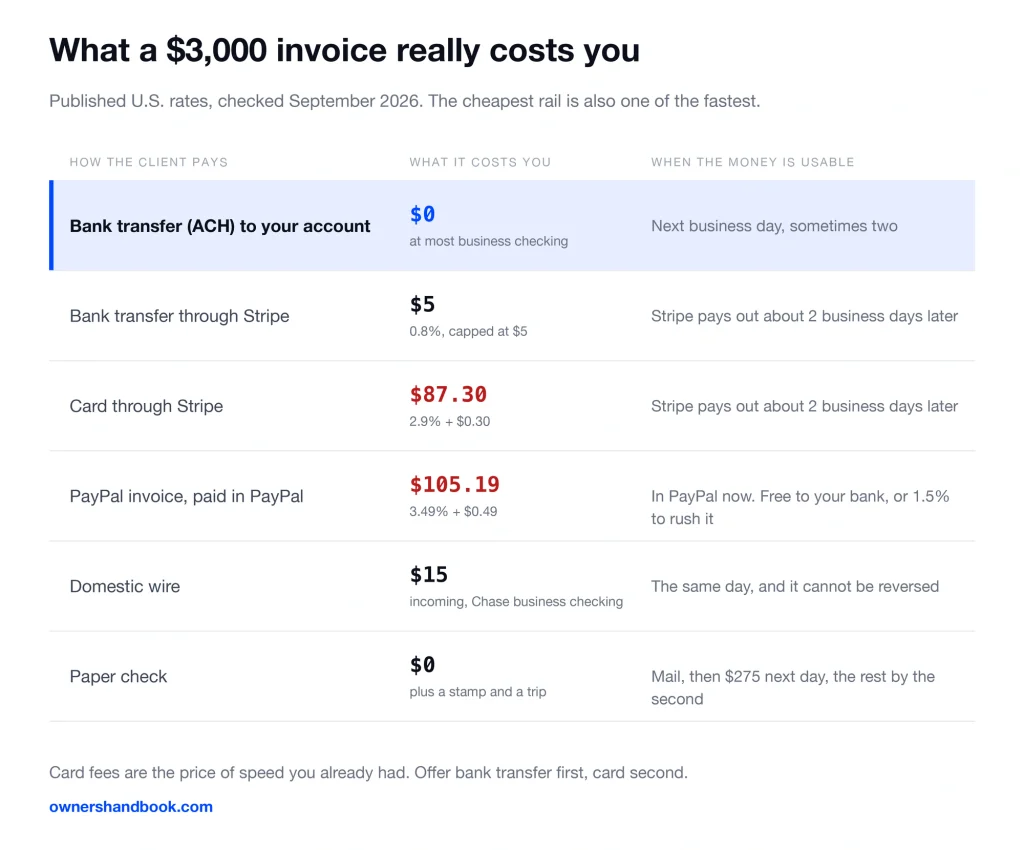
| How the client pays | What a $3,000 invoice costs you | When the money is usable |
|---|---|---|
| Bank transfer (ACH) straight to your account | $0 at most business checking accounts | Next business day, sometimes two |
| Bank transfer collected through Stripe | 0.8%, capped at $5 — so $5 | Stripe pays out about 2 business days later |
| Card through Stripe | 2.9% + $0.30 — so $87.30 | Stripe pays out about 2 business days later |
| PayPal invoice paid through PayPal checkout | 3.49% + $0.49 — so $105.19 | In PayPal at once, then free to your bank or 1.5% to rush it |
| Domestic wire | $15 incoming at Chase business checking | Same day, and it cannot be reversed |
| Paper check | Free, and the slowest thing on this list | Mail, then $275 the next business day, the rest by the second |
ACH is the bank-to-bank network that moves direct deposits. Most of it settles in one banking day, some of it in two, and there are three same-day windows a bank can use.
A wire is the only line here that is same-day and permanent. Fedwire, the Federal Reserve’s wire system, makes payment “final and irrevocable” once made. That is why it is the answer for a large invoice.
A check is not free either. It costs you the mail, the trip, and the hold. Under the federal funds-availability rule, only the first $275 has to be usable the next business day. The rest waits for the second.
If you take cards, price it in. On a $3,000 invoice, $87.30 never reaches you.
Either treat that as the cost of being paid fast, or make bank transfer the default and card the convenience.
An invoice they can actually process
Terms only work on an invoice that can be processed. One that gets kicked back starts the clock over.
The federal rule is a useful checklist, because it defines what makes an invoice “proper” — and an improper one goes back to the vendor within seven days for a corrected copy.
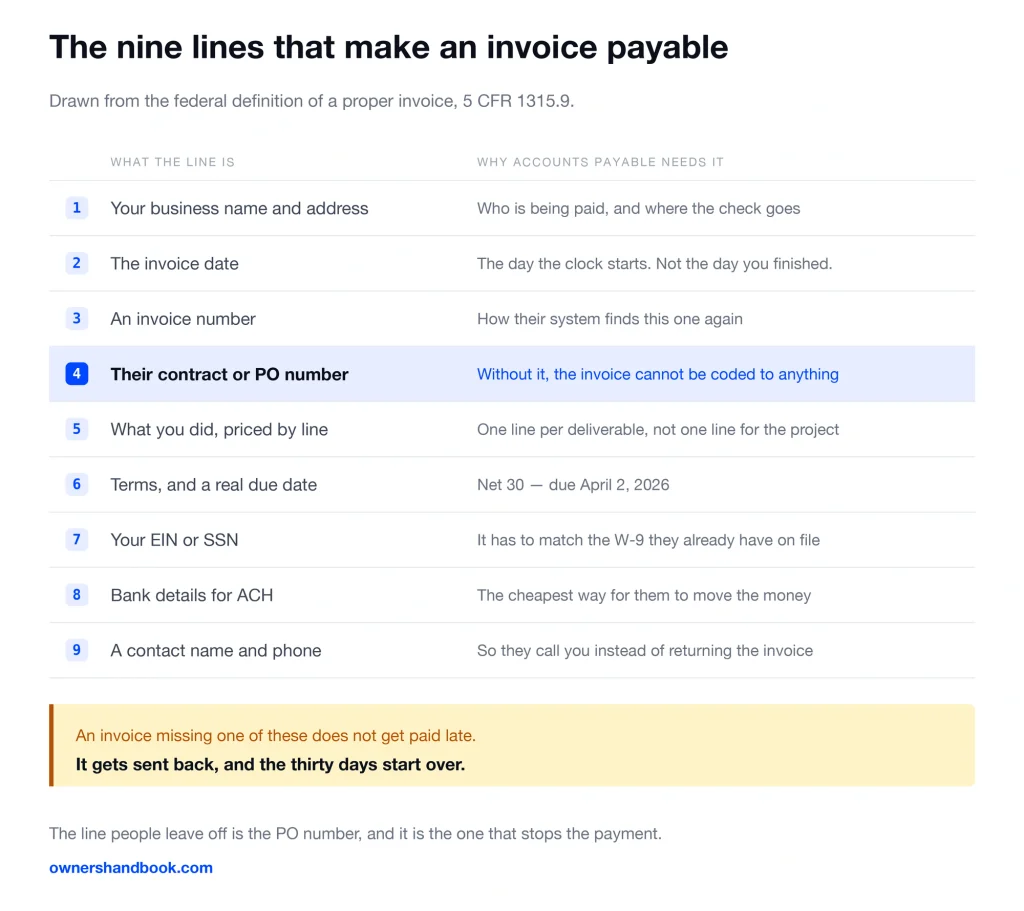
Translated to freelance work, that list is: your business name, the invoice date, the invoice number, and the contract or PO number they gave you.
Then a description with quantity and price, the payment terms, your taxpayer ID, your bank details, and a contact name and phone number.
The line people leave off is the PO or job number. Without it, accounts payable — the team that actually releases money — often cannot code the invoice to anything, so it sits.
Write the due date as a real date, not only as terms. “Net 30 — due April 2, 2026” ends an argument before it starts.
And ask one question at the start of any job with a larger client. What does your accounts payable process need, and when do you run payments?
A term that fits their cycle beats a shorter term that misses it by a day.
One more thing the date decides. You are taxed when the money arrives, not when you invoiced. An invoice you send on December 28 that clears on January 4 is next year’s income, and it lands in next year’s quarterly estimated taxes.
Frequently asked questions
Is Net 30 counted in calendar days or business days?
Calendar days, unless your contract says otherwise. If you want it beyond argument, write “30 calendar days from the invoice date” in the agreement and on the invoice.
Does the clock start when the client approves the work?
No, unless you wrote that into the contract. The convention is that terms run from the invoice date, which is one more reason not to sit on the invoice.
Can I charge a late fee if my contract never mentioned one?
Generally no. Nolo’s position is that without late fee provisions in both the written agreement and the invoice, you likely cannot impose finance charges. Add the clause to your next contract.
What late fee rate is safe to use?
Nolo suggests that at 10% a year or less you probably stay inside your state’s usury limits, and that the fee should still approximate your actual losses. Rates above that are worth running past a lawyer in your state.
Is Due on Receipt too aggressive for a new client?
Not for small or one-off jobs, and not for a deposit. For a company with a real accounts payable department it often reads as a term nobody can honor, so Net 15 usually collects faster.
My client insists on Net 60. Is there anything I can do?
Split the invoice. A 50% deposit before work starts and 50% at Net 60 gets you half the money immediately, and a milestone schedule does the same thing across a longer project.
Sources
U.S. Small Business Administration, How Net 30 Accounts Help Conserve Business Cash Flow
https://www.sba.gov/blog/how-net-30-accounts-help-conserve-business-cash-flow
Nolo, When Can I Charge Late Fees or Finance Charges?
https://www.nolo.com/legal-encyclopedia/question-when-charge-late-fees-finance-charges-28337.html
Nolo, How to Collect Unpaid Invoices from Clients
https://www.nolo.com/legal-encyclopedia/get-clients-pay-up-29988.html
Prompt Payment Act Final Rule, 5 CFR Part 1315
https://www.ecfr.gov/current/title-5/part-1315
U.S. Treasury, Bureau of the Fiscal Service, Prompt Payment
https://www.fiscal.treasury.gov/prompt-payment
Federal Reserve Board, Applying Funds Availability Rules (Regulation CC)
https://www.federalreserve.gov/supervisionreg/applying-funds-availability-rules.htm
Federal Reserve Board, Fedwire Funds Service
https://www.federalreserve.gov/paymentsystems/fedfunds_about.htm
Federal Reserve Financial Services, Same Day ACH Frequently Asked Questions
https://www.frbservices.org/resources/financial-services/ach/faq/same-day-ach.html
Stripe, Pricing
Stripe, Payouts
https://docs.stripe.com/payouts
PayPal, Merchant Fees
https://www.paypal.com/us/business/paypal-business-fees
JPMorgan Chase, Deposit Account Agreement — Business Product Information