Why a 50% Deposit Is the Fix That Works
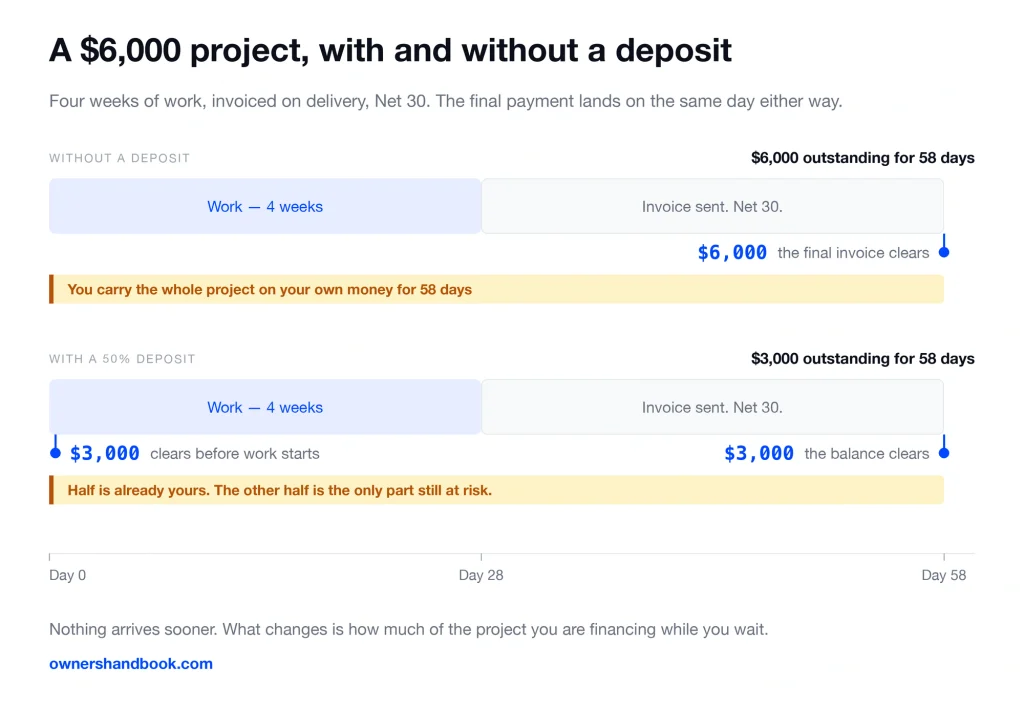
Ask for 50% before you start. Not mainly because the money is better in your account than in theirs, though it is. Ask because of what it does to the client. A stranger who has paid you nothing is deciding, quietly, every week, whether this project still deserves their attention. A client who has already sent $3,000 stopped deciding that the moment the payment cleared. They have money in the outcome now, and everything downstream gets easier — the feedback arrives, the files show up, the final invoice gets paid.
What the deposit actually buys
Most advice frames a deposit as cash flow. Money sooner instead of later. That part is real, and it is the smaller half.
The bigger half is behavioral. Before money moves, you are an item on somebody’s maybe list.
After it moves, you are a commitment they already made. People protect commitments they have paid for.
You notice it in ordinary ways. Email answered in a day instead of five. Brand files sent without three reminders. A kickoff call that actually happens.
You also notice who never sends it. Someone who agrees to your price, agrees to your timeline, then goes silent when the deposit invoice arrives has told you how the final invoice would have gone.
That is the second thing a deposit buys. It is a filter, and it runs before you have spent a single hour.
The problem it filters for is not rare. Freelancers Union surveyed more than 5,000 freelancers and found one in two had trouble collecting payment in a single year, and 71% had hit it at some point in their career.
The average unpaid freelancer lost close to $6,000 that year. About 13% of their income.
And it is not a big-contract problem. Of the payment complaints New York City’s freelance agency handled over five years, roughly half involved contracts worth $5,000 or less.
How much, and when to ask
You will see 25% to 50% in practice. No law or agency sets that range. It is simply where the market has landed, and nobody publishes an official number.
For a new client, ask for 50%. You know nothing about how they pay, and half the project is the amount you can afford to be wrong about.
For a client who has paid you three times without a reminder, 25% is plenty. You already have the information a deposit was buying.
Ask before you start. Not after the kickoff call, not after the first draft.
This is standard small business practice, not an unusual demand. The SBA’s own cash flow guidance lists requiring a minimum deposit among the ordinary ways a business speeds up what it collects.
And nothing starts until it lands. That is where most people give it away — they send the deposit invoice, then begin working while it sits unpaid, which spends the leverage they just built.
Three structures, and the project each one fits
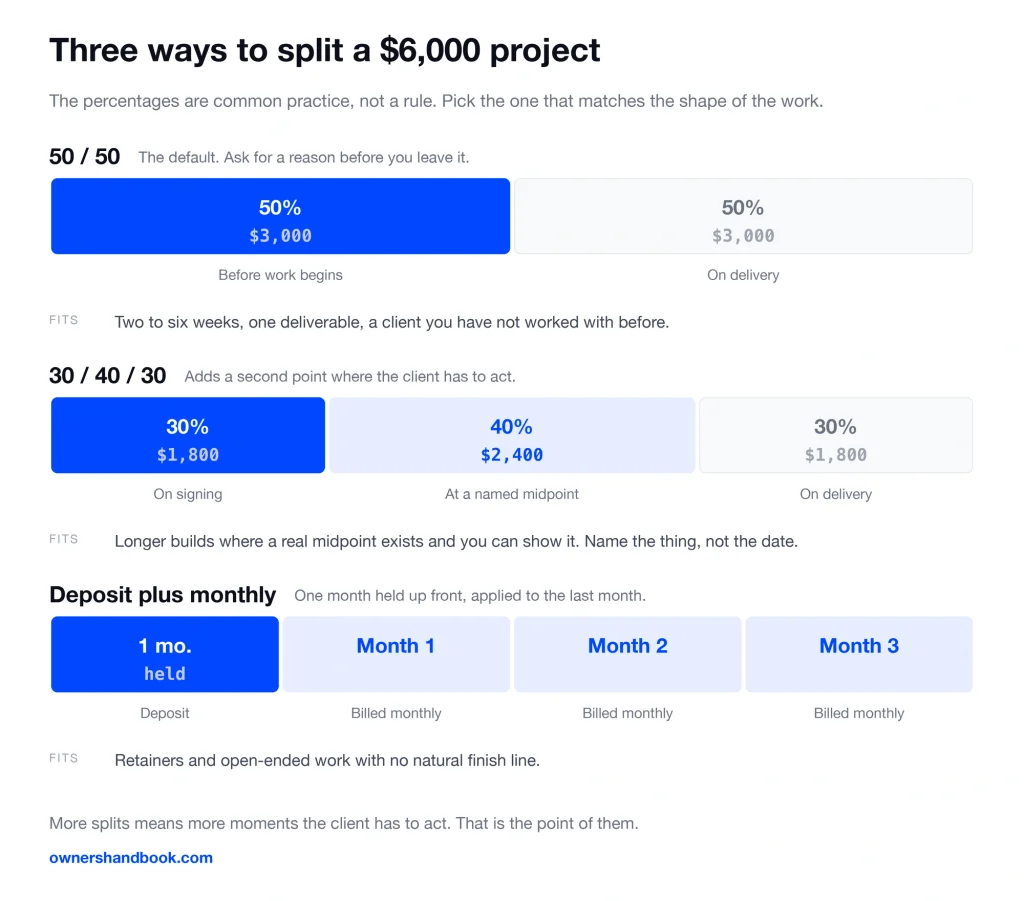
| Structure | How it splits | The project it fits |
|---|---|---|
| 50 / 50 | Half up front, half on delivery | Two to six weeks, one deliverable, a client you have not worked with before |
| 30 / 40 / 30 | 30% to start, 40% at a named midpoint, 30% on delivery | Longer builds where a real midpoint exists and can be shown |
| Deposit plus monthly | One month up front, then billed monthly | Retainers and open-ended work with no natural finish line |
50/50 is the default. You should need a reason to leave it.
30/40/30 buys something 50/50 does not — a second moment where the client has to act. If they stall at the midpoint, you learn it in week three instead of week eight.
But the midpoint has to be a thing, not a date. “Wireframes approved” works. “Halfway” invites an argument you will lose.
Deposit plus monthly fits retainers and anything without a defined end. The first month is held as a deposit and applied to the final month, or returned if nobody cancels.
The sentence to put in your proposal
Put it in the payment section of the proposal, stated as a fact. Not as a request, and not as a question.
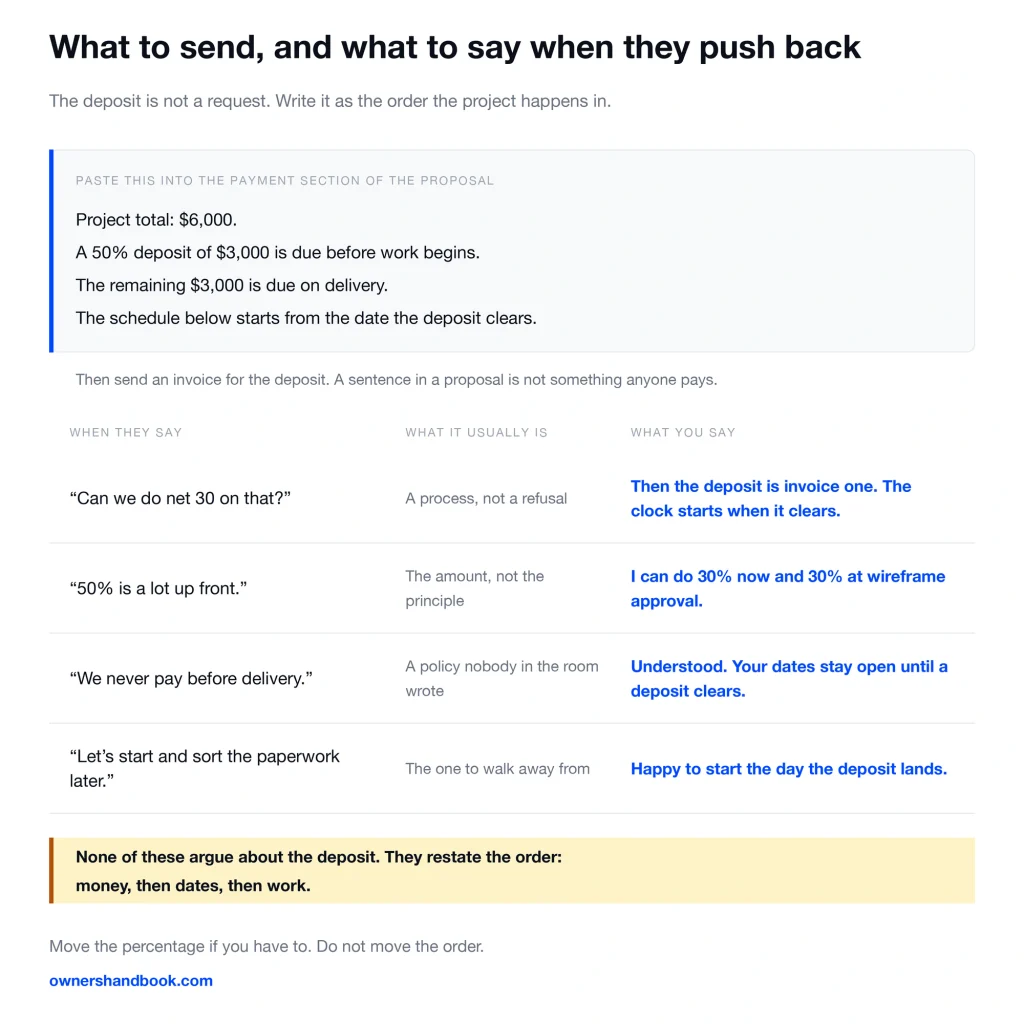
“Project total: $6,000. A 50% deposit of $3,000 is due before work begins. The remaining $3,000 is due on delivery. The schedule below starts from the date the deposit clears.”
Three things are working in there. The number is stated rather than proposed. The word before sets the order. And the timeline hangs off the deposit, which makes a delay their cost instead of yours.
Nolo’s guidance on service agreements says the same thing in plainer language: a payment schedule needs dates and amounts, not intentions.
Then send an actual invoice for the deposit. A sentence inside a proposal is not something anyone pays. An invoice with a due date is.
When they say no
Some will. Most of them are not refusing on principle — they are reacting to a number nobody warned them about.
Ask one question before you concede anything. Is it the amount, the timing, or their process?
If it is process, a company with net-30 terms and a purchase order system is not rejecting the deposit. It is scheduling it. Send the deposit as the first invoice and start when it clears.
If it is the amount, move the percentage, not the principle. 50% becomes 30%. 30% becomes a small first milestone.
If it is timing, take the deposit on signature and push the start date out to match.
If it is none of those — if they simply will not send money before you work — then you are being asked to lend a stranger several thousand dollars, unsecured, on their word.
You can still say yes. Price it accordingly, keep the first project small, and be clear with yourself about what you agreed to.
One line ends this conversation more often than any argument does. “Your dates are held when the deposit clears. Until then the calendar stays open.” It is true, it is not a threat, and it moves the cost of waiting onto them.
Non-refundable is a contract term, not a word
Writing NON-REFUNDABLE across an invoice does nothing. The invoice is not the agreement.
Nolo’s plain answer, discussing exactly this fight, is that whether you get a deposit back “depends on what the contract says, if anything.” Silence means you are arguing from zero.
So put it in the contract, and give it a reason:
“The deposit is non-refundable. It reserves the Client’s project dates and covers scheduling and preparation performed before the start date, which the Client agrees has value whether or not the project is completed.”
The reason clause is the part doing the work.
Contract law generally allows an amount agreed in advance when it is a fair estimate of a loss that is hard to measure. It refuses that amount when the clause reads as a punishment. The details vary by state.
A kill fee is a different mechanism, and worth having alongside the deposit. The deposit covers a client who disappears before you start. A kill fee covers a client who cancels a project you already mostly built.
Columbia Law School’s Kernochan Center defines it as a payment “in the event that the publisher ultimately declines to publish the work.”
In freelance contracts more broadly it is a percentage owed on cancellation after work has begun. Practice clusters around 25% to 50%, but there is no standard.
| The word | What people usually mean by it | What decides the outcome |
|---|---|---|
| Deposit | Money paid before work starts, applied against the total | What the contract says, not the label |
| Retainer | Sometimes the same thing, sometimes a monthly fee for availability | Whether the contract applies it to fees or sells access |
| Kill fee | A percentage owed if the client cancels partway | The cancellation clause and what triggers it |
Nobody uses these three words consistently, including clients, including lawyers. Define the one you use inside the contract and the confusion stops mattering.
A deposit in December is December income
One tax note, because it catches people every January.
If you file on the cash method, and nearly every freelancer does, you report income in the year you receive it.
IRS Publication 334 is direct about it. You include advance payments in income in the tax year you receive them, even when the work belongs to a future year.
So a $3,000 deposit landing on December 28 for a February project is income for the year that just closed.
Two effects worth planning for. It raises the estimated tax payment due January 15, and it can push your December profit past the number you had been setting aside against.
You cannot fix that after the fact, either. Declining to deposit a check you were handed does not move the income to next year.
Frequently asked questions
How much should I ask for?
50% from a new client, 25% or less from one who has paid you on time repeatedly. The 25% to 50% range is common practice rather than a rule, so there is nothing to violate by picking differently.
Is a deposit the same as a retainer?
Often, but not always, and the words are used loosely by everyone. What matters is whether your contract says the money is applied to project fees or buys ongoing availability.
What if a client refuses any deposit at all?
Find out whether it is the amount, the timing, or their payment process. Process is solvable. A flat refusal to send anything before you work is information about how the last invoice will go.
Can I really keep a non-refundable deposit?
Only if your contract says so, and it holds up better when the clause explains what the money covers. A deposit that reads as a penalty rather than a reasonable estimate of your loss is the kind courts cut down.
Do I owe tax on a deposit I have not earned yet?
Yes, if you are a cash-basis filer. The income lands in the year the money reaches you, not the year the work happens.
Should I take a deposit on a small $500 job?
Usually not worth the friction. Under about $1,000, ask for the whole amount up front or bill on delivery and keep the terms short.
Sources
U.S. Small Business Administration, How Net 30 Accounts Help Conserve Business Cash Flow
https://www.sba.gov/blog/how-net-30-accounts-help-conserve-business-cash-flow
Nolo, How to Draft a Service Agreement
https://www.nolo.com/legal-encyclopedia/how-to-draft-a-service-agreement.html
Nolo, Breach of Contract Cases in Small Claims Court
https://www.nolo.com/legal-encyclopedia/free-books/small-claims-book/chapter2-3.html
Freelancers Union, The Costs of Nonpayment
https://blog.freelancersunion.org/2015/12/10/costs-nonpayment
NYC Department of Consumer and Worker Protection, Freelance Isn’t Free Act
https://www.nyc.gov/site/dca/about/freelance-isnt-free-act.page
NYC Department of Consumer and Worker Protection, Five-Year Report on the Freelance Isn’t Free Act
New York State Department of Labor, Freelance Isn’t Free Act
https://dol.ny.gov/freelance-isnt-free-act
Kernochan Center for Law, Media and the Arts, Columbia Law School, Kill Fee
https://kernochan.law.columbia.edu/content/kill-fee
IRS, Publication 334, Tax Guide for Small Business