What Every Freelance Invoice Needs
An invoice gets paid when the person holding the checkbook can process it without asking you a question. That is the entire test.
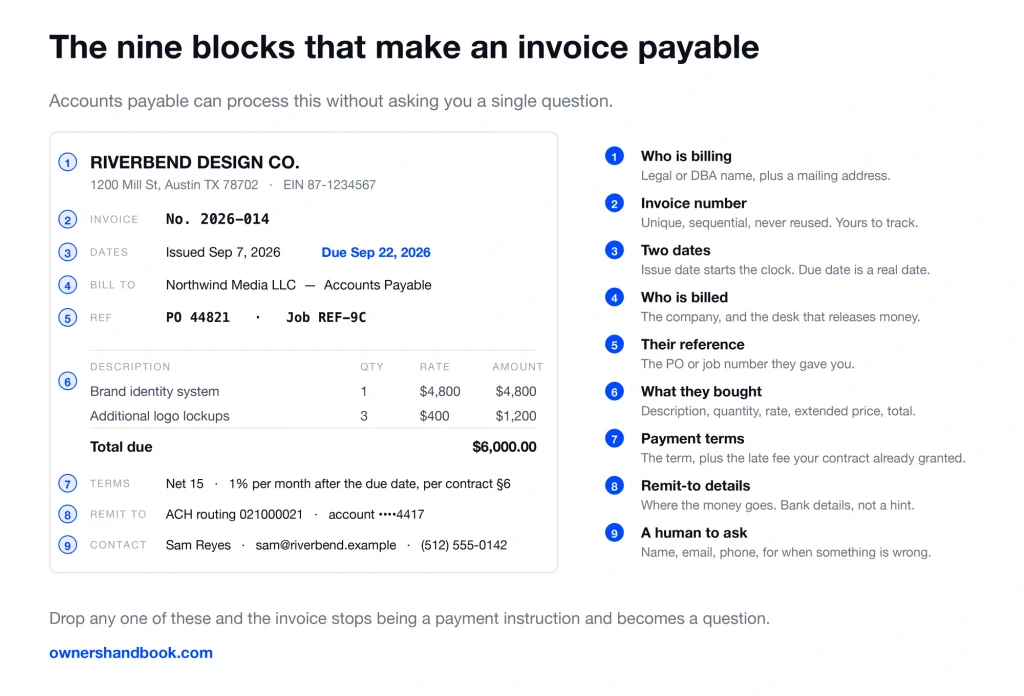
Nine blocks pass it. Who you are, a unique invoice number, the date you sent it, and a due date written as a real calendar date.
Then their reference number, the line items, the total, your remit-to details, and a human to call.
Leave one out and the invoice stops being a payment instruction. It becomes a question, and questions wait.
Somebody already wrote the checklist
The federal government publishes the definition of an invoice that has to be paid.
Under the Prompt Payment rule, an agency’s payment clock starts only when it receives a proper invoice. The rule then lists what a proper invoice contains, item by item, at 5 CFR 1315.9(b)(1).
If the invoice is not proper, the agency has to send it back within 7 days with the defects identified. The Federal Acquisition Regulation says the same thing at 32.905.
Here is the part that should change how you write invoices. When it comes back, the clock has not been running at all.
Say you send $6,000 on Net 15, due September 22. Accounts payable returns it on the 12th because the purchase order number is missing. You fix it and resend on the 14th.
The due date is now September 29. You lost a week to a field you could have filled in.
The nine blocks, and what the rule calls them
The federal list is written for government contractors. Translated, it is what belongs on any freelance invoice.
| What the rule calls it | What you actually write |
|---|---|
| Name of vendor | Your legal name or your DBA, spelled the way it appears on the W-9 they have |
| Invoice date | The day you send it. Not the day you finished |
| Vendor invoice number | 2026-014. Unique, and never reused |
| Contract number or other authorization | Their purchase order number, job number, or contract reference |
| Description, price, and quantity | One line per deliverable, with the extended price beside it |
| Shipping and payment terms | Net 15, and the due date as a calendar date |
| Taxpayer Identifying Number | Your EIN, matching the W-9 on file |
| Banking information | Your remit-to details. Routing and account, or the exact payment link |
| Contact name, title, telephone number | A person who can answer today |
FAR 32.905 adds one the freelance templates almost always miss: a payment address, listed separately from your business address.
Where you live and where the money goes are two different facts. Say both.
The invoice number is for you before it is for them
Number every invoice, in order, and never reuse a number.
Their system deduplicates on that number. Send two invoices carrying 2026-014 and the second is flagged as a duplicate, which usually means silently killed rather than bounced back.
A format that has never failed anyone: year, dash, sequence. 2026-001, 2026-002.
If you bill several clients heavily, put a client code in front. NW-2026-014.
The other reason is yours. The IRS lists invoices among the documents that show your gross receipts, and a numbered sequence is how you notice that 2026-011 was never paid.
Two dates, and one of them has to be a real date
The issue date starts the clock. That is why the invoice date is the day you send it, and why sitting on a finished invoice for a week is a week of your own money.
The due date is the one that gets ignored, because most freelancers write a term instead of a date.
Write both. Net 15, then due September 22, 2026.
A term is something a human has to convert. A date is something a system can schedule. You are writing for the second one.
Payment terms deserve their own conversation, and there is a longer piece on choosing between Net 30 and Net 15. On the invoice itself, the job is smaller: state the term, then state the date it produces.
Why Due on Receipt gets paid slower than Net 15
The most aggressive term on the menu is often the slowest to convert into cash.
Accounts payable does not pay invoices one at a time. It runs batches, usually weekly or twice a month, and the batch is built from due dates.
“Due on receipt” gives that process nothing to work with. There is no future date to schedule against, and the invoice arrives already past due, which in a lot of systems routes it to exception handling instead of the next run.
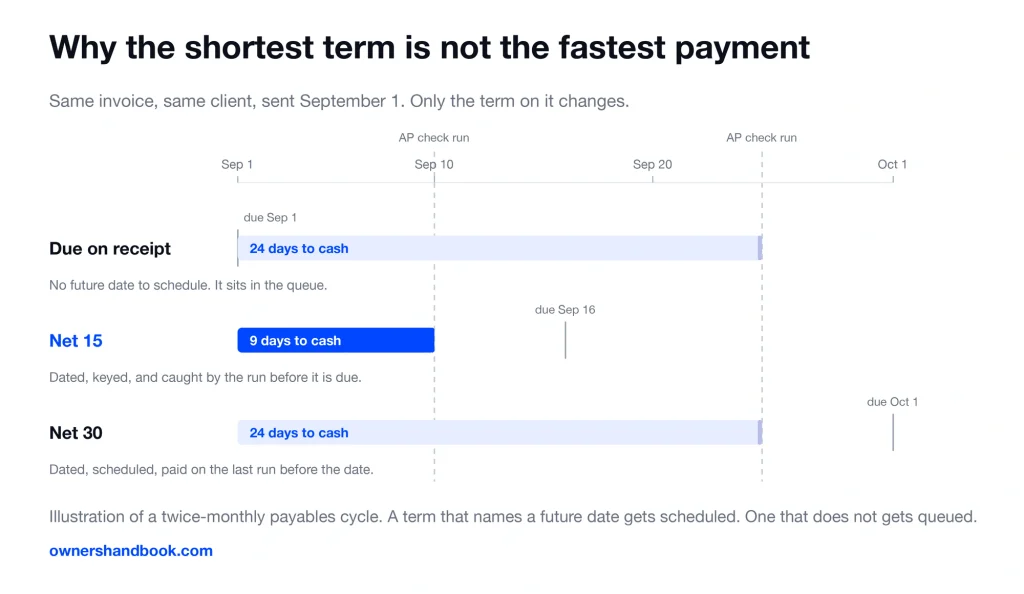
Net 15 gives the same client a date, and the date catches an earlier batch than Net 30 does. Shorter is not what did it. Schedulable is.
Fifteen days is also a number the system recognizes. Federal prime contractors are required to pay small business subcontractors within 15 days of a proper invoice under FAR 52.232-40, so it reads as a normal commercial term rather than a demand.
Due on receipt still has a place. Small one-off jobs, individuals paying personally, anywhere no accounts payable department exists.
For a new client of any size, the better lever is not a shorter term. It is a deposit before the work starts.
Remit-to is the block people write last and lose money on
The remit-to block answers one question: where does the money physically go.
Write it as instructions, not as a hint. Bank name, routing number, account number for ACH. If you take cards or a platform, give the exact link, not the name of the app.
Then put your taxpayer ID beside it. If a client has to pay you before they have a completed W-9 on file, the IRS requires them to withhold at 24 percent and send it in.
On that $6,000 invoice, that is $1,440 that goes to the IRS instead of to you. You get it back at filing, roughly a year later.
Use an EIN here rather than your Social Security number. Invoices get forwarded, printed, and left on desks, and an EIN does the same job.
If the client is a company, the reference number is the whole invoice
A purchase order is the company’s own promise to spend money on you. It exists before your invoice does, and the PO number is how accounts payable connects the two.
Without it, nobody in that building can code your invoice to a budget. It does not get rejected so much as it stops.
So ask three questions before you start work with any client that has more than a few employees.
What PO or reference number should appear on the invoice. Which address or portal receives it. When do you run payments.
That last answer is worth more than a shorter term. An invoice that lands two days before their run gets paid this cycle. The same invoice sent two days later waits a full cycle, no matter what the term says.
If they use an AP portal, the portal is the only address that counts. An emailed copy to your contact is a courtesy, not a submission.
When accounts payable kicks it back
Rejections sound personal and are almost always formatting.
| What they tell you | What is actually wrong | The fix |
|---|---|---|
| “We never received it” | It went to your contact, not to the invoices inbox or portal | Ask for the AP address once, then send to both |
| “There is no PO on this” | You were never given one, or you left it off | Get the PO number in writing before the work starts |
| “The name does not match our records” | Your invoice says one name, their vendor file says another | Match the W-9 exactly, including LLC or DBA |
| “This is a duplicate” | You reused an invoice number, or resent an old one unchanged | New number for every send. Note the original in the description |
| “You are not set up as a vendor” | Vendor onboarding never finished | Complete the W-9 and banking forms first. This can take two weeks |
| “It is pending approval” | The person who approves it has not looked | Email the approver, not AP. AP cannot approve anything |
Keep the copy you sent, with the date. Invoices are one of the documents the IRS names as proof of your gross receipts, and you generally keep them for 3 years after filing.
They also matter earlier than that. You owe self-employment tax on money in the year it lands, not the year you billed it, so the invoice date and the payment date can fall in different tax years.
And if everything on this page is right and the client still has not paid, the problem is no longer the document.
Frequently asked questions
Does my invoice have to be a PDF?
Not legally, but send one anyway. A PDF attaches to a record, survives forwarding, and uploads to a portal. An invoice written in the body of an email cannot do any of those things.
Do invoice numbers have to be sequential?
No rule requires it, but reusing or skipping numbers causes real problems. Duplicate numbers get flagged by the client’s system, and gaps make your own gross receipts harder to reconcile.
Should I put my Social Security number on an invoice?
No. Get an EIN from the IRS at no cost and use that. It serves the same purpose on the invoice and on the W-9, and it is not the number that unlocks your credit file.
If my contract already has a late fee, do I repeat it on the invoice?
Yes. Repeat it word for word, with the contract section number. The clause has to have existed before the work, and the invoice is where the client actually sees it.
For scale, the federal government’s own late-payment rate is 4.75 percent a year through December 2026. That is about $23 on a $6,000 invoice paid 30 days late.
What if the client never gives me a PO number?
Ask for any internal reference: a job code, a project name, the approver’s name. Then put it in the same place a PO would go. What AP needs is something to match against.
Can I change the terms on an invoice I already sent?
Not unilaterally. Terms come from the agreement, not the invoice. If the client agrees to a change in writing, void the original, issue a new invoice with a new number, and reference the one it replaces.
Sources
Prompt Payment Act Final Rule, 5 CFR Part 1315
https://www.ecfr.gov/current/title-5/part-1315
U.S. Treasury, Bureau of the Fiscal Service, Prompt Payment
https://www.fiscal.treasury.gov/prompt-payment
U.S. Treasury, Bureau of the Fiscal Service, Prompt Payment Interest Rates
https://www.fiscal.treasury.gov/prompt-payment/rates.html
Federal Acquisition Regulation 32.905, Payment documentation and process
https://www.acquisition.gov/far/32.905
Federal Acquisition Regulation 52.232-40, Providing Accelerated Payments to Small Business Subcontractors
https://www.acquisition.gov/far/52.232-40
IRS, Backup Withholding
https://www.irs.gov/businesses/small-businesses-self-employed/backup-withholding
IRS, About Form W-9
https://www.irs.gov/forms-pubs/about-form-w-9
IRS, What Kind of Records Should I Keep
https://www.irs.gov/businesses/small-businesses-self-employed/what-kind-of-records-should-i-keep
IRS, How Long Should I Keep Records
https://www.irs.gov/businesses/small-businesses-self-employed/how-long-should-i-keep-records