Scope Creep: The Two Sentences That Stop It
Two sentences stop most of it, both in the agreement. One is a numbered deliverables list that closes with “work not listed is outside the scope of this agreement.”
The other caps revisions and names a price: “the fee includes two rounds; additional rounds and out-of-scope work are billed at $150 per hour, on a written change order approved before work begins.”
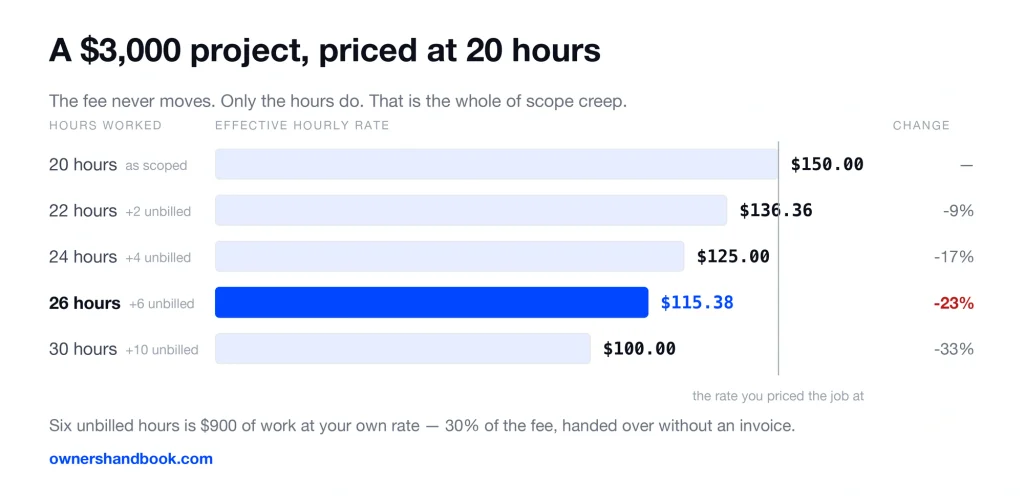
Without them, six unbilled hours on a $3,000 project drop your effective rate from $150 an hour to $115.38. You were not underpaid. You were paid the same amount for 30% more work.
Six hours does not sound like much
Scope creep is not a client problem. It is a definition problem.
Clients ask for things. That is not misconduct, it is what clients do. The question is whether your agreement can tell the difference between a request that is already paid for and one that is not.
When it cannot, the price holds still and the hours do not.
Price a project at $3,000 and plan 20 hours of work. Your effective rate — the fee divided by the hours you actually worked — is $150.
Then the logo needs one more variation. The deck needs a fourth section. The copy needs a pass in a different voice. Six hours across three weeks, and not one of them worth a fight.
| Hours actually worked | Effective hourly rate | Vs. plan |
|---|---|---|
| 20, as scoped | $150.00 | — |
| 22 | $136.36 | -9% |
| 24 | $125.00 | -17% |
| 26 | $115.38 | -23% |
| 30 | $100.00 | -33% |
The $900 gap is not abstract. It is six hours at your own rate, or 30% of the fee, handed over without an invoice.
Set aside 28% of it for self-employment and income tax and the $900 was about $648 of take-home. Still $648 you worked for and did not get.
Do this on eight projects a year and you have given away 48 hours. At 20 hours a project, that is 2.4 more projects delivered and unbilled.
It also eats price increases. Raise the same job to $3,300 and then let two unbilled hours in: $3,300 over 22 hours is $150 an hour, exactly where you started. Raising your rate only pays if the hours hold still.
Sentence one: the numbered list
Write the deliverables as a numbered list, then close the list.
“This agreement covers exactly the following deliverables: (1) one homepage design in desktop and mobile widths, (2) three interior page templates, (3) a one-page style sheet. Work not listed above is outside the scope of this agreement and is handled by change order.”
Numbered, because you need to be able to point at a number. “Website design” is not a list. It is a mood.
The word “exactly” and the closing sentence do the real work here. A list with no closing sentence reads as a set of examples, and examples expand.
New York agrees, in statute. The state’s Freelance Isn’t Free Act applies to any contract worth $800 or more — by itself, or added up with the same client over the previous 120 days.
That contract has to include “an itemization of all services to be provided,” along with their value and the rate and method of compensation.
And if the client cannot produce the contract, the law presumes the terms you present are the agreed terms. The list is not paperwork. It is evidence.
Make each item countable. Not “social graphics” but “eight square graphics at 1080 by 1080 pixels.” If two people could count the same line and get different answers, it is not written yet.
Sentence two: the cap and the rate
“The fee includes two rounds of revisions on each deliverable. Additional rounds, and any work outside the list above, are billed at $150 per hour in half-hour increments, on a written change order approved by both parties before work begins.”
Three things live in that sentence: a number, a price, and a gate.
The number is the cap. Two rounds is the common default for design and copy, one is fine for small jobs, three for large ones. Which number you pick matters far less than having one.
The price is what makes the cap real. A cap with no price attached is a preference, and preferences get overruled by whoever is more uncomfortable saying no.
Use your standard hourly rate, the one the rate formula gives you once taxes and non-billable hours are in it. Do not discount extra work because charging for it feels awkward.
The gate is the phrase “before work begins.” Approval afterward is not approval. It is a request for a favor with a number attached.
What one round of revisions has to mean
Define the round or the cap does nothing.
A round is one consolidated set of feedback, delivered in a single message, covering everything at once. Six emails over four days is not one round. It is six.
So say it: “A round of revisions means one consolidated set of feedback delivered in a single message.”
Then separate revision from redirection. A revision changes something inside the thing you already built. “Make the header smaller” is a revision.
“Let’s try it as a landing page instead” is a new deliverable wearing a revision’s clothes. That distinction saves more projects than any other line in the agreement.
The change order is a form, not a fight
A change order is a written amendment naming the added work, its price, and its effect on the delivery date.
Federal fixed-price contracts run on exactly this mechanic. Under FAR 52.243-1 the government may change the work “by written order,” and owes an “equitable adjustment in the contract price, the delivery schedule, or both” when the change moves cost or time.
The contractor has 30 days to assert that right. Copy the structure and skip the vocabulary.
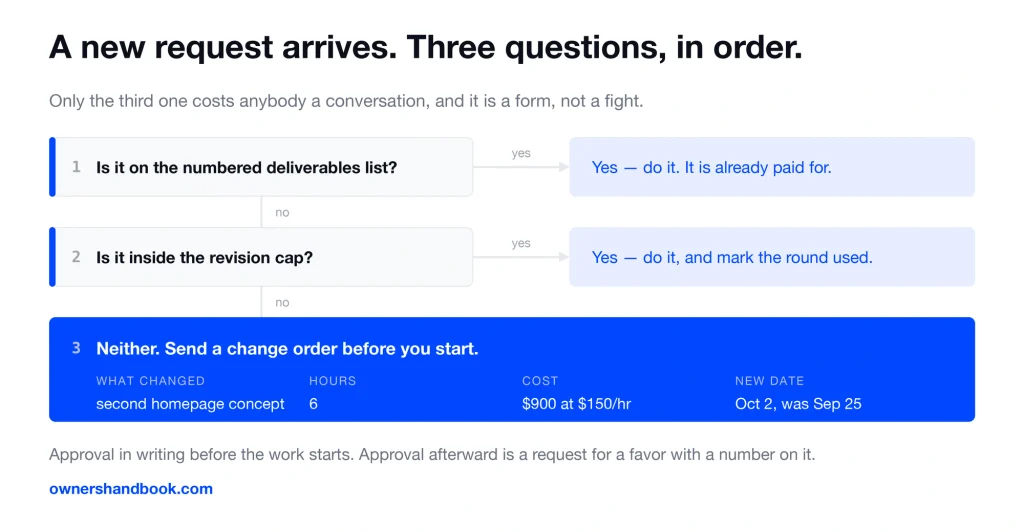
Three questions, in order. Is it on the numbered list? Then it is already paid for, so do it. Is it inside the revision cap? Then do it and mark the round used. Neither? Change order.
| Line in the change order | What goes there |
|---|---|
| What changed | A second homepage concept, not in the original three deliverables |
| Hours | 6 |
| Cost | $900, at the $150 hourly rate in the agreement |
| New delivery date | October 2 instead of September 25 |
| Approval | Client replies “approved” in writing, before work starts |
Five lines, and it fits in an email. No lawyer, no signature page, no template library. A written “approved” from someone who can approve it is enough.
The script, word for word
Nothing in this conversation should be about fairness. Fairness is arguable. Arithmetic is not.
“Happy to do it. That one falls outside the three deliverables we listed, so here is a change order. The second homepage concept is about 6 hours at $150, so $900, and it moves delivery from September 25 to October 2. Reply ‘approved’ and I will start today.”
Four things in that message and no fifth. What it costs, what it does to the date, how to say yes, and that you want the work.
Notice what is absent. No apology. No account of how busy you are. No reminder that they already asked for two other things this month.
If the answer is no, the answer is fine. “No problem, we will keep the original three deliverables then.” The request goes away and nobody has been told off.
If the client objects to change orders at all, point at the numbered list. Not at your workload.
Where a flat fee puts the risk
A flat fee is a bet that you scoped the work correctly. Federal procurement is blunt about who carries that bet: a firm-fixed-price contract “places upon the contractor maximum risk and full responsibility for all costs.”
You take the bet on purpose. A flat fee pays you for getting faster, and hourly billing charges you for it — which is the whole of choosing hourly or flat fee on a given project.
But only take it on work you can define. If you cannot write the numbered list, you do not have a flat-fee project yet. You have an hourly one, or a paid discovery phase you have not billed for.
Take the deposit too. A 50% deposit does not prevent scope creep. It means the change order conversation happens between two people who are both already committed, which is a different conversation.
When the creep is yours
Some of it is not the client’s doing at all.
You showed three concepts when the agreement said one. You rebuilt the file because you found a better structure. You said “while I’m in there” and then spent four hours in there.
That work does not become billable because it took time. Nobody asked for it, so nobody owes you for it.
The fix is the same list. Before starting anything, check whether it has a number next to it. If it does not, either send the change order or do not do the work.
Frequently asked questions
What if the client refuses to sign anything?
Put the numbered list in the proposal and get a written “approved” by email. That is a contract. In New York, a client who cannot produce a written contract for an $800-plus engagement loses the argument about what the terms were.
How many revision rounds should I include?
Two is the common default for design and copy. One for small jobs, three for large ones. The specific number matters less than naming one and defining what a round is.
Can I bill for scope creep that already happened?
Only if the agreement said you could. Without a named rate you are negotiating from zero, and you will usually lose. Going forward, the change order goes out before the work, not after.
What if the extra request takes twenty minutes?
Do it. The cap exists for patterns, not for single small favors. Note it in your next status email as something you did at no charge. That is what makes the next one billable.
Should the overage rate be higher than my normal rate?
It can be. Unplanned work displaces work you already scheduled, and some freelancers price that at 1.25 times their standard rate. Treat your standard rate as the floor, never the discount.
Does a retainer solve this?
It relocates it. A retainer needs the same two sentences — a defined monthly deliverable list and an hourly rate past it. Without them you have signed an unlimited-work agreement at a fixed price.
Sources
New York General Business Law Section 1410, Definitions
https://www.nysenate.gov/legislation/laws/GBS/1410
New York General Business Law Section 1412, Written contracts
https://www.nysenate.gov/legislation/laws/GBS/1412
New York State Department of Labor, Freelance Isn’t Free Act
https://dol.ny.gov/freelance-isnt-free-act
Federal Acquisition Regulation 52.243-1, Changes — Fixed-Price
https://www.law.cornell.edu/cfr/text/48/52.243-1
Federal Acquisition Regulation 52.243-4, Changes
https://www.law.cornell.edu/cfr/text/48/52.243-4
Federal Acquisition Regulation 43.103, Types of contract modifications
https://www.acquisition.gov/far/43.103
Federal Acquisition Regulation 16.202-1, Firm-fixed-price contracts
https://www.law.cornell.edu/cfr/text/48/16.202-1
IRS, Self-Employment Tax
U.S. Small Business Administration, Break-even point
https://www.sba.gov/business-guide/plan-your-business/calculate-your-startup-costs/break-even-point